Accountant Resume Examples: free ATS score and gap list
Accountant Resume: The Accounting Resume Format Firms Expect
By Mustafa Tarabya, founder of CVBooster · Published · Updated
Accountant resume examples in the accounting resume format controllers expect: credentials in the header, scope lines, close work and the ERP named.
Sample resumes for a accountant
The same accountant content laid out in three CVBooster templates, so you can see what the finished document looks like before you write a word.
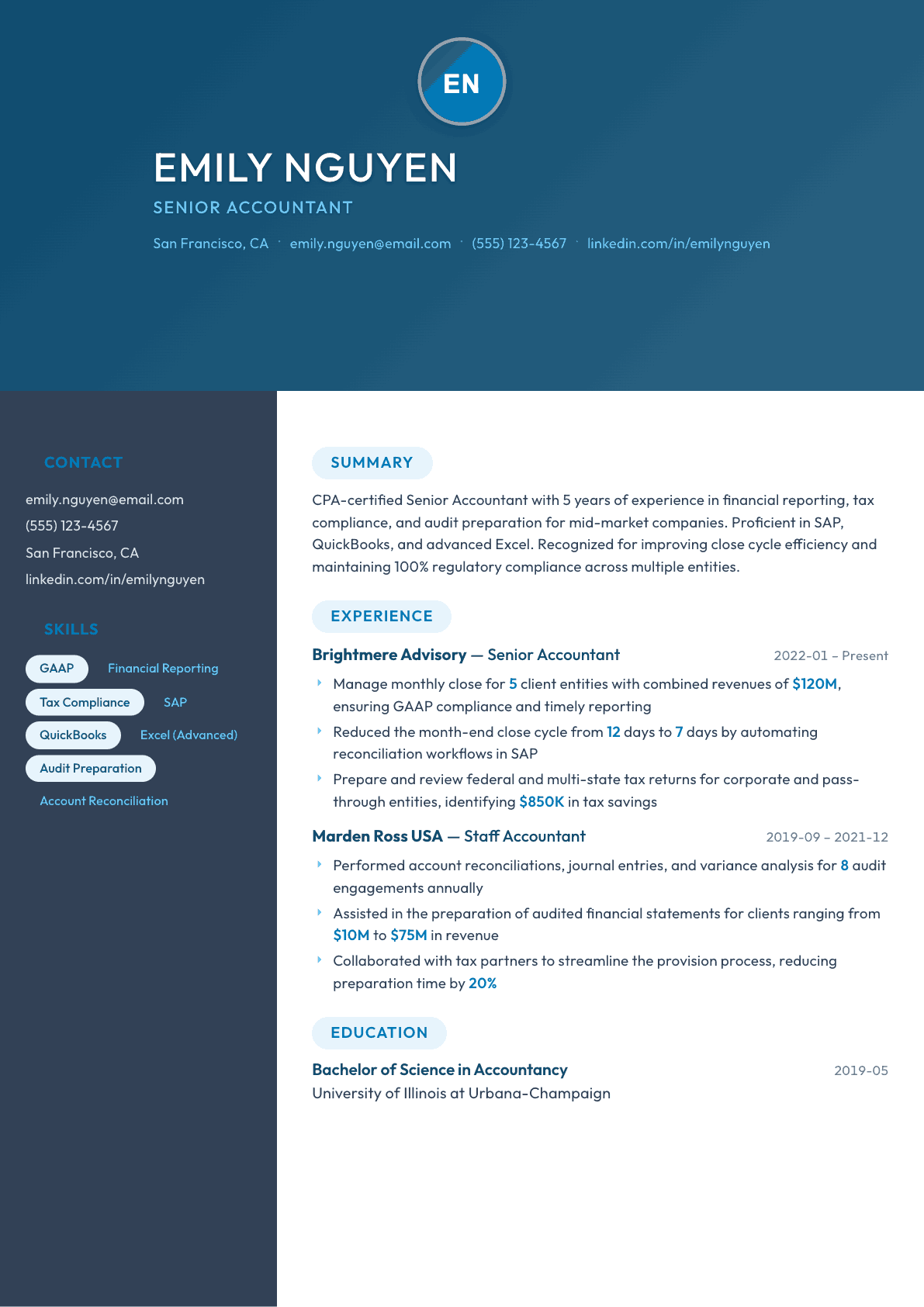
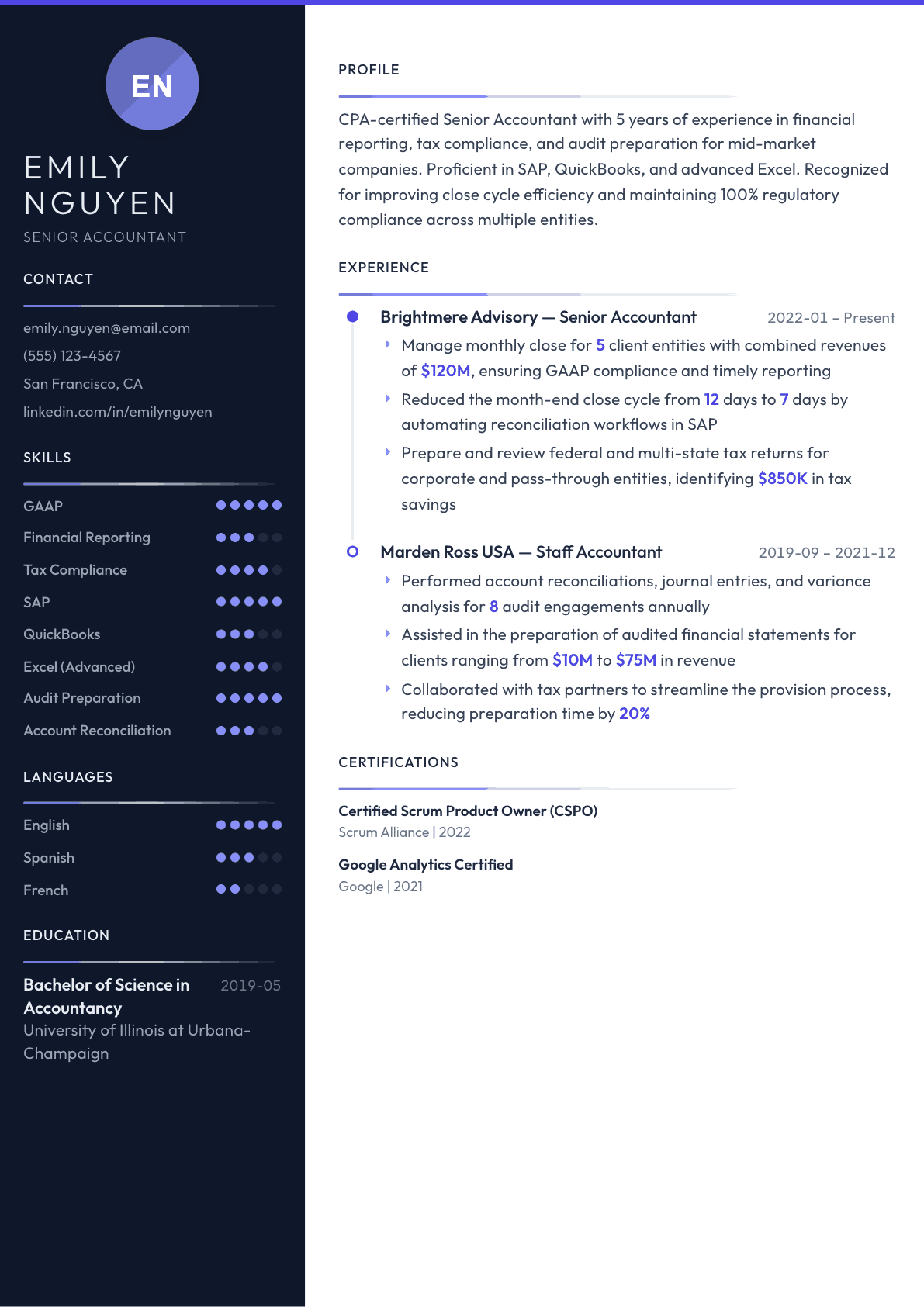
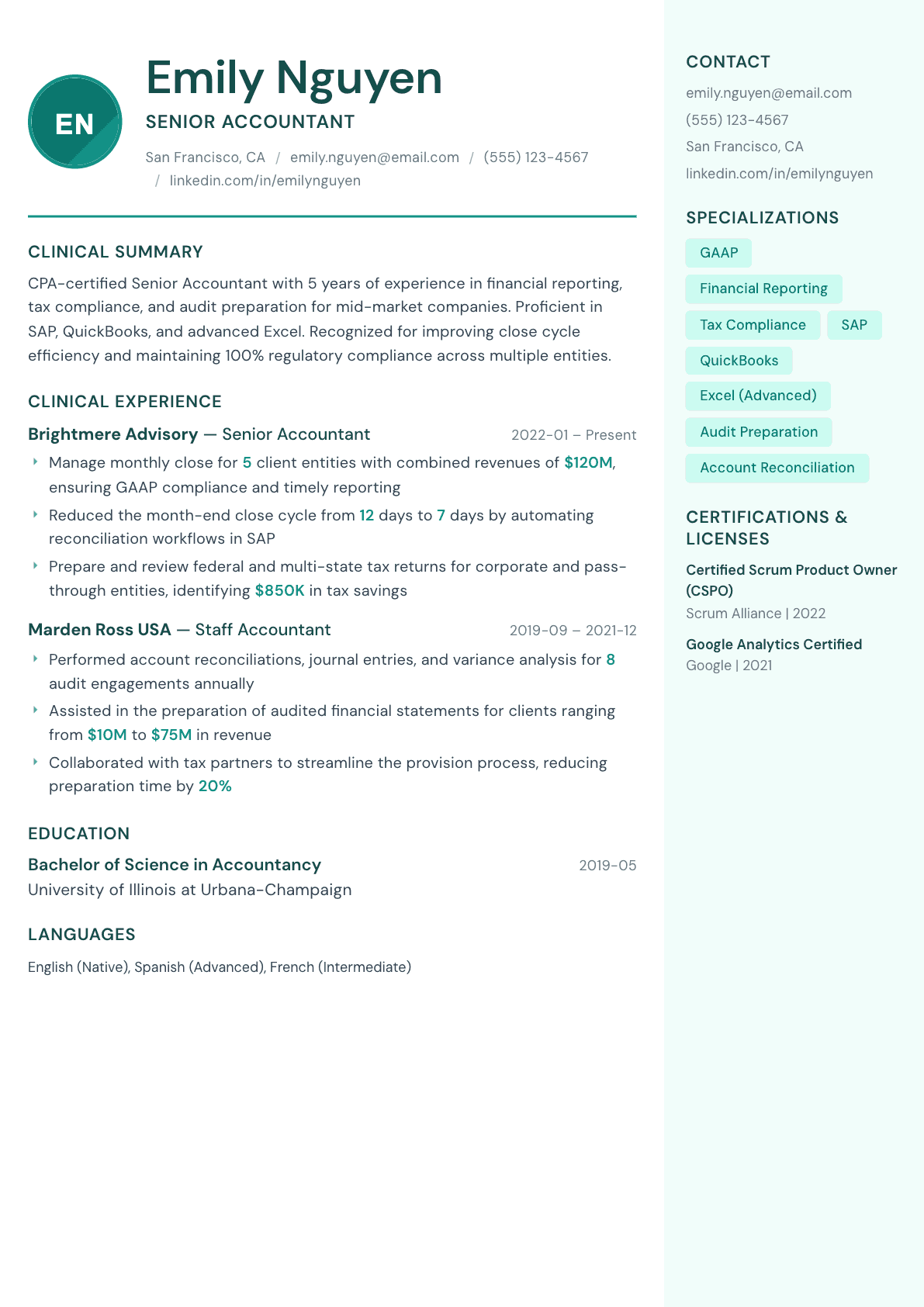
Example Accountant summary
CPA, 5 years in public accounting and client accounting services, running monthly close for five entities with $120M in combined revenue. Took the close from 12 days to 7 by automating reconciliations in SAP, prepares federal and multi-state returns, and found $850K in tax savings across the portfolio last year.
Skills to list on a Accountant resume
- US GAAP
- IFRS
- Financial Reporting
- Tax Compliance
- Audit
- SAP
- Oracle
- QuickBooks
- Excel (Advanced)
- Account Reconciliation
- Budgeting & Forecasting
- SOX Compliance
- Journal Entries
- Variance Analysis
- Month-End Close
What actually gets this resume read
- Place your CPA designation and other certifications (CMA, CIA) prominently next to your name or in a dedicated section.
- Quantify your impact: revenue managed, close cycle days reduced, tax savings identified, or audit findings resolved.
- List accounting software by name (SAP, Oracle, NetSuite, QuickBooks, Sage) for ATS matching.
- Specify the standards you work with: US GAAP, IFRS, SOX compliance, ASC 606, etc.
- Show career progression from staff to senior to manager with increasing scope and responsibility.
- Include industry specialization if applicable (manufacturing, real estate, healthcare, technology).
How to write a accountant resume
A hiring manager filling an accountant seat is trying to answer one question fast: can this person own a close, or do they have to be walked through one? The resume answers it with the standards you work under, the size and number of entities on the books you touched, the ERP you closed in, and whether the CPA is passed, sat, in progress or absent.
Most accountant resumes fail because they describe the profession rather than the person. Journal entries, reconciliations, accruals and month-end support sit on every file in the stack. What separates one candidate is the technical accounting they applied themselves: revenue recognition under ASC 606, lease accounting, an intercompany consolidation, a state nexus review, a purchase price allocation after an acquisition.
This guide covers the section order accounting recruiters expect, how the summary changes between staff, senior and manager level, the bullets that prove ownership rather than assistance, and the questions accountants ask when the resume has to carry them from public practice into industry or back.
Accounting resume format: reverse-chronological, credentials first
Accounting is a credential and dates profession, so a functional layout that hides employment order reads as a gap being covered. One page holds until roughly seven years of experience; two pages are normal once you have both public and industry roles. Keep the file free of text boxes and column layouts, because the parsers used by large finance departments frequently drop dates out of a sidebar.
Put the CPA after your name in the header and state the licensing jurisdiction later in a credentials block. If you have passed some sections, write the number passed and the parts, since a controller reading the file treats a candidate mid-exam very differently from one who has not started.
The accounting resume format that works for staff, senior and manager roles is the same skeleton, top to bottom: header with credential, a three line summary naming the standards and the ERP, a certifications block, experience with one scope line under each job title (entities, revenue size, close calendar, team), a technical accounting and systems section, then education. Detail roughly the last ten to fifteen years and compress anything older into one early career line with employer, title and dates.
Entry level accountants flip one thing: education moves above experience until the first full year of staff work, with credit hours toward licensure and exam plans on the line under the degree. Everything else in the format stays.
- Header: name with CPA or CMA, city and state, phone, email, and the state that issued the license.
- Order: summary, certifications, professional experience, technical accounting skills, systems, education.
- Public accounting candidates group clients by industry and size instead of listing each engagement separately.
Summary: what you close, under which standards, on what system
Three lines. Name the level, the reporting framework, the type of company and one thing you own outright. An accountant who writes that they are detail oriented and results driven has described the entire applicant pool. An accountant who writes that they close a five entity consolidation under US GAAP in NetSuite has described a specific person.
When you are moving from a public accounting firm into a corporate role, use the summary to translate. Audit fieldwork becomes technical accounting research and control testing; the reader needs to see that you understand the difference between testing a close and running one.
Experience: scope first, then what you owned in the close
Open each role with the scope line the reader is hunting for: the company size, the industry, the number of legal entities, the reporting cycle and who you reported to. A senior accountant supporting a single domestic entity and one supporting fourteen international subsidiaries with intercompany eliminations do the same job title and completely different work.
Then three to five bullets ordered by weight. Lead with the accounts you own end to end, the schedules you prepare rather than assist with, and the technical positions you documented. Follow with the audit or tax deliverables you produce, and finish with the automation or process work, because close cycle improvements are the accounting bullet that survives every screening round.
Avoid bullets that name a task without a boundary. Prepared journal entries tells the reader nothing about volume, complexity or review responsibility. Say which accounts, at what frequency, and whether you reviewed the work of others.
Certifications, licensure and continuing education
Give the CPA its own line with the issuing state board and active status. A CMA, CIA or an enrolled agent designation goes in the same block with the issuing body spelled out. Do not scatter credentials across the header, the education section and the skills list; a recruiter checking license status wants one place to look.
Coursework counts only when it is specific. A course in lease accounting or a firm training program on revenue recognition supports a technical claim; a general online accounting certificate next to a bachelor of science in accountancy adds nothing and dilutes the block.
Skills and systems: name the ERP and the subledgers
This section exists so the software finds you and so the controller can picture your first week. Name the general ledger platform, not the category: NetSuite, SAP, Oracle, Microsoft Dynamics, Sage Intacct, QuickBooks Enterprise. Add the tools that sit around the ledger, because those are what a modern accounting team actually spends its days in: BlackLine or FloQast for reconciliations, Avalara or Vertex for sales tax, Concur or Expensify for expenses, and the reporting layer, whether that is Excel with Power Query, Power BI or Hyperion.
Separate technical accounting from software. A reader scanning for ASC 606, ASC 842, consolidation, fixed assets, accruals, prepaid schedules and variance analysis should not have to dig those out of a list that also contains a spreadsheet application.
Keywords accounting postings reuse
Corporate accounting postings are written from a small set of templates, so the same phrases recur: month end close, account reconciliation, general ledger, financial statement preparation, US GAAP, internal controls, audit support, fixed assets, accruals and variance analysis. Mirror the exact phrasing of the posting once in the skills block and once inside a bullet where it is attached to real work. A term that appears only in a list looks like padding to the person who reads the file after the software does.
Accountant resume summary examples
Staff accountant, first role
Accounting graduate and CPA candidate with three of four exam sections passed, plus a public accounting internship covering bank reconciliations, fixed asset rollforwards and audit workpapers. Proficient in QuickBooks and Excel including pivot tables and lookups. Seeking a staff accountant role supporting a monthly close.
Five years in
CPA and senior accountant with five years across public audit and corporate accounting, currently closing three legal entities under US GAAP in NetSuite. Owns revenue recognition schedules under ASC 606, lease accounting under ASC 842, and the quarterly audit request list for an external audit team.
Accounting manager
Accounting manager and CPA with ten years of experience, leading a team of four through a nine entity consolidated close with intercompany eliminations and multi currency translation. Reduced the close from twelve days to seven, and owns technical memos, the audit relationship and SOX control documentation for the accounting cycle.
Work experience bullets: before and after
Before: Prepared journal entries and reconciliations for month-end close.
After: Owned 24 balance sheet reconciliations in BlackLine each month, including prepaid, accrual and payroll accounts, and cleared all aged items before the close checklist locked.
The count, the tool and the account types show the size of the workload and that the work was owned rather than assisted with.
Before: Helped with the annual audit.
After: Prepared the audit request list for the external auditors covering revenue, receivables and fixed assets, and resolved 40 open items without escalating a single adjustment to the controller.
Naming the cycles and the outcome turns generic audit support into evidence that the auditors trusted your workpapers.
Before: Worked on revenue recognition.
After: Wrote the ASC 606 position memo for multi-element software contracts, built the standalone selling price allocation model, and carried it through auditor review without a restated period.
Technical accounting only counts when you name the standard, the fact pattern and the fact that the position survived review.
Before: Improved accounting processes and saved time.
After: Replaced a manual intercompany spreadsheet with a NetSuite saved search and automated elimination entries, cutting two days from the consolidated close and removing a recurring source of variance.
The before state, the mechanism and the days saved make a process claim checkable instead of decorative.
Before: Handled sales tax filings.
After: Ran monthly sales and use tax filings across 18 states in Avalara, completed a nexus review after the sales team entered four new states, and registered the entities before the first filing was due.
State count, the tool and the nexus work show judgment about exposure, not just the mechanics of filing a return.
Hard skills
- US GAAP
- Month-end close
- Account reconciliation
- General ledger accounting
- Financial statement preparation
- Revenue recognition (ASC 606)
- Lease accounting (ASC 842)
- Fixed asset accounting
- Consolidations and intercompany eliminations
- Accruals and prepaid schedules
- Sales and use tax compliance
- NetSuite, SAP and Sage Intacct
- BlackLine and FloQast
- Excel modeling and Power Query
Soft skills
- Review and coaching of junior staff
- Written technical memos
- Working to a close calendar
- Auditor communication
- Cross-department follow-up
- Comfort saying a number is not ready
Certifications worth listing
- Certified Public Accountant (CPA) (State Board of Accountancy, administered by NASBA and the AICPA)
- Certified Management Accountant (CMA) (Institute of Management Accountants)
- Certified Internal Auditor (CIA) (Institute of Internal Auditors)
- Enrolled Agent (EA) (Internal Revenue Service)
- Certified Fraud Examiner (CFE) (Association of Certified Fraud Examiners)
Mistakes that cost accountant candidates the interview
- Hiding CPA exam progress. A candidate with two sections passed is more attractive than one whose status is unknown, so state it.
- Listing every client from a public accounting role instead of grouping them by industry and revenue band, which buries the interesting engagements.
- Writing bullets that could belong to any accountant at any company: prepared entries, performed reconciliations, assisted with close.
- Naming an ERP category rather than the system. Enterprise accounting software is not a keyword any recruiter searches for.
- Leaving out the number of entities and the reporting framework, so a reader cannot tell a single company close from a consolidated one.
- Claiming a technical accounting standard in the skills list with nothing in the experience section that shows you applied it.
Accountant resume questions
Do I need a CPA on my accountant resume to get interviews?
Not for staff and many senior roles, but you should state where you stand. Write the sections passed, the date you sit next, or the credit hours completed toward eligibility. Silence reads as no progress, and manager level postings usually treat the license as required.
How do I move from public accounting to a corporate accountant role?
Translate audit work into close work. Group clients by industry and size, lead with the cycles you tested, name the standards you researched, and add any experience preparing rather than auditing statements. Say plainly in the summary that you are moving into industry accounting.
Should an accountant resume list every accounting system I have used?
List the general ledger systems you actually closed in and the tools around them, then stop. A long list of software touched once in training dilutes the strong entries and invites an interview question you cannot answer well.
What is the best accounting resume format?
Reverse-chronological, single column, with the CPA or exam status in the header. Order the sections as summary, certifications, experience, technical skills and systems, then education, and give each job a scope line before the bullets. Entry level candidates put education first. Older roles beyond about fifteen years compress into one line.
What numbers should an accountant put on a resume?
Scope and cycle numbers rather than invented outcomes: entities closed, accounts reconciled, days in the close, transaction volume, team size reviewed, states filed in, and audit adjustments avoided. These are checkable in an interview, which is exactly why they work.
Related resume examples
- Business Analyst Resume example
- Project Manager Resume example
- Human Resources Resume example
- Cost Accountant Resume example
- Payroll Manager Resume example
- Payroll Specialist Resume example