Beauty Educator Resume Examples: the lines they read
Build a Beauty Educator Resume That Wins Classroom and Brand Roles
By Mustafa Tarabya, founder of CVBooster · Published · Updated
Beauty educator resume examples, a full sample teaching history, licensing keywords and section-by-section advice for schools and brand education teams.
Sample resumes for a beauty educator
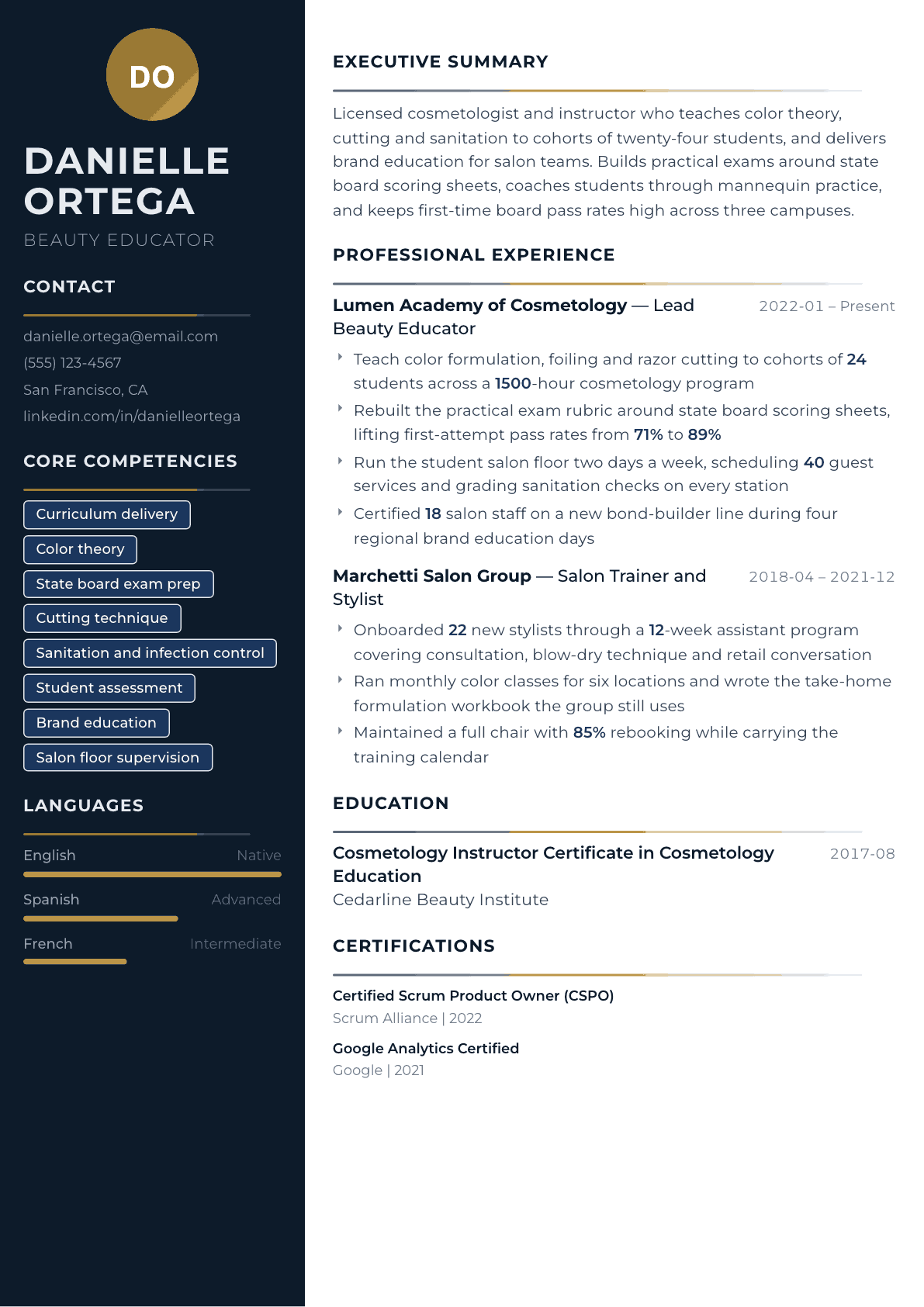
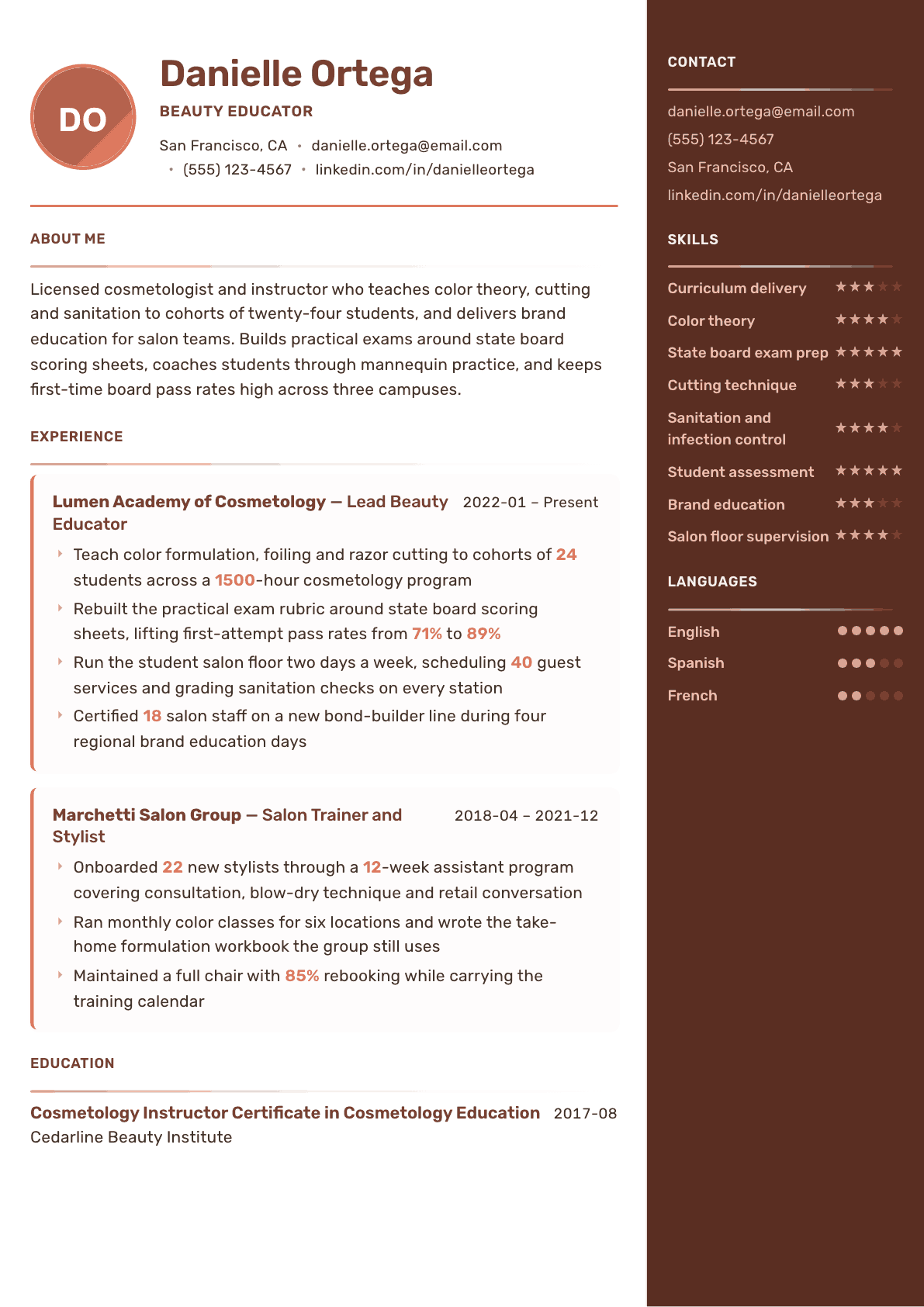
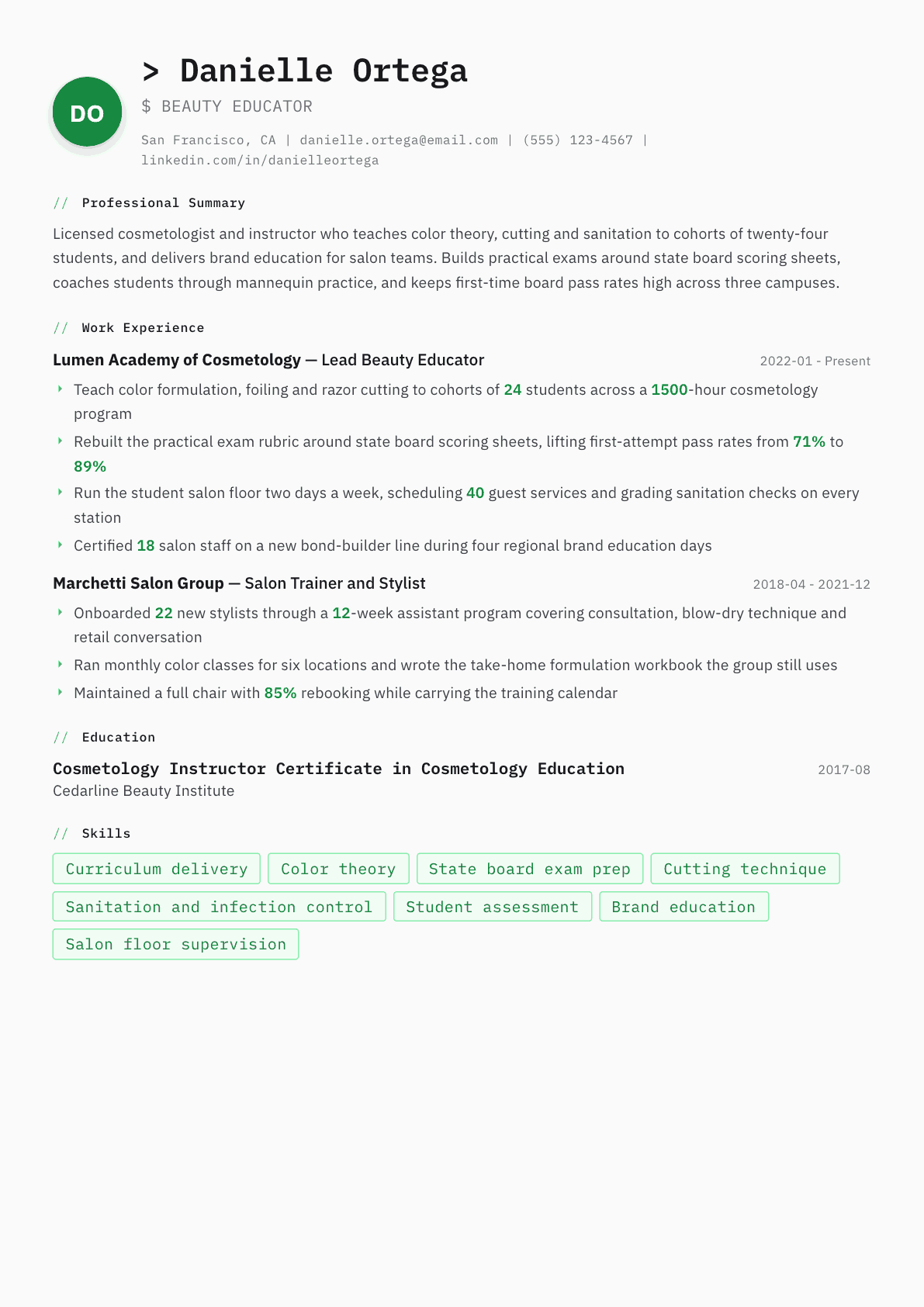
The same beauty educator content laid out in three CVBooster templates, so you can see what the finished document looks like before you write a word.
Example Beauty Educator summary
Licensed cosmetologist and cosmetology instructor with seven years behind the chair and four years in the classroom. Teaches color theory, cutting and sanitation to cohorts of twenty-four, rebuilt a practical exam rubric that raised first-attempt board pass rates, and delivers brand education days for multi-location salon groups. Looking for a lead educator seat at an accredited school.
Skills to list on a Beauty Educator resume
- Cosmetology instruction
- Lesson planning
- State board preparation
- Color formulation
- Haircutting instruction
- Texture services
- Sanitation standards
- Practical exam grading
- Student retention
- Clinic floor management
- Brand education
- Retail training
- Classroom management
- Learning assessment
- Mannequin demonstration
What actually gets this resume read
- Name the license type and the instructor license separately, because schools screen for the teaching credential first.
- Give every teaching job the cohort size, the program hours and the subjects you personally taught, not the school catalog.
- Report first-attempt state board pass rates for the cohorts you owned; that single number decides many interviews.
- Separate classroom teaching from clinic floor supervision, since accreditors and hiring directors count those hours differently.
- If you do brand education, list the product categories and the number of salon teams you certified per quarter.
- Keep your own service skills visible: schools want an educator who can still demonstrate a razor cut on a live model.
How to write a beauty educator resume
A beauty educator resume gets sorted by a school director or an education manager at a product company, and the two of them want different evidence. The school director is accountable to an accrediting body and to state board pass rates, so she checks the instructor license before she reads a word of prose. The brand education manager cares whether you can hold a room of working stylists for six hours and send them back to the salon selling the line.
Most applicants for these jobs write a stylist resume with the word educator dropped into the title. That fails both readers. Behind the chair you were measured on rebooking and retail; in front of a class you are measured on cohort size, hours delivered, practical exam outcomes and how many students finish the program.
This guide covers the section order these employers expect, what belongs in a teaching job entry, three example summaries at different stages, before-and-after bullets pulled from the way beauty educators actually write, and the questions that come up when a stylist writes a teaching resume for the first time.
Format: credentials block first, teaching history second
Use reverse-chronological order and keep it to one page until you have two full teaching posts, then two pages. Beauty education hiring runs on documents, so the top of the page carries the license numbers and the states they are held in. A school cannot put an unlicensed instructor on the clock, and a recruiter who has to email you for that information puts your file aside.
Do not use a heavy two-column layout with decorative icons. School groups often run applications through the same tracking software the parent company uses for retail staff, and those parsers scramble columns. Save the visual flourish for the portfolio link.
- Header line: name, cosmetology license state, instructor license state, and the disciplines you are licensed to teach.
- Section order for beauty education: summary, licenses, teaching experience, salon experience, education and training, skills.
- Add a short line naming the program hours you have taught within, since a nine hundred hour esthetics program and a fifteen hundred hour cosmetology program are staffed differently.
The teaching entry: cohort, hours, subjects, outcomes
Every teaching job needs four facts before any bullets: the school, the program, the cohort size you personally led, and the subjects you owned. A line that reads like a class roster tells a director whether you have stood in front of twenty-four students or tutored four at a time, and those are not the same job.
Then write bullets that show the teaching craft. Lecture delivery, demonstration on a live model, mannequin practice cycles, the way you break a corrective color case down into steps a second-term student can follow. Add the pieces a director inherits when she hires you: clinic floor supervision, guest service scheduling, grading, attendance and hour tracking for the state.
Outcomes belong here too. First-attempt state board pass rate for the cohorts you owned, completion rate, and how many students moved into salon jobs. Those are the numbers a school reports upward, and an instructor who already speaks in them is easy to hire.
Brand and platform education: a separate track
If you have done brand work, keep it separate from school teaching. It is a different rhythm: a half-day class for a salon team, a launch event, a trade show demonstration stage, a road schedule across a territory. Name the product categories you certified people on, color lines, chemical texture, bond builders, extensions, and how many salon teams you delivered to per quarter.
Platform work also carries a sales edge that schools do not have. If your classes moved the account, say what happened after the class in plain terms: reorders from the salons you taught, teams converted to the line, follow-up visits booked. Keep it factual and specific to accounts you served.
- Name the class formats you deliver: hands-on workshop, cutting class on mannequins, live model demonstration, in-salon coaching day.
- Say whether you travel, and the size of the territory, because education roles at brands are built around a route.
- Note any content you authored: workbooks, formulation charts, step-outs and video scripts belong in this section.
Licenses, certifications and continuing education
Give the license type, the state and the status for each one. The instructor license is the gate; a cosmetology or esthetics license alone qualifies you to work, not to teach. If you hold licenses in more than one state, list them all, because school groups with campuses across state lines hire specifically for that.
Under continuing education, list the classes you have taken from the brands and academies you name elsewhere on the resume. A director reading an instructor application wants proof that you are still learning technique, not only teaching it. Keep sanitation and infection control training current and visible, since that is the subject inspectors ask students about.
Keywords a school or brand screens for
Job postings for these roles reuse a small vocabulary: instructor license, curriculum delivery, lesson planning, practical and theory instruction, clinic floor supervision, state board preparation, student retention, sanitation and infection control, and the discipline itself. Mirror the exact phrase the posting uses once in your summary and once inside a teaching bullet where it is demonstrated.
Add the technical vocabulary of the chair, because it proves you can teach what you claim: color formulation, corrective color, foiling and balayage, razor and shear cutting, chemical texture, scalp analysis. A director skimming for teaching depth is really skimming for whether you can demonstrate on a Friday when a student asks.
Beauty Educator resume summary examples
Newly licensed instructor
Licensed cosmetologist with six years behind the chair and a new instructor license, completing a 600-hour instructor training track. Assisted on the clinic floor for two cohorts, graded practical checkoffs, and taught the sanitation and scalp analysis units. Seeking a full-time classroom seat at an accredited school.
Four years teaching
Cosmetology instructor teaching color theory, cutting and chemical texture to cohorts of 24 in a 1500-hour program. Rebuilt the practical exam rubric to match state board scoring sheets and lifted first-attempt pass rates from 71% to 89%. Supervises the student salon floor two days a week.
Lead educator
Lead beauty educator across three campuses, responsible for instructor onboarding, curriculum review and the state hour reporting cycle. Teaches advanced color correction, mentors four instructors, and delivers brand certification days for salon teams across the region. Looking for an education director role with curriculum ownership.
Work experience bullets: before and after
Before: Taught cosmetology students in a classroom setting.
After: Taught color theory, foiling and razor cutting to cohorts of 24 students inside a 1500-hour cosmetology program, splitting each day between theory lecture and mannequin practice.
The cohort size, program length and specific subjects tell a director exactly what load you have carried.
Before: Helped students prepare for the state board exam.
After: Rebuilt the practical exam rubric around the state board scoring sheet and ran timed mock exams every third week, raising first-attempt pass rates from 71% to 89%.
It names the method and the result instead of claiming that preparation happened.
Before: Supervised students on the salon floor.
After: Ran the student clinic floor two days a week, scheduling roughly 40 guest services per shift, signing off sanitation checks at every station and grading each service against the practical rubric.
Clinic supervision is a distinct duty with volume and compliance attached, so the detail matters more than the verb.
Before: Did product training for salons.
After: Certified 18 stylists across four salon teams on a bond-builder and demi-permanent color line through half-day hands-on classes, then returned for in-salon coaching within a month.
Naming the product category, the headcount and the follow-up shows brand education rather than a vague visit.
Before: Created lesson plans and handouts.
After: Wrote the formulation workbook and step-out sheets for the color unit, including a corrective color decision tree that instructors at two campuses now teach from.
Authored material that other instructors use is evidence of curriculum ability, not just preparation for your own class.
Hard skills
- Cosmetology instruction
- Instructor licensing compliance
- Lesson planning
- State board exam preparation
- Practical rubric grading
- Color formulation and correction
- Haircutting instruction
- Chemical texture services
- Sanitation and infection control
- Clinic floor supervision
- Student hour tracking
- Brand and product certification
- Curriculum review
- Live model demonstration
Soft skills
- Classroom management
- Patience with repetition
- Feedback delivery
- Public demonstration presence
- Student mentoring
- Conflict resolution on the floor
Certifications worth listing
- Cosmetology Instructor Examination (National Interstate Council of State Boards of Cosmetology)
- Barbicide Certification (King Research)
- Adult and Pediatric First Aid, CPR and AED (American Red Cross)
Mistakes that cost beauty educator candidates the interview
- Sending a stylist resume with the job title changed, so the reader sees rebooking and retail numbers where cohort sizes and pass rates should be.
- Leaving the instructor license off the top of the page, which forces a school to email you before it can even consider the file.
- Writing that you taught a subject without naming the program length, so nobody can tell a short esthetics course from a full cosmetology track.
- Blending brand education and school teaching into one block, when the two roles are budgeted, scheduled and evaluated differently.
- Skipping the state hour and attendance reporting work, which is a real part of the job and a real source of audit risk.
- Listing every product line you have ever touched instead of the categories you can certify others on.
Beauty Educator resume questions
Do I need an instructor license to apply for a beauty educator job?
For a licensed school in almost every state, yes, and the school cannot schedule you without it. Some states allow you to teach under supervision while you complete instructor training hours, so state your status and expected completion date if you are mid-track.
How do I show teaching skill when all my experience is behind the chair?
Pull out the teaching you already did. Assistant onboarding, apprentice checkoffs, in-salon color classes, mentoring a new stylist through her first six months. Give each one a headcount, a structure and a result so a director sees instruction, not informal help.
Should I put state board pass rates on my resume?
Yes, when the number is yours and you can defend it in an interview. Say which cohorts it covers and whether it is first-attempt or overall. If your school does not release the figure, use completion rate or practical checkoff results instead.
How is a brand educator resume different from a school instructor resume?
A brand educator resume leads with class formats, territory, product categories certified and account results. A school instructor resume leads with the license, cohort size, program hours and student outcomes. Keep two versions and send the one the posting describes.
How long should a beauty educator resume be?
One page while you have a single teaching post, two pages once you have several campuses, brand work or curriculum authorship to show. Move older chair-only jobs into a short earlier experience block rather than deleting the salon history entirely.
Related resume examples
- Hairstylist Resume example
- Esthetician Resume example
- Cosmetologist Resume example
- Salon Manager Resume example
- Aesthetician Resume example
- Brow Technician Resume example