Interview Questions for an LPN: 9 Full Sample Answers
By Mustafa Tarabya, founder of CVBooster · Published · Updated
10 min read
Interview questions for an LPN test one thing more than any other: whether you know where your scope ends and what you do the moment a patient changes. The constraint is that the RN or the provider makes the assessment calls, so every clinical answer has to show you observing, reporting and acting inside that line. O*NET, the US Department of Labor's occupation database, lists the core task as "Observe patients, charting and reporting changes in patients' conditions, such as adverse reactions to medication or treatment, and taking any necessary action." Below are nine interview questions for LPNs with full sample answers, checked in October 2026, each tagged for a new grad or an experienced nurse. They work word for word as LVN interview questions too. Written by Mustafa Tarabya, who hired for his own company, read every application himself and now writes CVBooster's guides.
The nurse manager interviewing you has probably worked a double this week. She is not looking for the perfect answer. She is looking for the nurse she will not have to call at home at two in the morning.
LPN or LVN: are the interview questions different?
No. O*NET groups both titles under one occupation, "Licensed Practical and Licensed Vocational Nurses", and the job is the same; the title depends on the state. California and Texas use LVN, most other states use LPN. What changes from one employer to the next is the setting. A long-term care facility asks about med passes for a whole hall, falls and families. A clinic asks about rooming patients, injections and phone triage protocols. A hospital asks about working under an RN on a team. Read the posting, find the setting, and prepare the answers below for that floor.
1. Tell me about yourself
The warm-up question. Give your license and where you trained, the setting you have worked in, and one reason you want this job. Ninety seconds, not your life story.
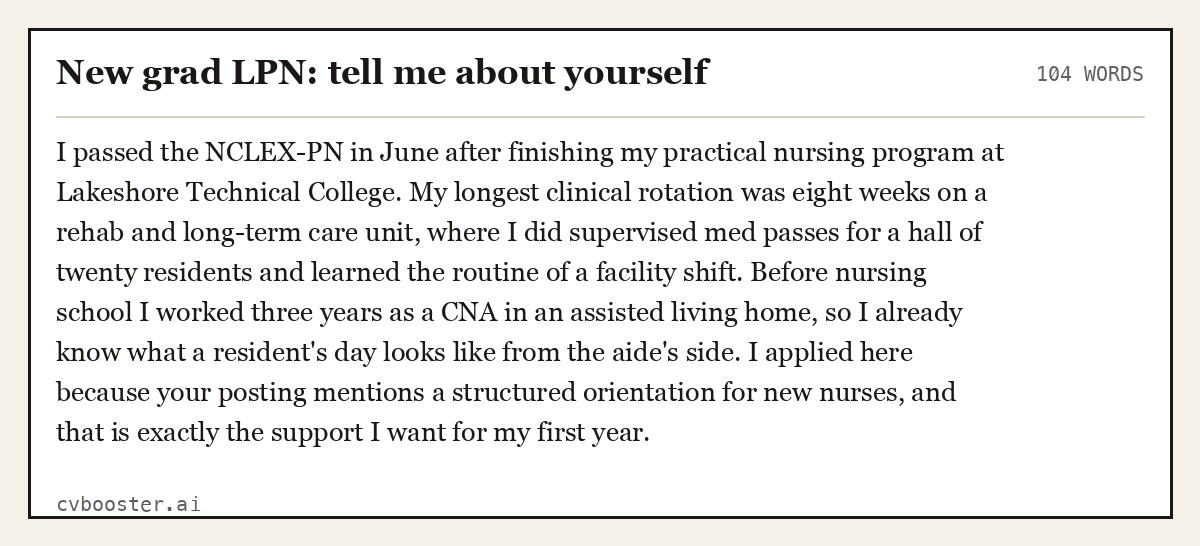
New grad LPN: tell me about yourself (104 words)
I passed the NCLEX-PN in June after finishing my practical nursing program at Lakeshore Technical College. My longest clinical rotation was eight weeks on a rehab and long-term care unit, where I did supervised med passes for a hall of twenty residents and learned the routine of a facility shift. Before nursing school I worked three years as a CNA in an assisted living home, so I already know what a resident's day looks like from the aide's side. I applied here because your posting mentions a structured orientation for new nurses, and that is exactly the support I want for my first year.
2. What is the difference between your role and the RN's?
This is the scope question, and it is asked in almost every LPN interview because a wrong answer is a safety problem. Name what you do, name what belongs to the RN, and say that your state's nurse practice act sets the exact line. NCSBN, the national council of state boards of nursing, puts it plainly: "It is the responsibility of all licensed nurses to know what is permitted in the jurisdictions they practice in."
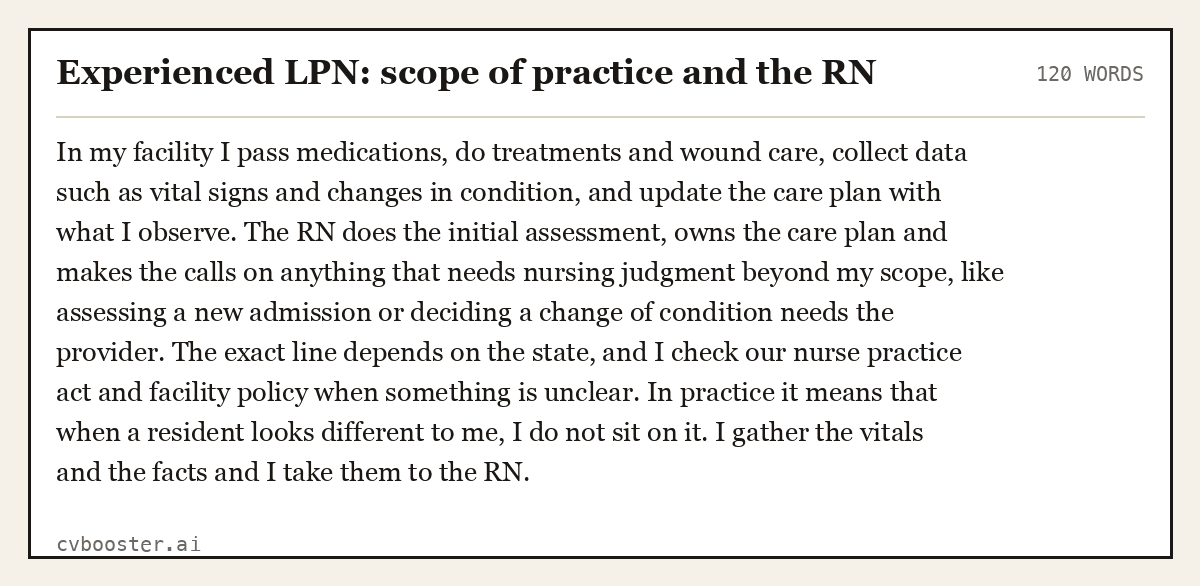
Experienced LPN: scope of practice and the RN (120 words)
In my facility I pass medications, do treatments and wound care, collect data such as vital signs and changes in condition, and update the care plan with what I observe. The RN does the initial assessment, owns the care plan and makes the calls on anything that needs nursing judgment beyond my scope, like assessing a new admission or deciding a change of condition needs the provider. The exact line depends on the state, and I check our nurse practice act and facility policy when something is unclear. In practice it means that when a resident looks different to me, I do not sit on it. I gather the vitals and the facts and I take them to the RN.
3. How do you organize a med pass for a full hall?
Long-term care interviews ask this every time. The manager wants to hear the order you work in, how you handle the five rights, and what you do when the cart is behind.
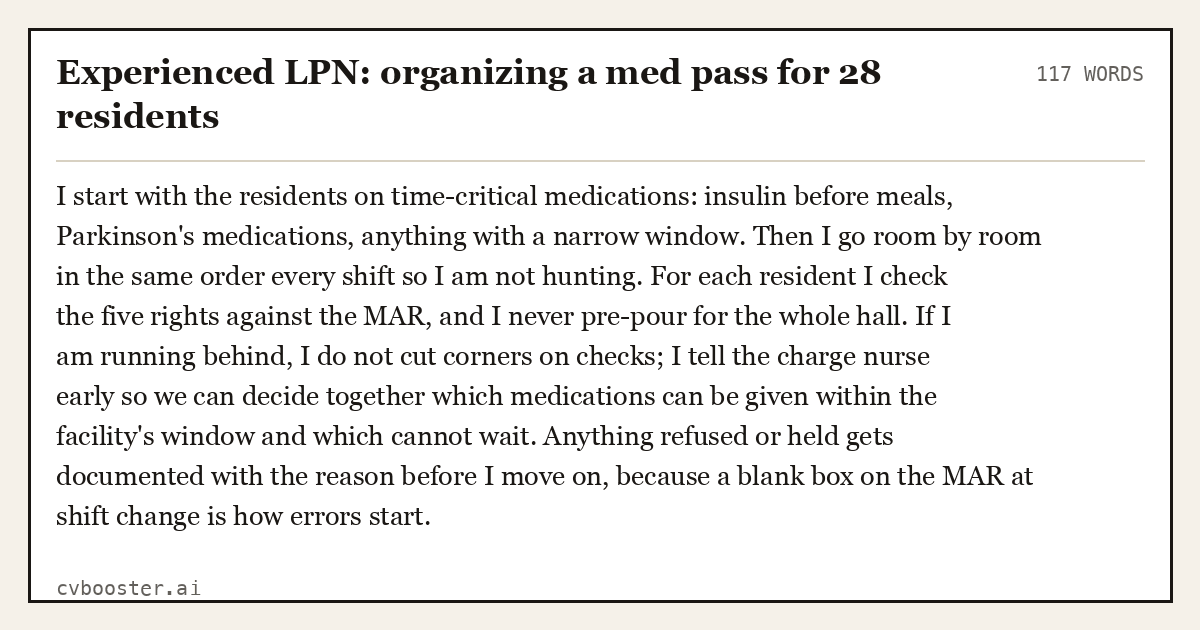
Experienced LPN: organizing a med pass for 28 residents (117 words)
I start with the residents on time-critical medications: insulin before meals, Parkinson's medications, anything with a narrow window. Then I go room by room in the same order every shift so I am not hunting. For each resident I check the five rights against the MAR, and I never pre-pour for the whole hall. If I am running behind, I do not cut corners on checks; I tell the charge nurse early so we can decide together which medications can be given within the facility's window and which cannot wait. Anything refused or held gets documented with the reason before I move on, because a blank box on the MAR at shift change is how errors start.
4. A resident's blood pressure is much lower than usual. What do you do?
The change of condition question. The panel is listening for the order: check, recheck, report, document. Do not diagnose.
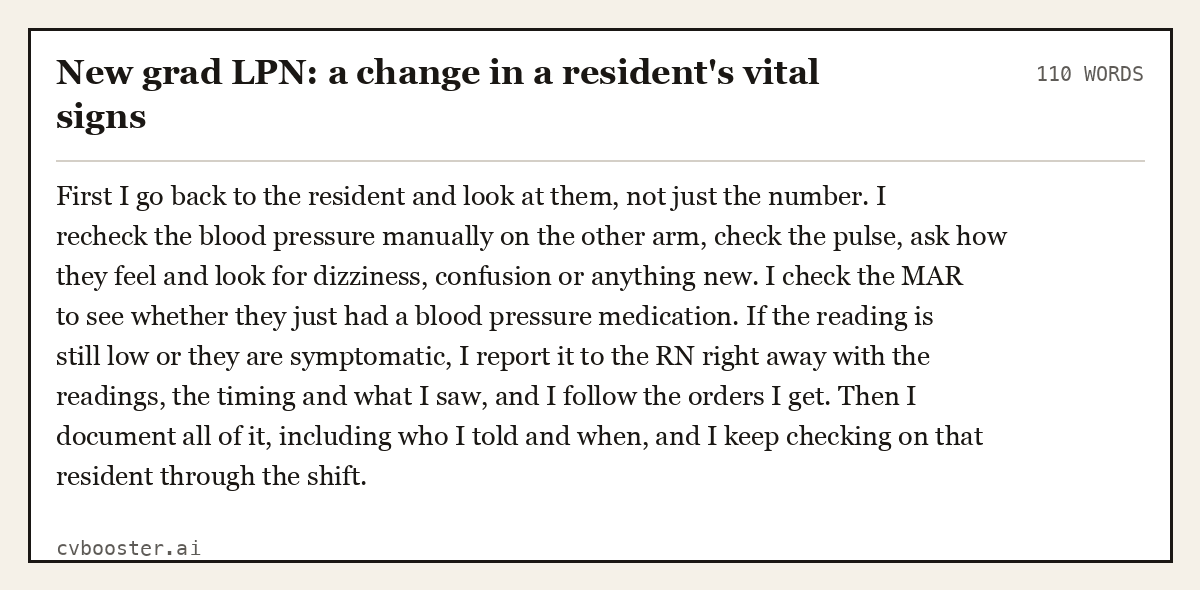
New grad LPN: a change in a resident's vital signs (110 words)
First I go back to the resident and look at them, not just the number. I recheck the blood pressure manually on the other arm, check the pulse, ask how they feel and look for dizziness, confusion or anything new. I check the MAR to see whether they just had a blood pressure medication. If the reading is still low or they are symptomatic, I report it to the RN right away with the readings, the timing and what I saw, and I follow the orders I get. Then I document all of it, including who I told and when, and I keep checking on that resident through the shift.
5. Tell me about a time you made or caught a medication error
Every nurse manager asks some version of this, and "I have never made a mistake" is the wrong answer. Use the STAR order: situation, task, action, result.
Experienced LPN: catching a medication error, STAR (116 words)
On a busy evening shift I was about to give a resident her scheduled potassium when I noticed her latest lab result in the chart was high and the order had not been changed. My task was to get it right before giving anything. I held the dose, told the charge RN, and she called the provider, who discontinued the potassium and ordered a recheck. I documented the hold and the call. The result was that nothing reached the resident, and afterward I suggested we add new lab results to our shift report so the next nurse would see them. Since then I always glance at recent labs before I give potassium, digoxin or blood thinners.
6. How would you handle a resident who falls?
Falls are the most common incident in long-term care, so this question tells the manager whether you know the facility routine. Safety first, then the report.
New grad LPN: responding to a fall (106 words)
I would call for help and stay with the resident without moving them until I know whether they are hurt. I check responsiveness, breathing and vital signs, look for pain, bleeding or a leg that looks shortened or turned, and ask what happened if they can tell me. If there is any sign of injury or a head strike on a blood thinner, the RN and the provider need to know immediately. Once it is safe, we use the lift or the right number of staff to get them up. Then I complete the incident report, notify the family per policy and start the follow-up checks.
7. How do you work with CNAs and delegate tasks?
In many settings the LPN runs a hall with aides, and O*NET lists "Supervise nurses' aides or assistants" among the core tasks. The question is whether aides will want to work with you.
Experienced LPN: delegating to CNAs (108 words)
I worked as a CNA before nursing school, so I know what it feels like to get a list of tasks with no explanation. At the start of the shift I go over the residents with my aides: who is a fall risk, who needs to be turned every two hours, who is on fluid restriction. I tell them exactly what I want reported to me, like intake, skin changes or a resident who seems confused. When I ask for help, I say why. And I help with care myself when the floor is short, because a nurse who never answers a call light loses the aides fast.
8. How do you handle a family member who is upset?
Families are part of the job in long-term care and home health. The manager wants calm, listening and the right escalation, not a defensive answer.
Experienced LPN: an upset family member (105 words)
A daughter once found her father's lunch tray untouched at three in the afternoon and was angry, with good reason. I took her to a quiet spot, let her finish, and told her I would find out what happened rather than guess. It turned out he had refused lunch and nobody had offered an alternative. I got him a meal right away, told her what we were changing, and asked the dietary team to add a substitute to his plan. I let my supervisor know about the complaint. Two weeks later she asked for me by name when she called about his care plan meeting.
9. Why should we hire a new grad LPN?
New grads get this almost every time. Do not apologize for being new. Show what you bring and how you will learn.
New grad LPN: why hire a new graduate (96 words)
Because I learned current practice in school only months ago, and I have no habits to unlearn. My clinical instructors marked me strong on med pass accuracy and documentation, and I have three years as a CNA, so I know how a shift runs and how to work with aides. I know what I do not know, and I ask before I act. In my first ninety days I want to be safe and independent on a full med pass, learn your charting system, and be someone the night shift is glad to get report from.
What the nurse manager is listening for
Every answer above is the same test from a different side: will you notice a change, report it to the right person and write it down. O*NET's task list for the role reads like a checklist for your examples, from vital signs to "Administer prescribed medications or start intravenous fluids, noting times and amounts on patients' charts." If an answer of yours does not end with reporting and documenting, add it.
Three habits separate strong answers. Use a real example for every behavioral question, with details changed to protect the patient. Say the RN or the provider where the decision belongs to them. And never claim a skill you are not licensed or trained for in that state, such as IV pushes, because the manager knows the rules better than you do.
Before the interview, check the setting, the hall size, the shift pattern and whether the job includes IV therapy. Bring your license number, CPR card and any certification such as IV therapy, and know your NCLEX-PN date.
Questions to ask at the end
Ask the things that decide whether you will be safe and stay: how many residents or patients per nurse on each shift, how long orientation lasts and who precepts you, how the RN supervision works at night, and how often agency staff fill the schedule. Our list of questions to ask in an interview has more.
To prepare the behavioral answers, the guide to STAR interview questions walks through the method. For your application, the licensed practical nurse resume guide shows how to lay out your clinical hours and license, and the nursing resume guide covers the rest of the nursing family. A short thank you letter after the interview keeps your name in front of the manager.
Frequently asked questions
What questions are asked in an LPN interview?
Expect scope questions about the difference between your role and the RN's, clinical scenarios such as a change in vital signs or a fall, med pass and medication error questions, teamwork questions about CNAs and RNs, and fit questions about shifts and the setting. New grads also get asked why the facility should hire someone new.
How do I prepare for an LPN interview as a new grad?
Prepare one story from each clinical rotation, a clear answer on your scope of practice, the change of condition order (check, recheck, report, document) and a ninety-day plan. Know your NCLEX-PN date and your license number. Practice saying who you would report to in every scenario answer.
What are common LVN interview questions?
They are the same as LPN interview questions, because LVN is the title California and Texas use for the same job. Expect questions on scope, medication administration, reporting changes in condition, falls, families and working with aides. Check the state's rules on tasks such as IV therapy before you answer them.
How do I answer "why do you want to be an LPN"?
Give a real reason tied to patient care, such as a family member's care or your work as a CNA, then connect it to the setting you are applying to. Keep it to three or four sentences and end with why this facility, for example its residents, its orientation or its hours.
What should I wear to an LPN interview?
Wear business casual clothes unless the facility tells you to come in scrubs, for example for a working interview or a floor tour. Keep it simple: clean shoes you can walk in, minimal jewelry, hair tied back. Bring copies of your license, CPR card and resume.
Related articles
- Creative Interview Questions With 6 Sample Answers
- ED Nurse Interview Questions With 9 Full Sample Answers
- Female Job Interview Attire: Six UK Outfits by Job Type
- Great Questions to Ask an Interviewee: 6 Ready Sets
More articles
- Making Effective Decisions: 4 Civil Service Examples
- Cover Letter Examples for a Manager Position: 6 Samples
- Manager Skills for a Resume: 26 and the Bullet for Each
Looking for a worked example for your job title? Browse the resume examples by job title.