Salon Manager Resume Examples: free ATS score and gap list
A Salon Manager Resume That Shows Column and Cost Control
By Mustafa Tarabya, founder of CVBooster · Published · Updated
Write a salon manager resume around utilization, retention, retail and staffing, with example bullets, keywords and a complete section by section guide.
Sample resumes for a salon manager
The same salon manager content laid out in three CVBooster templates, so you can see what the finished document looks like before you write a word.
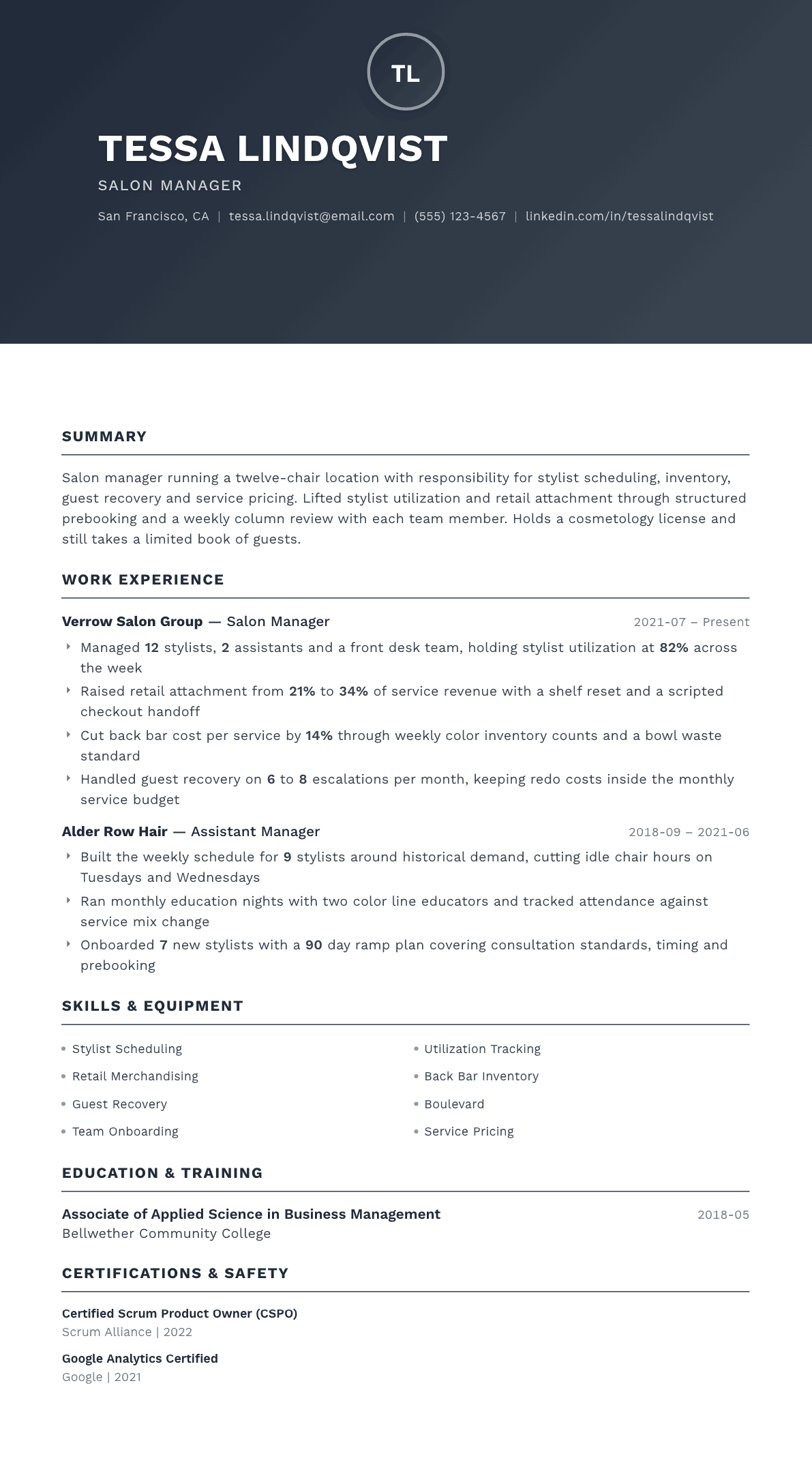
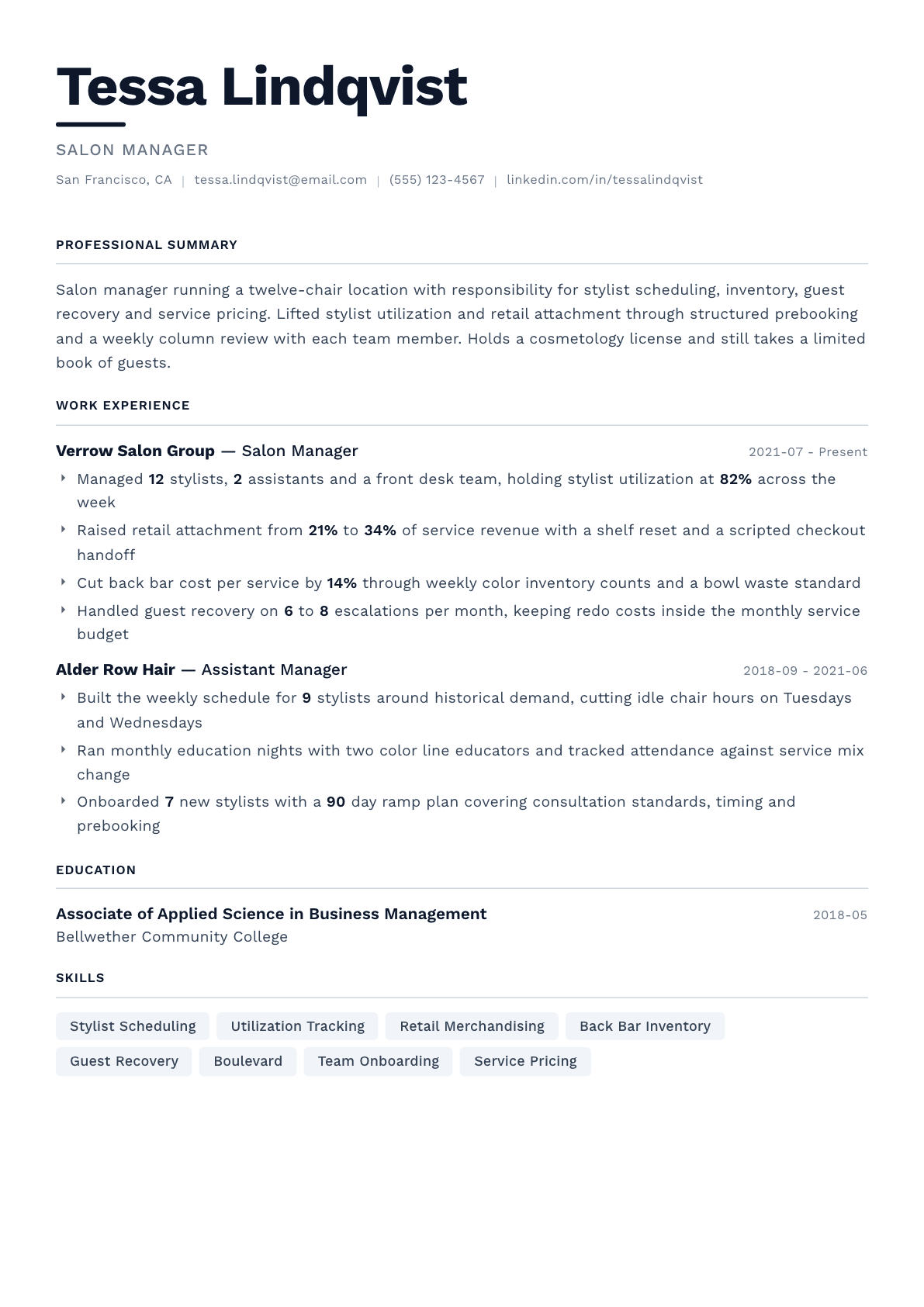
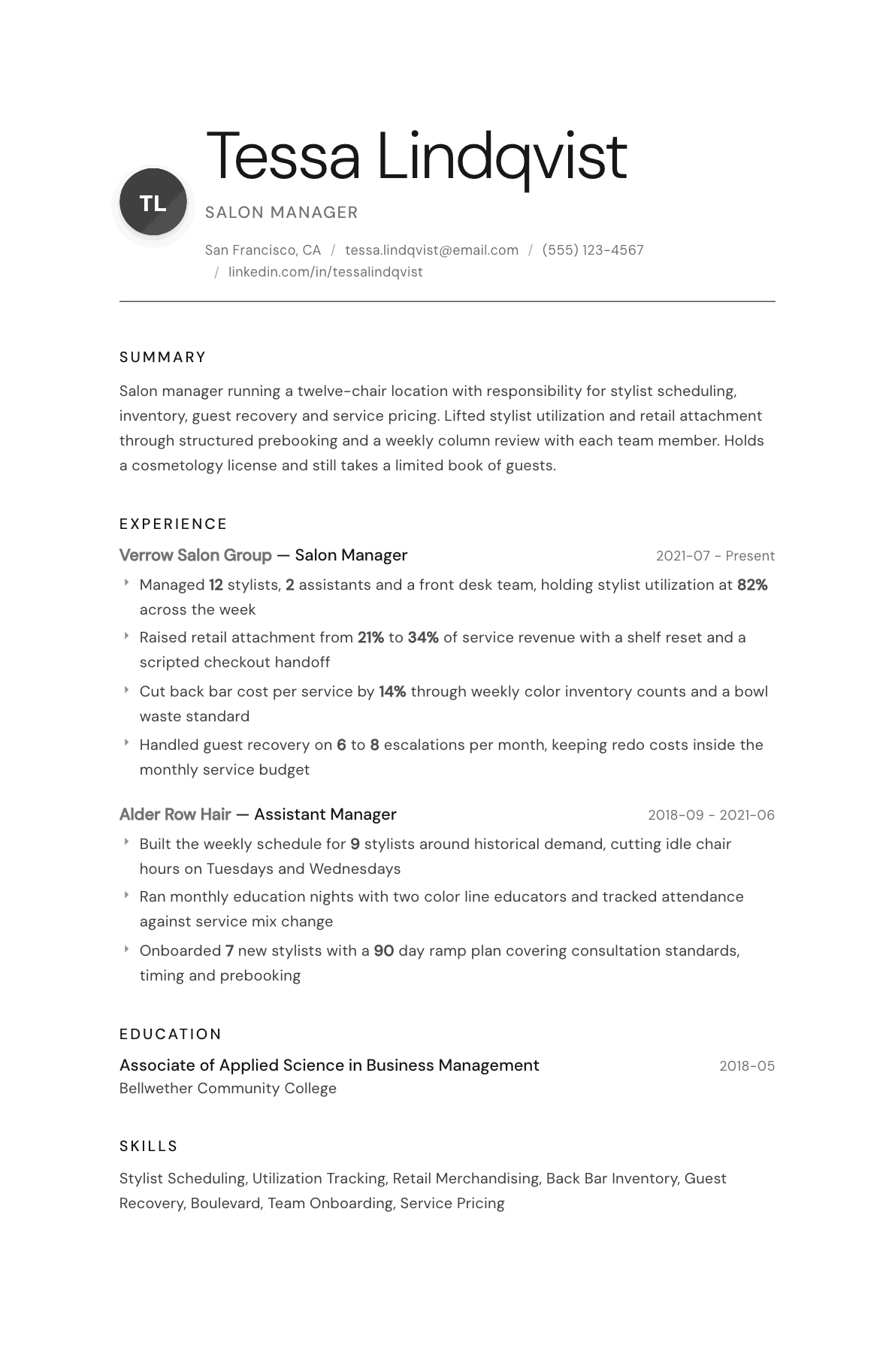
Example Salon Manager summary
Salon manager for a twelve-chair location responsible for scheduling, inventory, pricing and team development. Improved stylist utilization and retail attachment through weekly column reviews and a checkout handoff the front desk actually follows. Controls back bar cost with counted color inventory and a waste standard, and resolves guest escalations without eroding stylist trust. Seeking a multi-location manager role with hiring ownership.
Skills to list on a Salon Manager resume
- Stylist Scheduling
- Utilization and Column Analysis
- Prebooking Programs
- Retail Merchandising
- Back Bar Inventory Control
- Service Pricing
- Guest Recovery
- Hiring and Onboarding
- Team Education Planning
- Payroll and Commission Structures
- Boulevard
- Mindbody
- Sanitation Compliance
- Local Marketing
What actually gets this resume read
- Lead with the size of the location: chairs, stylists, assistants and front desk headcount in the first line.
- Report utilization, prebooking and retail attachment, the three numbers an owner uses to judge a manager.
- Show back bar and color inventory control, because product waste is where salon profit quietly disappears.
- Describe how you handled guest recovery and redo policy rather than saying you delivered excellent service.
- Name the salon software you ran reports in, such as Boulevard, Mindbody, Phorest or Vagaro.
- Say whether you still work behind the chair, since many owners want a working manager and will ask early.
How to write a salon manager resume
A salon manager is hired to fix one of three problems: chairs that sit idle, product that disappears faster than it sells, or a team that keeps leaving. An owner reading your resume is trying to work out which of those you have actually solved, and the only convincing evidence is a number attached to a method.
This is where most salon manager resumes fail. They describe duties that every manager performs, scheduling, ordering, hiring, customer service, and never say what changed. An owner cannot tell whether utilization went up under you or whether you simply kept the lights on, and in a business running on thin margins that difference is the whole job.
This guide sets out the operating numbers a salon runs on, how to write about stylist scheduling and back bar cost without turning the page into a spreadsheet, and how to handle the question every owner asks, which is whether you still work behind the chair.
Format: scale first, then the operating numbers
One page under eight years of management, two after that. Open with the scale you have run: chairs, stylists, assistants, front desk headcount, and whether you managed one location or several. An owner sizing a candidate wants that in the first line, because managing four stylists and managing fourteen are different jobs with the same title.
Keep your cosmetology license visible if you hold one. Many owners want a working manager who can take overflow guests and cover a call-out, and a license in the header answers that before anyone has to ask.
- Scale line: number of chairs, stylists, assistants and desk staff, plus locations managed.
- Operating metrics block: utilization, prebooking rate, retail attachment, average ticket and stylist retention.
- Systems used by name, since reporting is done inside the booking platform and nowhere else.
- Whether you carry a personal book, with the share of your week spent behind the chair.
Utilization: the number the whole job turns on
Utilization is the share of available chair hours that were actually booked and served. It is the cleanest measure of whether a manager is doing the job, because it captures scheduling accuracy, prebooking discipline and demand management at once. Give the figure, the size of the team it covered, and what you changed to move it.
The method is as important as the number. Weekly column reviews with each stylist, building the schedule against historical demand instead of stylist preference, protecting high-demand hours for high-ticket services, and clearing gaps from a standby list are all concrete practices an owner can picture you doing on Monday morning.
Cost control: back bar, color inventory and comped services
Salon profit leaks in three places, and a manager who names all three sounds experienced immediately. Color and back bar product is the first: weekly counts, bowl waste standards, portioning discipline and a par level per line. Say what cost per service was before and after you tightened it.
Comped services and redos are the second. A written redo policy, formula records that make corrections diagnosable, and a manager who reviews every comp turns a silent cost into a managed one. Payroll structure is the third: commission tiers, hourly guarantees and assistant hours all shift the labor line, and a manager who has restructured any of them should say so.
People: hiring, ramping and keeping a team together
Stylist turnover is the most expensive thing that happens to a salon, because the book often leaves with the person. Write about hiring the way an operator does: where you sourced candidates, how you ran a technical interview, what a ramp plan looked like, and how many hires reached a full column and stayed.
Education is the retention lever most owners underuse. If you built an education calendar, brought in brand educators, or ran an assistant program that produced stylists, that belongs in its own bullets. A manager who grows stylists internally is cheaper than one who recruits them repeatedly, and owners know it.
Guest experience and recovery
Every salon manager handles escalations, so the differentiator is method. Describe how a complaint reaches you, what you check first, usually the formula record and the consultation note, and how you decide between a redo, an adjustment and a refund without undermining the stylist in front of the guest.
Review management belongs here too. Naming how you respond publicly, how quickly, and how you convert an unhappy guest into a return visit says more than a claim about excellent customer service, which appears on every competing application.
Salon Manager resume summary examples
Stepping up from the chair
Senior stylist moving into management after two years as an informal floor lead, building the weekly schedule for nine stylists and running the assistant program. Licensed cosmetologist who still carries a partial book. Comfortable with booking platform reporting, inventory counts and guest recovery. Seeking a first salon manager role.
Four years managing
Salon manager for a twelve-chair location with responsibility for scheduling, inventory, pricing and guest recovery. Holds stylist utilization at 82%, lifted retail attachment from 21% to 34%, and cut back bar cost per service by 14%. Still takes a limited book. Seeking a larger single location or a two-site role.
Multi-location manager
Multi-location salon manager overseeing three sites, 34 stylists and a shared front desk team. Standardized consultation and prebooking across locations, rebuilt the commission tiers, and reduced stylist turnover across two years while opening a fourth site. Seeking an area manager or director of operations position in a growing group.
Work experience bullets: before and after
Before: Managed the daily operations of a busy salon.
After: Ran a twelve-chair location with 12 stylists, 2 assistants and a front desk team, holding stylist utilization at 82% across a seven-day week.
Headcount and a utilization figure describe the scale and the result, where daily operations describes neither.
Before: Increased retail sales at the salon.
After: Raised retail attachment from 21% to 34% of service revenue through a shelf reset and a scripted checkout handoff between stylist and desk.
A before and after figure plus the mechanism shows an owner what she would be buying and how it was achieved.
Before: Ordered products and managed inventory.
After: Cut back bar cost per service by 14% with weekly color counts, per-line par levels and a bowl waste standard the team agreed to.
Back bar cost is where salon margin quietly disappears, so a cost movement beats the word inventory every time.
Before: Hired and trained new stylists.
After: Onboarded 7 stylists on a 90 day ramp plan covering consultation standards, service timing and prebooking, with 6 reaching a full column.
A ramp structure and a retention outcome prove hiring judgment rather than the act of filling a chair.
Before: Handled customer complaints professionally.
After: Resolved 6 to 8 guest escalations a month by reviewing the formula record first, then choosing between adjustment, redo or refund inside the service budget.
Volume and a decision process show a repeatable method instead of a claim about temperament.
Hard skills
- Stylist scheduling against demand
- Utilization and column analysis
- Prebooking program design
- Retail merchandising and shelf resets
- Back bar and color inventory control
- Service menu pricing
- Commission and payroll structures
- Hiring and technical interviewing
- Ramp and onboarding plans
- Education calendar planning
- Guest recovery and redo policy
- Booking platform reporting
- Sanitation and state board compliance
Soft skills
- Coaching stylists individually
- Difficult conversations with the team
- Owner communication
- Composure at the desk on a full day
- Fairness in schedule building
- Decisiveness on comps
Certifications worth listing
- Licensed Cosmetologist (state license) (State board of cosmetology)
- Certified Salon Manager (Professional Beauty Association)
- SHRM Certified Professional (SHRM-CP) (Society for Human Resource Management)
Mistakes that cost salon manager candidates the interview
- Listing duties every manager performs while never naming a single number that changed under your management.
- Omitting the size of the team and the number of chairs, so an owner cannot tell whether you have run her scale.
- Treating inventory as ordering rather than as cost per service, which is how an owner actually reads product spend.
- Skipping the working manager question, which every owner asks in the first interview and often decides on.
- Claiming a turnover improvement with no ramp plan, education calendar or pay structure to explain it.
- Writing about excellent customer service instead of describing your escalation and redo decision process.
Salon Manager resume questions
Does a salon manager need a cosmetology license?
Not always, but it widens what an owner can staff you for and it settles the working manager question immediately. If you hold one, put it in the header even when the posting does not require it.
What numbers belong on a salon manager resume?
Utilization, prebooking rate, retail attachment, average ticket, back bar cost per service and stylist retention. Give the figure, the team size it covered and the change you made, because a number with no method behind it invites doubt.
How do I show I can control product cost?
Describe the counting rhythm and the standard. Weekly color counts, par levels per line, a bowl waste rule and a locked back bar all read as operator habits. Then attach the movement in cost per service across a defined period.
Should I mention still working behind the chair?
Yes, and say what share of the week it takes. Many owners specifically want a working manager. Others want full floor attention. Being explicit lets each one self-select rather than discovering a mismatch after you start.
How do I move from senior stylist to salon manager?
Document the management work you already do informally: building the schedule, running education nights, training assistants, handling escalations. Frame those as operating responsibilities with numbers attached, then apply to a location roughly the size of the one you know.
Related resume examples
- Spa Manager Resume example
- Hairstylist Resume example
- Salon Owner Resume example
- Salon Receptionist Resume example
- Spa Receptionist Resume example
- Aesthetician Resume example