Bilingual Customer Service Representative Resume Examples
Write a Bilingual Customer Service Representative Resume That Sells the Language
By Mustafa Tarabya, founder of CVBooster · Published · Updated
Bilingual customer service representative resume examples showing language proficiency, dual queue volume, keywords and a section by section guide.
Sample resumes for a bilingual customer service representative
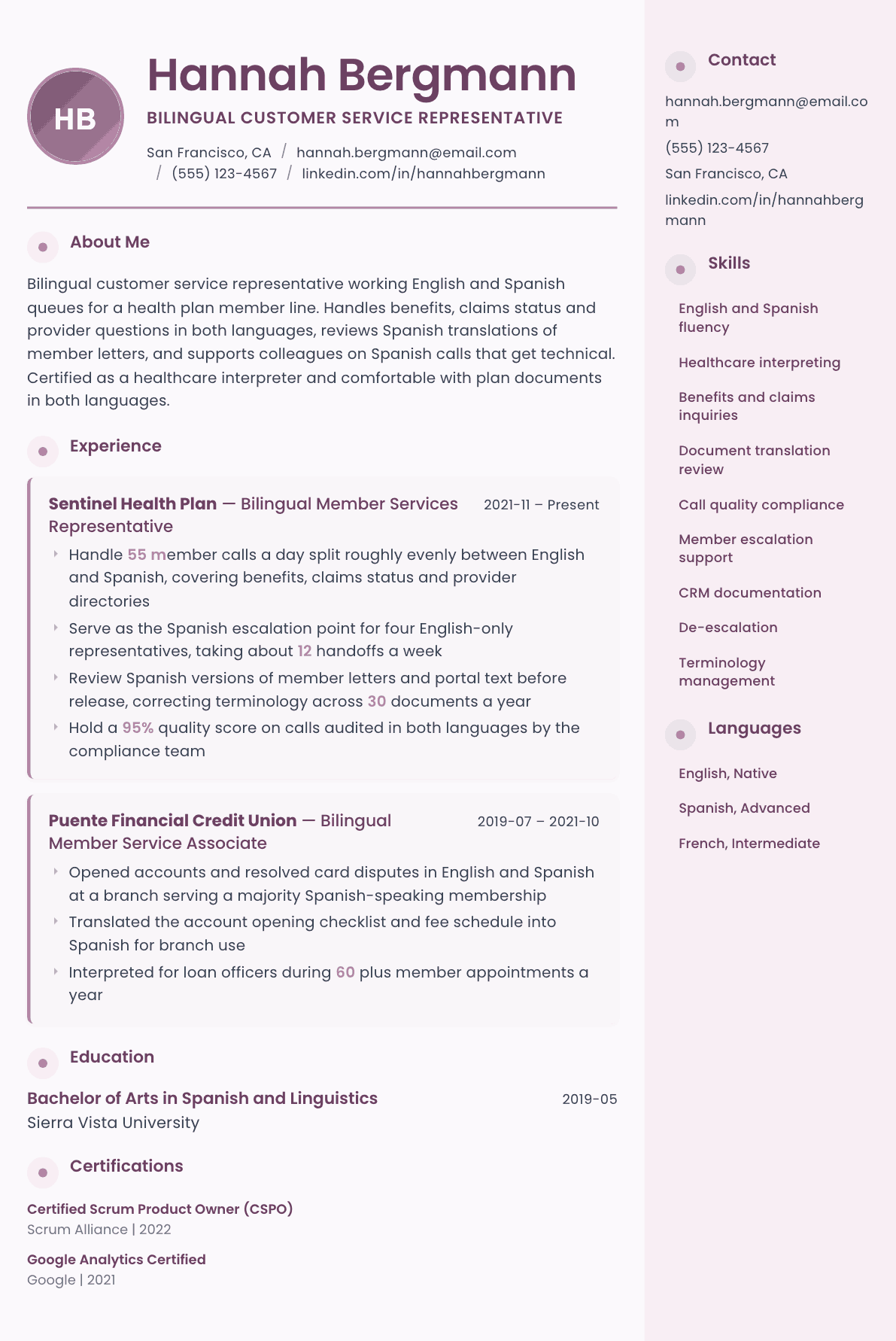
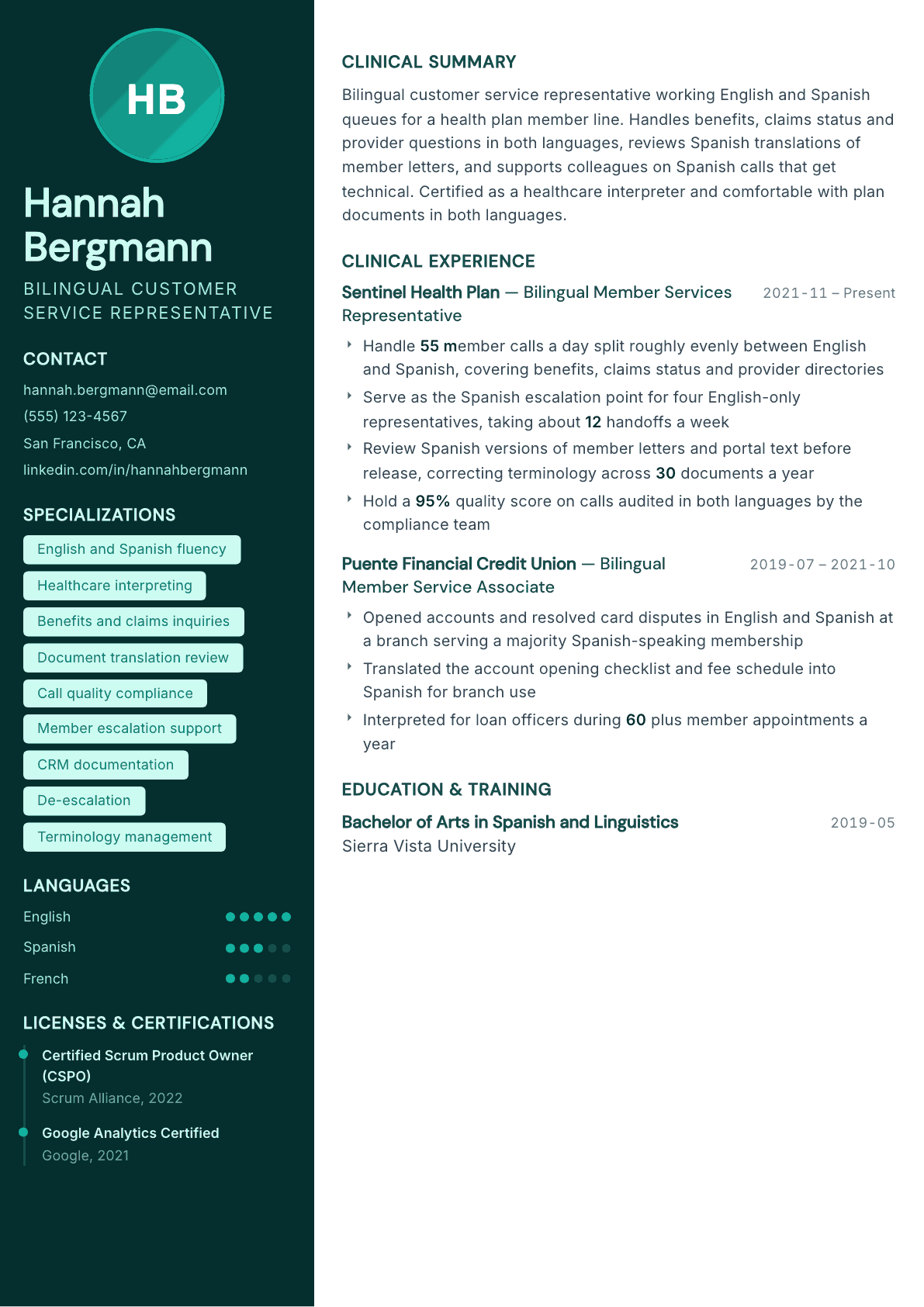
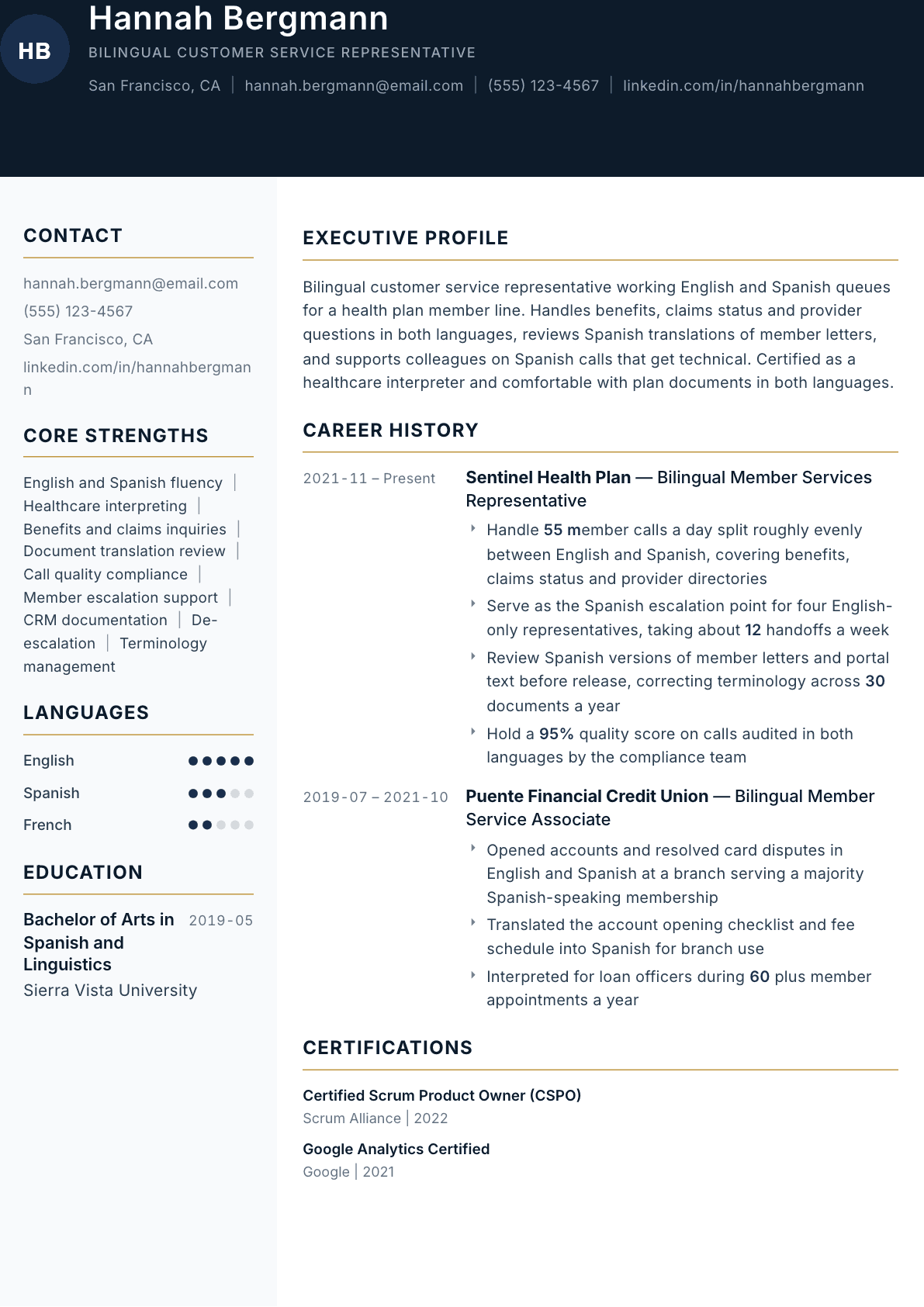
The same bilingual customer service representative content laid out in three CVBooster templates, so you can see what the finished document looks like before you write a word.
Example Bilingual Customer Service Representative summary
Bilingual customer service representative handling 55 daily calls split between English and Spanish on a health plan member line. Covers benefits, claims status and provider questions in both languages, takes about 12 Spanish handoffs a week from English-only colleagues, and reviews Spanish member letters before release. Holds a 95% quality score across audits in both languages. Seeking a bilingual team lead role.
Skills to list on a Bilingual Customer Service Representative resume
- Bilingual customer service
- Spanish fluency
- Interpreting
- Document translation review
- Inbound call handling
- Claims and benefits support
- De-escalation
- Quality assurance scorecards
- CRM documentation
- Member escalation support
- Terminology management
- Cultural competence
- Call dispositioning
- Compliance scripting
What actually gets this resume read
- State each language with a proficiency level and what you do in it: speak, write, interpret or translate.
- Split your call volume by language so a hiring manager can see the real load on the second queue.
- Say whether you were the escalation point for colleagues, because that is what a language differential pays for.
- Mention any translation or document review work separately, since it is a different skill from taking calls.
- Name an interpreting or language certification with its issuing body if you hold one, and leave it out if not.
- Show that quality audits covered both languages, which answers the unspoken question about your weaker one.
How to write a bilingual customer service representative resume
A bilingual customer service representative is hired to solve a staffing problem, and the resume has to name the problem it solves. A health plan with a Spanish-speaking membership, a credit union in a border market or a utility with a large second-language customer base is not looking for someone who studied a language. It is looking for someone who can take a claims call, explain a deductible and calm an upset member without switching back.
That is why the strongest line on this resume is a split volume. Fifty five calls a day divided roughly evenly between two languages tells a workforce planner exactly how much of the second queue you can absorb. A skills entry that says bilingual with no volume behind it leaves her guessing, and language differential pay is rarely approved on a guess.
This guide covers how to state proficiency so it survives a screening call, how to separate call handling from interpreting and translation, three summaries at different stages, before and after bullets from a real member services line, and the questions bilingual representatives ask when the second language is the reason they are being interviewed.
Format: one page, languages stated in the header area
One page, reverse chronological, single column. Put the languages and proficiency levels near the top, either in the summary or in a two line languages block directly beneath it. A recruiter staffing a second-language queue is searching for the language name, and it should appear well before the education section.
Do not describe proficiency with a bar chart or a star rating. Use language a hiring manager can act on: native, professional working proficiency, conversational. Then say what you do in each language, because reading a policy document and taking a live claims call are different capabilities.
- Section order: summary, languages, skills, experience, education, certifications.
- State the proficiency level and the tasks: speak, write, interpret, translate, review.
- Split daily contact volume by language wherever the employer tracked it that way.
- Keep interpreting and document review as their own bullets, separate from queue handling.
Summary: the queue, the split, the escalation role
Four lines. Name the line you worked and the subject matter, give the daily volume and the language split, then say whether you were the escalation point for colleagues who do not speak the second language. That last part is what a language differential actually pays for, and most candidates leave it out.
Where the subject matter is regulated, say so. Benefits, claims status and provider directory questions on a health plan member line carry compliance scripting and privacy rules that a retail queue does not. A hiring manager at a payer reads that as ready to work.
Experience: volume by language, escalation handoffs, quality in both
Lead each job with the split volume and the topics. Fifty five member calls a day divided between two languages, covering benefits, claims status and provider directories, is a sentence that answers volume, language load and subject matter at once.
The second bullet is the handoff count. If English-only colleagues transferred second-language calls to you, say roughly how many a week. That number is the operational reason the role exists, and it converts a language skill into a measurable service the department depended on.
The third bullet separates written work from spoken work. Reviewing member letters and portal text before release, correcting terminology across a set number of documents a year, is a translation review responsibility, not a call handling one, and it is worth more on a resume than any general fluency claim.
The fourth bullet answers the question nobody asks out loud: whether your weaker language holds up under audit. Say that quality audits covered calls in both languages and give the score. A compliance team that audits in both languages has already validated you, and pointing at that is stronger than any self-assessment.
Languages and certifications: claim only what you can be tested on
Expect a live language screen. Many employers with second-language queues run a short assessment or a vendor proficiency test before an offer, so the level on the page has to match what you can do on a call at speed with a caller who is upset. Overstating here costs the offer, not just the point.
If you hold an interpreting or translation credential, name it with its issuing body and the language pair. Healthcare and court interpreting have formal certifying bodies, and a certified interpreter on a member services line is a materially different hire. If you hold none, leave the section empty rather than inventing something. Documented on-the-job interpreting counts for a lot on its own.
Skills, education and the tailoring pass by industry
Keep the skills list split between the language work and the service work. Interpreting, document translation review, terminology management and cultural competence sit on one side. Inbound call handling, claims and benefits support, de-escalation, quality scorecards, compliance scripting and customer relationship documentation sit on the other.
Then tailor by industry, because the vocabulary changes completely. A payer wants benefits, claims status, prior authorization and privacy handling. A credit union wants account opening, card disputes and loan appointment interpreting. A utility wants billing, payment arrangements and outage handling. Swap the first bullet and the summary for each and leave the rest.
Bilingual Customer Service Representative resume summary examples
First bilingual queue
Bilingual service candidate with native Spanish and professional English, moving from a branch counter into a full-time member services queue. Opened accounts and resolved card disputes in both languages, translated the account opening checklist for branch use, and interpreted for loan officers during member appointments.
Four years on a dual-language line
Bilingual customer service representative handling 55 daily calls split between English and Spanish on a health plan member line. Covers benefits, claims status and provider questions in both languages, takes about 12 Spanish handoffs a week from English-only colleagues, and holds a 95% quality score across audits in both languages.
Senior representative and language escalation point
Senior bilingual representative and designated Spanish escalation point for a 20 seat member services team. Reviews Spanish member letters and portal text before release, mentors new bilingual hires through nesting, and supports compliance on terminology decisions. Certified healthcare interpreter seeking a bilingual team lead role.
Work experience bullets: before and after
Before: Assisted Spanish-speaking customers on the phone.
After: Handled 55 member calls a day split roughly evenly between English and Spanish, covering benefits, claims status and provider directory questions on a health plan line.
The split volume plus the subject matter tells a workforce planner exactly how much second-language load you can carry.
Before: Helped coworkers with Spanish calls.
After: Served as the Spanish escalation point for four English-only representatives, taking about 12 transferred calls a week including the ones that had already been through a vendor interpreter line.
A handoff count turns an informal favor into the operational service the language differential is paying for.
Before: Translated documents when needed.
After: Reviewed Spanish versions of member letters and portal text before release, correcting terminology across roughly 30 documents a year with the compliance team.
Document review is a distinct professional skill, so it needs its own bullet, a volume and the team you worked with.
Before: Maintained good call quality.
After: Held a 95% quality score on calls audited in both languages by the compliance team, including scripted disclosures required on every recorded member call.
Auditing in both languages answers the unspoken question about the weaker language better than any self-assessment.
Before: Interpreted for staff at the branch.
After: Interpreted for loan officers during more than 60 member appointments a year, covering disclosures, payment terms and identification requirements at a branch with a majority Spanish-speaking membership.
Naming the setting, the content and the frequency shows sustained interpreting work rather than occasional help.
Hard skills
- Bilingual call handling
- Spanish and English fluency
- Interpreting
- Document translation review
- Terminology management
- Claims and benefits support
- Compliance scripting
- Quality assurance scorecards
- CRM documentation
- Call dispositioning
- Payment and account servicing
- Member escalation support
Soft skills
- De-escalation in two languages
- Cultural competence
- Active listening
- Discretion with protected information
- Patience with unfamiliar accents and dialects
- Peer support on the floor
Certifications worth listing
- Certified Healthcare Interpreter (CHI) (Certification Commission for Healthcare Interpreters)
- Certified Medical Interpreter (CMI) (National Board of Certification for Medical Interpreters)
- Certified Translator (American Translators Association)
- Federal Court Interpreter Certification (Administrative Office of the United States Courts)
Mistakes that cost bilingual customer service representative candidates the interview
- Listing bilingual as a single word in a skills block with no proficiency level and no volume behind it.
- Using star ratings or bars for language ability instead of terms a hiring manager can act on.
- Failing to split the daily call volume by language, which leaves a workforce planner unable to size the second queue.
- Leaving out the escalation handoffs from colleagues, which is the operational reason the role is funded.
- Mixing interpreting and translation review into the general call handling bullets, where both disappear.
- Overstating proficiency before a live language screen that most second-language employers run before an offer.
- Sending the same file to a payer, a credit union and a utility when the subject matter vocabulary is completely different.
Bilingual Customer Service Representative resume questions
How should I list language proficiency on a bilingual customer service resume?
Use terms an employer can act on, such as native, professional working proficiency or conversational, and say what you do in each language: speak, write, interpret, translate or review. Avoid star ratings, which mean something different to every reader.
Do I need an interpreting certification for a bilingual service role?
Not usually for a call queue, though healthcare and legal settings value one highly. If you hold a credential from a recognized certifying body, name it with the language pair. If not, document the interpreting you have actually done instead.
How do I show the second language is a real workload and not a footnote?
Split the daily volume by language, count the transferred calls you took from colleagues who do not speak it, and mention any documents you reviewed or translated. Three numbers make the second language look like a job, which it is.
Will I be tested on my language before an offer?
Often, yes. Many employers with second-language queues run a short spoken assessment or a vendor proficiency test. Write the level you can hold on a difficult live call at speed, not the level you reached in a classroom.
Does bilingual experience help me earn more in a contact center?
Many centers pay a language differential for agents who handle a second-language queue, and some require a proficiency assessment to qualify. Making the split volume and the escalation role visible on the page is how you get considered for it.
Related resume examples
- Customer Service Resume example
- Call Center Manager Resume example
- Call Center Representative Resume example
- Bank Customer Service Representative Resume example
- Remote Customer Service Representative Resume example
- Live Chat Agent Resume example