Customer Service Skills on a Resume: What to List and Prove
By Mustafa Tarabya, founder of CVBooster · Published · Updated
15 min read
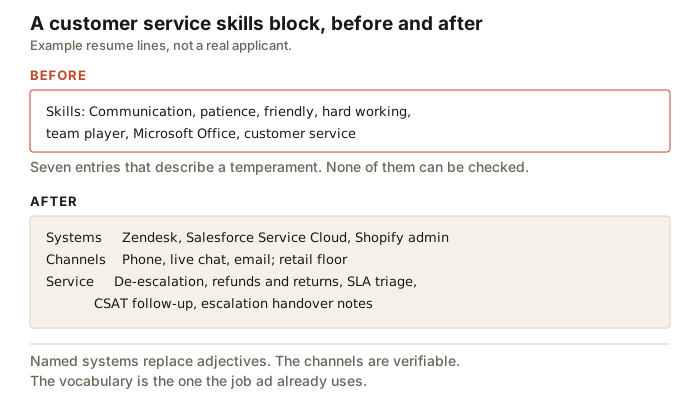
The customer service skills on a resume that count are the ones a reader can check: the systems you worked in, the channels you handled and the procedures you followed, not "friendly" and "patient". Zendesk, live chat, de-escalation, refunds and returns, SLA triage: those are skills. Everything else is temperament, and every applicant claims it.
This matters more in customer service than in almost any other field, because the applicant pool is large and the adjectives are identical across all of it. The resumes that get read are the ones where the first line of the skills block shows the person has actually sat in the seat. Below: what to list, the vocabulary of a real queue, skills lines for four kinds of job, and a section on customer service skills on a CV for UK jobs. Written by Mustafa Tarabya, who hired for his own company, read every application himself and now writes CVBooster's guides.
Which customer service skills belong on a resume?
Sort your candidates into three buckets before you write anything. Systems, which are the software and hardware you operated. Procedures, which are the named things you did inside those systems. And traits, which are how you were while doing it.
The first two go in the skills section. The third does not go in a list at all: it goes into your experience bullets, where it can bring evidence along with it. That distinction is the same one that governs every skills section, and the reasoning behind it is set out at soft skills.
The reason the distinction bites so hard here is the volume of the pool. In a field where nearly every application says "excellent communication skills, patient, works well under pressure", those words are not a claim any more. They are the background noise the reader is trying to see through. Everyone is a people person. The pile is wall to wall people persons.
Why do the named systems matter so much?
Because they are the only part of a customer service resume with a fact in it. Anyone can write that they are good with people. Only somebody who has worked a ticket queue writes "Zendesk macros and triggers", and the person reading knows that.
There is a practical reason too, which is what happens on the employer's side. A support team that runs on Salesforce Service Cloud has a real training cost for every hire who has never seen it, and a real saving on one who has. That saving is the thing your skills line is advertising. Naming the platform is you telling them how short your ramp-up will be.
- Ticketing and helpdesk: Zendesk, Freshdesk, Intercom, Jira Service Management, HubSpot Service Hub, ServiceNow.
- CRM: Salesforce Service Cloud, Microsoft Dynamics 365, HubSpot, Zoho.
- Telephony and contact centre: Genesys, Five9, Talkdesk, Avaya, Amazon Connect, RingCentral.
- Retail and point of sale: Shopify admin, Square, Lightspeed, Oracle Micros, plus the returns and stock modules you actually used.
- Hospitality: Opera PMS, Mews, Toast, OpenTable, ResDiary.
- Everything around the edges: Slack, Teams, Confluence or a named knowledge base, and the QA scorecard tool if there was one.
Tip: If you do not remember the platform's name, it is worth ten minutes to find out. Ask a former colleague, check an old email signature, or look at a screenshot in your phone's photo roll. A named platform is worth more on the page than three adjectives, and the name is a fact you already own.
The vocabulary that shows you have worked a queue
Every trade has words that are only used by people inside it. Using them correctly is a signal that does not need explaining, and using them incorrectly is a signal too, so only take the ones that describe what you genuinely did.
- First contact resolution: closing the case on the first interaction rather than passing it on.
- Escalation and tiering: knowing which cases you own and which go to a second line, and writing the handover note that makes the transfer useful.
- SLA triage: sorting a queue by the response time each case has been promised rather than by arrival order.
- CSAT follow-up: acting on the satisfaction score a customer left, not just receiving it.
- Macros, canned responses and templates: the reusable answers a helpdesk runs on, and the judgement about when not to use one.
- Knowledge base authoring: writing the article so the next person does not have to answer the question again.
- Ticket deflection: turning a repeated question into self-service documentation.
- Backlog and queue management: what you did on the morning after a spike.
- De-escalation: the named technique for bringing an angry conversation down, as distinct from being a calm person.
- Chargebacks, refunds, returns and goodwill: the money-touching procedures, which carry authority levels with them.
The follow-up question here is usually about scale: should you say how many contacts you handled? Yes, if you know the real figure and it is genuinely yours. A volume that came from a dashboard you looked at every day is a fact. A volume you are estimating upward because it sounds better is the kind of thing an interviewer asks a second question about.
Does the soft side disappear entirely?
No, it moves. Customer service is a field where how you behave genuinely is the job, so the evidence has to be on the page. It just cannot be on the page as a word.
Weak: "Excellent communication skills and a patient manner with difficult customers."
Rewritten: "Handled the complaints queue after a delivery failure week, taking the calls other agents had escalated and closing them without further escalation."
The second sentence contains the first one. It also contains a situation, a specific action and an outcome, which is the only structure that makes a behavioural claim believable in writing. The word "patient" never appears and does not need to.
Four kinds of customer service job, four different lists
"Customer service" covers jobs that share almost nothing operationally. Sending the same skills block to all of them is the most common reason a strong candidate reads as generic. Example lines follow for each.
Retail and the shop floor
What the ad is really asking about is till accuracy, stock, returns and how you behave in a queue of physical people. Example: "Systems: Shopify POS, Lightspeed, stock counts. Service: returns and exchanges to store policy, price matching, cash and card reconciliation at close, visual merchandising resets."
Contact centre and inbound phone
Here the ad is asking about handling a queue under measurement. Example: "Systems: Genesys Cloud, Salesforce Service Cloud. Service: inbound call handling, after-call work, SLA triage, escalation to second line with written handover, CSAT follow-up, QA scorecard reviews."
Technical and SaaS support
The ad is asking whether you can diagnose as well as reassure. Example: "Systems: Zendesk (macros, triggers, views), Jira Service Management, Intercom. Technical: log reading, browser console basics, SQL for account lookups, API error triage. Service: tier 1 to tier 2 escalation, knowledge base authoring, release note communication."
Hospitality and front desk
The ad is asking about bookings, money and recovery when something has gone wrong in a place the guest is standing. Example: "Systems: Opera PMS, OpenTable, Toast. Service: check-in and check-out, overbooking recovery, upselling to availability, allergen handling, complaint resolution at the desk, cash float management."
Read those four side by side and the point makes itself. They are all customer service and none of them would substitute for another. Pick the one that matches the ad in front of you and let the others go.
What if this is your first job?
Then you have less to list and more to describe, which is a workable trade. The skills section stays short and honest, and the weight moves to whatever you have actually done with people.
Volunteering counts, and so does a school or club role where you dealt with the public. Working a stall, running a sign-up desk, answering a society's inbox, taking bookings for a sports club, helping in a family business over the summer. Any of those puts you in front of a customer with a problem, which is the thing the employer is trying to find out about.
Weak: "No professional experience but I am a fast learner and very friendly."
Rewritten: "Ran the sign-up desk at the university sports fair: took payments, answered membership questions from a printed price list, and passed the disputes I could not settle to the club treasurer with a written note."
That names a channel, a procedure and an escalation path. It is a first-job line and it still reads as somebody who understands what the work is.
What if you are moving into customer service from somewhere else?
Look for the parts of your last job that were customer service without being called it. Care work is de-escalation and family communication. Teaching is explaining the same thing five different ways. Warehouse and logistics is chasing a problem across two systems until somebody gets their delivery. Administration is inbox triage.
Name those in the target field's vocabulary rather than your old one, and the transfer becomes obvious rather than something the reader has to work out. "Handled the ward's phone enquiries from families, including complaints" is a support skill written in care language; "complaint handling and de-escalation, phone channel" is the same fact written in the reader's language.
What you should not do is drop the old vocabulary entirely. The system names from your previous field are still evidence that you learn systems, which is a real part of the job.
What if your customer service experience is old?
Two years behind a till at nineteen is still relevant at thirty-five, and it is worth keeping, but it should not be presented as current. Leave it in the experience section with its real dates, and keep your skills line to the things you could do this week.
If you are returning to the field after a gap, name the platforms you know and be straight about their age rather than hoping nobody checks. A line such as "Systems: Zendesk (2019-2022), Salesforce Service Cloud" is more credible than an undated list, and it puts the question you would have been asked anyway on your own terms.
The gap itself is not a skills-section problem and should not be solved there. It belongs in the experience section or the cover letter, briefly and without apology.
Turning the skills into experience bullets
Every skill in the list should reappear below it, doing something. Three example pairs, weak first.
Weak: "Responsible for answering customer emails and phone calls." Rewritten: "Worked the shared inbox and the phone queue on the same shift, triaging by SLA so the overnight backlog cleared before the morning peak."
Weak: "Dealt with difficult customers." Rewritten: "Took the escalated calls for the team after a billing error, agreed goodwill credits inside my authority limit, and wrote the handover note for the cases that went to the account managers."
Weak: "Helped train new staff." Rewritten: "Wrote nine knowledge base articles for the questions we answered most often, and used them as the onboarding material for the two agents who joined after me."
In each pair the rewrite adds no new virtue. It adds the specifics that were always true and were simply left out, which is what most weak resume bullets actually are.
The entries to drop
- "Customer service" as a skill on a customer service resume. It is the job title, not a skill within it.
- "Friendly", "patient", "people person", "bubbly personality": unverifiable and universally claimed.
- "Microsoft Office" as a standalone entry, unless you mean a specific capability inside it.
- "Telephone skills" without the platform or the type of call.
- Star ratings and progress bars against tools, which have no units and may not survive being read as text.
- A platform you used once during a two-week trial, which will be the first thing you are asked about.
Customer service skills on a CV for UK jobs
The skills are the same on a UK CV; the words around them shift. The National Careers Service sets out what a customer service assistant could do day to day, starting with "answer customer questions by phone, email, webchat, social media or in person" and including "handle feedback and complaints". Read those two lines as a checklist: name every channel you have actually worked, then show how you handled the complaint that came through it.
The same service lists "active listening skills" and "the ability to accept criticism and work well under pressure" among the skills you'll need. Those belong in your bullets as evidence, not in the skills block as words, exactly as with a US resume, and our CV listening skills guide has six complete examples of that. Three UK skills lines to adapt:
- Contact centre: "Systems: Genesys Cloud, Salesforce Service Cloud. Service: inbound calls and webchat, complaint handling to resolution, call wrap up, escalation to second line with written notes."
- Retail and hospitality: "Systems: EPOS tills, handheld stock scanners, table booking system. Service: refunds and exchanges on the shop floor, Challenge 25 age checks, cashing up and till reconciliation."
- Utilities, telecoms and local services: "Service: account changes, payment arrangements, complaint logging against the company's own complaints procedure, call backs on open cases."
Use British spelling on a CV for a UK job: centre, organise, behaviour, judgement. In a role that is mostly written replies to customers, the spelling is part of the evidence.
Where do these skills take you next?
It is worth knowing, because it changes how you write the resume now. A support background reads directly into customer success, account management, sales development, quality assurance, community management, technical writing and operations.
The skills that carry across are the systems, the writing, and the escalation judgement, not the shift patterns. If you have any suspicion that the next move is out of the queue, start naming the knowledge base work, the process improvements and the training you did, because those are the entries the next employer is buying.
The check before you send it
- At least one named platform appears in the first line of the skills block.
- Nothing in the block is an adjective.
- The channels you handled are stated: phone, chat, email, social, in person.
- Every listed skill appears again in an experience bullet with a situation attached.
- The vocabulary matches this ad rather than the last four you applied to.
- Any number on the page is one you actually know, not one you rounded up.
Done properly, a customer service skills block stops looking like every other one in the pile within the first line, because it contains facts instead of qualities. For the wider method, how to pull the right skills out of a job ad, how to format the section and where to place it on the page, the main guide is at which skills to put on a resume, with the hard and soft halves of the list covered at hard skills and soft skills. The same skills carry a cabin crew cover letter, where one calm customer story matters more than any list.
Related articles
- Customer Service Resume: Metrics That Are Real
- Computer Skills on a Resume: 30 With the Line for Each Level
- Hard Skills for a Resume: How to List Them
- Skills to Put on a Resume (and What to Cut)
More articles
- CV Example No Experience: 6 Full UK CVs for a First Job
- CV Examples: What a Good One Shows You
- CV Examples No Work Experience: 6 UK CVs Written Out
Resume examples for this role
- Customer Service Representative Resume example
- Call Center Representative Resume example
- Remote Customer Service Representative Resume example
- Bank Customer Service Representative Resume example
- Help Desk Analyst Resume example
- Customer Success Manager Resume example
- All Customer Service resume examples
- All Retail resume examples