Civil Service Success Profiles: the Five Elements, Explained
By Mustafa Tarabya, founder of CVBooster · Published · Updated
12 min read
Civil Service Success Profiles has five elements, and the advert tells you which ones your application will be assessed on. That is the constraint that decides everything: gov.uk states plainly that "Not all of the elements are relevant to every role".
The definitions below are quoted from the Success Profiles pages on gov.uk, element by element. One worked application follows for each element. A full 250-word behaviour statement, a strengths answer, an ability question walked through, a set of experience bullets and a technical statement. Then how the sift and interview are scored.
Written by Mustafa Tarabya, who hired for his own company, read every application himself and now writes CVBooster's guides.
The five elements, in gov.uk's own words
gov.uk defines a Success Profile as being "made up of 5 elements":
- behaviours - "the actions and activities that people do which result in effective performance in a job"
- strengths - "the things we do regularly, do well and that motivate us"
- ability - "the aptitude or potential to perform to the required standard"
- experience - "the knowledge or mastery of an activity or subject gained through involvement in or exposure to it"
- technical - "the demonstration of specific professional skills, knowledge or qualifications"
The guidance adds: "You should read the job description carefully to see what elements are required for the specific job you are applying for."
Tip: the advert is the contract. If it lists three behaviours and no technical element, writing a technical statement earns nothing and costs you time.
Behaviours
Definition: "the actions and activities that people do which result in effective performance in a job."
Behaviours are the element almost every advert uses, at every grade from AA to Director General. There are nine of them, and the indicator wording changes by grade band. gov.uk groups AA with AO, HEO with SEO, and Grade 6 with Grade 7.
They are assessed at sift, at interview, and sometimes through a situational judgement test or a structured behavioural assessment. The usual sift format is a written statement per behaviour, most often capped at 250 words.
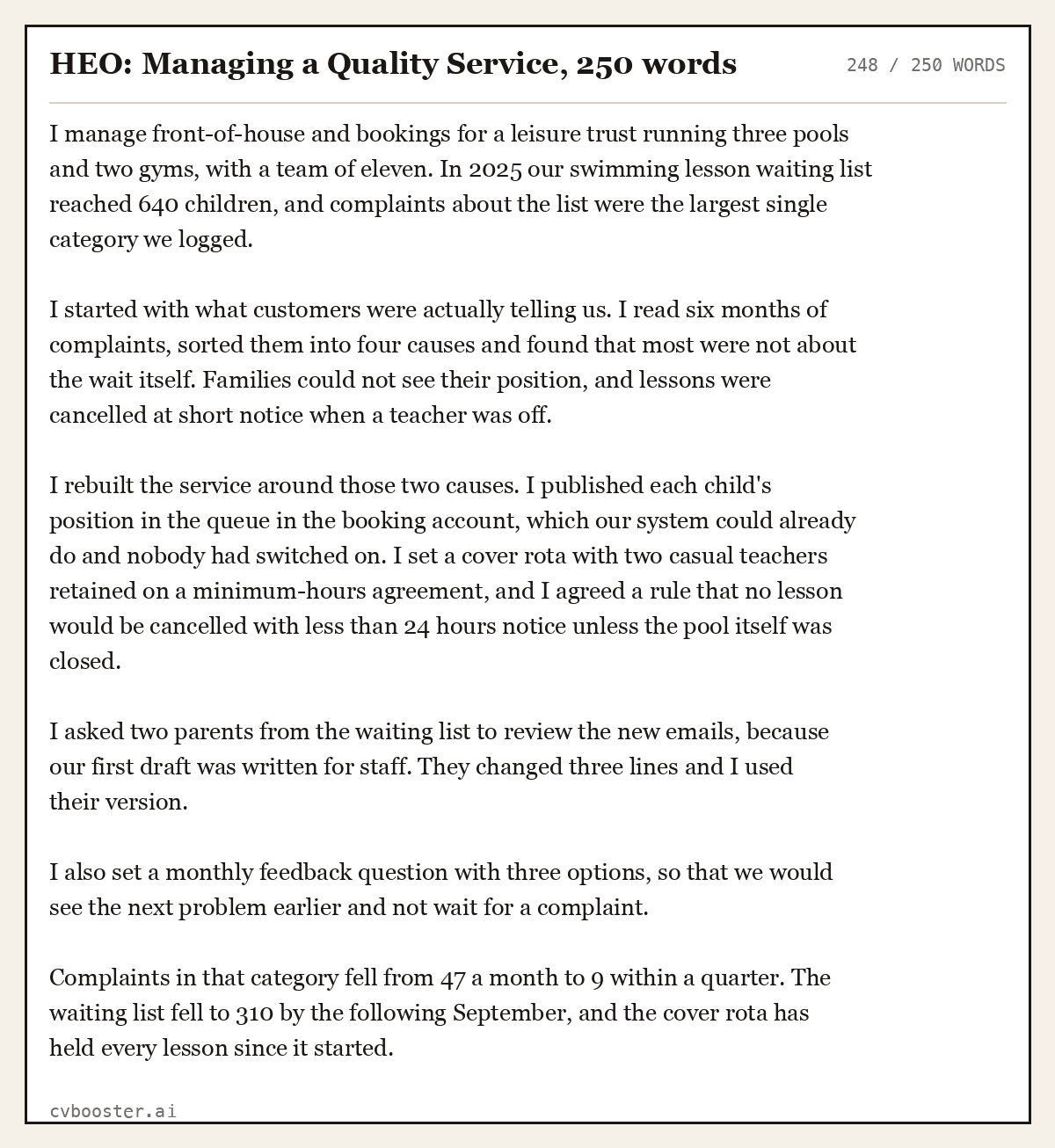
HEO: Managing a Quality Service, 250 words (248 words)
I manage front-of-house and bookings for a leisure trust running three pools and two gyms, with a team of eleven. In 2025 our swimming lesson waiting list reached 640 children, and complaints about the list were the largest single category we logged.
I started with what customers were actually telling us. I read six months of complaints, sorted them into four causes and found that most were not about the wait itself. Families could not see their position, and lessons were cancelled at short notice when a teacher was off.
I rebuilt the service around those two causes. I published each child's position in the queue in the booking account, which our system could already do and nobody had switched on. I set a cover rota with two casual teachers retained on a minimum-hours agreement, and I agreed a rule that no lesson would be cancelled with less than 24 hours notice unless the pool itself was closed.
I asked two parents from the waiting list to review the new emails, because our first draft was written for staff. They changed three lines and I used their version.
I also set a monthly feedback question with three options, so that we would see the next problem earlier and not wait for a complaint.
Complaints in that category fell from 47 a month to 9 within a quarter. The waiting list fell to 310 by the following September, and the cover rota has held every lesson since it started.
What the sifter is scoring
- Indicator quoted: "establish ways to find and respond to feedback from customers about the services provided" (gov.uk, HEO/SEO). Shown by: the complaint analysis and the monthly feedback question.
- Indicator quoted: "develop, implement, maintain and review systems and services to ensure delivery of professional excellence" (gov.uk, HEO/SEO). Shown by: queue visibility switched on, and a retained cover rota with a notice rule.
- Indicator quoted: "involve a diverse range of colleagues, stakeholders and delivery partners in developing suggestions for improvements" (gov.uk, HEO/SEO). Shown by: two waiting list parents reviewing the customer emails.
Strengths
Definition: "the things we do regularly, do well and that motivate us."
gov.uk states that "Civil Service strengths are not defined by job grade", and that three things decide whether something counts: "Performance", "Engagement" and "Use". Strengths are assessed at interview, in recorded video interviews, in a "bespoke situational strengths test", in simulations and in personality tests.
The guidance is explicit about preparation. gov.uk says "It is important to remember that there are no right or wrong answers to these questions". It adds: "Do not rehearse your answers - because we are looking for your initial response."
Strengths questions sound like "What do you enjoy doing most?" or "What comes easily to you?" Answer with a real pattern, not a claim.
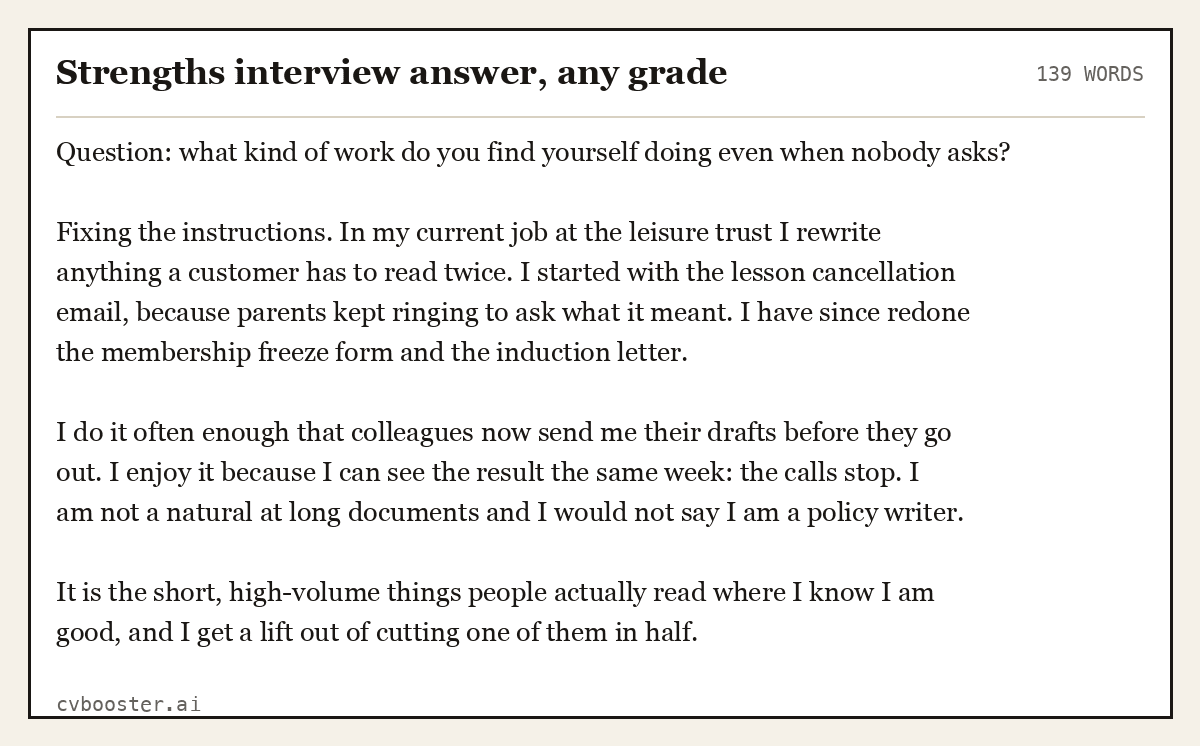
Strengths interview answer, any grade (139 words)
Question: what kind of work do you find yourself doing even when nobody asks?
Fixing the instructions. In my current job at the leisure trust I rewrite anything a customer has to read twice. I started with the lesson cancellation email, because parents kept ringing to ask what it meant. I have since redone the membership freeze form and the induction letter.
I do it often enough that colleagues now send me their drafts before they go out. I enjoy it because I can see the result the same week: the calls stop. I am not a natural at long documents and I would not say I am a policy writer.
It is the short, high-volume things people actually read where I know I am good, and I get a lift out of cutting one of them in half.
Ability
Definition: "the aptitude or potential to perform to the required standard."
gov.uk says ability is assessed with psychometric tests, "often in an online internet-based format". The two most common are a "verbal reasoning test - to assess your verbal capabilities" and a "numerical reasoning test - to assess your numerical capabilities". These tests usually come first, and "The tests are scored automatically."
Scoring is by percentile. The gov.uk online tests guidance explains it. "Your test score is calculated from your responses, which we compare with the results of a peer group who took the same test - this creates a percentile."
That page (https://www.gov.uk/guidance/civil-service-online-tests) continues. "For example, if you score at the 44th percentile, it means you scored better than 44% of the comparison group."
It also warns that "Meeting the minimum required percentile is no guarantee of an invitation to continue the selection process."
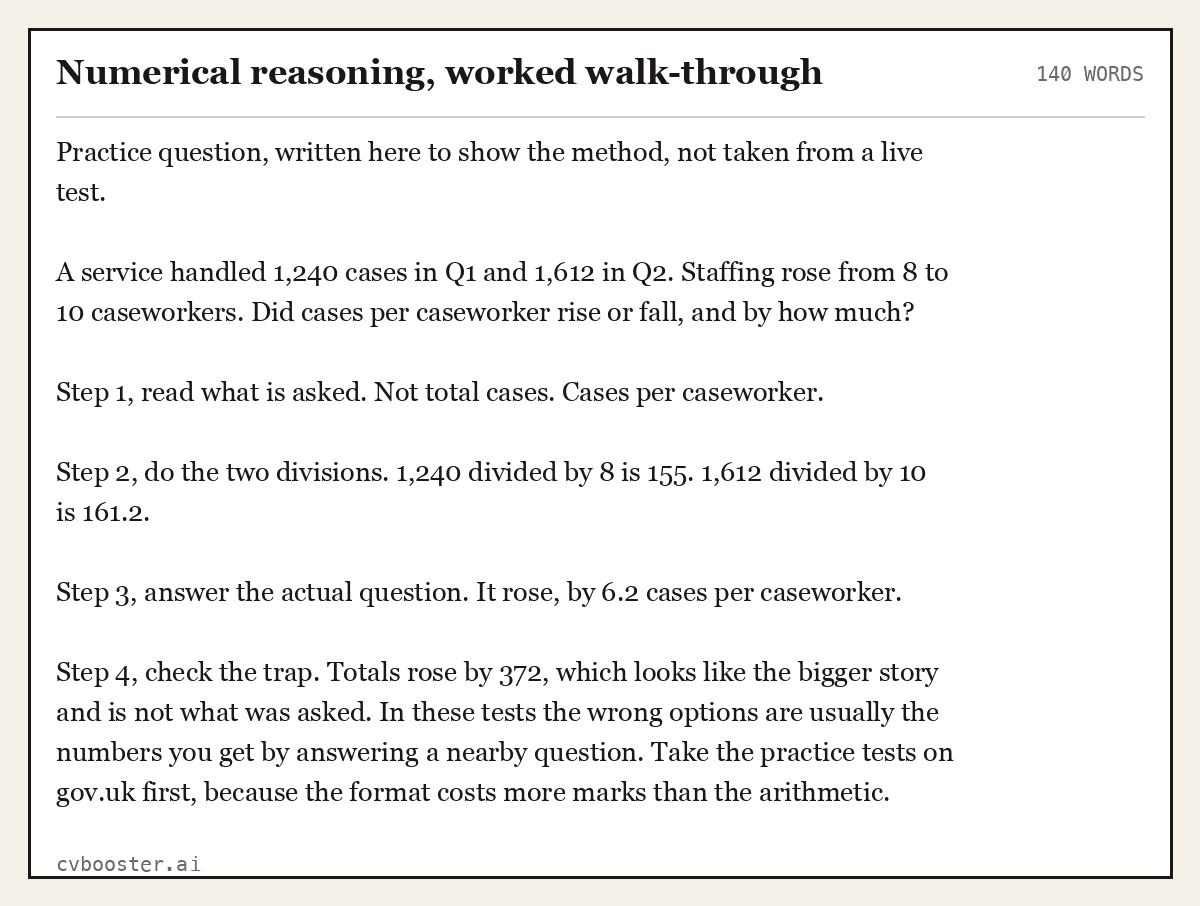
Numerical reasoning, worked walk-through (140 words)
Practice question, written here to show the method, not taken from a live test.
A service handled 1,240 cases in Q1 and 1,612 in Q2. Staffing rose from 8 to 10 caseworkers. Did cases per caseworker rise or fall, and by how much?
Step 1, read what is asked. Not total cases. Cases per caseworker.
Step 2, do the two divisions. 1,240 divided by 8 is 155. 1,612 divided by 10 is 161.2.
Step 3, answer the actual question. It rose, by 6.2 cases per caseworker.
Step 4, check the trap. Totals rose by 372, which looks like the bigger story and is not what was asked. In these tests the wrong options are usually the numbers you get by answering a nearby question. Take the practice tests on gov.uk first, because the format costs more marks than the arithmetic.
Experience
Definition: "the knowledge or mastery of an activity or subject gained through involvement in or exposure to it."
gov.uk says experience is most often used for "senior roles" and "roles in the Civil Service Professions". It is assessed through an application form, a CV or an interview. The guidance is specific about what is judged: "How you performed in a particular field - not how long you served."
It also accepts evidence from outside paid work: "Skills gained through voluntary work or a hobby can show the experience you may need for a role."
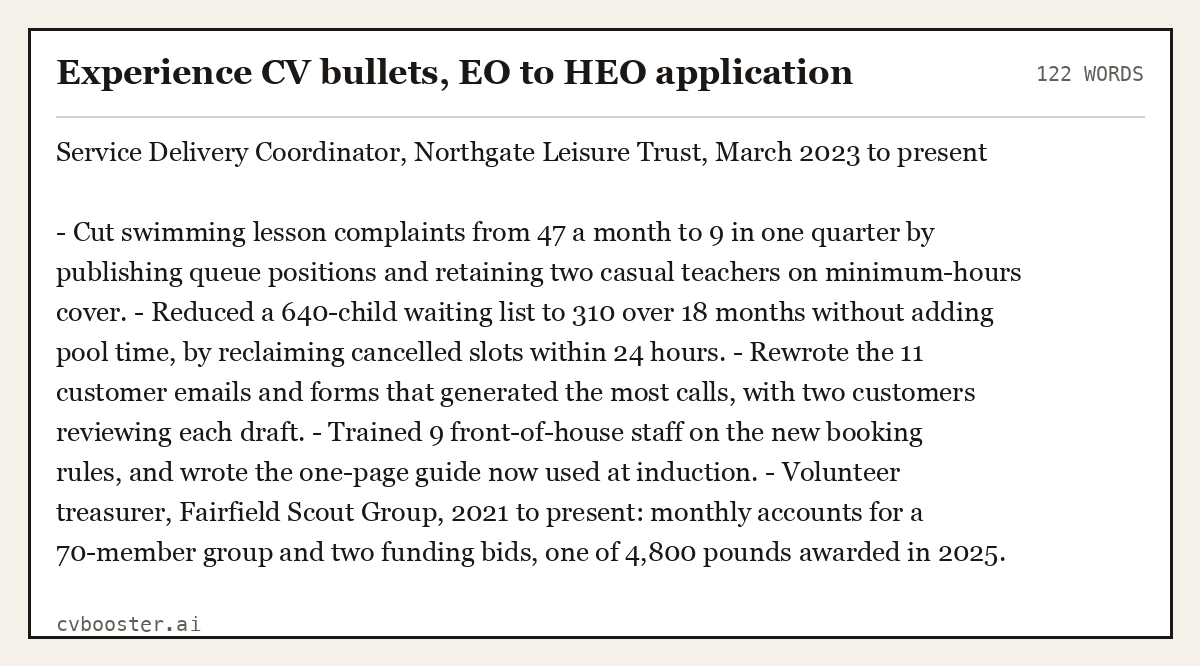
Experience CV bullets, EO to HEO application (122 words)
Service Delivery Coordinator, Northgate Leisure Trust, March 2023 to present
- Cut swimming lesson complaints from 47 a month to 9 in one quarter by publishing queue positions and retaining two casual teachers on minimum-hours cover. - Reduced a 640-child waiting list to 310 over 18 months without adding pool time, by reclaiming cancelled slots within 24 hours. - Rewrote the 11 customer emails and forms that generated the most calls, with two customers reviewing each draft. - Trained 9 front-of-house staff on the new booking rules, and wrote the one-page guide now used at induction. - Volunteer treasurer, Fairfield Scout Group, 2021 to present: monthly accounts for a 70-member group and two funding bids, one of 4,800 pounds awarded in 2025.
Technical
Definition: "the demonstration of specific professional skills, knowledge or qualifications."
gov.uk notes there are "more than 20 professions in the Civil Service". It adds that "The head of each Profession defines the specific skills, knowledge and qualifications we may ask you to demonstrate". Assessment can be an application form, a CV or an interview. It can also be a technical test, a presentation, a work sample, an in-tray exercise or an assessment centre.
If the advert names a qualification or professional body membership, expect to evidence it: "we may ask you to provide evidence of your qualification(s) or membership."
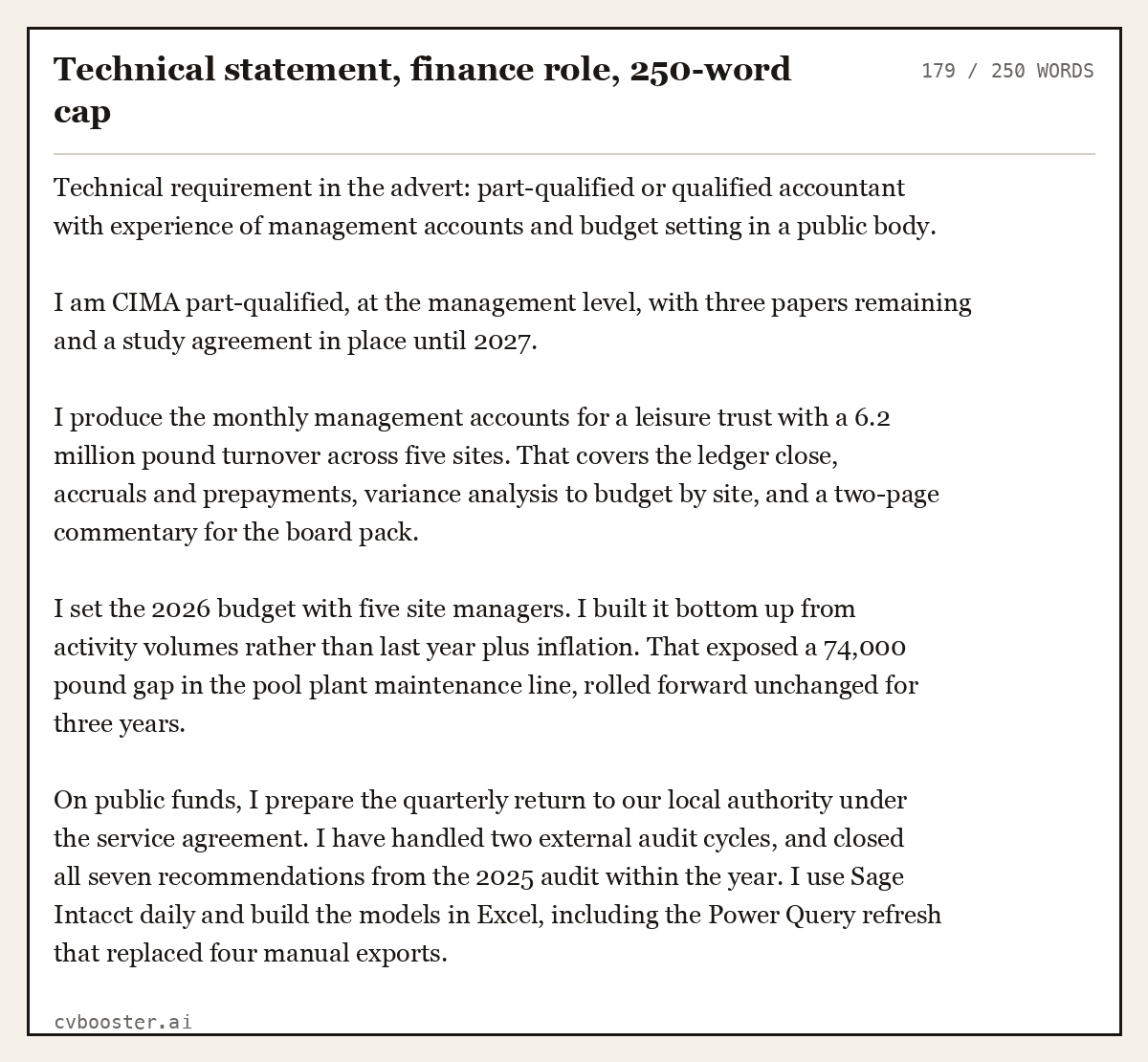
Technical statement, finance role, 250-word cap (179 words)
Technical requirement in the advert: part-qualified or qualified accountant with experience of management accounts and budget setting in a public body.
I am CIMA part-qualified, at the management level, with three papers remaining and a study agreement in place until 2027.
I produce the monthly management accounts for a leisure trust with a 6.2 million pound turnover across five sites. That covers the ledger close, accruals and prepayments, variance analysis to budget by site, and a two-page commentary for the board pack.
I set the 2026 budget with five site managers. I built it bottom up from activity volumes rather than last year plus inflation. That exposed a 74,000 pound gap in the pool plant maintenance line, rolled forward unchanged for three years.
On public funds, I prepare the quarterly return to our local authority under the service agreement. I have handled two external audit cycles, and closed all seven recommendations from the 2025 audit within the year. I use Sage Intacct daily and build the models in Excel, including the Power Query refresh that replaced four manual exports.
How a sift and interview are scored
Every element in the advert is scored separately, and the scores decide the order of appointment. civil-service-careers.gov.uk describes the sift: "The selection panel assesses each application against the advertised criteria and the highest scoring applicants that meet the minimum criteria will be invited to interview."
gov.uk does not publish the numeric scale itself. Departments do. The Crown Office and Procurator Fiscal Service publishes the full version: "Applications are scored using the 7 point scale noted below."
| Point | What COPFS calls it and how it is described |
|---|---|
| 1 | "Not Demonstrated": no positive evidence, or substantial negative evidence |
| 2 | "Minimal Demonstration": limited positive evidence, or mainly negative evidence |
| 3 | "Moderate Demonstration": moderate positive evidence, but some negative evidence |
| 4 | "Acceptable Demonstration": adequate positive evidence, with nothing that causes concern |
| 5 | "Good Demonstration": substantial positive evidence of the behaviour |
| 6 | "Strong Demonstration": substantial evidence, including some of exceeding expectations |
| 7 | "Outstanding Demonstration": evidence that "wholly exceeds expectation at this level" |
The same page states that at interview, "Behaviours, experience and technical skills are scored on the same 1-7 rating scale used at Sift".
A panel may also set a benchmark. The published example: "Candidates must score a 5 on the lead behaviours noted in the pack or an overall score of 20 must be scored across the 4 behaviours."
Two consequences worth planning for:
- A 4 is a pass, not a place. In a busy campaign the appointments go down the merit order from the top.
- Scores are per element. A brilliant behaviour statement does not rescue a weak one, so spread your effort evenly across the elements the advert lists.
Before you apply
- List the elements named in the advert, then write only to those.
- Note the grade and the word limit next to each behaviour.
- Book the practice tests on gov.uk before the live one if ability is listed.
- For strengths, do not script an answer. Prepare the material, not the wording.
- For technical, hold your qualification evidence ready in the format the advert asks for.
- Ask for a reasonable adjustment at the point you apply. gov.uk names examples including "allowing more time for a test or interview".
- Check every statement against the indicators for your grade in the behaviours framework guide.
If the advert lists behaviours, take the grade wording from the behaviours framework guide and then borrow a shape from a full-length example: Working Together, Seeing the Big Picture, Making Effective Decisions, Managing a Quality Service, Delivering at Pace or Communicating and Influencing.
A sample of all nine sits on the statement hub. If your campaign opens with an online test, the judgement test examples walk through the reasoning option by option.
Frequently asked questions
Which Success Profiles elements will my advert use?
Only the ones the job advert names, and it will name them. gov.uk is explicit that "Not all of the elements are relevant to every role, and will vary depending on the profession, level and type of role". Most campaigns use behaviours plus one other element. Senior and professional roles are the ones most likely to add experience or technical.
What is the difference between behaviours and strengths?
Behaviours are what you did, scored against grade wording you can read in advance. Strengths are what you enjoy and do often, and gov.uk says they "are not defined by job grade". Behaviour answers should be prepared in detail. Strengths answers should not be scripted, because the panel is listening for your initial response.
Can I prepare for the ability tests?
Yes, and gov.uk publishes the material itself. The online tests guidance carries practice tests for the numerical, verbal and judgement tests, plus detailed test guidance and videos. Sit the matching practice test before the live one. Format, not arithmetic, is what costs most people their marks.
What counts as experience for a Civil Service application?
Achievement and depth, not length of service. gov.uk says it is looking at "How you performed in a particular field - not how long you served", and accepts evidence from outside employment: "Skills gained through voluntary work or a hobby can show the experience you may need for a role." Write it as achievements with numbers, not as a duty list.
Is a score of 4 enough to get the job?
It is enough to be appointable, not enough to be appointed. Roles go to the highest scoring candidate first, and a panel can set a higher benchmark for lead elements in the candidate pack. Treat 4 as the floor, spread your effort across every element the advert lists, and expect a reserve list place if you sit on the floor.
Do I have to ask for reasonable adjustments in advance?
Ask when you submit the application. gov.uk says to "tell us when you submit your application that you need an adjustment and how it will help", and gives examples including documents in large print or braille, more time for a test or interview, and assistance at an assessment centre. Adjustments apply to tests as well as interviews.
More in this series: Civil Service applications
- Civil Service Behaviours Framework: All 9, Level by Level
- Civil Service Behaviours: 9 Examples, One Per Behaviour
- Civil Service Judgement Test: 8 Questions and Answers
- Communicating and Influencing: 4 Civil Service Examples
- Delivering at Pace: 4 Civil Service Examples, EO to G7
- Making Effective Decisions: 4 Civil Service Examples
- Managing a Quality Service: 4 Worked Examples, EO to G7
- Seeing the Big Picture Civil Service Example: AO to G7
- Working Together Civil Service Example: AO to Grade 7
Related articles
- Changing and Improving Civil Service Example: AO to G7
- Civil Service Behaviours Framework: All 9, Level by Level
- Civil Service Judgement Test: 8 Questions and Answers
- Communicating and Influencing: 4 Civil Service Examples
More articles
- Clearances on an Australian Resume: WWCC, Police, Visa
- Clerical Officer Competency Examples: 6 Full Answers
- Interview Questions and Answers: the 20 You Will Be Asked
Looking for a worked example for your job title? Browse the resume examples by job title.