Customer Service Resume: Metrics That Are Real
By Mustafa Tarabya, founder of CVBooster · Published · Updated
12 min read
Use the numbers your helpdesk actually reports — ticket or call volume, first contact resolution, CSAT, backlog, handle time — and drop the ones you invented to sound impressive. Then name your tools, and show one moment of escalation judgement. That is the whole difference between a support resume that reads as real and one that reads as filler.
Support is one of the few jobs where genuine measurement is everywhere. Almost everything you did was logged by a system that produced a dashboard. So a vague customer service resume is a strange thing: the evidence existed, and you did not use it.
Which support metrics are real?
The real ones are the ones your platform computed and your team looked at in a weekly meeting. You can recognise them because you could say where the number came from without hesitating.
- Volume: tickets, calls, chats or emails per day, week or month — and how many channels you covered at once
- First contact resolution: the share of contacts closed without a second touch or a hand-off
- CSAT: the post-contact satisfaction score, with the scale it was measured on
- Average handle time or average response time, and which one your team was actually held to
- Backlog and queue: what the queue looked like when you inherited it and what it looked like later
- Escalation rate: how much you passed upward, which is a quality signal in both directions
- Quality assurance scores, if your team ran call or ticket audits
- Coverage facts: languages, shift patterns, out-of-hours or weekend rotas, and how many products you supported
Write the number with the unit and the period attached. "Handled 1,200 tickets a month" is checkable. "High volume" is not, and "high volume" is the phrase on almost every other resume in the pile.
Which metrics are invented?
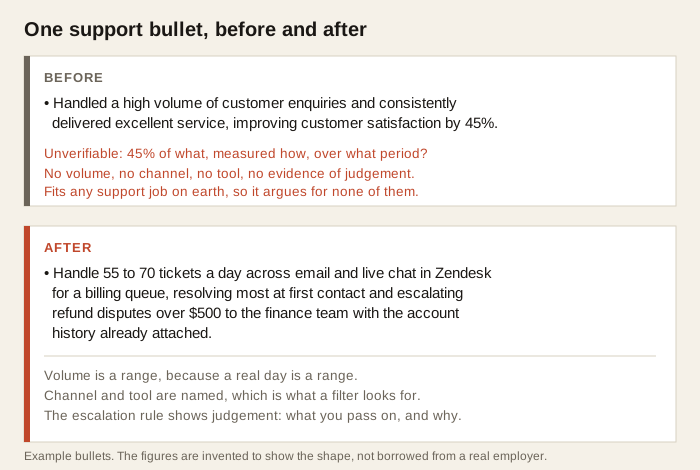
The invented ones share a shape: a big percentage improvement, attached to an outcome one agent does not control, with no baseline and no timeframe. "Increased customer satisfaction by 45%" is the classic. Forty-five per cent of what, from what starting point, over how long, and how do you know it was you?
- Percentage lifts with no before-number and no period attached
- Revenue or retention figures for a whole company credited to one agent
- "Reduced churn by 30%" from a role with no access to churn data
- Round, memorable numbers that appear on many resumes: 99%, 100%, exactly 50%
- Team results written in the first person singular
The fix is not to remove the achievement. It is to describe your part in it. If the team's CSAT rose after a macro library was rebuilt and you wrote the macros, say that: you wrote the macros, the team's CSAT rose. That version survives the interview question, and the interview question is coming.
How do you name the tools?
By their product names, spelled the way the vendor spells them, and grouped so a reader can see what kind of support environment you came from. "Ticketing systems" matches nothing; "Zendesk" matches a search.
- Helpdesk and ticketing: Zendesk, Freshdesk, Salesforce Service Cloud, Intercom, HubSpot Service Hub, Jira Service Management, ServiceNow, Gorgias, Front
- Telephony and contact centre: Genesys, Five9, Talkdesk, Amazon Connect, RingCentral, Aircall
- Live chat and messaging: Intercom, LiveChat, Drift, WhatsApp Business, in-app chat widgets
- Knowledge base and self-serve: Confluence, Guru, Zendesk Guide, Notion
- Order, billing and account systems: Shopify, Stripe, NetSuite, SAP, whatever back office you actually opened every day
- Workforce and quality: Assembled, Playvox, Klaus, or whatever your team used for scheduling and QA
Add what you did inside the tool where it is a real skill: built macros and triggers, designed the ticket taxonomy, set up routing rules, wrote the knowledge base articles, built the reporting views. Configuring Zendesk is a different job from answering tickets in it, and a hiring manager wants to know which one you have done.
Tip: If the posting names a platform you have not used, do not pretend. Name the closest one you know and say what transfers: queues, macros, SLAs and routing behave similarly across most helpdesks, and saying that out loud reads as competence rather than a gap.
How do you show escalation judgement?
By writing the rule you followed, not the adjective you would like to be described by. Escalation judgement is the single hardest thing to hire for in support, and almost nobody puts it on their resume, which makes it the cheapest way to stand out.
A good escalation line has three parts: the trigger, where it went, and what you sent with it. "Escalated when needed" has none of them. "Escalated suspected data-loss reports to engineering within the hour, with reproduction steps and the affected account IDs attached" has all three, and it tells a manager exactly how much supervision you will need.
- Name a real trigger: a dollar threshold, a suspected security or privacy issue, a legal or regulator mention, a repeat contact, a safeguarding concern, a bug you could reproduce
- Name where it went: tier two, engineering, finance, the account manager, a duty manager
- Name what you attached: reproduction steps, account history, the timeline, the customer's exact words
- Say what you did not escalate, if you were trusted with a refund limit or a goodwill budget — that authority is worth stating
What does a strong customer service resume look like?
Everything below is an invented example. The company, the products and every number are fictional, and they are here to show the shape of a good entry rather than to be copied.
Example summary: "Support specialist with four years in subscription software, currently handling 55 to 70 email and chat tickets a day on a billing queue in Zendesk. Own the refund and dunning macro set, hold a $500 goodwill limit, and run the weekly quality review for a team of six. Comfortable as the first responder on out-of-hours rota."
Example experience heading: "Customer Support Specialist — Marlow Software, Remote (UK hours). June 2023 to present. Billing and account queue for a B2B subscription product, roughly 9,000 tickets a month across a team of six."
- Example bullet: "Handle 55 to 70 tickets a day across email and live chat in Zendesk, resolving the majority at first contact and keeping the billing queue under a four-hour first response through the working day."
- Example bullet: "Escalate refund disputes above $500 and any suspected duplicate-charge incident to finance within the hour, with the account timeline and the customer's own wording attached so they do not have to ask twice."
- Example bullet: "Rewrote 40 billing macros and the dunning email templates after auditing a quarter of closed tickets; the team's reopen rate on billing tickets fell over the following two months."
- Example bullet: "Run the weekly quality review for six agents: sample five tickets each, score against the team rubric, and give written feedback in a 30-minute session."
Read the third bullet again. It credits the team result to the team while making perfectly clear who did the work. That is the honest version of a metric claim, and it is stronger than a fabricated percentage because a hiring manager can ask about it and get a real answer.
How is a call centre resume different from an email support one?
The measurements change and so does the pressure. Phone work lives on handle time, adherence to schedule, occupancy and call quality scoring. Email and chat work lives on tickets per day, concurrency, first response time and written tone. When you are applying to lead the team rather than join it, use the supervisor resume examples, which include a contact center supervisor. If the role is front desk work, the receptionist job descriptions for a resume turn calls, visitors and calendars into bullets with numbers. For hotels and restaurants, the hospitality resume examples cover the front desk, the dining room and the kitchen.
- Phone: calls per shift, average handle time, adherence, QA score, whether you took escalation calls
- Chat: how many concurrent conversations you held, which is a real skill and a real number
- Email: tickets per day, first response time, and whether you wrote the templates other people used
- In-person or retail support: footfall, returns handled, till or POS system, safeguarding or security procedures
- Technical support: the product depth, the tier, and whether you wrote bug reports engineers could act on
Whichever it is, say which channel mix you covered. "Omnichannel" is a word from a vendor brochure; "phone and chat, roughly 60/40" is a description of your day.
More weak bullets, and the rewrites
One before-and-after is never enough, because the vague sentences come in several distinct flavours. All of these pairs are invented examples.
Weak: "Resolved customer issues in a timely and professional manner." Rewritten: "Own the billing queue on early shift: 40 to 55 tickets a day, first response inside two hours, with refunds up to $500 issued without escalation."
The weak version is a description of the job's minimum standard. The rewrite tells a manager your volume, your queue, your response commitment and the authority you were trusted with.
Weak: "Achieved a 98% customer satisfaction rating." Rewritten: "Held CSAT between 92 and 95 on a five-point post-chat survey across roughly 900 rated conversations last year, against a team target of 90."
A single flawless number invites suspicion. A range, a scale, a sample size and a target invite a conversation, and the conversation is the thing you want.
Weak: "Reduced ticket backlog and improved team efficiency." Rewritten: "Cleared a 1,400-ticket billing backlog over six weeks by triaging into four categories, writing macros for the two largest, and running a Friday clear-down with two colleagues."
Rewrites like this work because they explain the method. Anyone can claim a backlog was cleared; describing how it was cleared is what proves you were the one who cleared it.
Weak: "Excellent communication skills, both written and verbal." Rewritten: "Write the customer-facing incident updates during outages, published every 30 minutes to the status page and repeated as a macro reply in the queue."
Communication is the one claim every support resume makes and none of them evidence. Replace the adjective with the artefact you produced.
The rest of the worked example: skills and coverage
Continuing the invented example from earlier — same fictional company, same fictional person — here are the blocks that usually get skipped.
Example skills block: "Helpdesk — Zendesk (macros, triggers, views, Explore reporting), Intercom, Jira Service Management. Telephony — Aircall, escalation call handling. Back office — Stripe refunds and disputes, NetSuite invoices, Shopify orders. Quality — Klaus ticket scoring, weekly review sessions. Languages — English (native), Portuguese (professional working)."
Example coverage line, sitting directly under the summary: "Channels: email and live chat, roughly 60/40. Shifts: 07:00 to 15:30 UK, plus one weekend in four and out-of-hours first responder on a rota. Products supported: billing, subscriptions, invoicing."
That coverage line takes two lines of a page and answers most of what a support manager would otherwise use a screening call to find out. It is the highest-value real estate on a customer service resume and almost nobody uses it.
How does the resume change across support roles?
"Customer service" covers a dozen jobs that share a name and very little else. Write for the one in the posting. If the posting is a bank branch, our bank teller responsibilities for resume page turns cash handling and service into teller bullets.
- Phone agent: calls per shift, average handle time, adherence, QA score, whether you took escalation or retention calls, and how you handled abusive callers.
- Chat agent: concurrency is the headline number — how many conversations you held at once and at what quality — plus typing throughput and macro use.
- Email and ticket agent: tickets per day, first response and resolution times, and whether you wrote the templates other agents used.
- Technical support: the product depth, the tier, the diagnostic steps you ran, and whether engineering could act on your bug reports without asking follow-ups.
- Escalations or tier two: what arrives on your desk, your resolution authority, and how you close the loop with the original agent.
- Team lead or supervisor: headcount, rota ownership, QA sampling, coaching cadence, hiring and onboarding, and which reports you owned.
- Retail or in-person service: footfall, returns and exchanges, POS system, cash handling, and any safeguarding or security procedures.
- Customer success crossover: renewals or accounts you touched, but be careful not to claim revenue outcomes you did not own.
Tip: If you are moving from phone to chat or from B2C to B2B, say so directly in the summary and name what transfers. The skills genuinely do transfer, but the reader will not do that translation work for you.
What does support hiring actually look like?
Support is one of the most heavily tested hiring processes there is, because the work is easy to simulate. Knowing the sequence tells you what your resume needs to set up.
- A high-volume application stage, often with knockout questions on shift availability, language and location. Your coverage line answers these before they are asked.
- A recruiter screen about channels, volume, tools and shift pattern — all facts your resume should already contain.
- A written exercise: reply to two or three sample tickets, usually including one angry customer and one where the correct answer is no.
- For phone roles, a call simulation or role play, scored on tone, control of the call and whether you followed a process.
- A hiring manager interview that leans hard on judgement: what you escalated, what you refused, and a time you got it wrong.
- Sometimes a tools test, especially where the team runs a specific helpdesk you claimed on the page.
Every one of those stages is easier if your resume was honest. If you claimed a tool you have not used, the tools test finds it; if you claimed a fabricated CSAT lift, the manager interview finds it. Writing the true version is not just an ethical position, it is the version that survives the process.
The check before you send it
- Every number has a unit and a period attached
- No company-level outcome is written as your personal result
- Your helpdesk, telephony and back-office systems are all named
- One bullet states an escalation trigger and what you sent with it
- Your channel mix and shift pattern are visible
- You could explain where any figure on the page came from
For a starting layout with a sample summary, a skills list and role-specific tips, see our customer service resume page at /resume/customer-service. Use it for the structure, and use this guide for the parts that decide whether anyone believes it.
Related articles
- Customer Service Skills on a Resume: What to List and Prove
- Accounting Executive Resume: 5 Examples by Career Level
- Administration Resume Examples: 8 Samples, Entry to Manager
- Aged Care Resume: 6 Australian Examples and a Template