Biomedical Engineer Resume Examples: what gets the call
Engineer a Biomedical Resume That Stands Out in MedTech
By Mustafa Tarabya, founder of CVBooster · Published · Updated
Build a biomedical engineer resume highlighting medical device design, regulatory knowledge, and clinical collaboration with industry-standard formatting.
Sample resumes for a biomedical engineer
The same biomedical engineer content laid out in three CVBooster templates, so you can see what the finished document looks like before you write a word.
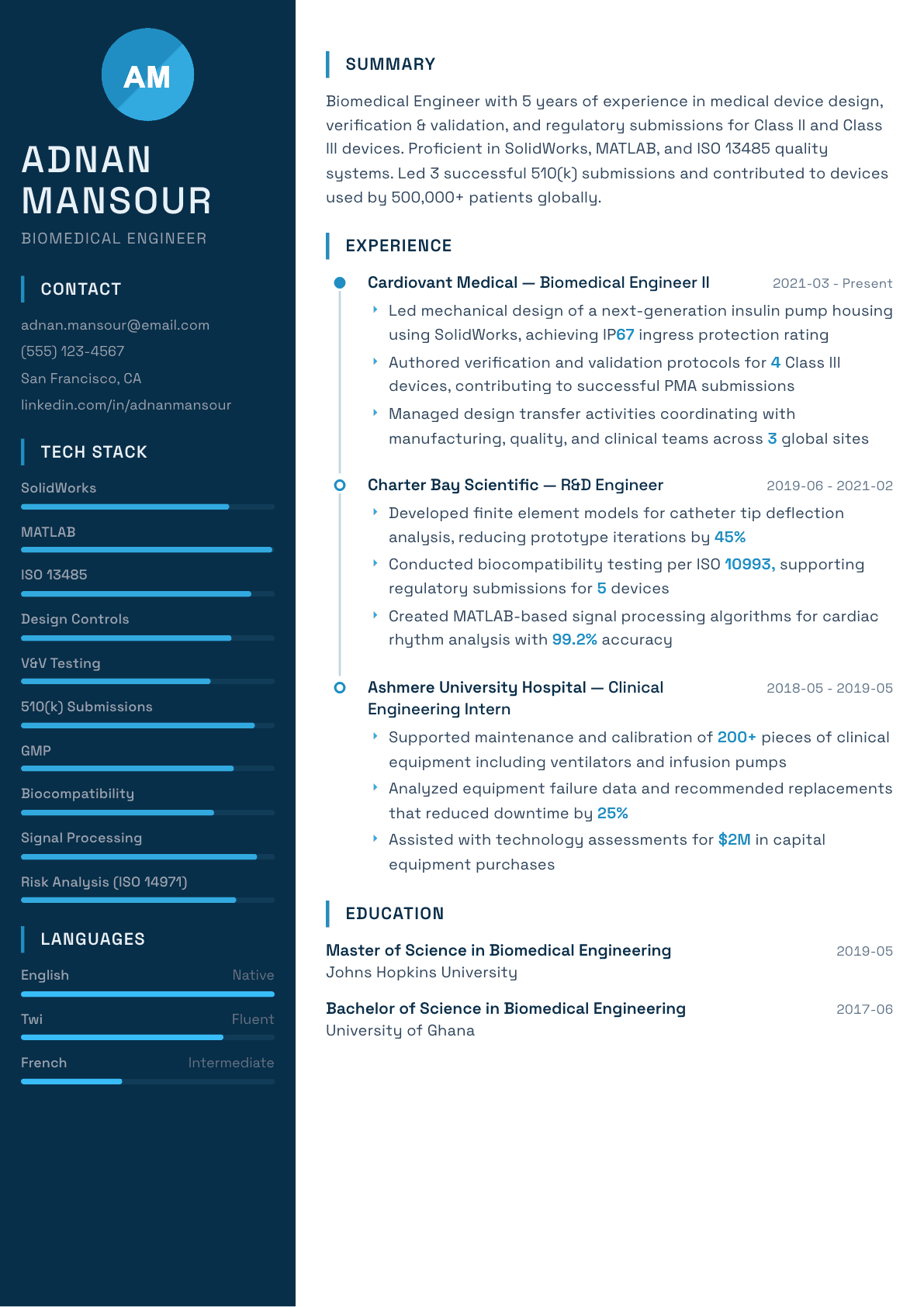
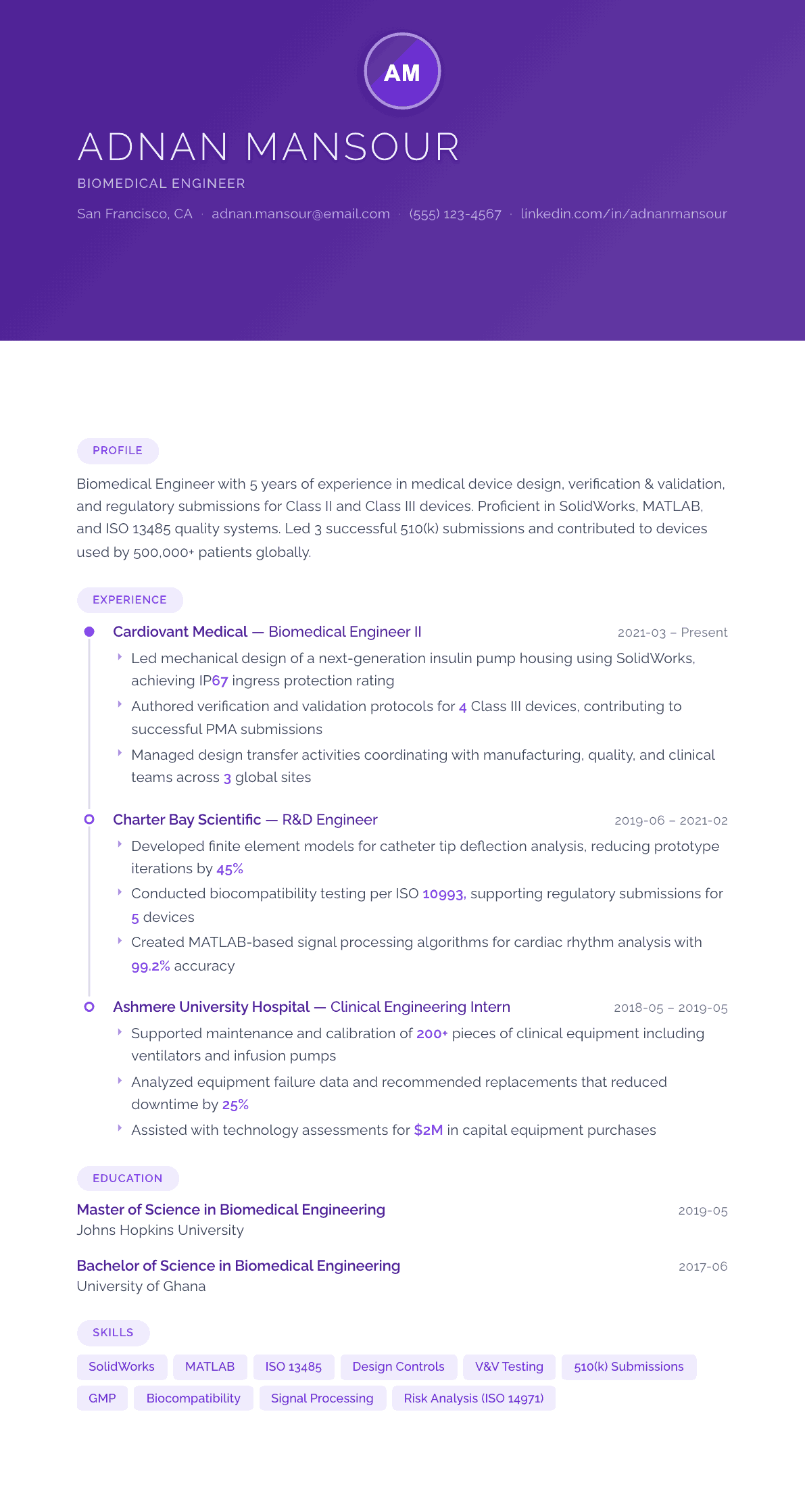
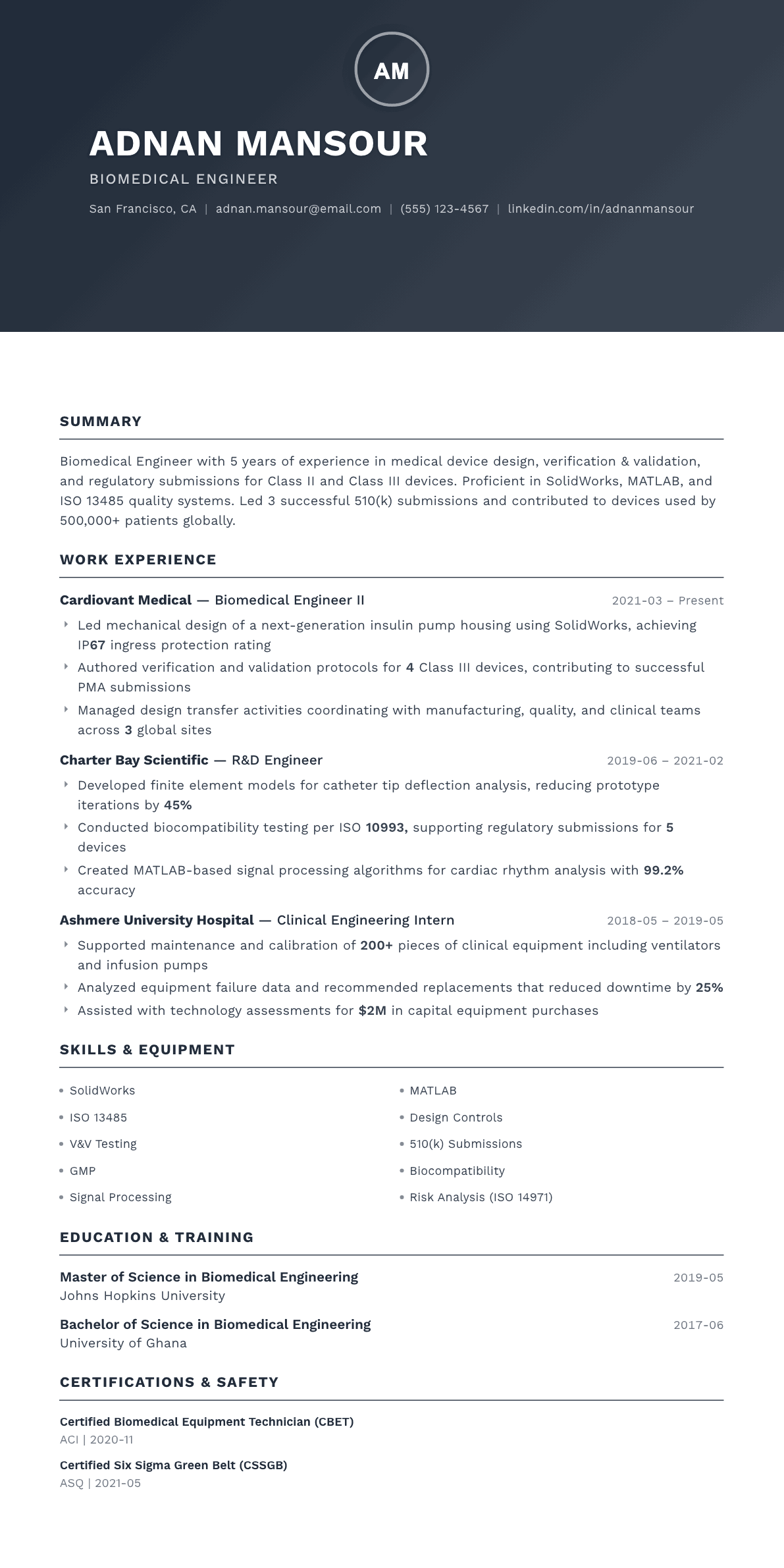
Example Biomedical Engineer summary
Biomedical Engineer with 5 years in medical device design, V&V, and regulatory submissions for Class II/III devices. Proficient in SolidWorks, MATLAB, and ISO 13485 quality systems. Led 3 successful 510(k) submissions for devices impacting 500,000+ patients worldwide.
Skills to list on a Biomedical Engineer resume
- Medical Device Design
- SolidWorks
- MATLAB
- ISO 13485
- ISO 14971
- FDA 510(k)
- PMA Submissions
- Design Controls
- V&V Testing
- Biocompatibility (ISO 10993)
- GMP / cGMP
- Signal Processing
- FEA
- LabVIEW
- Risk Management
What actually gets this resume read
- Highlight regulatory knowledge: FDA 510(k), PMA, ISO 13485, ISO 14971, IEC 60601, EU MDR.
- Specify device classes and types you have worked on (Class I, II, III).
- Quantify clinical impact: patients served, accuracy rates, prototype reduction, or submission success.
- Include design control experience: design inputs, outputs, V&V, design transfer, DHF.
- Mention CAD and analysis tools: SolidWorks, MATLAB, COMSOL, Minitab, LabVIEW.
- Reference biocompatibility and testing standards: ISO 10993, ASTM, ANSI/AAMI.
How to write a biomedical engineer resume
Biomedical engineer covers several jobs that share a degree. There is device research and development, where you design hardware or software that will be implanted, worn or plugged into a patient. There is quality and regulatory, where you prove that device is safe and get it cleared. There is clinical engineering inside a hospital, where you keep thousands of pieces of equipment working and manage the technology fleet. There is manufacturing and process engineering, and there is clinical research support. A hiring manager reads to find out which of these you are.
What unites all of them is that medical device work is governed. Nothing you design gets used until the design history file supports it, the risk analysis covers it, the verification and validation testing passes, and the regulatory pathway closes. A resume that describes engineering without the quality system attached reads as somebody who has not yet worked in the industry.
This guide covers how to present design controls and regulatory work, how to write verification and validation bullets that survive scrutiny, how the clinical engineering track differs, and how to talk about a device without disclosing what you should not. Summaries are included for a graduate, a mid-level design engineer and a lead.
Format: name the track and the device class
One page for the first several years, two after that. Single column, plain, reverse chronological. Put a target title that matches the posting rather than the umbrella term, whether that is research and development engineer, verification and validation engineer, quality engineer, regulatory affairs specialist or clinical engineer.
Then, in the summary or a short line beneath it, state the device classes and types you have worked on. Class II and Class III carry very different burdens, and a company hiring for an implantable device wants somebody who has lived inside that level of scrutiny. Add whether your devices were electromechanical, disposable, software as a medical device, diagnostic or combination products.
- Header: name, target title, city, phone, email.
- Sections in order: summary, technical and regulatory skills, experience, education, certifications, patents and publications.
- Graduates add a design project block with the clinical need, the prototype and the testing performed.
Design controls: the spine of a medical device resume
Show that you can work inside design controls rather than around them. Name the stages you have owned: user needs and design inputs, design outputs, design reviews, verification, validation, design transfer to manufacturing, and the design history file that has to hold all of it together. An engineer who has personally written design inputs and traced them through to test evidence is a different hire from one who prototyped and handed the paperwork to somebody else.
Risk management belongs next to it. Say whether you have built or maintained a hazard analysis and a failure modes and effects analysis, how risk controls fed back into design inputs, and whether you carried a risk file through to a post-market phase. This is the part of the job that new candidates most often leave out and that hiring managers most reliably ask about.
Verification, validation and the testing you actually ran
Verification proves the device meets its specification and validation proves it meets the user need, and confusing the two on a resume is noticed immediately. Write which protocols you authored, which you executed, the sample sizes and the statistical rationale behind them, and how you handled failures and deviations. A candidate who says she wrote a protocol, ran it, hit a failure, investigated it and closed the report has described the actual job.
Name the test types that matter for your device: mechanical fatigue and durability cycling, ingress protection, electrical safety and electromagnetic compatibility, sterilization and package integrity, shelf life and accelerated aging, biocompatibility, and human factors and usability studies. For software, add unit and integration testing, traceability to requirements and the software safety classification you worked under.
- Protocols authored versus executed, with sample size rationale.
- Bench, environmental and animal or cadaver testing you supported.
- Human factors and usability validation, including formative and summative studies.
- Deviations, investigations and corrective actions you closed.
Regulatory and quality: pathways, submissions and standards
Say which regulatory pathways you have contributed to and what you personally wrote. There is a large gap between authoring the substantial equivalence discussion in a premarket notification and being on the team while somebody else did. Name the submission type, your section, and whether you responded to agency questions, because handling a deficiency response is a strong signal.
List the standards you have worked to rather than the ones you have heard of. Quality management for medical devices, risk management, biological evaluation, electrical safety for medical electrical equipment, software life cycle processes and usability engineering are all named standards, and an engineer names only the ones she has been audited against. Add the regulatory regions you have supported, since a European technical file is not a domestic submission.
The clinical engineering track, and confidentiality
If you work inside a hospital, the job is fleet and uptime, not design. Write about the size of the equipment inventory you maintained, the modalities covered, scheduled maintenance completion rates, response and repair times, incident investigation and reporting to the manufacturer and regulator, capital planning, and the computerized maintenance management system you worked in. Networked device security and integration with the medical record are increasingly part of that role and worth naming.
Across all tracks, keep confidential information off the page. Describe the device by type and class, the engineering by method, and the outcome by whether requirements were met. Do not put unreleased product names, clinical results, formulations or manufacturing parameters into a document that will sit in a recruiting database.
Biomedical Engineer resume summary examples
New graduate
Biomedical engineering graduate with a mechanical design focus, a summer in a hospital clinical engineering department and a capstone that built and bench-tested a low-cost infusion monitoring device through 3 prototype rounds. Skilled in SolidWorks, MATLAB and design of experiments.
Five years in
Research and development engineer with 5 years on Class II electromechanical devices, owning mechanical design inputs, tolerance analysis and verification protocols through 2 premarket notifications. Works inside a quality management system, maintains the risk file and has led design transfer to a contract manufacturer.
Principal engineer
Principal biomedical engineer with 12 years on Class III implantable devices, leading a team of 6 through design controls, verification and premarket approval support. Owns the design history file for 2 product families, chairs design reviews and manages the risk file into post-market surveillance.
Work experience bullets: before and after
Before: Designed medical device components using SolidWorks.
After: Designed the housing and fluid path of a Class II infusion device in SolidWorks, running tolerance stack analysis across 9 mating parts and qualifying an ingress protection rating through environmental testing.
The device class, the specific assembly and the qualification test show design work that closed rather than a modeling task.
Before: Wrote verification and validation documents.
After: Authored and executed 11 verification protocols covering mechanical durability, package integrity and electrical safety, with sample sizes justified against the acceptance criteria and 3 deviations investigated to closure.
Protocol counts, the test scope and closed deviations demonstrate the full testing cycle rather than document production.
Before: Helped with regulatory submissions.
After: Wrote the performance testing and substantial equivalence sections of 3 premarket notifications and drafted responses to agency additional information requests, with all 3 cleared without a second review cycle.
Naming your sections and the deficiency responses separates authorship from being on the distribution list.
Before: Did risk analysis for the product.
After: Built and maintained the hazard analysis and design failure modes and effects analysis for a wearable monitor, tracing 60 risk controls back into design inputs and verifying each one in test.
Tracing controls back to inputs and forward to test is the part of risk work that auditors and hiring managers check.
Before: Maintained hospital medical equipment.
After: Managed a clinical equipment inventory of 2,400 devices across infusion, respiratory and imaging modalities, holding scheduled maintenance completion above 95% and closing repair tickets within a 2-day median.
Fleet size, modality range and service metrics are the language a clinical engineering director already uses.
Hard skills
- Design controls and design history files
- Risk management and hazard analysis
- Verification and validation protocol authoring
- SolidWorks and mechanical design
- Tolerance stack analysis
- Finite element analysis
- MATLAB and signal processing
- Biocompatibility evaluation
- Electrical safety and electromagnetic compatibility testing
- Sterilization and package validation
- Human factors and usability engineering
- Premarket notification and approval submissions
- Quality management systems for medical devices
- Design transfer and process validation
Soft skills
- Working with clinicians
- Design review facilitation
- Cross-functional coordination with quality and regulatory
- Writing for auditors
- Supplier technical management
- Judgment about patient safety
Certifications worth listing
- Certified Biomedical Equipment Technician (CBET) (AAMI Credentials Institute)
- Certified Healthcare Technology Manager (CHTM) (AAMI Credentials Institute)
- Regulatory Affairs Certification (RAC) (Regulatory Affairs Professionals Society)
- Certified Quality Engineer (CQE) (American Society for Quality)
- Certified Six Sigma Green Belt (CSSGB) (American Society for Quality)
- Fundamentals of Engineering (FE) (National Council of Examiners for Engineering and Surveying)
Mistakes that cost biomedical engineer candidates the interview
- Describing design work with no mention of design controls, which signals no industry experience to a medtech manager.
- Using verification and validation interchangeably, a distinction every interviewer in this field will test.
- Claiming a regulatory submission without saying which sections you wrote.
- Leaving the device class off, so the reader cannot judge the level of scrutiny you have worked under.
- Putting unreleased product names, clinical results or manufacturing parameters on a resume held in a recruiting database.
- Applying to hospital clinical engineering roles with a design resume, when that job is measured on fleet uptime and service metrics.
- Listing standards you have read about rather than the ones you have been audited against.
Biomedical Engineer resume questions
How do I get into medical devices without industry experience?
Make the regulated thinking visible even in academic work. Describe user needs, design inputs, the testing you ran and what you would need to prove for a real device. Internships in quality, test or clinical engineering are the most common way in.
Should I list the standards I have worked with?
Yes, but only the ones you have actually applied or been audited against. Interviewers ask what a standard required you to do on a specific project, and a list you cannot defend does more damage than a shorter honest one.
What is the difference between an R and D resume and a quality resume here?
The design resume leads with device architecture, prototypes and verification results. The quality resume leads with the system: audits, corrective actions, complaint investigation, process validation and supplier quality. Many engineers can write both, but not in the same document.
How do I write about a device that has not launched?
Describe it generically by class and function, name the engineering discipline and the testing performed, and state the outcome as requirements met. Avoid the internal program name, images, specifications and anything that would identify the product before release.
Is a clinical engineering role a step down from design?
No, it is a different career with its own progression toward healthcare technology management. It rewards breadth across modalities, regulatory reporting, vendor management and capital planning, and directors hire on fleet metrics rather than on design portfolio work.
Related resume examples
- Chemical Engineer Resume example
- Quality Engineer Resume example
- Mechanical Engineer Resume example
- Design Engineer Resume example
- Electrical Engineer Resume example
- Validation Engineer Resume example