Electrical Engineer Resume Examples: what gets the call
Electrical Engineer Resume and Curriculum Vitae Sample
By Mustafa Tarabya, founder of CVBooster · Published · Updated
Electrical Engineer resume examples with expert tips, ATS keywords, and professional templates. See exactly what a winning electrical engineer resume looks like.
Sample resumes for a electrical engineer
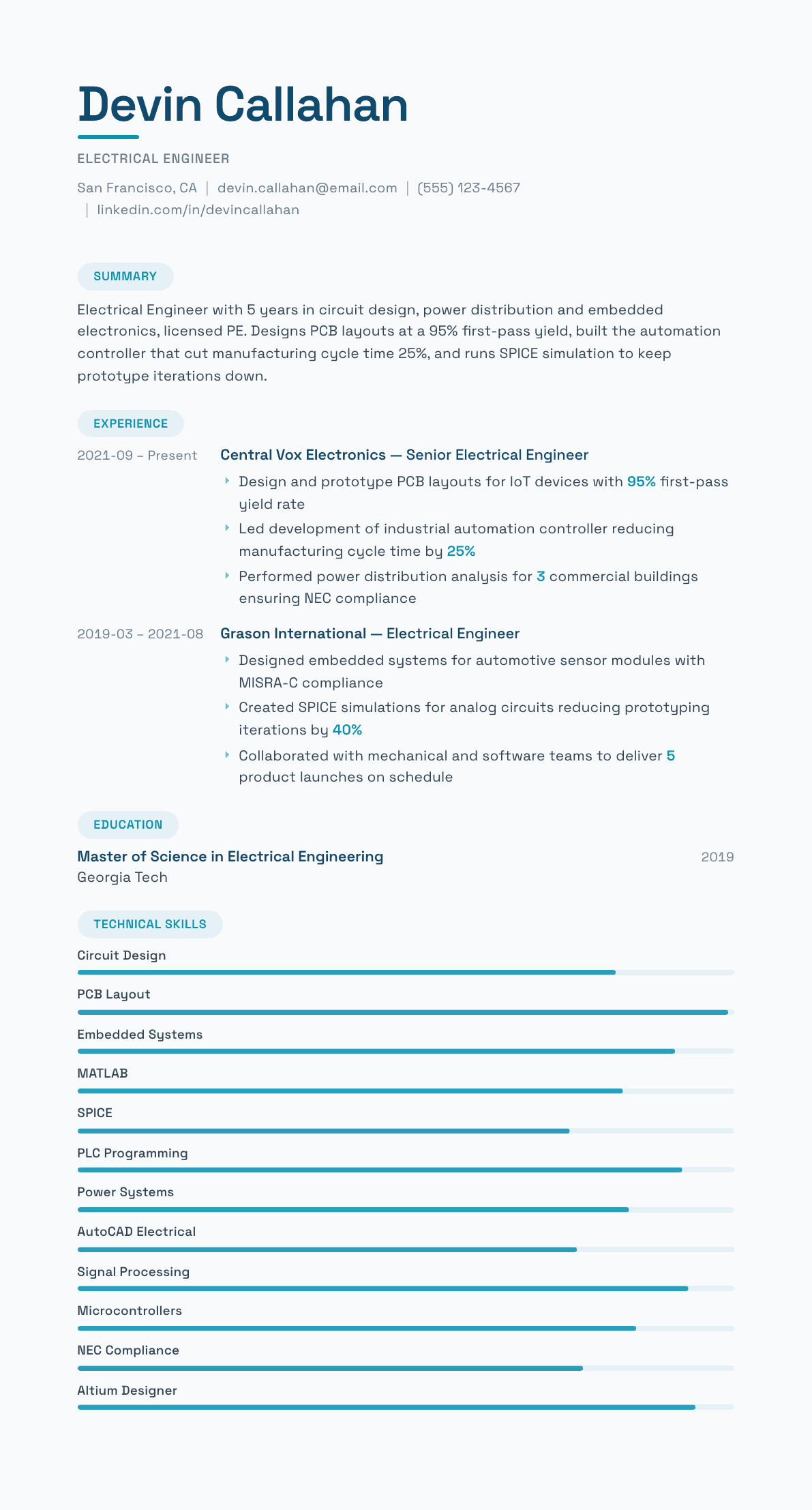
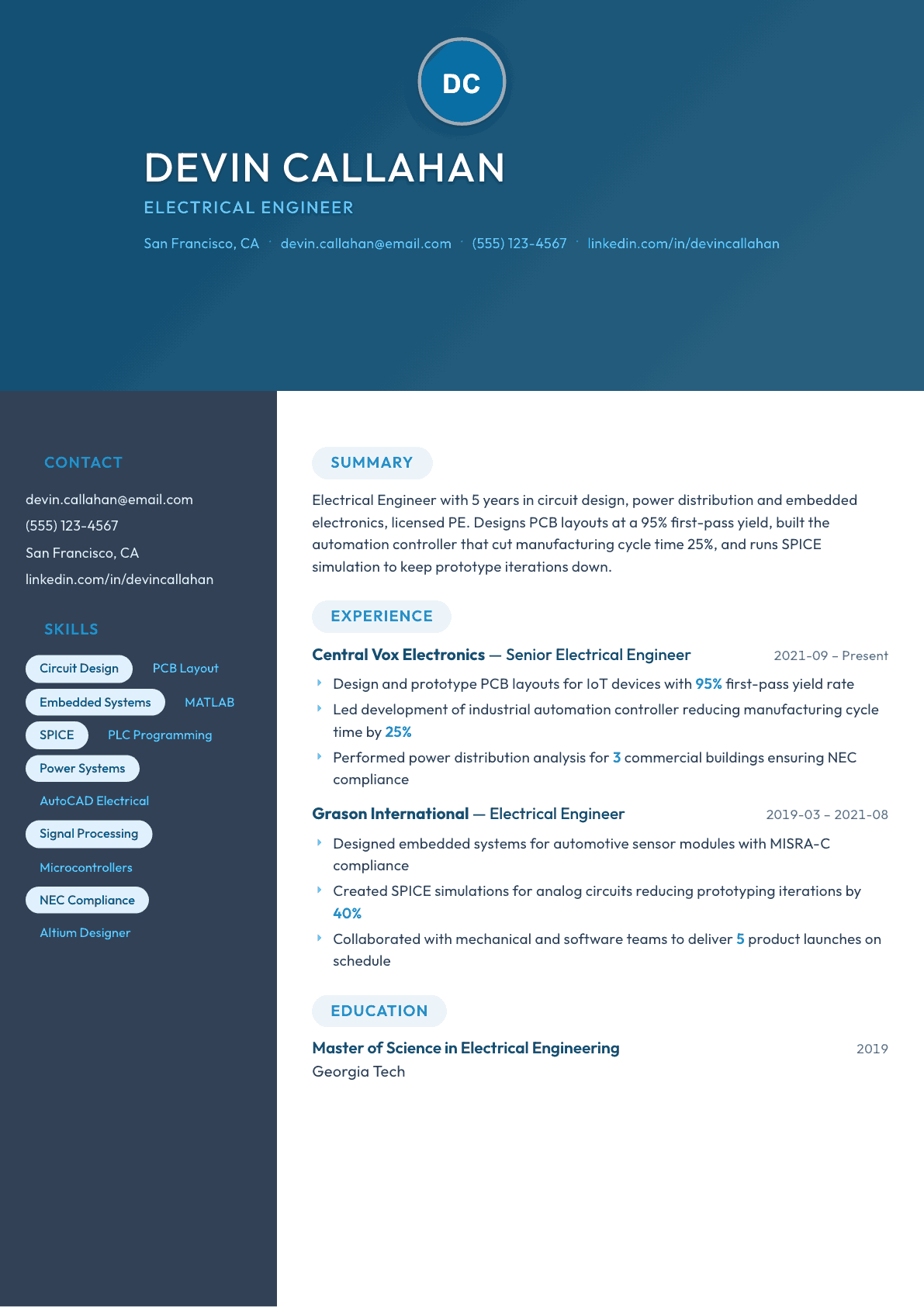
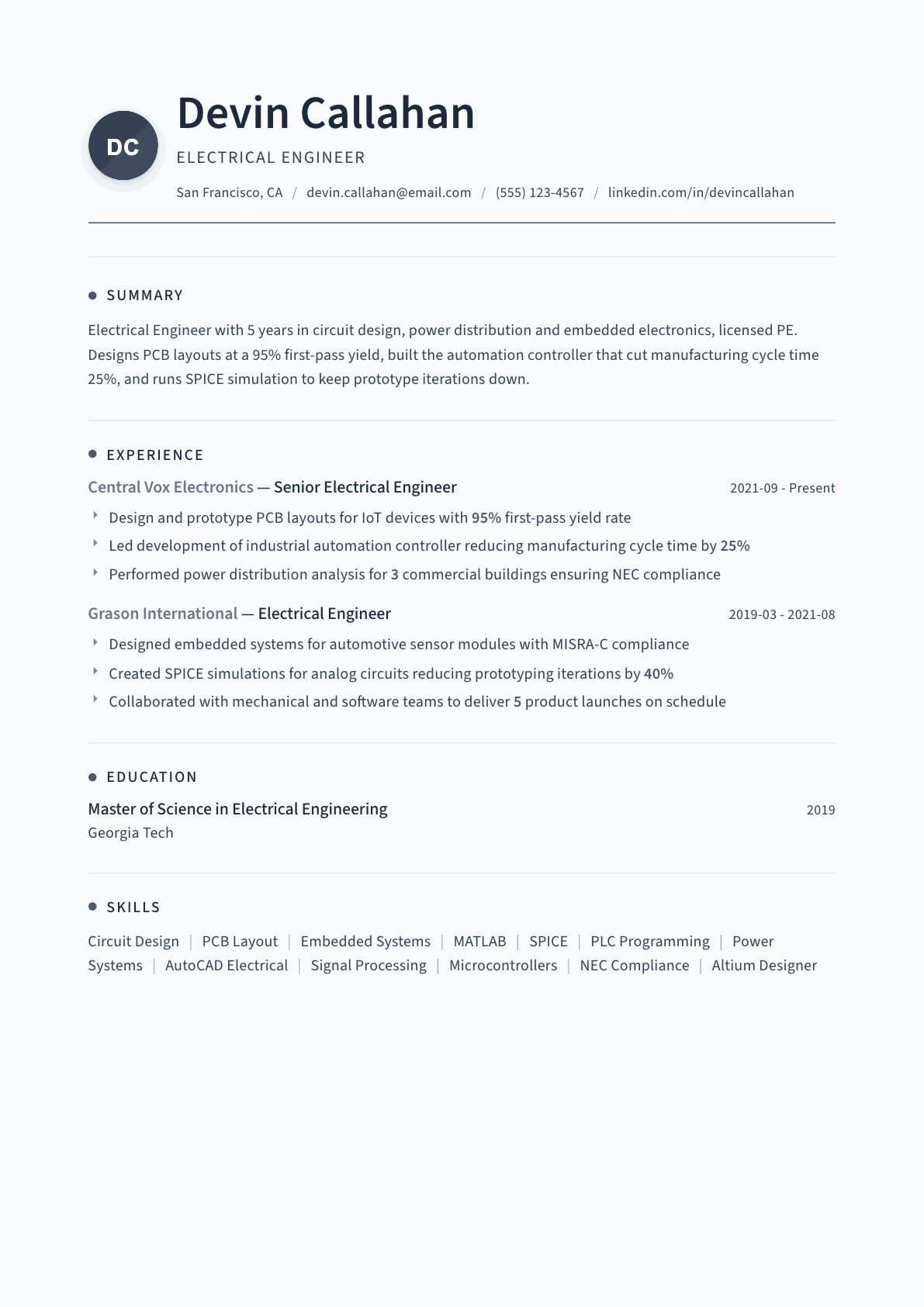
The same electrical engineer content laid out in three CVBooster templates, so you can see what the finished document looks like before you write a word.
Example Electrical Engineer summary
Electrical engineer, PE licensed, 5 years across IoT hardware and industrial automation. Works in Altium and SPICE, holds 95% first-pass yield on board bring-up, wrote MISRA-C compliant firmware for automotive sensor modules, and does the power distribution analysis to NEC.
Skills to list on a Electrical Engineer resume
- Circuit Design
- PCB Layout
- Embedded Systems
- MATLAB
- SPICE
- PLC Programming
- Power Systems
- AutoCAD Electrical
- Signal Processing
- Microcontrollers
- NEC Compliance
- Altium Designer
What actually gets this resume read
- List PE license, FE certification, and relevant technical certifications.
- Include specific EDA tools and simulation software you use.
- Quantify design improvements: yield rates, efficiency gains, cost reductions.
- Show both hardware and embedded software skills if applicable.
- Mention industry standards compliance (IEEE, NEC, UL).
How to write a electrical engineer resume
Electrical engineering job titles cover four different jobs. One designs boards and enclosures. One writes firmware for the microcontroller on that board. One designs building power distribution and stamps the drawings. One tests and qualifies hardware against standards. Hiring managers screen for their own version of the title, so a resume that stays generic gets passed over by all four.
The hiring manager for a hardware team reads a resume backwards from a question: has this person taken a design from schematic to a working, manufacturable board that passed compliance testing? Everything that answers that question deserves space, and everything else is filler.
This guide sets out the section order electronics and hardware teams expect, summaries for a new graduate, a design engineer and a lead, before and after bullets drawn from real design work, and the questions engineers ask when they need to show both hardware and embedded work on one page.
Format: pick your lane in the first line
One page for the first eight years or so, two after. Immediately under your name, write the specialization: analog and mixed signal, digital and high speed, power electronics, embedded systems, RF, or building power design. A hiring manager sorting fifty applications for a switch mode power supply role will not go hunting through your third job to discover you have done magnetics.
If your work is in building services and you hold a license, put PE and your states in the header. If your work is in product design, the license matters far less and a portfolio of shipped hardware matters far more, so name the products and where they went to market.
- Header: name, specialization, PE or EIT where relevant, location, phone, email, portfolio or repository link if you have real hardware or firmware in it.
- Order: summary, technical skills, engineering experience, selected projects, education, patents and publications.
- New graduates put projects above experience: senior design, competition teams, and any board you laid out and populated yourself.
Summary: the product, the technology, the standards you cleared
Three lines that state the class of product you design, the technologies inside it, and the standards it had to pass. A designer of motor drives, a designer of medical instrumentation and a designer of consumer audio all describe themselves as circuit designers, and only the specifics separate them.
Include the design stage you are strong at. Architecture and specification, schematic capture and simulation, layout and signal integrity, bring up and debug, design for manufacture, or compliance and qualification. Most engineers are strong at two or three of these, and naming yours makes it easy for a team to see where you fit.
Experience: from schematic to a board that ships to production
Structure each role around designs, not duties. For each significant design give the function, the key parts, the constraints and the outcome: a four layer board for a battery powered sensor node, a buck converter delivering a named current at a named efficiency, a high speed interface with controlled impedance routing, an isolated gate drive for an industrial inverter.
Show simulation and analysis, because that is what separates engineers from technicians on paper. SPICE and LTspice runs, worst case and tolerance analysis, thermal analysis, power integrity and decoupling studies, timing budgets, derating reviews and failure mode and effects analysis all belong in bullets.
Then show what happened after the design left your desk. Bring up and debug with an oscilloscope, logic analyzer and spectrum analyzer. Design for manufacture reviews with the assembly house. First article inspection, yield at the test station, field returns analyzed, and the compliance testing the product cleared. Engineers who have carried a board through production are the ones companies keep.
Skills: separate design tools, simulation, firmware and lab equipment
Four short groups read far better than one long list. Design tools: Altium Designer, Cadence Allegro and OrCAD, KiCad, AutoCAD Electrical, Mentor Xpedition. Simulation and analysis: LTspice, PSpice, MATLAB and Simulink, ANSYS for thermal or electromagnetic work. Firmware: C and C plus plus, ARM Cortex parts, RTOS use, communication buses such as I2C, SPI, CAN and Ethernet. Lab: oscilloscopes, vector network analyzers, power analyzers, environmental chambers and automated test with LabVIEW or Python.
List the standards families you have designed against rather than a vague compliance claim. IPC design and acceptance standards for boards, IEC and UL safety standards for the product class, FCC emissions limits, CISPR for radiated and conducted noise, IEC 61508 or ISO 26262 for functional safety, and NEC and IEEE standards for power distribution work.
Education, licensure and evidence of depth
Give the degree, the ABET accreditation for licensure paths, and one line on the specialization if your coursework points somewhere specific such as power electronics, control systems or radio frequency design. Do not list every course, but do name the graduate work if it produced hardware.
Patents, published application notes and conference papers are strong evidence in hardware and belong on the resume with a title and status. A single granted patent on a converter topology says more about depth than a paragraph of adjectives.
Curriculum vitae sample for electrical engineers: when the posting asks for a CV
In the United States a CV usually means an academic or research document, so a university lab, a national laboratory or a research and development group may ask for one instead of a resume. Outside the United States, CV is simply the everyday word for the same two page document. Read which one the posting means before you rewrite anything.
A research CV for an electrical engineer keeps the resume sections and adds the evidence an academic panel weighs: every publication in full citation form, patents with numbers and status, conference talks, grants or funded projects, teaching and the students you supervised. It can run past two pages because the publication list is the point. If you link to your projects, link to board files, measured waveforms and papers a working engineer would open, not tutorial exercises.
- CV section order: contact, research or technical profile, education with thesis title, experience, publications, patents, presentations, grants, teaching, skills.
- Industry posting outside the US that says CV: use the resume layout on this page and keep it to two pages.
- Name the IEEE or other venue for each paper, so a reviewer can judge it without searching.
Electrical Engineer resume summary examples
New graduate
Electrical engineering graduate with a focus on embedded and mixed signal design. Laid out 4 boards in KiCad, wrote firmware in C for an ARM Cortex sensor node, and ran the power budget and bring up for a senior design project that passed a pre compliance emissions scan.
Design engineer, six years
Hardware engineer with 6 years designing industrial control electronics. Owns schematic through layout on 8 to 12 layer boards, isolated power supplies to 200 W, and CAN and Ethernet interfaces. Has taken 5 designs through EMC testing and into volume manufacture with a 99% test yield.
Lead hardware engineer
Lead electrical engineer with 12 years in medical instrumentation, running a 5 engineer hardware group. Owns architecture, design reviews and supplier qualification, has closed 3 product families through safety and EMC certification, and holds 2 granted patents in low noise analog front end design.
Work experience bullets: before and after
Before: Designed circuit boards for company products.
After: Designed a 10 layer controlled impedance board for a motor controller: schematic capture in Altium, DDR routing with length matching, isolated gate drives and thermal relief for a 40 A output stage.
Layer count, routing constraints and current rating let a hardware manager judge the difficulty of the work.
Before: Used simulation software to verify designs.
After: Ran LTspice worst case and Monte Carlo analysis across component tolerance and temperature on a precision analog front end, which caught a bias drift issue before the first prototype build.
The analysis method plus what it caught demonstrates engineering judgment rather than tool access.
Before: Worked on EMC compliance testing.
After: Prepared and attended radiated and conducted emissions testing for 3 products, added common mode filtering and a revised ground stitching scheme, and cleared the limit line on the second attempt at the test house.
Naming the emissions work, the fix and the attempt count shows you solved compliance, not just watched it.
Before: Wrote firmware for microcontrollers.
After: Wrote bare metal C firmware for an ARM Cortex-M4 controller: SPI and CAN drivers, a bootloader supporting field updates, and a watchdog and fault handler tested against injected bus faults.
Specific peripherals, a bootloader and fault testing prove production firmware rather than sample code.
Before: Improved manufacturing of a product.
After: Ran design for manufacture reviews with the assembly supplier on 6 boards, added test points and boundary scan coverage, and cut in circuit test escapes at final assembly by two thirds over 3 build cycles.
Test coverage and an escape rate are the manufacturing numbers a hardware manager actually tracks.
Hard skills
- Schematic capture and PCB layout
- Altium Designer
- Cadence Allegro and OrCAD
- LTspice and PSpice simulation
- Signal integrity and controlled impedance routing
- Switch mode power supply design
- Analog and mixed signal front end design
- Embedded C and ARM Cortex microcontrollers
- I2C, SPI, CAN and Ethernet interfaces
- MATLAB and Simulink
- EMC and safety compliance testing
- Design for manufacture and test coverage
- Oscilloscope and network analyzer bench work
- PLC programming and industrial control
Soft skills
- Design review facilitation
- Working with contract manufacturers
- Debugging under schedule pressure
- Explaining hardware limits to software teams
- Documentation and version discipline
Certifications worth listing
- Professional Engineer (PE), Electrical and Computer (State board of professional engineers, exam by NCEES)
- Engineer in Training (EIT) after the FE exam (NCEES and the state licensing board)
- IPC Certified Interconnect Designer (CID) (IPC)
- Certified LabVIEW Associate Developer (NI)
- Certified Six Sigma Green Belt (CSSGB) (American Society for Quality)
Mistakes that cost electrical engineer candidates the interview
- Writing "electrical engineer" with no specialization, so a hardware team, a power team and a firmware team all assume you belong to one of the others.
- Listing tool names with no design behind them, which reads as software familiarity rather than engineering output.
- Stopping the story at the prototype and never mentioning compliance testing or volume manufacture.
- Mixing firmware and hardware into one undifferentiated list so neither depth is visible.
- Leaving out board complexity such as layer count, speed and current, the details that tell a reviewer how hard the work was.
- Padding the skills section with every bus and part family you have read about, which invites an interview question you cannot answer.
Electrical Engineer resume questions
Do electrical engineers need a PE license?
For building power, utility and consulting work the license is close to mandatory because drawings must be sealed. For product design in electronics and semiconductors most engineers never sit the exam, and design portfolio and standards experience carry the resume instead.
How do I show both hardware and firmware experience without looking unfocused?
Pick the one the posting is hiring for as your headline specialization and let the other appear as supporting bullets inside the same projects. Framing firmware as the thing you wrote to bring up your own board reads as depth, while two equal lists read as indecision.
What is the difference between an electrical engineer CV and a resume?
In the United States a resume is the one or two page document for industry jobs, and a CV is the longer academic record with every publication, patent, talk and grant. Elsewhere CV is just the local word for a resume. Send a full CV only to research, university and laboratory roles that ask for one.
How much detail about parts and topologies is too much?
Name the topology, the key constraint and the outcome, and stop. A reviewer wants to know you designed a flyback with synchronous rectification at a given output, not the part number of every capacitor in the compensation network.
What if most of my experience is in test rather than design?
Lead with the qualification work, since compliance and reliability testing is a hiring shortage of its own. Name the standards you tested to, the fixtures and automation you built, and the design changes you recommended that fixed a failure, which is the bridge into a design role.
Related resume examples
- Mechanical Engineer Resume example
- Civil Engineer Resume example
- Software Engineer Resume example
- Electronics Engineer Resume example
- Electrical Power Engineer Resume example
- RF Engineer Resume example