Mechanical Engineer Resume Examples: what gets the call
Engineer a Mechanical Engineer Resume Built for Success
By Mustafa Tarabya, founder of CVBooster · Published · Updated
Create a technical mechanical engineer resume with CAD proficiency, project outcomes, and industry-specific keywords that get noticed.
Sample resumes for a mechanical engineer
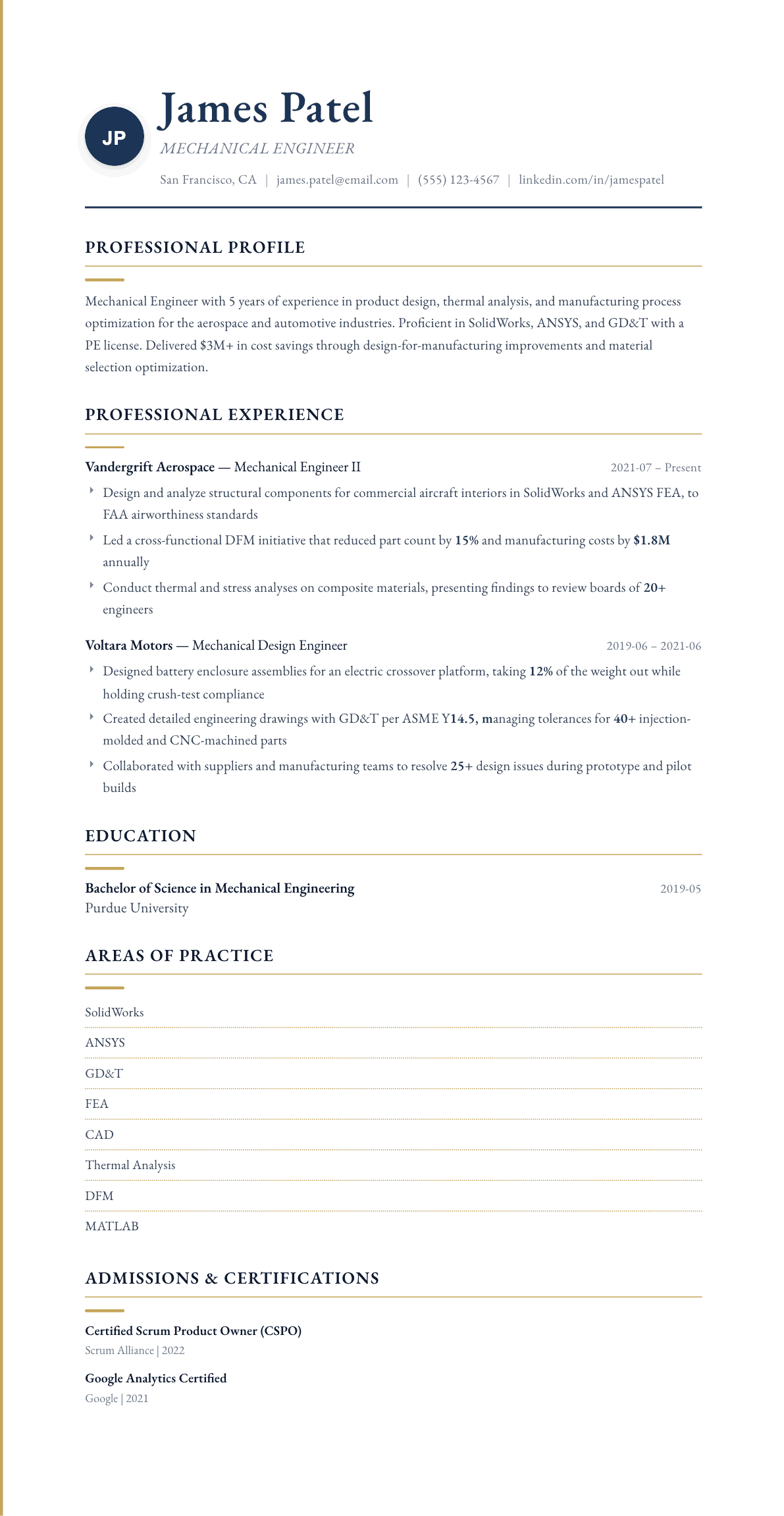
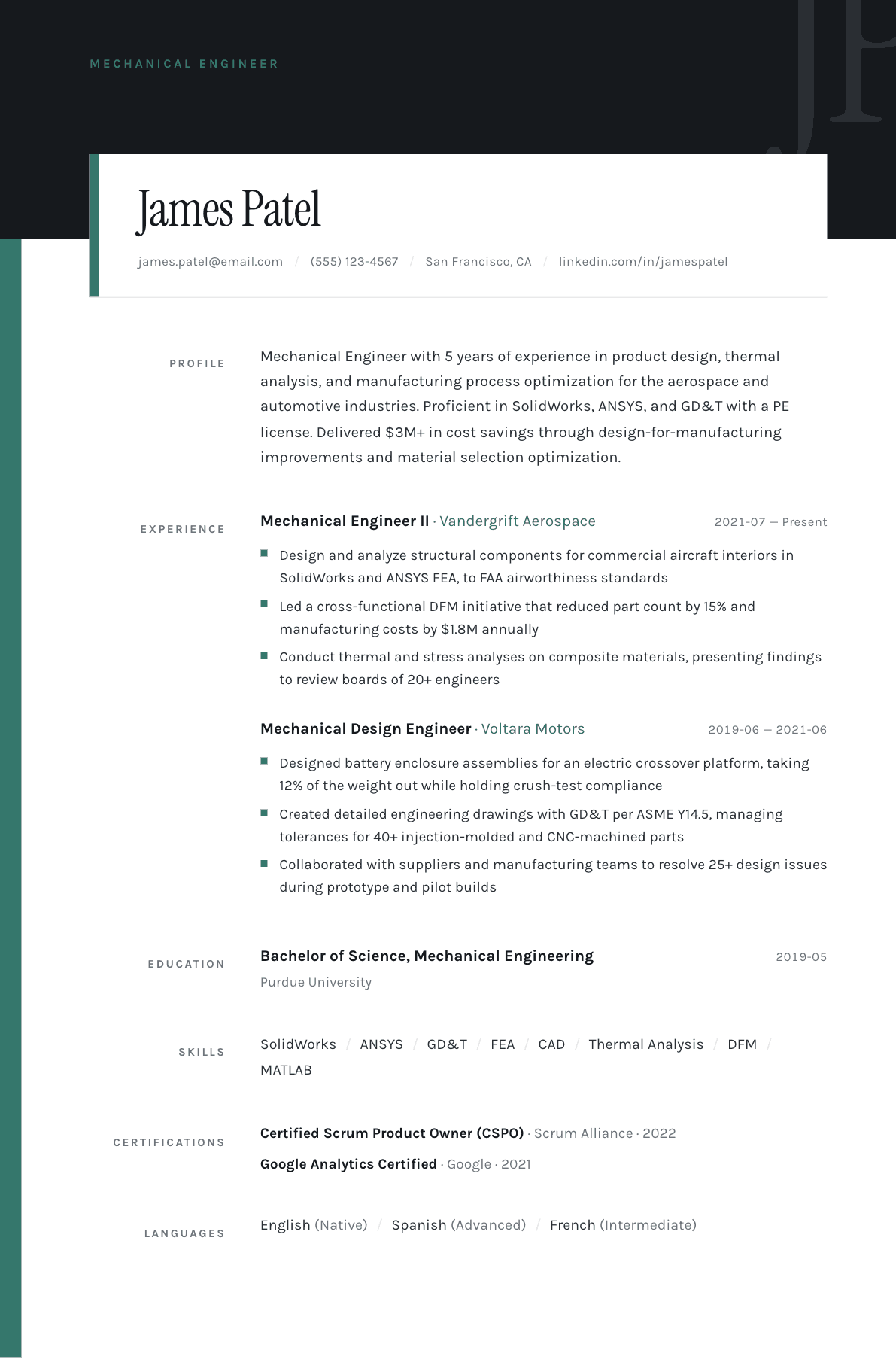
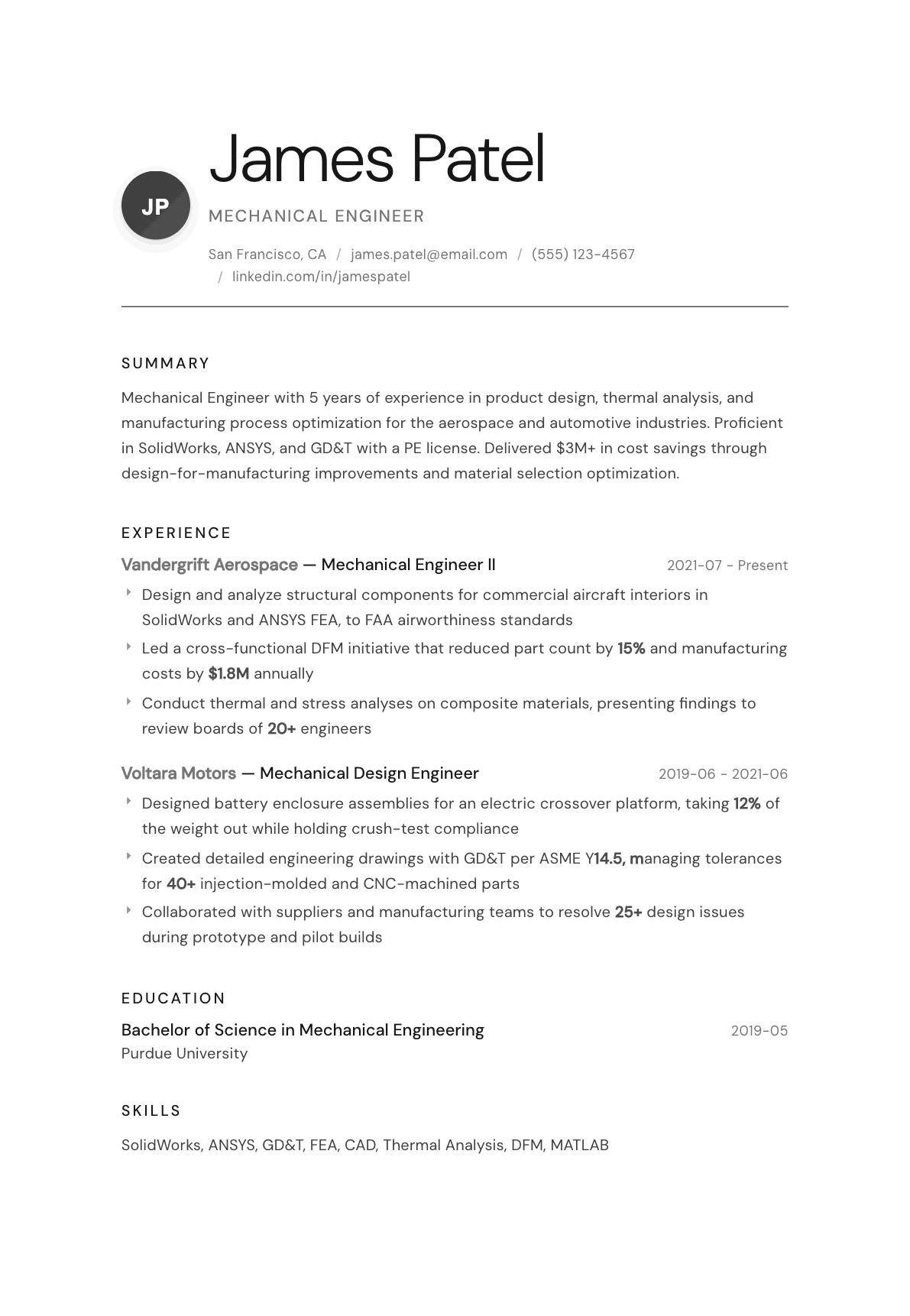
The same mechanical engineer content laid out in three CVBooster templates, so you can see what the finished document looks like before you write a word.
Example Mechanical Engineer summary
Licensed Professional Engineer, 5 years across aerospace structures and electric vehicle enclosures, working in SolidWorks, ANSYS and GD&T to ASME Y14.5. A design-for-manufacturing program cut part count 15% and $1.8M a year in manufacturing cost, and enclosure redesign took 12% of the weight out without losing crush compliance.
Skills to list on a Mechanical Engineer resume
- SolidWorks
- CATIA
- AutoCAD
- ANSYS
- MATLAB
- FEA
- CFD
- GD&T (ASME Y14.5)
- Thermal Analysis
- DFM / DFA
- Prototyping
- Root Cause Analysis
- Lean Manufacturing
- Six Sigma
- Technical Drawing
What actually gets this resume read
- List CAD and simulation tools prominently: SolidWorks, CATIA, AutoCAD, ANSYS, Abaqus, MATLAB, or Simulink.
- Quantify engineering outcomes: cost savings, weight reduction percentages, cycle time improvements, or defect rate reductions.
- Include your PE license, EIT/FE certification, or Six Sigma belt if applicable.
- Reference industry standards you work with: ASME, ASTM, ISO, GD&T (ASME Y14.5), or FAA regulations.
- Describe the full design cycle you participate in: concept, detailed design, prototyping, testing, and production release.
- Mention cross-functional collaboration with manufacturing, quality, and supply chain teams to show breadth.
How to write a mechanical engineer resume
Mechanical engineer is the widest title in engineering, which is exactly why the resumes are so hard to screen. The same two words cover a product designer drawing injection molded housings, a building systems engineer sizing chillers, a plant engineer keeping rotating equipment alive, and an analyst running structural simulation. A hiring manager spends the first fifteen seconds working out which one you are.
Make that easy and the rest follows. Name the domain, name the products or systems, and then prove the engineering: the calculations you ran, the tolerances you specified, the tests you designed, and the hardware that exists because of you. The most common failure is a page of software logos with no evidence that anything was ever built.
This guide covers the section order mechanical hiring managers expect, how to write design and analysis bullets that survive a technical interview, summaries for a graduate through a lead engineer, and the questions that come up around licensure, portfolios and switching industries.
Format: one column, projects visible, hardware evidence early
Reverse chronological, one page until about five years of experience, two pages after that. Avoid multi column layouts and skill rating bars. The bars are the single most criticized element on engineering resumes because a filled circle communicates nothing about depth in a modeling package.
Add a projects section if you are early career or if your work is contract based. Each entry gets the objective, your specific contribution, the tools, and the outcome. This is where a graduate proves capability that job titles cannot yet show.
- Header: name, city and state, phone, email, and a portfolio link if your work is visual.
- Order: summary, technical skills, experience, projects, education, licenses and certifications.
- State the industry in each role: consumer products, aerospace structures, industrial machinery, building services, medical devices.
Summary: domain, products, analysis depth
Say what you design or maintain and at what scale. A designer of sheet metal enclosures and a designer of high pressure hydraulic systems both write mechanical design, and the phrase tells a reader nothing until the product appears next to it.
Then state your analysis depth honestly. There is a real difference between running a simple static stress check to sanity check a bracket and owning nonlinear or dynamic simulation with correlated test data. Claiming the second and delivering the first is discovered in the first technical interview question.
Experience: what you designed, what you calculated, what shipped to production
Open each role with what the group builds and what you owned within it. Then write bullets that show the engineering decision, not the activity. Selected a bearing arrangement and justified it with life calculation. Sized a heat exchanger from a duty calculation. Ran a tolerance stack that changed a fit from interference to clearance. These sentences are what convince another engineer.
Attach numbers that a mechanical engineer would actually track: mass, load, factor of safety, pressure and temperature limits, natural frequency, deflection, heat rejection, flow rate, efficiency, cycle life, part count and cost per unit. Vague improvement claims are worth less here than in most fields, because your reader can spot an unsupported number instantly.
Show the path from drawing to hardware. Prototype builds, design verification testing, failure investigations, engineering change orders, supplier drawing reviews, first article approvals and production support all prove that your designs met reality. A resume full of concepts and no released drawings reads as a student portfolio.
Include the documentation. Drawings released with geometric dimensioning and tolerancing to the ASME standard, calculation reports, test plans and reports, design failure mode and effects analyses, and specifications. These are the deliverables that a lead engineer is judged on.
Skills: modeling, analysis, manufacturing knowledge, and data
List computer aided design packages by name and note the depth: surfacing, sheet metal, weldments, large assembly management, or drawing detailing. Then analysis: finite element analysis with the solver you use, computational fluid dynamics, thermal, kinematics and multibody dynamics, and hand calculation methods you are fluent in.
Manufacturing knowledge is what separates a designer whose parts can be made from one whose parts cannot. Say which processes you design for: machining, sheet metal fabrication, injection molding, die casting, extrusion, welding, additive manufacturing, and composite layup. Add tolerancing, materials selection and surface finish specification.
Finish with the working tools: product data or product lifecycle management systems, requirements management, scripting for automation or data processing, and any test data acquisition and instrumentation you set up yourself.
Licensure, education and the industry vocabulary
The fundamentals of engineering examination and professional licensure matter for building systems, civil adjacent, forensic and consulting work, and matter far less in product design and manufacturing where the industrial exemption applies. If you have passed the fundamentals examination, list it even before you hold the license, because it signals intent for the roles that care.
A degree in mechanical engineering goes below experience after your first job, with graduation year and any specialization worth naming. Mirror the vocabulary of the target sector once in the summary and once in the bullets. Aerospace speaks of airworthiness and stress substantiation, medical device of design controls and verification, building services of load calculations and code compliance, and machinery of duty cycles and maintainability.
Mechanical Engineer resume summary examples
New graduate
Mechanical engineering graduate with an internship in industrial machinery and a capstone designing a test rig that was built and used by the department. Fluent in solid modeling, drawing detailing with geometric tolerancing, and static finite element analysis. Passed the Fundamentals of Engineering examination.
Five years in product design
Mechanical design engineer with five years on consumer and medical hardware, owning enclosure, mechanism and thermal design from concept to production. Released about 180 drawings across 6 products, ran tolerance stacks and design verification testing, and cut assembly time on one product by 25% through part consolidation.
Lead engineer
Lead mechanical engineer and licensed professional engineer with 12 years in industrial equipment. Owns the mechanical architecture for a pressure vessel and rotating equipment product line, signs off structural and fatigue calculations, mentors 5 engineers, and drove a redesign that lowered unit cost by 18%.
Work experience bullets: before and after
Before: Designed parts using SolidWorks.
After: Designed a die cast housing and its machined interfaces, ran a tolerance stack that removed a press-fit risk, and released 24 drawings with geometric tolerancing to the supplier.
Process, analysis and released drawings prove a part reached production rather than staying in a model tree.
Before: Performed FEA on components.
After: Built a nonlinear contact model of a clamp assembly in the structural solver, correlated it against strain gage data from three prototypes, and raised the predicted fatigue life above the required cycle target.
Model type plus test correlation is the difference between simulation that is trusted and colorful pictures.
Before: Worked on testing new prototypes.
After: Wrote and ran the design verification plan for a pump assembly: 9 tests covering pressure, vibration and endurance, instrumented the rig myself, and closed two failures with design changes before release.
Owning the plan, the instrumentation and the resulting design changes shows the full verification loop.
Before: Reduced manufacturing costs on a product.
After: Consolidated a 14-piece bracket weldment into a single stamped part, requalified it with a static and fatigue calculation, and cut piece cost by about a third while removing a welding operation.
The design change, the substantiating analysis and the manufacturing consequence make the saving credible.
Before: Collaborated with suppliers and manufacturing teams.
After: Reviewed supplier tooling proposals for two molded parts, adjusted draft and wall thickness to remove sink risk, and resolved 11 first article dimensional deviations with the supplier before production release.
Specific producibility fixes and a deviation count demonstrate genuine manufacturing engagement.
Hard skills
- Solid modeling and assembly design
- Drawing detailing and geometric tolerancing
- Tolerance stack analysis
- Finite element analysis, static and nonlinear
- Thermal and heat transfer analysis
- Computational fluid dynamics
- Machine design and component selection
- Design for manufacturing and assembly
- Materials selection
- Design verification test planning
- Design failure mode and effects analysis
- Product data management systems
- Prototype build and instrumentation
- Hand calculation and first-principles sizing
Soft skills
- Design review defense
- Clear technical writing
- Working with technicians and machinists
- Trade-off judgment under schedule
- Mentoring junior designers
- Cross-discipline coordination
Certifications worth listing
- Fundamentals of Engineering (FE) (NCEES)
- Professional Engineer, Mechanical (State licensing board, NCEES examination)
- Certified SolidWorks Professional (CSWP) (Dassault Systemes)
- Geometric Dimensioning and Tolerancing Professional (GDTP) (ASME)
- Certified Six Sigma Green Belt (CSSGB) (American Society for Quality)
- Project Management Professional (PMP) (Project Management Institute)
Mistakes that cost mechanical engineer candidates the interview
- Leading with a wall of software names. A modeling package is a tool, and listing eight of them without a released design behind any of them reads as inexperience.
- Using skill rating bars or star ratings, which reviewers in this field consistently dislike because they replace evidence with self assessment.
- Writing responsibilities that could belong to any engineer instead of the specific calculation, tolerance or component decision that was yours.
- Claiming simulation depth you do not have. Interviewers ask about mesh, boundary conditions and correlation, and the answer reveals the truth quickly.
- Leaving out manufacturing detail, so the reader cannot tell whether your parts were ever made or only modeled.
- Sending a single generic resume across product design, building systems and plant maintenance roles, when each expects a different vocabulary and a different first bullet.
Mechanical Engineer resume questions
Do mechanical engineers need a PE license?
It depends on the sector. Building systems, forensic, consulting and public works roles often require or strongly prefer it, while product design and manufacturing generally do not because of the industrial exemption. List the Fundamentals of Engineering examination as soon as you pass it.
How do I write a mechanical engineer resume with no experience?
Lean on projects with real outcomes. Give each one the objective, your contribution, the tools and the result, and favor anything that was actually built and tested. A capstone, a competition team or a repair you engineered yourself carries far more weight than coursework listings.
Should I include a portfolio link?
Yes if your work is visual and you can show it without breaching confidentiality. A short page with renders, drawings, analysis plots and test photographs helps enormously for design roles, provided every item is work you are permitted to publish.
How technical should my mechanical engineering bullets be?
Technical enough that another mechanical engineer can judge the difficulty, and plain enough that a recruiter can follow the outcome. Name the component, the method and the result, then leave the deeper derivation for the interview where you can draw it.
How do I switch mechanical engineering industries?
Identify the shared physics and lead with it. Thermal, structural, fluid and mechanism work transfers cleanly across sectors, so foreground the analysis and testing, then adopt the target industry vocabulary for standards, documentation and verification so the resume does not read as an outsider guess.
Related resume examples
- Software Engineer Resume example
- Data Scientist Resume example
- Project Manager Resume example
- Tooling Engineer Resume example
- R&D Engineer Resume example
- Simulation Engineer Resume example