Design Engineer Resume Examples: the lines they read
Craft a Design Engineer Resume Around Parts That Got Made
By Mustafa Tarabya, founder of CVBooster · Published · Updated
Design engineer resume example with CAD, tolerance and release bullets, product development keywords and a section by section guide.
Sample resumes for a design engineer
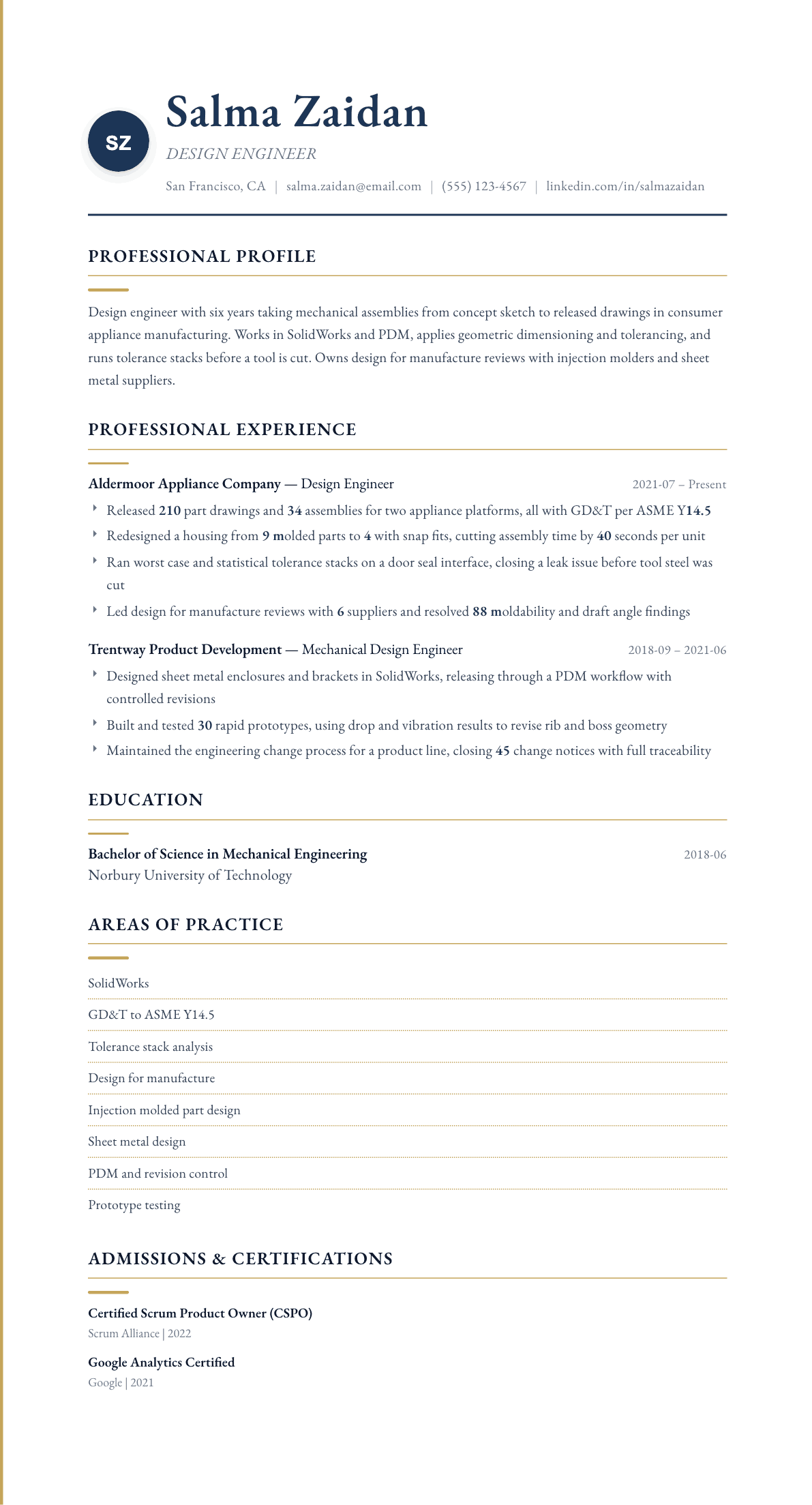
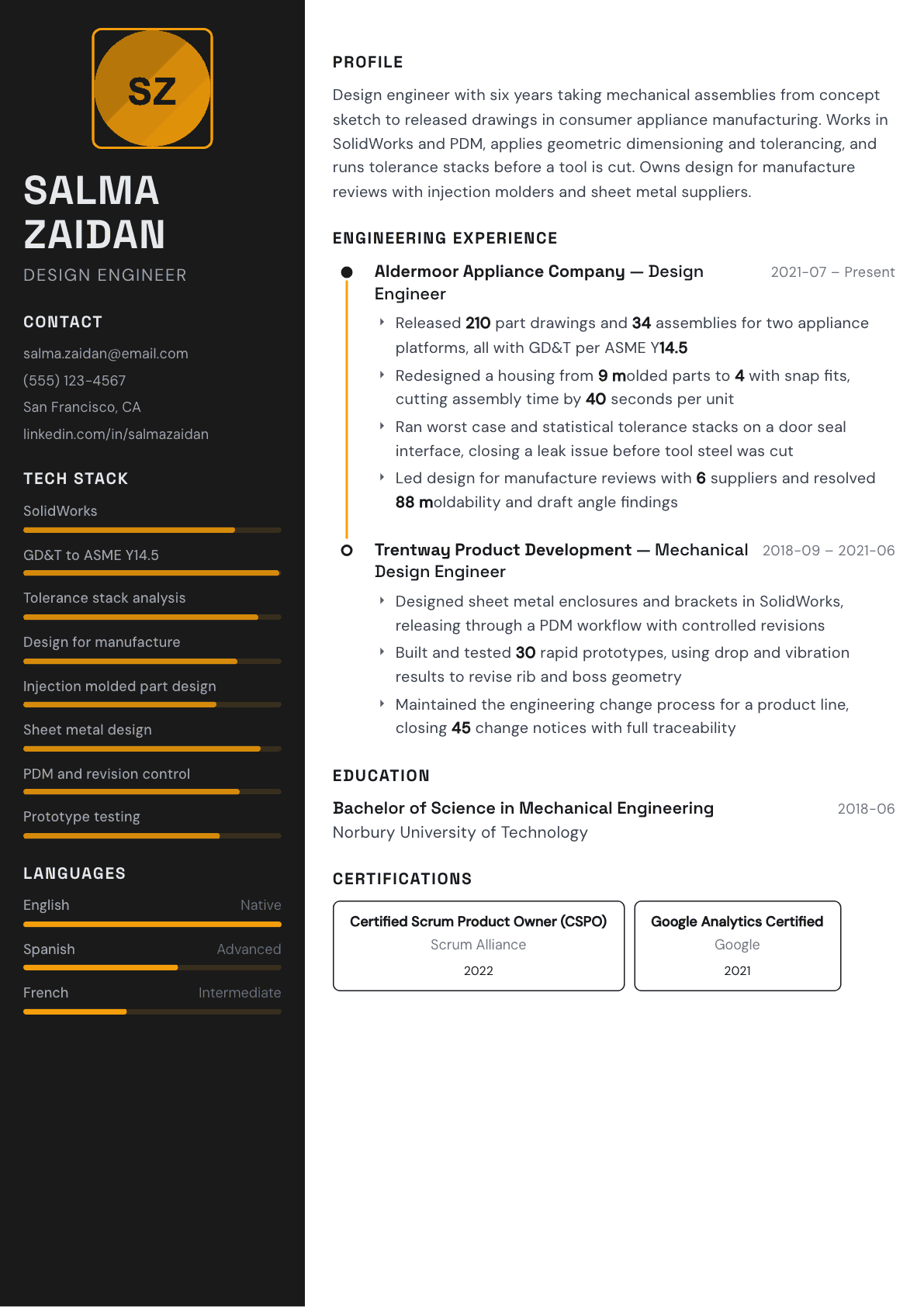
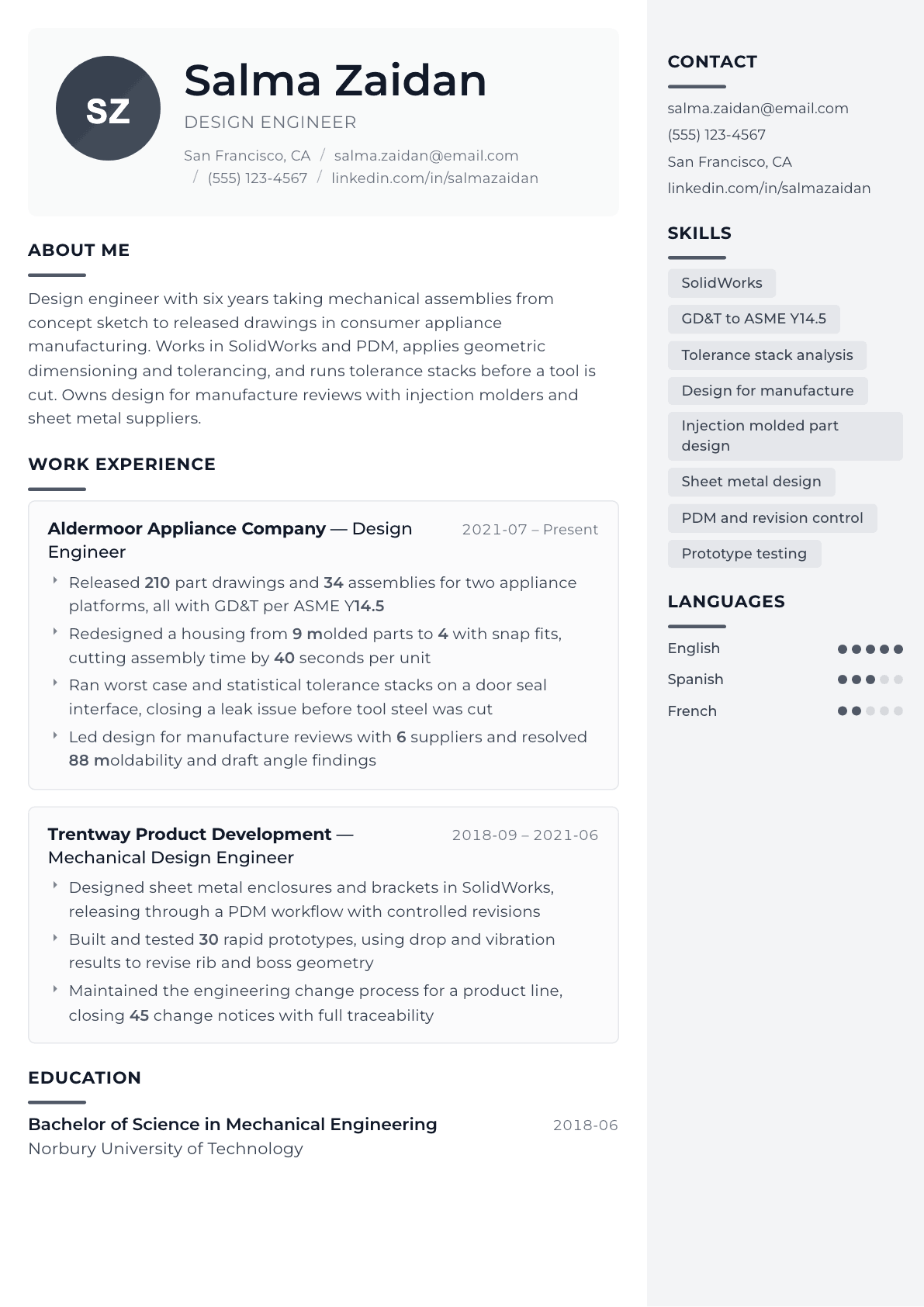
The same design engineer content laid out in three CVBooster templates, so you can see what the finished document looks like before you write a word.
Example Design Engineer summary
Design engineer with six years taking mechanical assemblies from concept to released production drawings in consumer appliances. Models in SolidWorks under PDM revision control, applies GD&T to ASME Y14.5, and runs tolerance stacks before tooling is committed. Has cut part count on a molded housing and closed supplier moldability findings through structured design for manufacture reviews. Seeking a senior mechanical design role on new product platforms.
Skills to list on a Design Engineer resume
- SolidWorks
- Creo Parametric
- CATIA
- GD&T
- Tolerance stack analysis
- Design for manufacture
- Design for assembly
- Injection molded part design
- Sheet metal design
- Finite element analysis
- Prototype and validation testing
- PDM and PLM workflows
- Engineering change control
- Bill of materials management
- Supplier design reviews
What actually gets this resume read
- Count the parts and assemblies you released, because a design engineer is judged on drawings that went to production, not concepts.
- Name the CAD system and the data management system together, since PDM and PLM discipline matters as much as modeling skill.
- Show tolerance work explicitly, as a stack analysis that prevented a tooling change is one of the strongest bullets in this field.
- State the manufacturing processes you design for, because injection molding, sheet metal, casting and machining need different instincts.
- Include the standards you applied, such as ASME Y14.5 or ISO 2768, so the reader knows your drawings are readable by a supplier.
- Describe one design you simplified, giving the before and after part count and what it saved in assembly or cost.
How to write a design engineer resume
The question behind every design engineer resume is simple: did anything you drew get made. Concept renderings and student projects are common, released drawings that a supplier quoted and a factory built are not. A hiring manager reads for released part counts, for tolerancing practice, for the manufacturing processes you design toward, and for evidence that your drawings did not come back with questions.
The second question is which manufacturing world you belong to. Designing an injection molded consumer housing, a welded steel frame, a precision machined assembly and a sheet metal enclosure demand different instincts about draft, wall thickness, weld access, fixturing and cost. Saying mechanical design engineer without naming the processes leaves the reader guessing.
This guide covers layout, section content, three example summaries, five rewritten bullets and the questions design engineers ask when they update their resume.
Format: CAD and release discipline visible immediately
One page under seven years, two after that. Under the summary place a short line naming the CAD system, the data management system, the tolerancing standard you work to and the manufacturing processes you design for. Those four items answer most of the screening question before the reader reaches your first job.
Keep any portfolio reference to a single link with a note about what it contains. Design engineering portfolios help, but a hiring manager will only open one if the resume has already convinced them that real parts exist behind it.
- Header: name, design discipline, city and state, phone, email, portfolio link if the work is releasable.
- Technical line: CAD, PDM or PLM, tolerancing standard, processes designed for.
- Section order: summary, technical line, experience, skills, education, certifications, selected projects.
Summary: what you released and to which process
Start with the industry and the product type, then state the volume of released drawings and assemblies. A design engineer who has released two hundred production drawings has been through revision cycles, supplier questions and change notices that a concept-only designer has never seen.
Add the tolerancing and analysis dimension. Mentioning geometric dimensioning and tolerancing practice plus tolerance stack work tells a reader you design for assembly variation rather than for a perfect nominal model, and that is the single most common gap in mid level candidates.
Experience: parts, tolerances, and the change that saved money
Give released volumes per role. Part drawings, assembly drawings and change notices are countable and meaningful. Then describe the hardest design problem you solved with the constraint attached: a wall thickness limit, a cost target, an assembly time target, a sealing requirement or a stiffness specification.
Tolerance work is where design engineers prove depth. A stack analysis that found an interference before tool steel was cut, or a datum scheme change that eliminated a supplier measurement dispute, is worth a full bullet with the mechanism explained.
Simplification bullets are the ones hiring managers repeat internally. Reducing a housing from nine molded parts to four with snap fits, or replacing a machined bracket with a formed part, gives a before and after that a reader can immediately value.
Design for manufacture and supplier work
Describe how you work with suppliers, because design engineers who talk to molders, machinists and fabricators early produce fewer late surprises. Name the review format, the number of findings closed, and the kinds of issues raised: draft angles, undercuts, tool access, weld distortion, form radii or flatness limits.
Prototype and validation work belongs here too. State how you built and tested prototypes, what the tests measured, and what the results changed in the design. A rib thickness revised after a drop test is a design decision backed by evidence.
- Molded parts: wall thickness, draft, gate location, shrink allowance, undercut and slide avoidance.
- Sheet metal: bend radius, relief, forming order, hardware selection, flat pattern verification.
- Machined parts: datum accessibility, tool reach, fixturing, surface finish callouts, cost driving features.
Documentation, revisions and the change process
Drawing quality is a real skill and rarely claimed. Say that your drawings carry complete datum schemes, correct surface finish and material callouts, and that they were released through a controlled revision workflow. Add how many engineering change notices you have processed, since change discipline is what keeps a factory building the right part.
If you own bills of material, say so and describe how you kept them aligned with drawings and work instructions. Design engineers who ignore the bill of material create work for everyone downstream, and reviewers know it.
Design Engineer resume summary examples
New graduate
Mechanical engineering graduate with a capstone designing a sheet metal test rig modeled in SolidWorks, including flat patterns and a complete drawing package. Trained in geometric dimensioning and tolerancing fundamentals. Seeking an entry design engineer role in product development or industrial equipment.
Six years in
Design engineer with 6 years in consumer appliances, having released 210 part drawings and 34 assemblies under a controlled revision workflow. Runs tolerance stacks before tooling commitment and cut a molded housing from 9 parts to 4 using snap fit features.
Lead design engineer
Lead design engineer with 13 years across appliances and industrial products, owning mechanical architecture on new platforms and chairing design reviews with molders and fabricators. Sets the drawing standard for the team and mentors 4 engineers on tolerancing and design for manufacture.
Work experience bullets: before and after
Before: Designed parts and assemblies in CAD.
After: Released 210 part drawings and 34 assemblies for two appliance platforms, each carrying a full datum scheme and geometric tolerances to the company drawing standard.
Released volume and drawing completeness prove production output rather than modeling activity.
Before: Simplified a product design.
After: Redesigned a housing from 9 molded parts to 4 by combining features and adding snap fits, cutting assembly time by 40 seconds per unit and removing two fasteners from the bill of material.
Part count, time saved and the bill of material impact make the simplification measurable across three functions.
Before: Performed tolerance analysis.
After: Ran worst case and statistical tolerance stacks on a door seal interface, found a compression shortfall at the extremes and revised the datum scheme before tool steel was cut.
Naming the analysis types and the point in the tooling timeline shows the work prevented real cost.
Before: Worked with suppliers on manufacturability.
After: Led design for manufacture reviews with 6 suppliers and resolved 88 findings covering draft angles, gate locations and slide avoidance before tool kickoff.
Supplier count, finding count and the specific issue types demonstrate genuine molding knowledge.
Before: Built and tested prototypes.
After: Built and tested 30 rapid prototypes through drop and vibration sequences, then revised rib and boss geometry based on the failure locations before releasing production tooling.
Connecting a test result to a specific geometry change shows design driven by evidence.
Hard skills
- SolidWorks, Creo or CATIA modeling
- Production drawing creation
- Geometric dimensioning and tolerancing
- Tolerance stack analysis
- Design for manufacture and assembly
- Injection molded part design
- Sheet metal design and flat patterns
- Machined part design
- Material and finish selection
- Finite element analysis
- Prototype and validation testing
- PDM and PLM revision control
- Engineering change notices
- Bill of material structure
Soft skills
- Design review facilitation
- Supplier communication
- Accepting and acting on test results
- Cost awareness during concept work
- Clear drawing annotation
Certifications worth listing
- Certified SolidWorks Professional (CSWP) (Dassault Systemes SolidWorks)
- Geometric Dimensioning and Tolerancing Professional, Senior Level (American Society of Mechanical Engineers)
- Fundamentals of Engineering (FE), Mechanical (NCEES)
- Professional Engineer (PE), Mechanical (NCEES member state licensing boards)
Mistakes that cost design engineer candidates the interview
- Showing concepts and renderings with no evidence that a drawing was ever released to a supplier.
- Naming a CAD package without the data management system, which hides whether you worked under revision control.
- Leaving tolerancing out entirely, which is the fastest way to look like a modeler rather than a design engineer.
- Failing to name the manufacturing processes you design for, so the reader cannot judge fit.
- Ignoring the change process and bill of material work that keeps production building the right revision.
- Listing analysis software without saying what the analysis changed in the design.
Design Engineer resume questions
How do I prove design experience when my work is confidential?
Describe the class of product, the processes involved, the constraints you designed against and the measurable outcome, without naming the customer or showing geometry. Reviewers are used to this and care more about your reasoning than about seeing the actual part.
Is a portfolio necessary for a design engineer?
It helps early in a career and matters less once you have released production work. If you build one, show three projects with the constraint, your decisions, the drawings and the result. Quality of reasoning beats quantity of images every time.
How much analysis should I claim on my resume?
Claim only what you can defend in an interview, including the boundary conditions and mesh decisions. A single finite element study you can walk through convincingly is worth more than a list of solvers you once watched a specialist run.
Should I list every CAD package I have touched?
List the ones you could work in productively on day one, and mark any others as familiar. Hiring teams do search on CAD names, but overstating fluency creates an awkward first week that most managers remember for a long time.
How do I move from drafting into design engineering?
Lead with the design decisions you already make: tolerance choices, material callouts, supplier questions you resolve and design changes you propose. Then add one project where you owned geometry from requirement to release, even a small bracket, so the reader sees ownership.
Related resume examples
- Mechanical Engineer Resume example
- Manufacturing Engineer Resume example
- Mechanical Design Engineer Resume example
- Product Engineer Resume example
- Packaging Engineer Resume example
- Biomedical Engineer Resume example