Chemical Engineer Resume Examples: the lines they read
Craft a Chemical Engineer Resume That Reacts with Recruiters
By Mustafa Tarabya, founder of CVBooster · Published · Updated
Build a compelling chemical engineer resume showcasing process design, safety compliance, and plant optimization expertise with ATS-friendly formatting.
Sample resumes for a chemical engineer
The same chemical engineer content laid out in three CVBooster templates, so you can see what the finished document looks like before you write a word.
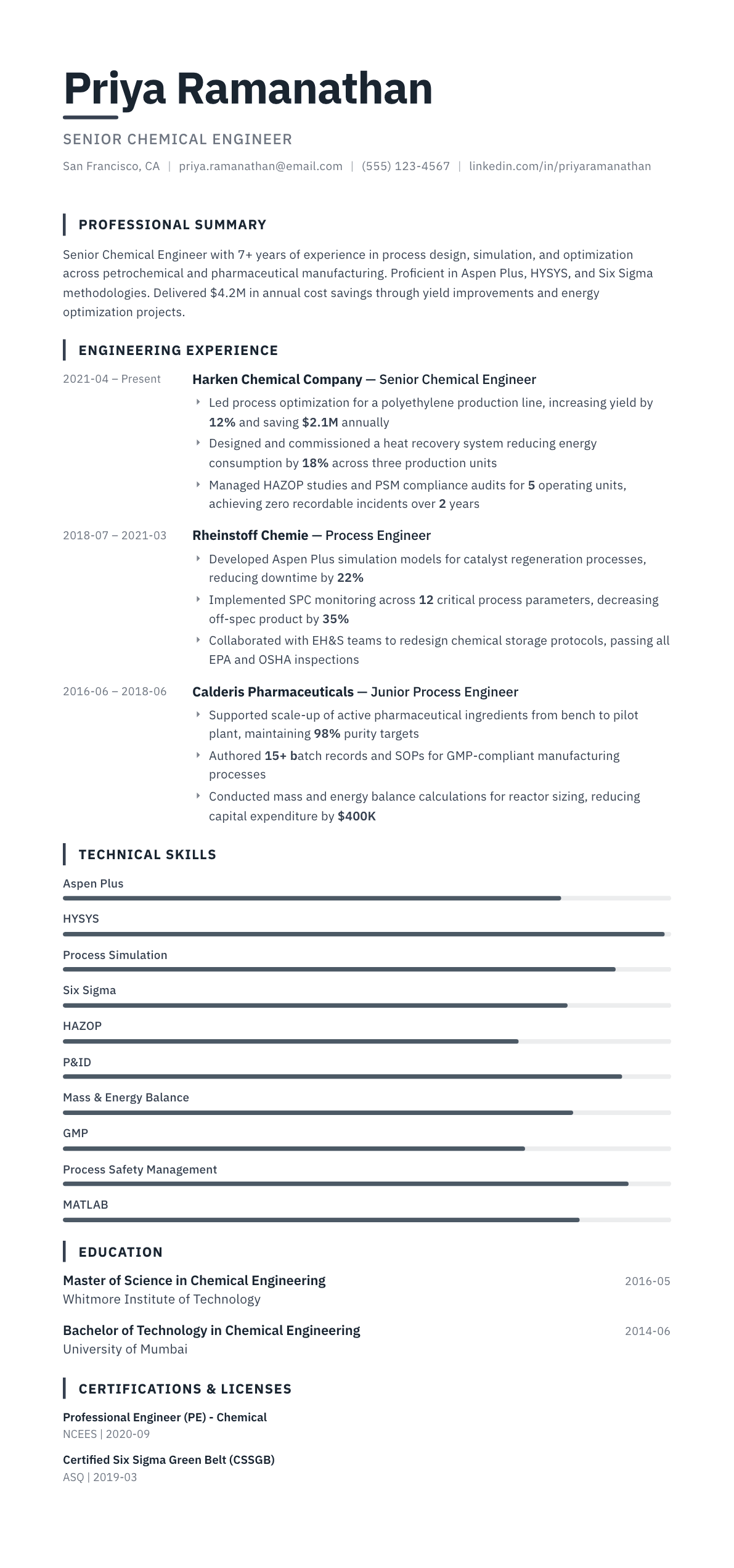
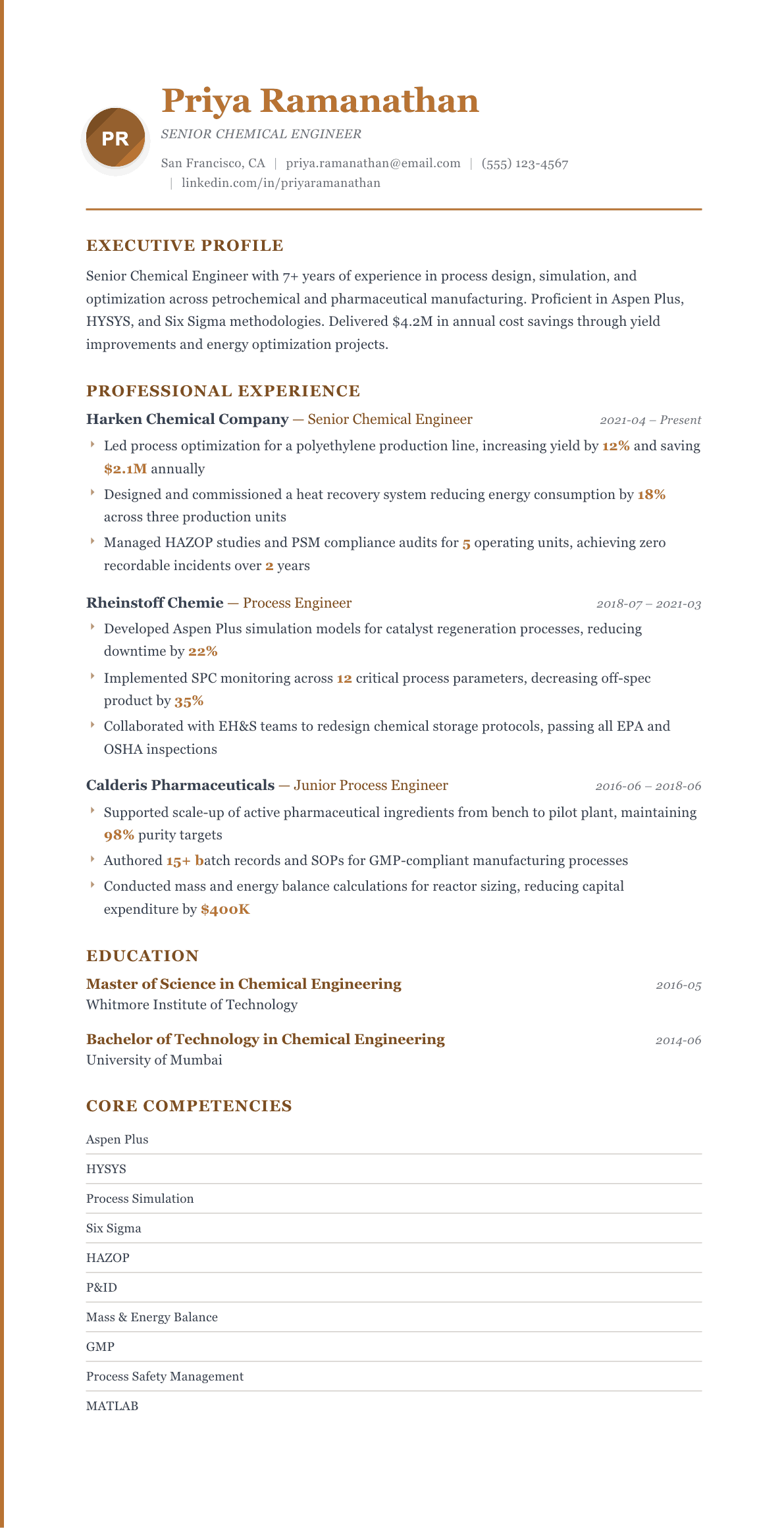
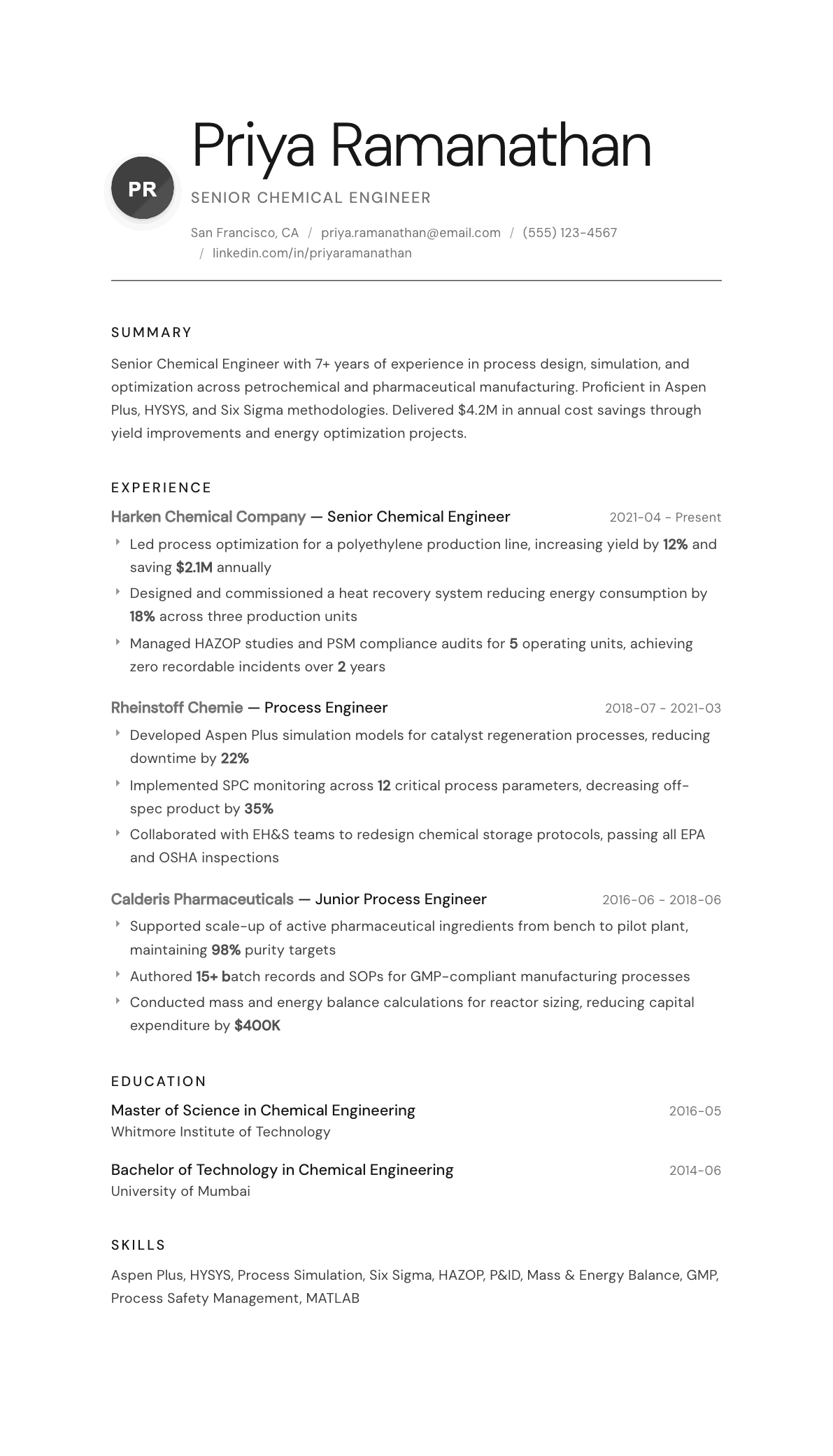
Example Chemical Engineer summary
Licensed Professional Engineer, 7 years in chemical process design, simulation, and plant optimization across petrochemical and pharmaceutical sites. Works daily in Aspen Plus and HYSYS and holds an ASQ Six Sigma Green Belt. Delivered $4.2M in annual savings from yield and energy projects with zero recordable incidents over two years.
Skills to list on a Chemical Engineer resume
- Aspen Plus
- HYSYS
- CHEMCAD
- Process Design
- Process Simulation
- Six Sigma
- HAZOP
- P&ID Development
- Mass & Energy Balance
- Reaction Engineering
- Process Safety Management
- GMP / cGMP
- Statistical Process Control
- MATLAB
- Unit Operations
What actually gets this resume read
- Highlight simulation tools prominently: Aspen Plus, HYSYS, CHEMCAD, COMSOL, or Pro/II.
- Quantify process improvements with specific metrics: yield increases, cost savings, energy reduction percentages.
- Include safety credentials and compliance experience: HAZOP, PSM, OSHA, EPA, and GMP.
- Mention your PE license or FE/EIT certification near the top of your resume.
- Describe the scale of operations you managed: production volumes, number of units, or batch sizes.
- Reference industry-specific standards and regulations relevant to your target sector.
How to write a chemical engineer resume
Chemical engineers get hired into three fairly separate worlds, and a resume that does not pick one reads as unfocused. Plant and process engineering sits inside an operating facility and is judged on throughput, yield, reliability and safety. Design and projects engineering sits at an owner or a contractor and is judged on deliverables through the front end and detailed engineering stages of a capital project. Process development and technology sits closer to the laboratory and is judged on scale-up, from bench through pilot to first commercial batch.
What every one of those hiring managers checks first is process safety. This is an industry where a mistake removes a unit and sometimes a person, so the resume needs to show that you have worked inside a management of change system, sat in a hazard study, and understand that a design is not finished until the relief case is covered. Candidates who write only about optimization and simulation and never mention safety look inexperienced regardless of how good the numbers are.
This guide covers how to write plant work, project deliverables and scale-up experience, which simulation and safety terms carry weight, and how to quantify results without inventing them. Summaries are included for a graduate, a plant process engineer and a senior lead.
Format: unit operations and industry up front
One page early, two after roughly eight years. Reverse chronological, plain single column. Below the summary, put a short technical block naming the unit operations you have owned and the simulation tools you use, because a hiring engineer reads that before the job history.
Name the industry in the same breath. Refining, petrochemicals, specialty chemicals, pharmaceutical manufacturing, food processing, pulp and paper, semiconductors and water treatment all use the same equations and none of them are interchangeable to a hiring manager. Regulatory exposure, batch versus continuous operation and cleanliness requirements differ enormously.
- Header: name, discipline and industry, city, phone, email.
- Sections in order: summary, technical proficiencies and unit operations, experience, education, certifications, safety training.
- Graduates add a design project block with the process, the basis and the economics you evaluated.
Summary: unit operations, mode of operation, and where you sit
Say which unit operations you have actually run or designed. Distillation, absorption, extraction, crystallization, drying, filtration, reaction engineering, heat transfer and fluid handling are the vocabulary of this profession, and a candidate who says process optimization without naming a column, a reactor or a dryer has told the reader nothing.
Then say whether the process is continuous or batch and whether you sit in operations, design or development. A batch pharmaceutical engineer writing recipes and a continuous refinery engineer chasing a distillation pinch are doing genuinely different jobs, and hiring managers screen on that distinction.
Plant experience: the numbers a plant manager already tracks
Plant engineering results should be written in the terms the site already reports. Yield, conversion, selectivity, throughput, energy per unit of product, first pass quality, off-specification rate, unplanned downtime and days between incidents are all real measures. Give the baseline, the change and the mechanism, because a number with no mechanism reads as a claim rather than an engineering result.
Troubleshooting is the daily work and deserves specific bullets. A column that would not hold a temperature profile, a heat exchanger fouling faster than the cleaning schedule allowed, a reactor losing selectivity as catalyst aged, a pump cavitating on a hot summer day: each of these has a root cause and a fix, and describing one properly shows more competence than a list of software.
Include the turnaround and shutdown work. Planning a unit outage, writing the work scope, commissioning after a change and bringing a unit back to rate are experiences a plant hiring manager values highly, and most resumes leave them out entirely.
Design, projects and simulation used properly
For project work, name the deliverables rather than the project. Process flow diagrams, heat and material balances, piping and instrumentation diagrams, equipment datasheets, line sizing and hydraulics, relief device sizing, control narratives and the operating manual are the documents that make a project real. Say which stage you worked at, from conceptual and feasibility through front end engineering into detailed design, construction support and commissioning.
Simulation belongs to the deliverable, not to a tool list. Say what you modeled and what the model decided: a steady-state flowsheet that sized a column and set the reflux ratio, a dynamic model that proved a surge case, a rating study that justified reusing an existing exchanger instead of buying one. Add the property package where it mattered, since choosing thermodynamics for an electrolyte or a highly non-ideal system is a real judgment call.
- Steady-state and dynamic simulation, with what each model actually settled.
- Hydraulics, relief sizing and the standards you applied.
- Equipment specification and vendor technical evaluation.
- Commissioning, startup and performance test runs.
Process safety and quality: the sections that prove seniority
Name your role in hazard studies rather than saying you participated. Leading or scribing a hazard and operability study, running a layer of protection analysis, assigning a safety integrity level, writing or reviewing a management of change package, closing recommendations and taking part in an incident investigation are distinct contributions. Add the elements of a process safety management program you have worked under, including process safety information, mechanical integrity and pre-startup safety review.
In regulated manufacturing, quality is the parallel system. Batch records, standard operating procedures, cleaning validation, process validation, deviation and investigation handling, and technology transfer between sites are the deliverables. An engineer who has taken a process from a laboratory through a pilot campaign to a validated commercial batch should say exactly that, because scale-up experience is one of the scarcest things in the market.
Chemical Engineer resume summary examples
Graduate engineer
Chemical engineering graduate with an internship in a polymer plant and a senior design project sizing a 3-column separation train with a full heat and material balance. Skilled in Aspen Plus, comfortable reading piping and instrumentation diagrams, and trained in the site process safety induction.
Plant process engineer
Process engineer with 6 years owning a continuous polyethylene line, responsible for distillation, heat integration and reactor performance. Raised unit yield by 12% through a reflux and feed preheat change, and led 4 hazard and operability studies covering the unit and its relief cases.
Senior process engineer
Senior chemical engineer with 12 years across petrochemical and pharmaceutical manufacturing, leading front end design for 2 capital projects and technology transfer of 3 processes from pilot to commercial scale. Owns process safety documentation for 5 operating units and mentors 4 engineers.
Work experience bullets: before and after
Before: Optimized a production process to improve efficiency.
After: Raised polyethylene line yield by 12% by rebalancing reflux ratio and adding feed preheat from a waste stream, verified across 3 months of production data.
The mechanism and the verification period make the improvement an engineering result instead of a claim.
Before: Used Aspen Plus for process modeling.
After: Built an Aspen Plus model of a catalyst regeneration loop with an electrolyte property package, and used it to set the purge rate that cut regeneration downtime by 22%.
Naming the model, the thermodynamics choice and the decision it drove shows judgment rather than tool exposure.
Before: Participated in HAZOP studies.
After: Led 5 hazard and operability studies across 5 operating units, closed 40 recommendations through the management of change process and revalidated 3 relief cases against updated feed rates.
Leading, closing and revalidating are three separate contributions that a participant bullet hides.
Before: Helped scale up a product from the lab.
After: Scaled an active pharmaceutical ingredient from bench through a 2-campaign pilot to first commercial batch, holding 98% purity and authoring the batch records and cleaning validation protocol.
The full scale-up path with the documents you wrote is the scarcest experience a chemical engineer can show.
Before: Solved problems with plant equipment.
After: Traced a recurring exchanger fouling problem to a cooling water temperature excursion, changed the cleaning interval and added an online pressure drop trend that gave operators a week of warning.
A root cause, a fix and a lasting detection method describe real troubleshooting instead of activity.
Hard skills
- Process simulation in Aspen Plus and HYSYS
- Heat and material balances
- Distillation and separation design
- Reaction engineering and kinetics
- Heat exchanger and heat integration design
- Hydraulics and line sizing
- Relief system sizing
- Piping and instrumentation diagram development
- Hazard and operability studies
- Layer of protection analysis
- Management of change
- Process validation and batch records
- Statistical process control
- Commissioning and startup
Soft skills
- Working with operators and maintenance
- Leading a hazard study room
- Technical writing for approval
- Vendor negotiation on technical scope
- Decision making during upsets
- Mentoring graduate engineers
Certifications worth listing
- Fundamentals of Engineering (FE) (National Council of Examiners for Engineering and Surveying)
- Professional Engineer (PE), Chemical (State Board of Professional Engineers)
- Certified Six Sigma Black Belt (CSSBB) (American Society for Quality)
- Certified Safety Professional (CSP) (Board of Certified Safety Professionals)
- Project Management Professional (PMP) (Project Management Institute)
Mistakes that cost chemical engineer candidates the interview
- Writing process optimization without naming a single unit operation you actually worked on.
- Leaving process safety off the resume entirely, which reads as inexperience whatever the technical content.
- Listing simulation packages as a tool inventory without saying what any model decided.
- Giving improvement numbers with no mechanism and no measurement period, so a reader cannot believe them.
- Not saying whether the process was batch or continuous, which changes the job more than most candidates realize.
- Omitting turnaround, commissioning and startup work, which plant hiring managers weigh heavily.
- Putting proprietary yields, catalyst formulations or process conditions on a document that will sit in a recruiting database.
Chemical Engineer resume questions
Do chemical engineers need a professional engineer license?
Most industrial roles do not require it because manufacturers work under an industrial exemption, but it matters for consulting, owner engineering and any work where documents are stamped. Passing the fundamentals exam early keeps the option open at low cost.
How do I write about confidential process improvements?
Describe the unit operation, the problem type, the method and the relative improvement without absolute rates, formulations or catalyst identity. Saying yield improved on a continuous polymerization line through a heat integration change gives a reader plenty and discloses nothing.
What if my plant does not let me quantify results?
Use scope instead of outcome. Units owned, throughput scale in relative terms, number of hazard studies led, projects delivered, procedures written and turnarounds supported all describe responsibility. Then give one relative improvement where you can justify the figure.
How do I move from plant operations into design or projects?
Lead with the deliverables you have already touched: diagrams you marked up, datasheets you reviewed, relief cases you checked and commissioning you supported. Operating experience is prized by design groups precisely because it catches problems drawings do not show.
Should I include my senior design project?
Yes for your first two roles, written like a real project: the process, the basis and capacity, the unit operations, the simulation work, the safety review and the economic evaluation. Drop it once you have industrial experience that covers the same ground.
Related resume examples
- Process Engineer Resume example
- Environmental Engineer Resume example
- Materials Engineer Resume example
- Biomedical Engineer Resume example
- Product Engineer Resume example
- Nuclear Engineer Resume example