Budget Analyst Resume Examples: the lines they read
Build a Budget Analyst Resume That Adds Up
By Mustafa Tarabya, founder of CVBooster · Published · Updated
Create a budget analyst resume demonstrating budget development, variance analysis, and financial planning with quantified organizational impact.
Sample resumes for a budget analyst
The same budget analyst content laid out in three CVBooster templates, so you can see what the finished document looks like before you write a word.
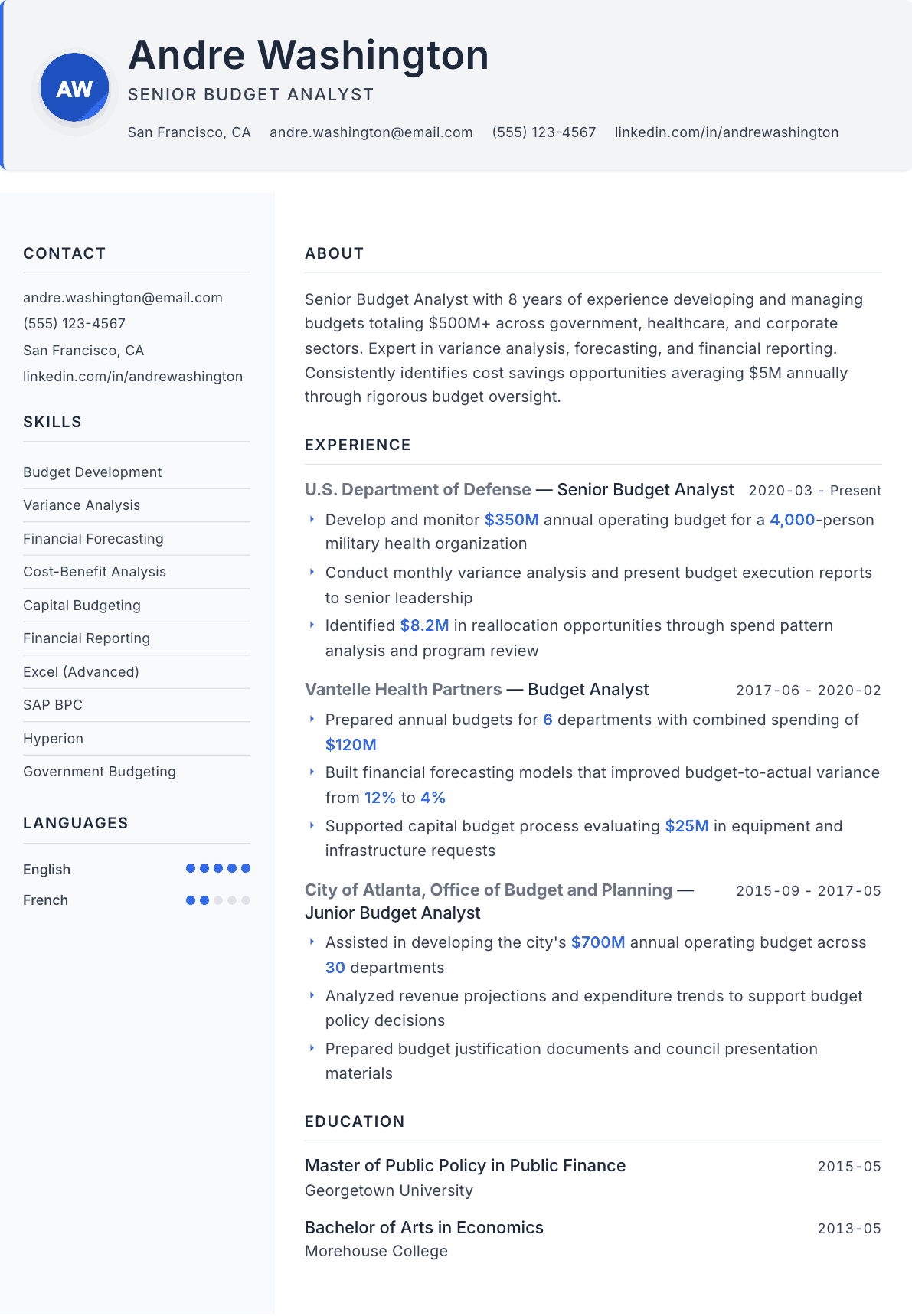
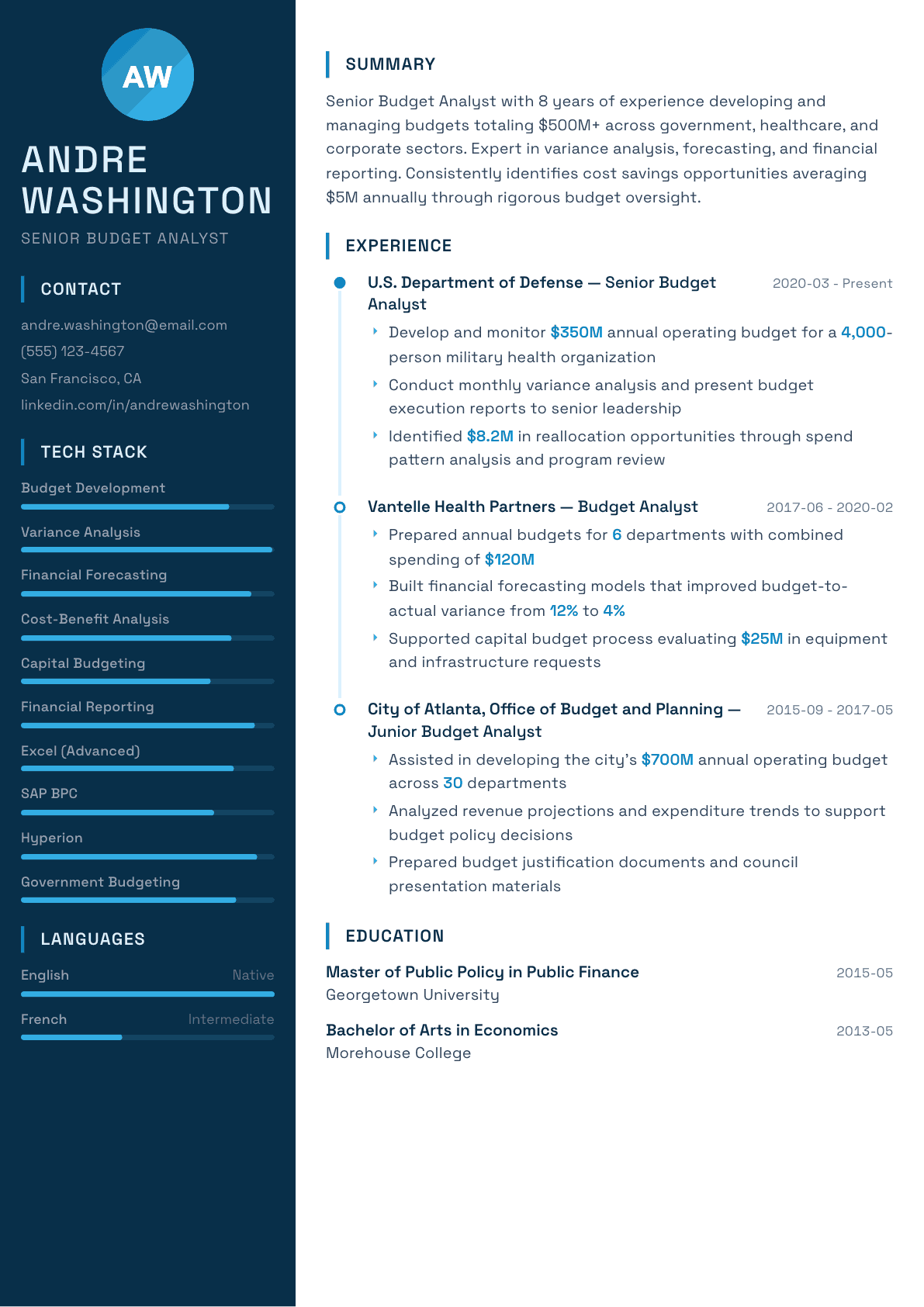
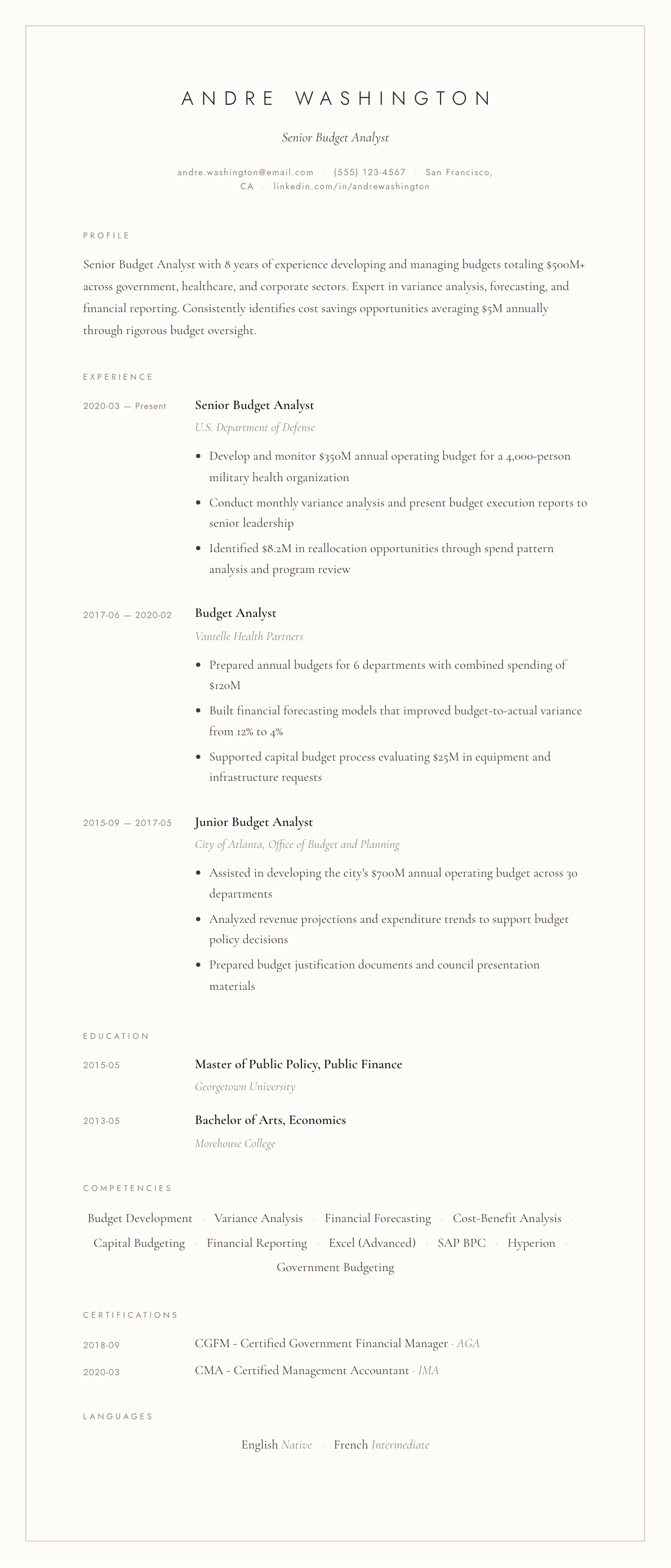
Example Budget Analyst summary
CGFM-certified Senior Budget Analyst with 8 years of experience developing and managing $500M+ budgets across government and healthcare sectors. Improved budget-to-actual variance from 12% to 4% and identified $5M+ in annual cost savings. Seeking a Budget Director role to lead financial planning and resource allocation.
Skills to list on a Budget Analyst resume
- Budget Development
- Variance Analysis
- Financial Forecasting
- Cost-Benefit Analysis
- Capital Budgeting
- Financial Reporting
- Excel (Advanced)
- SAP BPC
- Hyperion Planning
- Anaplan
- Government Budgeting
- Revenue Forecasting
- Program Evaluation
What actually gets this resume read
- Quantify total budget sizes you have developed or monitored.
- Show variance analysis improvements and cost savings identified.
- Highlight forecasting accuracy improvements with specific metrics.
- Include budget tools and ERP systems: SAP BPC, Hyperion, Adaptive Insights, Anaplan.
- Demonstrate experience across budget types: operating, capital, grant, program.
- Government budget experience should reference specific funding regulations if applicable.
How to write a budget analyst resume
A budget analyst resume is read by someone who lives inside an annual cycle. Whether the employer is a federal agency, a school district, a hospital system or a corporate planning team, the reader wants to know which parts of that cycle you have personally run: the call for estimates, the build, the review hearings or executive challenge sessions, the adopted budget document, the monthly monitoring, the reprogramming and the closeout.
The sector matters more here than in almost any other finance role. Government budget analysts work with appropriations, funds, object codes, encumbrances and legislative deadlines. Corporate budget analysts work with cost centers, driver based models, forecast reforecasts and a chief financial officer who wants a variance explanation by Wednesday. A resume that does not signal which world you come from will be filtered out by both.
This guide covers section order for a budget analyst resume, how to write budget size and variance work without inflating either, five bullet rewrites that show analytical ownership, and the questions analysts ask when they move between the public and private sides of the same craft.
Format: one page early, sector signals in the first three lines
One page until roughly eight years, two after. Reverse-chronological and plain, since public sector application systems are usually the least forgiving parsers a candidate will meet. If you are applying to a federal posting, the resume format expected there is longer and more detailed than a private sector one, and the same document rarely serves both.
Signal the sector immediately. Words like appropriation, fund balance, encumbrance, continuing resolution and object class place you in government instantly; cost center, driver based planning, reforecast and headcount planning place you in a company. Use the vocabulary of the employer you are writing to.
- Header: name, city and state, phone, email, and a budgeting credential if you hold one.
- Order: summary, budget experience, systems and modeling skills, education, certifications.
- Each role names the total budget under your analysis, the fund or department count, and the cycle you supported.
Summary: budget size, unit count, cycle role
Three facts carry the summary: how large a budget you analyzed, how many departments, funds or cost centers were in your portfolio, and which part of the cycle you owned. A budget analyst who builds the operating budget for eleven departments is a different candidate from one who monitors execution against an already adopted plan.
Add the analytical specialty if you have one. Position and personnel cost forecasting, capital and multi year project budgeting, grant budgeting with matching and indirect cost requirements, or revenue estimation are all recognizable specialisms that separate you from a general analyst.
Experience: build, monitor, explain, decide
Structure each role around the four things a budget analyst does. You build: gathering requests, testing assumptions, challenging department estimates and consolidating a submission. You monitor: tracking obligations and expenditures against plan and calling out an emerging overrun early. You explain: producing the variance narrative that survives an executive or a council question. You support decisions: pricing options, modeling a hiring freeze, or costing a service change.
Explanation work is where budget analysts prove themselves and where most resumes go quiet. Say what you found and what happened next. Discovering a personnel forecast that missed the effect of a vacancy rate assumption, or a department that had encumbered but never expended a major contract, is real analysis with a real consequence.
Name the deliverables. A budget book, a five year forecast, a decision package, a request for proposal cost analysis, a monthly budget to actual report, a fiscal note, or a board or council presentation all tell the reader the level of visibility your work reached.
Systems and modeling: the tools, and the depth in each
Name the budgeting platform, not just the spreadsheet. Public sector systems include Tyler Munis, Workday Financials, Oracle PeopleSoft, Questica and Infor. Corporate planning tools include Anaplan, Adaptive Planning, Oracle Hyperion and SAP Analytics Cloud. Federal analysts should name the systems and formats their agency used for budget formulation and execution.
Then be exact about your modeling depth. Building a personnel cost model with position level detail, salary steps, vacancy assumptions and fringe rates is a different claim from maintaining a template someone else designed. Say which, and add the data skills that support it, such as advanced Excel, Power Query, SQL against the financial system, and reporting in Power BI or Tableau.
Keywords a budget analyst posting will contain
Expect and mirror these: budget development, budget execution, variance analysis, forecasting, cost benefit analysis, capital budgeting, position control, appropriation, encumbrance, financial reporting, spending plan, resource allocation and management reporting. Use each once in the skills area, then let the experience section carry it with a real example so the reader sees the phrase attached to work.
Budget Analyst resume summary examples
Budget analyst I
Public administration graduate with an agency internship supporting budget preparation, plus a year of accounting technician work reconciling expenditures against appropriations. Skilled in advanced Excel, comfortable in Tyler Munis, and seeking an entry budget analyst position in a city or county finance office.
Five years in
Budget analyst supporting 9 departments and a general fund operating budget of roughly 400 million dollars, owning the annual build, the personnel cost model and the monthly budget to actual reporting. Prepares fiscal notes and decision packages and presents variance findings to department directors each quarter.
Senior or lead budget analyst
Senior budget analyst leading the operating and capital budget process across 17 departments and 6 funds, supervising two analysts and producing the adopted budget document. Rebuilt the five year forecast model, improved the accuracy of the personnel projection, and presents the recommended budget to the council annually.
Work experience bullets: before and after
Before: Assisted with the preparation of the annual budget.
After: Consolidated budget requests from 9 departments into the recommended operating budget, challenged 24 expansion requests against historical spending, and produced the adopted budget document on the statutory deadline.
Department count, the challenge work and the deadline show ownership of the build rather than assistance with it.
Before: Performed variance analysis on a monthly basis.
After: Produced the monthly budget to actual report for a portfolio of roughly 400 million dollars, flagged departments trending above plan by the fourth month, and wrote the variance narrative presented to the finance director.
Portfolio size, the early warning timing and the named audience turn routine reporting into a control you operated.
Before: Built financial models in Excel.
After: Built a position level personnel cost model covering 1,400 budgeted positions with salary step progression, vacancy assumptions and fringe rates, replacing a department level average that had understated the payroll line.
The model structure and the flaw it fixed prove modeling skill instead of naming a spreadsheet program.
Before: Identified cost savings for the department.
After: Analyzed three years of overtime by division, traced the growth to unfilled positions in two units, and costed a recruitment plan that the department adopted in place of the requested budget increase.
The chain from analysis to root cause to an adopted alternative is what a budget office is actually paid to produce.
Before: Worked with grant funding.
After: Budgeted 12 federal and state grants including matching requirements and indirect cost recovery, tracked expenditure against period of performance, and closed out two awards with no questioned costs.
Grant count, the compliance features and a clean closeout show you can handle restricted funding without creating findings.
Hard skills
- Operating budget development
- Capital and multi-year project budgeting
- Budget execution and expenditure monitoring
- Variance and trend analysis
- Personnel cost and position control modeling
- Revenue estimation and forecasting
- Cost-benefit and fiscal impact analysis
- Grant budgeting and indirect cost recovery
- Encumbrance and appropriation accounting
- Anaplan, Adaptive Planning and Hyperion
- Tyler Munis, Workday and Oracle PeopleSoft
- Advanced Excel, Power Query and Power BI
Soft skills
- Saying no to a department with data
- Written narrative for non-financial readers
- Presenting to elected officials or executives
- Working to statutory deadlines
- Neutrality between competing units
Certifications worth listing
- Certified Government Financial Manager (CGFM) (Association of Government Accountants)
- Certified Public Finance Officer (CPFO) (Government Finance Officers Association)
- Certified Management Accountant (CMA) (Institute of Management Accountants)
- Chartered Financial Analyst (CFA) (CFA Institute)
Mistakes that cost budget analyst candidates the interview
- Not naming the budget size, which leaves a reader unable to tell a small program portfolio from an enterprise fund.
- Using corporate planning vocabulary in a government application, or the reverse, so the file reads as sector unaware.
- Describing budget monitoring without a single example of an overrun you caught before it became a supplemental request.
- Listing Excel as the modeling skill while the posting names a planning platform the resume never mentions.
- Claiming savings that were policy decisions made by others, when the defensible claim is the analysis that supported them.
- Omitting the presentation and narrative work, which is how a budget analyst earns influence beyond the spreadsheet.
Budget Analyst resume questions
What budget size should a budget analyst put on a resume?
Use the portfolio you personally analyzed rather than the whole organization total. If you supported four departments inside a much larger agency, give both figures separately so the scope is honest and the scale is still visible.
How is a government budget analyst resume different from a corporate one?
Government resumes are longer and more procedural, naming funds, appropriations, object codes, statutory deadlines and the adopted budget document. Corporate versions emphasize driver based models, reforecast cycles, cost center ownership and the speed of the monthly variance explanation.
Do I need the CGFM to work in public budgeting?
No, it is not a requirement for most positions, but it signals commitment to the public finance track and helps at senior levels. A public administration or accounting degree plus demonstrated cycle ownership usually carries more weight for a first move.
How do I show forecasting accuracy without inventing a number?
Point to something recorded. The size of the year end variance against your projection, the number of supplemental appropriations required, or a reduction in reforecast swings across quarters all come from documents that exist and can be discussed in an interview.
Can a budget analyst move into financial planning and analysis?
Yes, and the overlap is large. Reframe the annual build as planning cycles, monitoring as monthly close support, and fiscal notes as business case analysis. Add any driver based modeling and any planning platform experience, since those are the two things corporate teams screen for.
Related resume examples
- Financial Analyst Resume example
- Revenue Analyst Resume example
- Controller Resume example
- FP&A Analyst Resume example
- Finance Manager Resume example
- Cost Accountant Resume example