Cost Accountant Resume Examples: the lines they read
Write a Cost Accountant Resume Around Standard Costing
By Mustafa Tarabya, founder of CVBooster · Published · Updated
A cost accountant resume example with variance analysis, standard cost rolls and inventory bullets, plus the manufacturing keywords recruiters filter on.
Sample resumes for a cost accountant
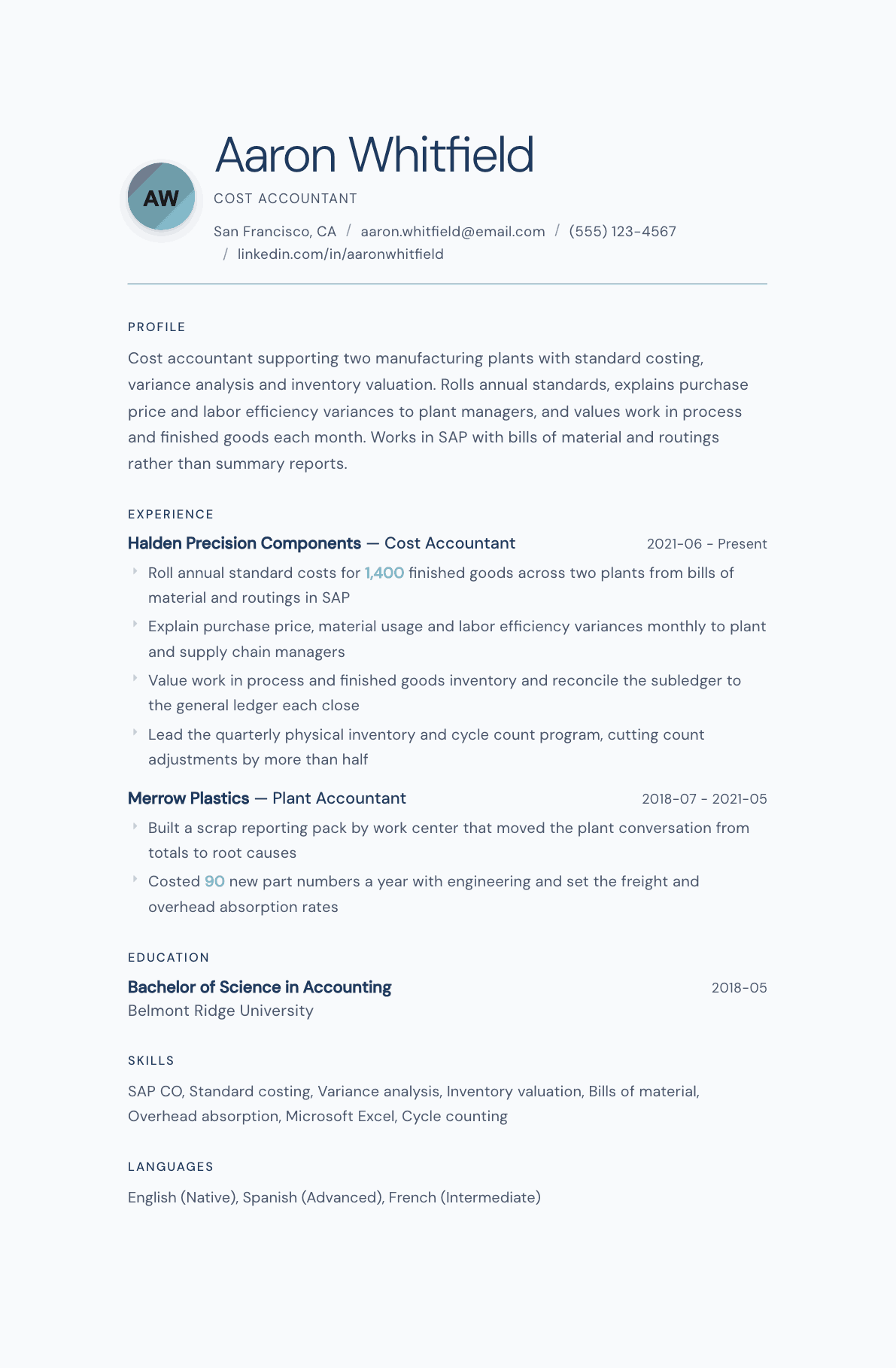
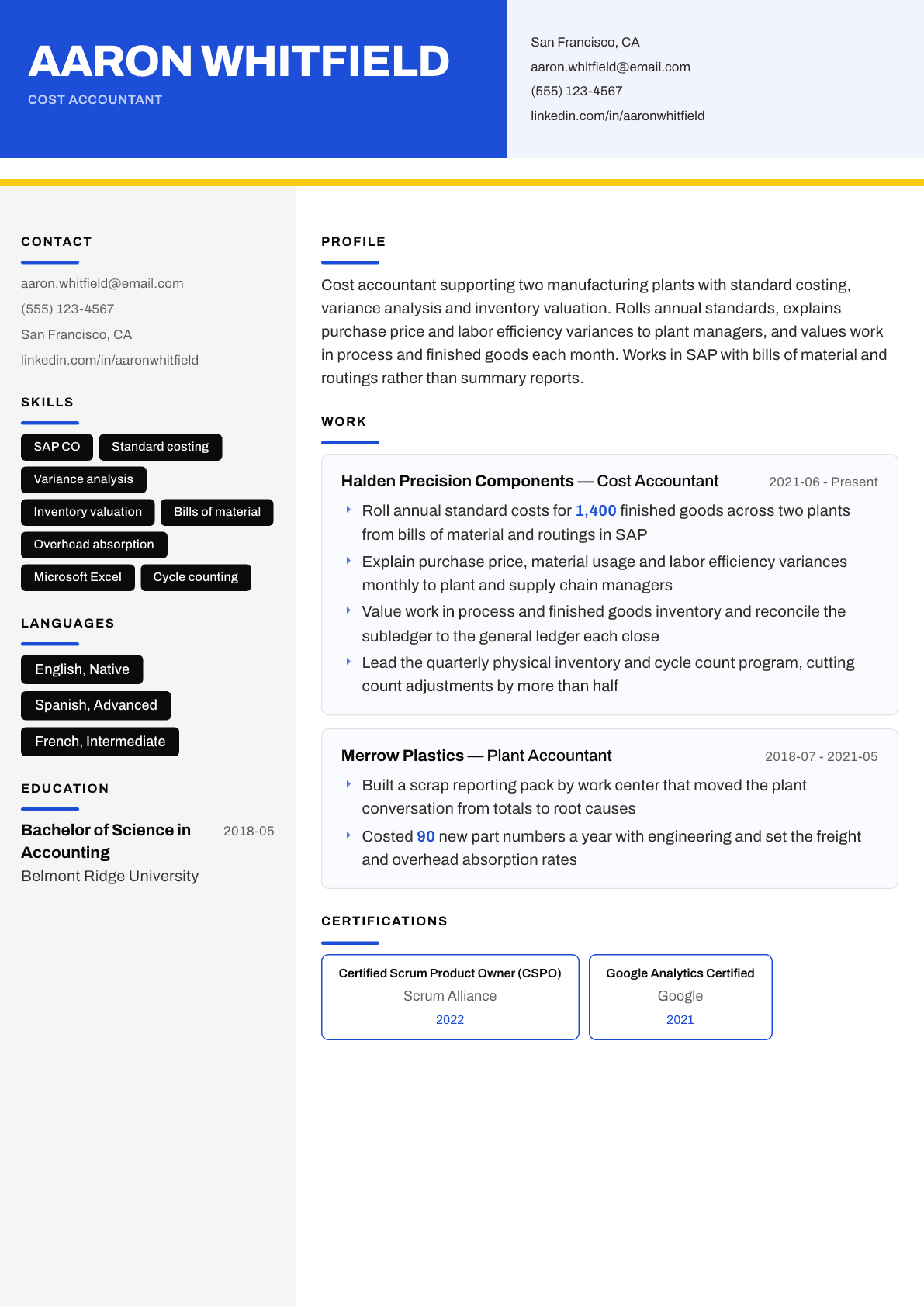
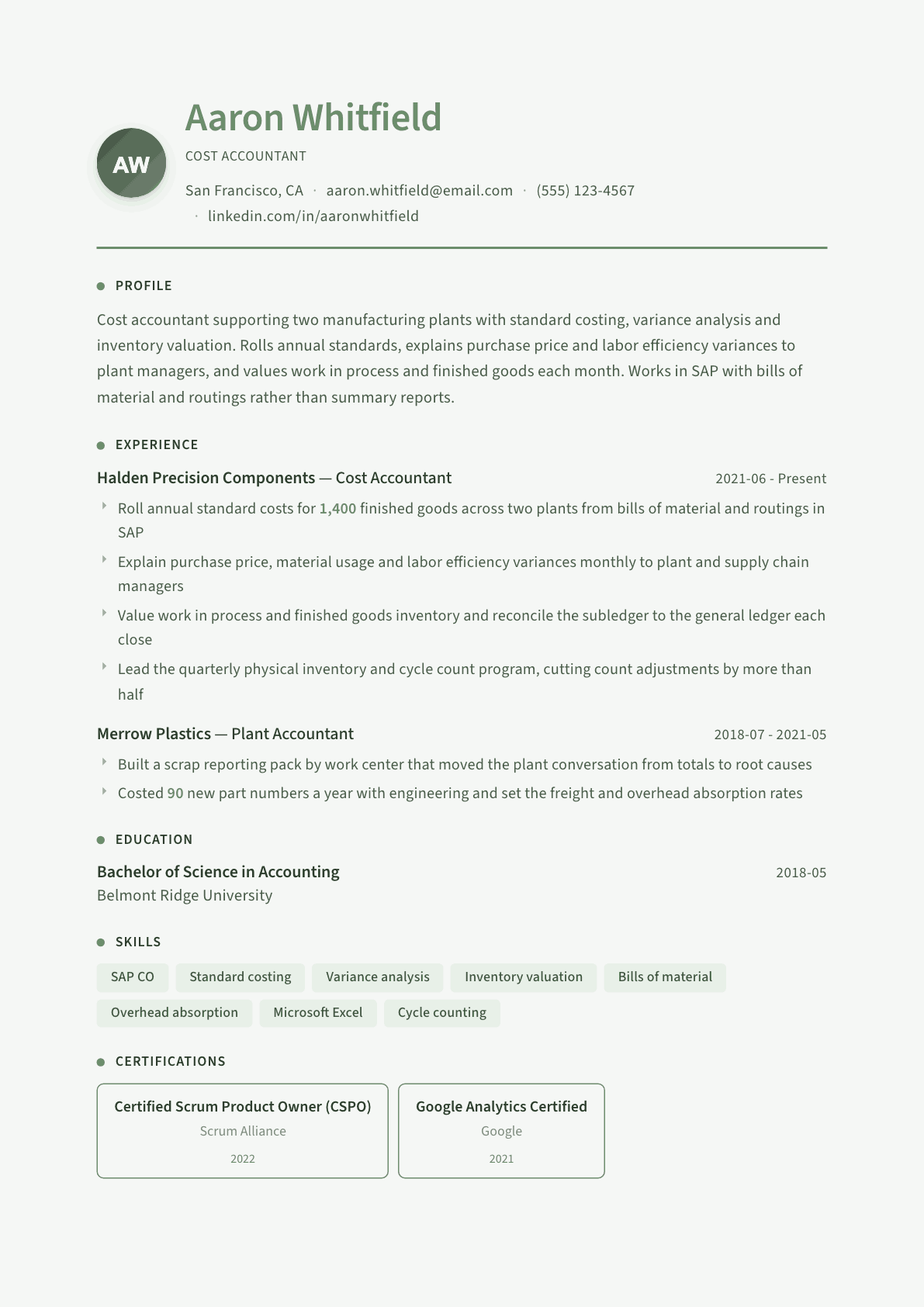
The same cost accountant content laid out in three CVBooster templates, so you can see what the finished document looks like before you write a word.
Example Cost Accountant summary
Cost accountant with five years supporting two manufacturing plants in SAP. Rolls annual standards for 1,400 finished goods from bills of material and routings, explains purchase price and labor efficiency variances to operations, and values work in process and finished goods each month. Owns the physical inventory and cycle count program and cut count adjustments by more than half.
Skills to list on a Cost Accountant resume
- Standard costing
- Variance analysis
- Inventory valuation
- Bills of material and routings
- Overhead absorption
- Work in process accounting
- Cycle counting
- Physical inventory
- Margin analysis
- Capital project support
- SAP CO
- Oracle Cost Management
- Microsoft Excel
- Manufacturing account reconciliation
What actually gets this resume read
- Say which costing method you run, standard, actual or activity based, because plants hire for their own method.
- Name the variances you explain, since purchase price and labor efficiency are the daily language of this job.
- Show the size of the item master you cost, in part numbers or bills of material rolled each year.
- Include physical inventory and cycle count ownership, which separates a cost accountant from a general one.
- State the ERP module you live in, as SAP CO and Oracle Cost Management are screened as distinct skills.
- Add the operations audience you present to, because credibility with plant managers is part of the hiring test.
How to write a cost accountant resume
A cost accountant resume is read by a plant controller who needs someone able to stand in front of an operations team and explain why the margin moved. The accounting is only half of it. The other half is knowing how a product is actually made, which is why bills of material, routings, work centers and scrap belong on the page as prominently as the journal entries.
Employers separate candidates on costing method first. A plant running standard costing with annual rolls hires differently from one running actual or activity based costing, and a resume that never names the method forces the reader to guess. The same applies to the ERP module, because SAP CO, Oracle Cost Management and a mid-market inventory module are not interchangeable skills.
This guide covers how to present costing method and system, how to write variance work so an operations audience is visible in it, and the inventory ownership that distinguishes a cost accountant from a general accountant who happens to work at a factory.
Lead with method, system and the size of what you cost
The summary should carry four facts: years in cost accounting, the costing method, the ERP module, and the size of the item master or the number of plants you support. A line naming standard costing across two plants for fourteen hundred finished goods in SAP places you immediately.
Follow with a competencies block that repeats the costing vocabulary the posting uses, then experience. Keep education and any credential at the bottom unless you hold a management accounting certification, which is worth moving up because it is directly relevant to this discipline.
- Summary: method, ERP module, plant count, item master size, and the audience you report to.
- Competencies: variance names, inventory valuation, absorption, cycle counting, margin analysis.
- Experience: what you rolled, what you explained, what you counted and what you fixed.
Write variances by name, with the audience attached
Say which variances you own: purchase price, material usage, labor rate, labor efficiency, overhead spending, volume and mix. Naming them is the fastest technical signal on the page, because a candidate who has never explained a labor efficiency variance to a supervisor will not use the phrase naturally.
Then attach the audience. Explaining variances to a plant manager, a supply chain lead or a production supervisor is a different exercise from putting them in a report for the controller, and employers hire for the version they need. If you presented in a monthly operations review, say so, because that is a credibility test many accountants fail.
Standard cost rolls and the bill of material
The annual roll is the signature project of this role. Describe the scope: how many finished goods and components, how the material, labor and overhead rates were set, who you worked with in engineering and purchasing, and how the revaluation hit the balance sheet at cutover.
Add the maintenance work that surrounds it. New part costing with engineering, routing updates when a process changes, freight and overhead absorption rate setting, and the review of items whose standards have drifted from actual. This is the work a plant controller most wants covered, and it is often left off entirely.
Inventory: valuation, work in process and the physical count
Inventory ownership is what makes the role an accounting job rather than an analyst job. Write the monthly valuation of raw material, work in process and finished goods, the subledger to general ledger reconciliation, the reserve for excess and obsolete stock, and how you treat scrap and rework.
Then the count program. Whether you run a full physical inventory or a cycle count schedule, say the frequency, the accuracy standard, and what happened to adjustments over time. A cost accountant who reduced count adjustments has evidence of influence on the shop floor, not only on the ledger.
Keywords manufacturing finance teams search
Expect these terms in the posting and mirror them precisely: standard costing, purchase price variance, labor efficiency variance, overhead absorption, bill of materials, routings, work in process, inventory valuation, excess and obsolete reserve, cycle counting, physical inventory, margin analysis and cost of goods sold. Put the ERP module name beside them, since that is frequently the first filter applied.
Cost Accountant resume summary examples
Moving into cost from general accounting
Staff accountant at a manufacturer with two years of inventory reconciliation, scrap reporting and cycle count support. Comfortable reading bills of material and routings, and prepared the monthly work in process valuation for review. Seeking a cost accountant seat with standard cost roll responsibility.
Five years in a plant
Cost accountant supporting two plants in SAP, rolling annual standards for 1,400 finished goods from bills of material and routings. Explains purchase price, material usage and labor efficiency variances in the monthly operations review, values work in process and finished goods, and leads the cycle count program.
Cost manager
Cost accounting manager for four plants across two countries, owning the standard cost calendar, absorption rates and the excess and obsolete reserve. Leads two cost accountants, sets the count accuracy standard, and supports capital appropriation requests with payback and unit cost analysis.
Work experience bullets: before and after
Before: Maintained standard costs in the ERP.
After: Rolled annual standard costs for 1,400 finished goods across two plants from bills of material and routings in SAP, coordinating rate inputs with engineering and purchasing.
The item count, the source data and the departments involved show the real scope of a cost roll.
Before: Analyzed manufacturing variances.
After: Explained purchase price, material usage and labor efficiency variances each month in the plant operations review and traced the largest to specific work centers.
Named variances plus a live audience prove the work went beyond a report nobody discussed.
Before: Responsible for inventory accounting.
After: Valued raw material, work in process and finished goods monthly and reconciled the inventory subledger to the general ledger before close.
Listing the three inventory stages and the reconciliation makes the ownership specific and checkable.
Before: Participated in physical inventory counts.
After: Led the quarterly physical inventory and the weekly cycle count schedule, cutting count adjustments by more than half over two quarters.
Leading rather than participating, with an adjustment trend, shows influence on the shop floor.
Before: Costed new products.
After: Costed 90 new part numbers a year with engineering, setting material, labor and freight absorption assumptions before the first production run.
A yearly count and the assumptions you set demonstrate the judgment behind new product costing.
Hard skills
- Standard cost development and rolls
- Variance analysis
- Bills of material and routings
- Overhead absorption rates
- Work in process valuation
- Excess and obsolete reserve
- Cycle counting and physical inventory
- Inventory subledger reconciliation
- Margin and product profitability analysis
- SAP CO
- Oracle Cost Management
- Microsoft Excel
Soft skills
- Explaining cost to operators
- Walking a production floor
- Challenging a routing assumption
- Working with engineering on new parts
- Standing behind a number in a review
Certifications worth listing
- Certified Management Accountant (CMA) (Institute of Management Accountants)
- Certified Public Accountant (CPA) (State Boards of Accountancy)
- Certified in Planning and Inventory Management (CPIM) (Association for Supply Chain Management)
- SAP Certified Associate: Management Accounting (SAP)
Mistakes that cost cost accountant candidates the interview
- Never naming the costing method, which forces a plant controller to guess whether you fit the environment.
- Writing variances as a single word when the posting is looking for purchase price and labor efficiency by name.
- Leaving out inventory valuation and the count program, the two areas that define ownership in this role.
- Describing the ERP generically instead of the costing module you configure and pull data from.
- Presenting only reports and never an operations audience, which reads as an analyst rather than a plant partner.
- Skipping new part costing and routing maintenance, the ongoing work every plant controller needs covered.
Cost Accountant resume questions
How do I move from general accounting into cost accounting?
Pull every manufacturing touch point you already have to the front: inventory reconciliation, scrap reporting, cycle counts and any exposure to bills of material. Then name the costing method your employer uses so the reader can place your background.
Does the ERP matter more than the accounting for a cost role?
Neither alone gets you hired, but the ERP module is often the first filter. Name the module, then show the accounting judgment underneath it, because a plant can teach navigation faster than it can teach cost logic.
Should I include capital project and payback work?
Yes, when you supported appropriation requests with unit cost or payback analysis. Cost accountants are frequently asked to justify equipment purchases, and that work distinguishes you from a pure inventory accountant.
How much detail should I give about the products I costed?
Enough to convey complexity: the industry, the number of part numbers, whether assemblies are multi level, and whether production runs to order or to stock. Product names matter less than the structure of the bill of material.
Is a cost accountant resume different for a job at a smaller plant?
Yes, because smaller sites expect one person to cover costing, inventory, fixed assets and often the close. Broaden the resume to show that range rather than presenting yourself as a narrow specialist in a single module.
Related resume examples
- Accountant Resume example
- Financial Analyst Resume example
- Staff Accountant Resume example
- Accounting Manager Resume example
- Budget Analyst Resume example
- Senior Accountant Resume example