Revenue Analyst Resume Examples: the lines they read
Build a Revenue Analyst Resume That Drives Top-Line Growth
By Mustafa Tarabya, founder of CVBooster · Published · Updated
Create a revenue analyst resume highlighting revenue forecasting, pricing analysis, and business intelligence with data-driven insights that increase revenue.
Sample resumes for a revenue analyst
The same revenue analyst content laid out in three CVBooster templates, so you can see what the finished document looks like before you write a word.
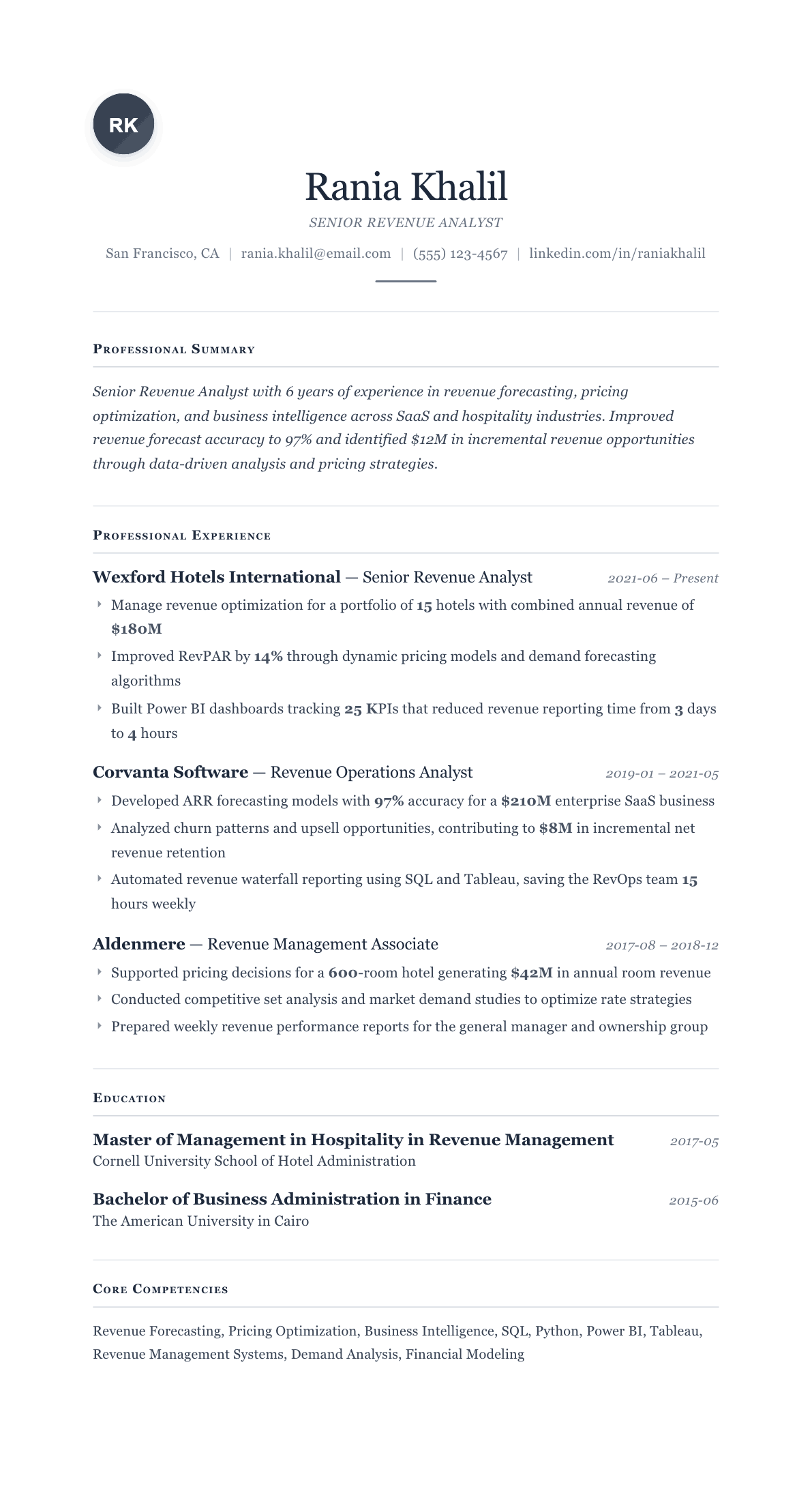
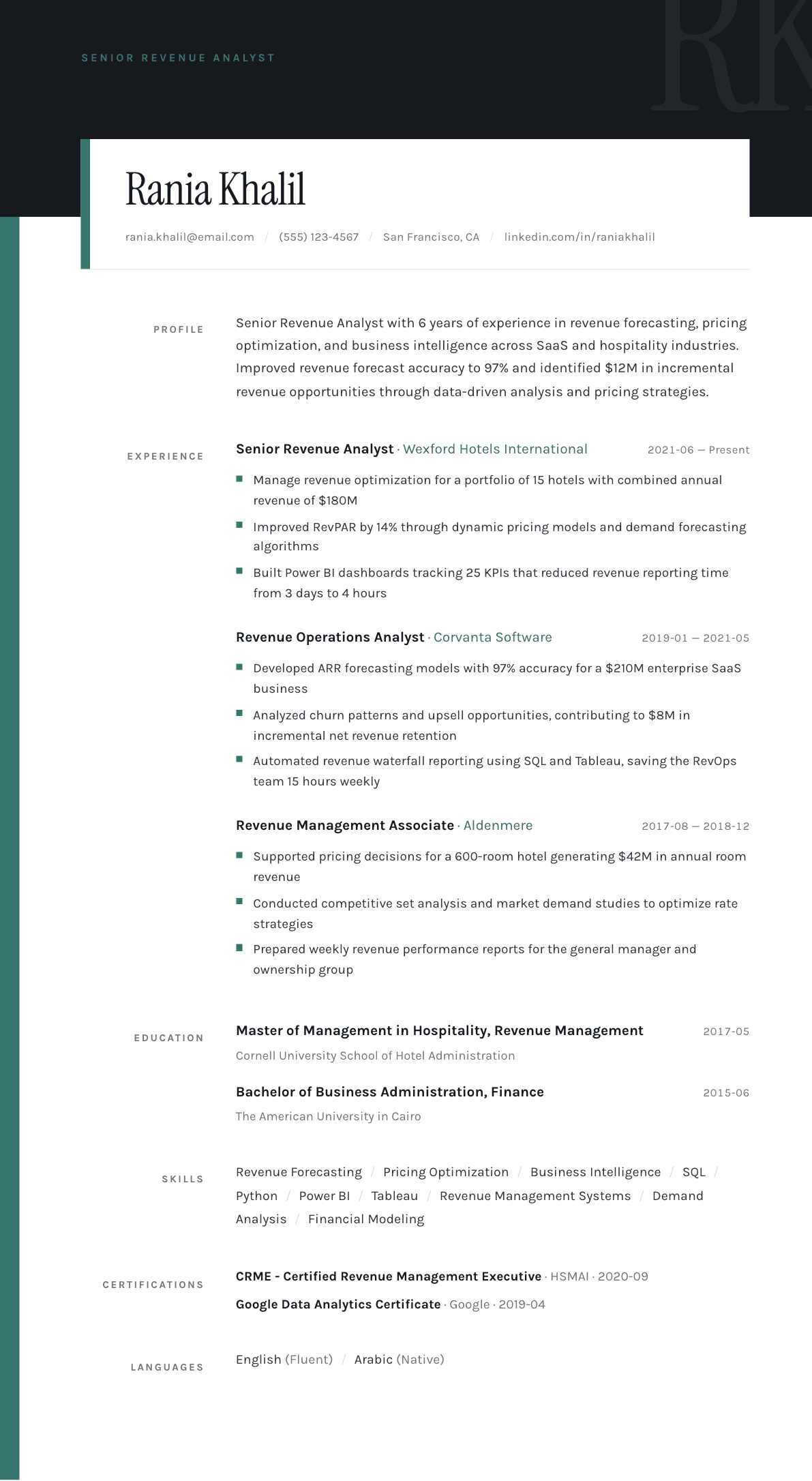
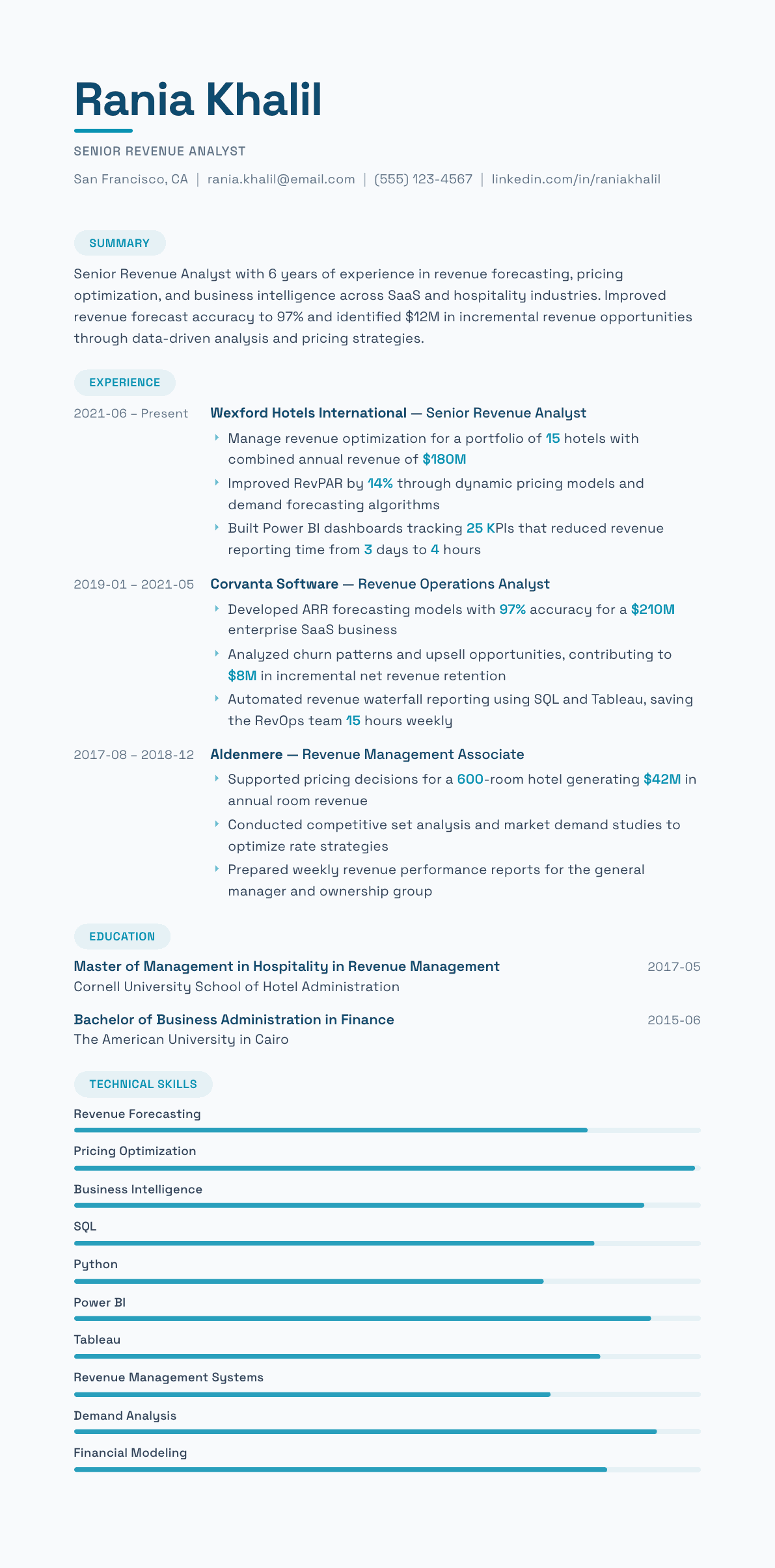
Example Revenue Analyst summary
Senior Revenue Analyst with 6 years of experience driving revenue optimization across SaaS and hospitality. Improved forecast accuracy to 97% and identified $12M in incremental revenue through pricing analytics and demand modeling. Expert in SQL, Python, and Power BI. Seeking a Director of Revenue Strategy role to lead data-driven revenue growth.
Skills to list on a Revenue Analyst resume
- Revenue Forecasting
- Pricing Optimization
- Business Intelligence
- SQL
- Python
- Power BI
- Tableau
- Revenue Management
- Demand Analysis
- Financial Modeling
- Competitive Analysis
- Data Visualization
- Excel (Advanced)
What actually gets this resume read
- Quantify revenue improvements, forecast accuracy, and incremental revenue identified.
- Highlight analytical tools: SQL, Python, R, Tableau, Power BI, Looker.
- Show experience with pricing strategies, demand forecasting, and revenue optimization.
- Include industry-specific metrics: RevPAR, ARR, NRR, ARPU, churn rate.
- Demonstrate ability to translate data insights into actionable business recommendations.
- Include revenue management systems specific to your industry.
How to write a revenue analyst resume
Revenue analyst means something different in each industry that uses the title, and the resume has to declare which one you are within the first two lines. In hotels and airlines it is pricing and inventory: you set rates against demand, manage overbooking and channel mix, and live in a revenue management system. In software it is bookings, renewals and net revenue retention. In retail and consumer goods it is promotional effectiveness, trade spend and price elasticity. In healthcare it is the revenue cycle, which is a different job entirely.
Once the reader knows your flavor, she screens for three things: whether you own a forecast that gets graded, whether you can get to the data yourself, and whether a pricing or mix decision has ever moved because of your work. Revenue teams are full of people who produce reports. They are short of people who produce decisions.
This guide covers the structure that fits revenue analysis, three summaries at different levels, before and after bullets, and the metric discipline that keeps a revenue resume credible.
Format: declare the industry, then the tooling, then the ownership
One page under about six years and two beyond. Immediately under the header, give the business context: industry, revenue scale, the unit you priced or forecast, and the systems. Revenue analysis is only legible with that context, since a rate decision for 400 hotel rooms and a renewal forecast for a subscription book share almost no vocabulary.
Give the technical stack its own block. Revenue roles increasingly screen on whether you write your own queries, and putting SQL, the warehouse, the business intelligence layer and the revenue or pricing system in one place makes that quick to confirm.
- Header: name, city and state, phone, email, and a portfolio or dashboard link only if it contains no confidential data.
- Order: summary, technical skills, experience, metrics owned, education and certifications.
- Career changers from finance or operations add a line naming the analytics coursework or pricing training completed.
Summary: the revenue you touched and the lever you pulled
Say the revenue base you worked against and the lever you actually controlled. Setting rates is a lever. Approving discount exceptions is a lever. Recommending a promotional calendar is a lever. Producing the weekly revenue pack is not a lever, and calling it one in an interview will be noticed.
Name the metrics your business is judged on, using their real names. Revenue per available room, average daily rate and occupancy in lodging. Annual recurring revenue, net revenue retention, average revenue per user, churn and expansion in subscription. Sell through, promotional lift, trade spend efficiency and price realization in consumer goods. Using the right vocabulary is the fastest proof that you have worked in the industry rather than around it.
Experience: forecast accuracy, pricing decisions, and the recovery
Structure bullets around three things a revenue leader cares about. Forecast quality: what you forecast, at what grain, at what horizon, and how accurate it was measured against actuals. Pricing and mix: the analyses that changed a price, a promotion, a channel allocation or a discount policy, and what happened afterward. Recovery: revenue you found that was being lost, whether through leakage, unbilled usage, wrong contract terms, expired rates, or a channel taking margin nobody had checked.
State the grain explicitly, because it is the difference between a hard forecast and an easy one. Forecasting total company revenue for a quarter is not the same job as forecasting by property, by rate class and by day, and a resume that hides the grain reads as though it was the easy version.
Be careful with attribution. Revenue is influenced by many things at once, so write that your analysis supported or preceded a change rather than claiming the whole lift, and say how you controlled for the obvious alternatives. A hiring manager who tests analytical honesty in the interview will find it either way.
Technical skills: get to the data yourself
Name the warehouse and the query language, not just the dashboard. Working knowledge of SQL across a warehouse such as Snowflake, BigQuery or Redshift, and the ability to build a clean model in the business intelligence layer, is what separates an analyst who can answer a new question in an afternoon from one who has to file a request. Add Python or R if you use them for elasticity work, forecasting or cohort analysis, and say what you built with them.
Then the operational systems: the revenue management system in travel, the billing and subscription platform in software, the customer relationship manager where pipeline lives, the enterprise resource planning system where invoiced revenue lands, and the planning tool where the forecast is submitted. Also state the revenue recognition context if you work near it, since a revenue analyst who understands the difference between bookings, billings, invoiced revenue and recognized revenue is markedly more useful than one who does not.
Metrics discipline and the keywords in the posting
Define any number you print. A resume that says forecast accuracy improved without stating the measure, the grain and the horizon invites the interviewer to unpick it. State the measure you used, such as mean absolute percentage error at a monthly grain, and give the before and the after. Analysts are hired on rigor and the resume is the first sample of it.
Postings recycle a predictable vocabulary: revenue forecasting, pricing strategy, demand analysis, elasticity, channel mix, promotional analysis, revenue leakage, variance to plan, cohort analysis, dashboard development, and the industry metric set. Mirror the terms the posting uses and attach each to something you did.
Revenue Analyst resume summary examples
First analyst role
Business analytics graduate with an internship on a hotel revenue team, where I rebuilt the weekly pace report in SQL and Power BI for a 12 property cluster. Comfortable with elasticity basics, forecasting and demand calendars. Seeking a revenue analyst seat in hospitality or subscription software.
Four years in
Revenue analyst for a subscription software business at roughly 90 million annual recurring revenue, owning the renewal and expansion forecast at segment grain and the monthly net revenue retention pack. Built the churn cohort model in SQL and Looker that now drives the customer success outreach list.
Senior revenue analyst
Senior revenue analyst with seven years across hospitality and consumer goods, owning pricing and demand forecasting for a 200 million portfolio. Runs the promotional effectiveness framework, sets rate strategy with the commercial team, and has cut forecast error at weekly grain by nearly half over two years.
Work experience bullets: before and after
Before: Created revenue forecasts for the business.
After: Owned the weekly revenue forecast at property and rate class grain across 12 hotels on a 90 day horizon, cutting mean absolute error from 11% to 6% over four quarters.
The grain, the horizon and a named error measure make a forecast claim testable instead of decorative.
Before: Analyzed pricing and made recommendations.
After: Ran a price elasticity study across three product tiers using two years of transaction data, and recommended a tier restructure that the commercial team adopted for the following pricing cycle.
Naming the method, the data span and the decision that followed shows analysis with consequences.
Before: Built dashboards for the revenue team.
After: Replaced four conflicting spreadsheets with a single Looker model over the Snowflake warehouse, giving sales, finance and customer success one definition of net revenue retention.
Ending a metric disagreement is a bigger contribution than building another dashboard, and the bullet says so.
Before: Identified opportunities to increase revenue.
After: Found unbilled overage usage on 140 subscription accounts by reconciling platform usage records against the billing system, and worked with revenue operations to correct the contract terms at renewal.
Revenue leakage found through a specific reconciliation is concrete, credible and easy to picture.
Before: Reported on monthly revenue performance.
After: Produced the monthly revenue review for the commercial leadership team: variance to plan by channel and segment, the drivers behind each gap, and the actions the team agreed for the following month.
Naming the audience and the actions turns a reporting task into a decision forum you support.
Hard skills
- Revenue forecasting and pace analysis
- Pricing and elasticity analysis
- Demand and capacity modeling
- Cohort and churn analysis
- Promotional and discount effectiveness
- Channel and product mix analysis
- Variance to plan reporting
- SQL on Snowflake or BigQuery
- Power BI, Tableau and Looker
- Python or R for forecasting
- Revenue management and billing systems
- Bookings to recognized revenue bridges
Soft skills
- Translating analysis into a recommendation
- Challenging a commercial assumption politely
- Working to a weekly trading rhythm
- Defining a metric everyone can agree on
- Presenting to commercial leadership
- Curiosity about why a number moved
Certifications worth listing
- Certified Revenue Management Executive (CRME) (Hospitality Sales and Marketing Association International)
- Certified Hospitality Revenue Manager (CHRM) (American Hotel and Lodging Educational Institute)
- Certified Management Accountant (CMA) (Institute of Management Accountants)
- Microsoft Certified: Power BI Data Analyst Associate (Microsoft)
- Tableau Certified Data Analyst (Tableau)
Mistakes that cost revenue analyst candidates the interview
- Never saying which kind of revenue analysis you do, so a hospitality reader and a subscription reader both put the file down.
- Reporting forecast accuracy with no grain, horizon or error measure, which an experienced interviewer will take apart in two questions.
- Claiming a revenue lift that many factors produced. Say what your analysis showed and what decision followed it.
- Listing dashboard tools without SQL, which suggests you consume data someone else prepares rather than reaching it yourself.
- Using generic finance language instead of the industry metric names your reader uses daily.
- Filling the page with reporting duties. A revenue analyst is hired for the decisions the reporting supports, not the report itself.
Revenue Analyst resume questions
What is the difference between a revenue analyst and a financial analyst?
A financial analyst usually owns the full profit and loss view, including costs and planning. A revenue analyst owns the top line in depth: pricing, demand, mix, retention and the drivers behind each, often in a weekly commercial rhythm rather than a monthly close cycle.
How do I show forecast accuracy credibly?
State what you forecast, at what grain, over what horizon, which error measure you used, and the before and after figures. Add how often the forecast was refreshed. Without those details a reader cannot tell whether the improvement was real or definitional.
Do I need SQL for a revenue analyst job?
For most modern teams, yes. Even where an analytics team exists, the analysts who get promoted are the ones who can pull and shape their own data rather than waiting in a queue, and postings increasingly list it as a requirement rather than a preference.
How do I move into revenue analysis from hotel operations?
Lead with the commercial work you already did: rate loading, group quoting, channel management, pace reviews and demand calendars. Then add the analytical layer you have built, such as SQL, forecasting or a rebuilt reporting model, because that is the part employers cannot assume.
Should I include revenue figures for my employer?
Use approximate scale for context, such as the revenue base or portfolio size you supported, which is normal and usually public enough. Avoid unpublished detail from a private company, and describe scale in round terms if you are unsure.
Related resume examples
- Financial Analyst Resume example
- Budget Analyst Resume example
- Financial Planner Resume example
- FP&A Analyst Resume example
- Actuary Resume example
- Economist Resume example