FP&A Analyst Resume Examples: free ATS score and gap list
Write an FP&A Analyst Resume That Earns Finance Interviews
By Mustafa Tarabya, founder of CVBooster · Published · Updated
FP&A analyst resume examples, forecasting and variance bullets, modeling keywords, and a section by section guide finance managers actually read.
Sample resumes for a fp&a analyst
The same fp&a analyst content laid out in three CVBooster templates, so you can see what the finished document looks like before you write a word.
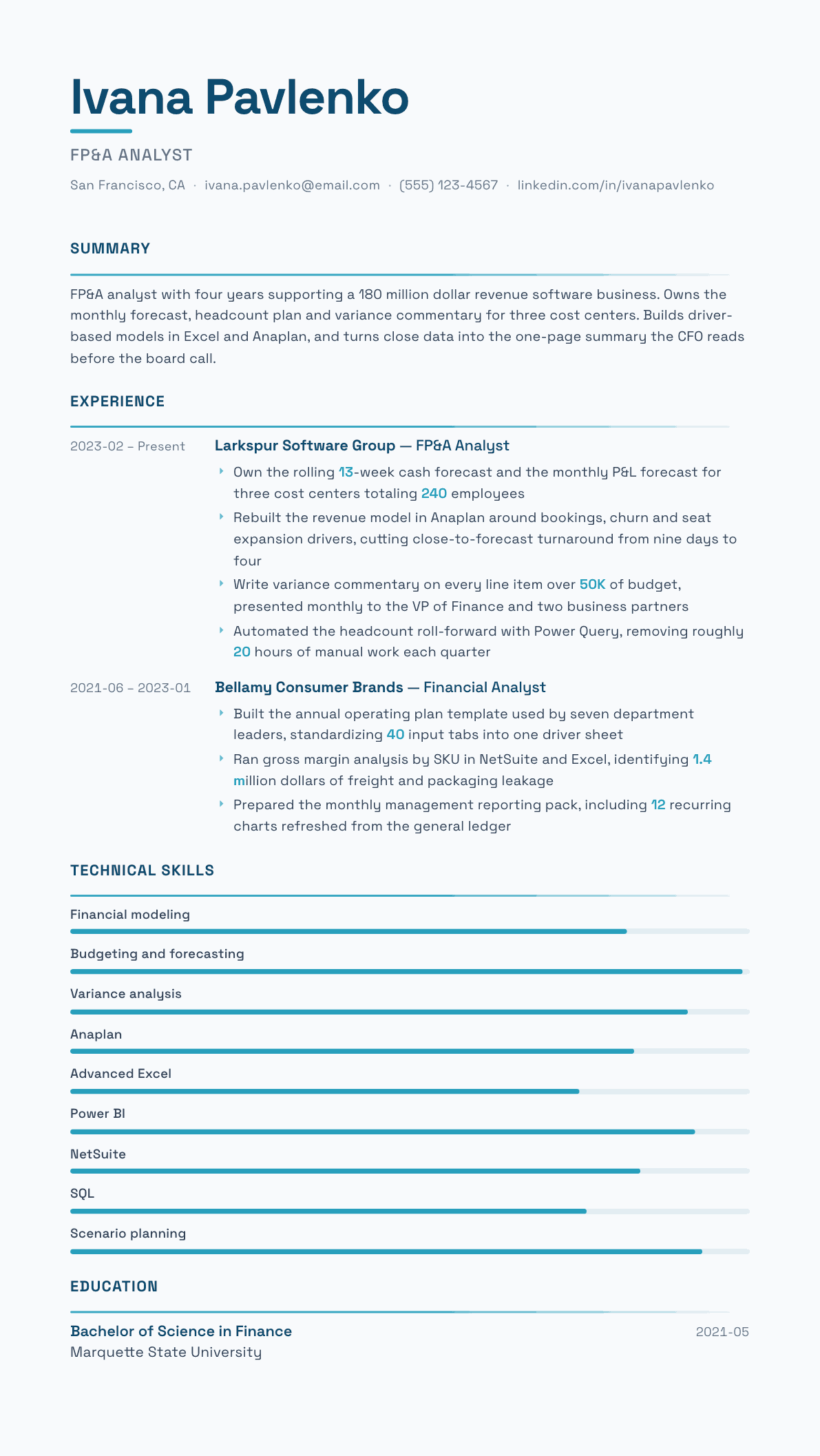
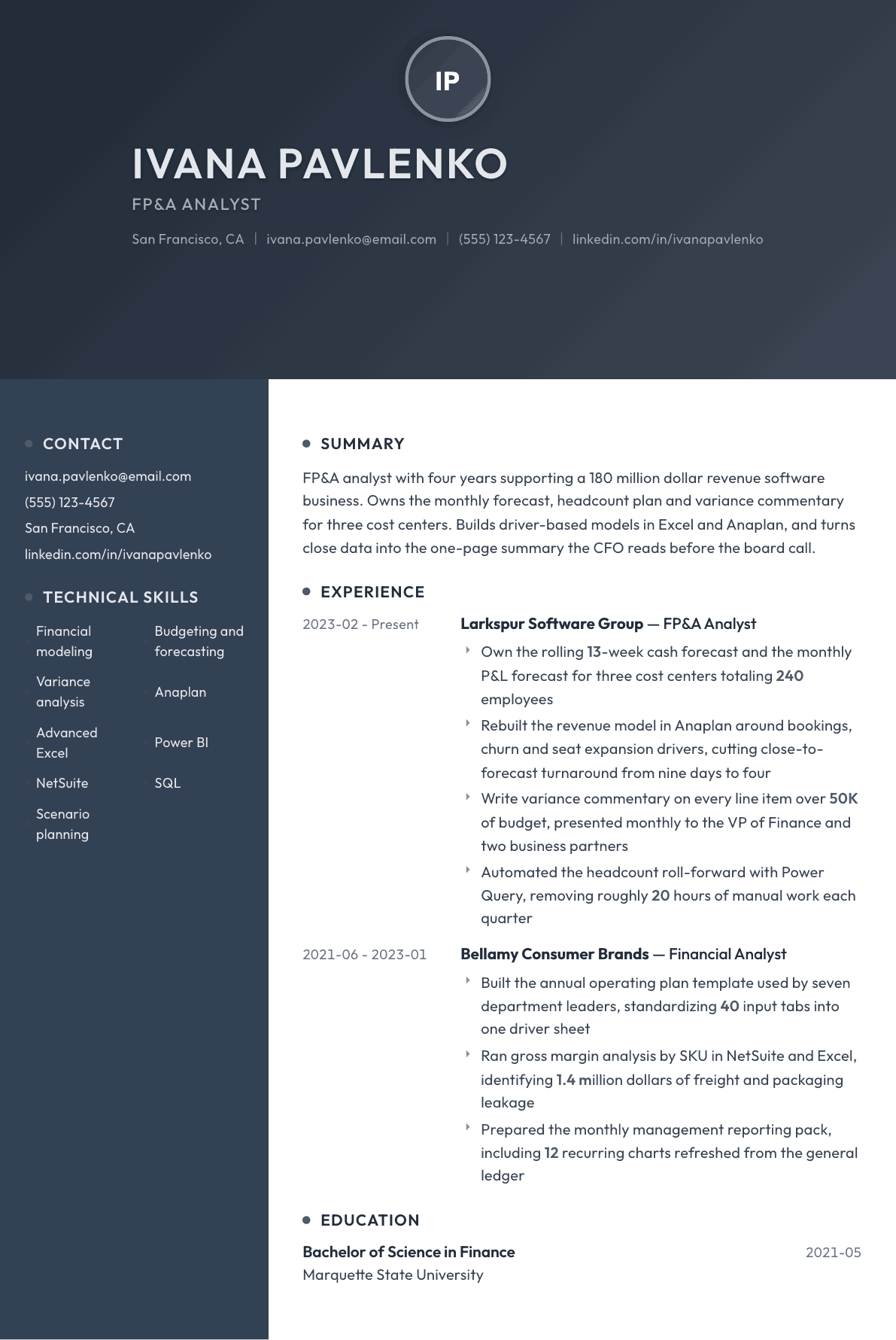
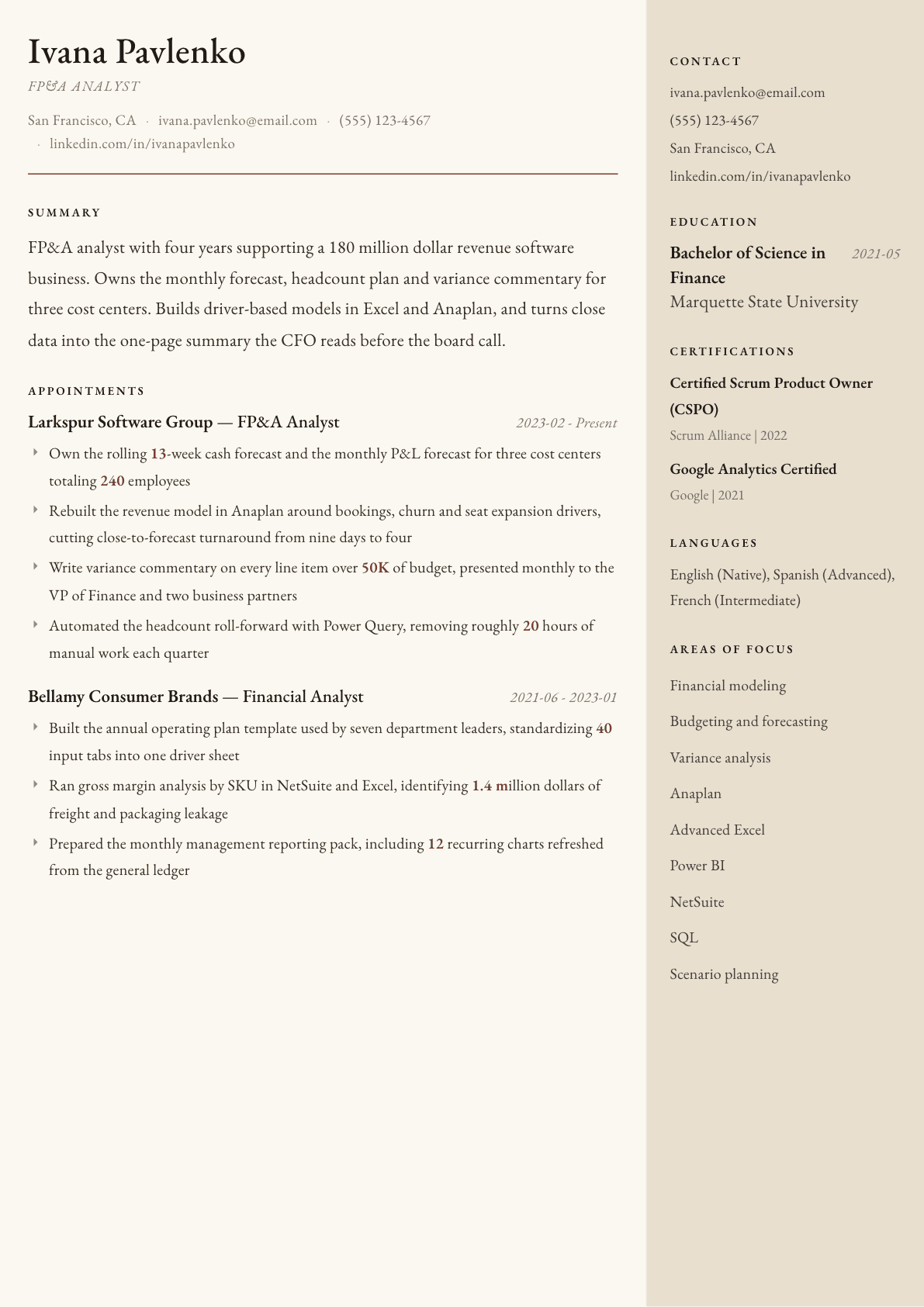
Example FP&A Analyst summary
FP&A analyst with four years owning the forecast, annual operating plan and variance commentary for a software business with roughly 200 million dollars of revenue. Rebuilt the planning model around bookings and retention drivers, cutting reforecast turnaround by half. Comfortable pulling my own data in SQL and presenting the result to functional leaders in a single page. Looking for a senior FP&A seat with direct exposure to the CFO.
Skills to list on a FP&A Analyst resume
- Financial modeling
- Budgeting
- Forecasting
- Variance analysis
- Driver-based planning
- Management reporting
- Anaplan
- Adaptive Planning
- Advanced Excel
- Power Query
- Power BI
- SQL
- NetSuite
- Scenario modeling
- Headcount planning
- Business partnering
What actually gets this resume read
- Name the revenue or spend you plan against in every job, because scope is the first thing an FP&A hiring manager checks.
- State which planning system you own, whether Anaplan, Adaptive Planning, Pigment, Vena or a pure Excel model.
- Show the forecast cycle you run: monthly reforecast, rolling cash view, annual operating plan, or all three.
- Quantify variance work by the threshold you investigate and the audience who reads your commentary, not by adjectives.
- Put business partnering on the page: name the functions you supported and the decision your analysis changed.
- Include the accounting fluency signals a controller looks for, such as accruals, deferred revenue and the close calendar.
- List SQL or Power Query if you truly use them, since data pulls now sit inside the FP&A job rather than beside it.
How to write a fp&a analyst resume
An FP&A analyst resume is judged on scope before it is judged on skill. The finance director scanning it wants to know how much revenue or spend you planned against, how many cost centers you carried, and whether the forecast you owned was a real cycle with a deadline or a spreadsheet you helped update. Two candidates can both write financial modeling and mean completely different jobs.
The second thing that gets checked is whether you can explain a number to someone who does not work in finance. FP&A sits between the general ledger and the operating leaders, and the analyst who gets promoted is the one whose variance commentary tells a marketing director what to do differently next month. Resumes that only list systems miss this entirely.
This guide covers the section order finance leaders expect, how to size your scope honestly, the planning tools worth naming, and the before and after bullets that turn a maintenance description into evidence of ownership.
Format: one page until you manage people
Reverse chronological, one page for anything under eight years, and no columns inside the experience block. Finance recruiters open resumes in an applicant tracking system that reads left to right, and a two column layout scrambles the order of your bullets.
Lead the header with your name, city, phone, email and any credential in progress. Put a short scope line under your title in each role rather than a separate achievements section, because the reader wants context attached to the job it belongs to.
- Sections in order: summary, experience, education, systems and technical skills, certifications.
- Under each employer, add one line of context: industry, revenue size, and the functions you supported.
- New graduates put education first and add a modeling coursework or case competition line.
Summary: scope, cycle, systems, one thing you rebuilt
Three lines is enough. Name the size of the business, the planning cycle you own, the tool the plan lives in, and one improvement that was yours. A summary reading collaborative finance professional with strong analytical skills describes the entire applicant pool.
If you are moving from accounting into FP&A, say so directly and name the transferable half. Close experience is an asset here because the analyst who understands accruals and deferred revenue writes a forecast that ties to the actuals.
Experience: what you owned, not what the team produced
Every job needs the business size and the functions you partnered with. A line reading FP&A analyst supporting sales, marketing and customer success for a business with roughly 200 million dollars of revenue does more work than a whole paragraph of adjectives.
Then four or five bullets. Cover the forecast cycle, the annual operating plan, the variance work, one automation or model rebuild, and one business partnering outcome. Give the cadence: monthly reforecast, quarterly board pack, rolling thirteen week cash view.
Cut the bullets that describe the job title itself. Prepared reports and analyzed financial data are true of every analyst in the pile, so they buy no space at all.
- Name the threshold at which you investigate a variance and who reads the commentary.
- Show a model you built or rebuilt, and what it replaced.
- Include headcount planning if you own it, since it is often the largest cost line.
Systems and technical skills: name the planning tool
This section is where the applicant tracking system finds you, so use the exact product names. Split it into planning platforms such as Anaplan, Adaptive Planning, Pigment, Vena or Planful, the general ledger you pull from such as NetSuite, SAP or Oracle, and the analysis layer of Excel, Power Query, Power BI, Tableau or SQL.
Be honest about depth. If you write SQL on a resume, expect an interviewer to ask which joins you use to build a revenue extract. Listing a tool you touched once is the fastest way to lose credibility in the first fifteen minutes.
Keywords finance postings repeat
FP&A job descriptions are written from a small vocabulary: annual operating plan, rolling forecast, variance analysis, driver-based planning, month-end close support, management reporting, business partnering, scenario modeling and headcount planning. Mirror the phrases that are genuinely true of your work once in the summary and once inside a bullet where you show them.
Avoid keyword blocks pasted at the bottom. A finance director reads the resume immediately after the software does, and a wall of unattached terms reads as padding.
FP&A Analyst resume summary examples
First finance role
Finance graduate with a summer in corporate FP&A supporting the monthly management reporting pack and the departmental budget templates. Built a Power Query refresh that cut the reporting cycle by two days. Strong Excel modeling from a national valuation case competition. Looking for an analyst seat with forecast ownership.
Four years in
FP&A analyst owning the monthly reforecast, annual operating plan and variance commentary for three cost centers in a business with roughly 200 million dollars of revenue. Rebuilt the planning model in Anaplan around bookings and retention drivers, cutting reforecast turnaround from nine days to four. Pulls source data in SQL rather than waiting on a request queue.
FP&A manager track
Senior FP&A analyst leading the planning cycle for a 400 person division, managing two analysts and presenting the monthly business review to the operating committee. Consolidated four disconnected department models into one driver-based plan and moved the close-to-forecast window inside five business days. Partner of record for sales and customer success leadership.
Work experience bullets: before and after
Before: Responsible for budgeting and forecasting.
After: Own the monthly reforecast and annual operating plan for three cost centers covering 240 employees and roughly 60 million dollars of operating expense.
It replaces a job duty with the actual scope a hiring manager needs in order to size the role.
Before: Performed variance analysis on monthly results.
After: Investigate every P&L line varying more than 50K from plan and write the commentary presented to the VP of Finance and two business partners each month.
The threshold and the audience turn a generic task into a defined, repeatable responsibility.
Before: Improved reporting processes using Excel.
After: Automated the headcount roll-forward and department expense pack with Power Query, removing about 20 hours of manual rework each quarter.
Naming the tool and the hours saved makes the improvement checkable instead of decorative.
Before: Built financial models for the business.
After: Rebuilt the revenue model in Anaplan around bookings, churn and seat expansion drivers, shortening close-to-forecast turnaround from nine days to four.
It states which model, which drivers, which platform and the cycle time that moved as a result.
Before: Worked with department heads on their budgets.
After: Partnered with seven department leaders through the annual plan, replacing 40 input tabs with a single driver sheet and a locked assumption page.
The partnering claim now has a deliverable attached, which is what separates a business partner from a report builder.
Hard skills
- Driver-based financial modeling
- Annual operating plan
- Rolling forecast
- Variance analysis
- Management reporting
- Headcount planning
- Scenario and sensitivity modeling
- Anaplan or Adaptive Planning
- Advanced Excel and Power Query
- Power BI or Tableau
- SQL
- NetSuite or SAP reporting
- Month-end close support
- Cash flow forecasting
Soft skills
- Business partnering
- Written commentary
- Executive presentation
- Prioritization under close deadlines
- Constructive challenge
- Cross-functional collaboration
Certifications worth listing
- Certified Corporate FP&A Professional (Association for Financial Professionals)
- Chartered Financial Analyst (CFA Institute)
- Certified Management Accountant (Institute of Management Accountants)
- Financial Modeling and Valuation Analyst (Corporate Finance Institute)
Mistakes that cost fp&a analyst candidates the interview
- Listing Excel without saying what you build in it, when every applicant lists Excel.
- Hiding the size of the business, which forces the reader to guess whether you planned against millions or billions.
- Describing the team output as if it were yours, which collapses the moment an interviewer asks what you personally owned.
- Filling the page with software names while showing no evidence you ever changed a business decision.
- Writing variance analysis with no threshold, no cadence and no audience attached to it.
- Leaving off close support and accounting fluency, which is what controllers screen for when they hire into FP&A.
- Running to two pages before you have managed anyone or led a full planning cycle.
FP&A Analyst resume questions
Do I need accounting experience to move into FP&A?
It is not required, but it helps more than most candidates expect. Understanding accruals, deferrals and the close calendar means your forecast ties to actuals without rework, so put any close or reconciliation experience on the resume even if the title was not FP&A.
Should I list Anaplan if I only used it as a contributor?
List it, but describe the level accurately. Write model contributor or planner if you entered and reviewed data, and reserve model builder for cases where you built modules, lists and formulas. Interviewers test this quickly and the correction is embarrassing.
How do I show impact when FP&A does not generate revenue?
Use cycle time, accuracy and decisions. A forecast delivered four days faster, a variance caught before it hit the quarter, or a spend decision changed by your analysis are all measurable outcomes that a finance director recognizes as real value.
Is the CFA or the CMA better for an FP&A career?
The CMA maps more closely to corporate planning, costing and internal reporting, while the CFA points toward investment and capital markets work. If your goal is a controller or finance director seat, the CMA or the corporate FP&A credential fits the day job better.
How much SQL should an FP&A analyst actually know?
Enough to pull and join your own data without filing a ticket. Selects, joins, group by aggregation and simple date filtering cover most planning work. If you can build the extract that feeds your model, say so, because it removes a dependency the team feels every month.
Related resume examples
- Financial Analyst Resume example
- Controller Resume example
- Finance Manager Resume example
- Budget Analyst Resume example
- Revenue Analyst Resume example
- Accountant Resume example