Project Manager Resume Examples: the lines they read
Project Manager Resume and Project Management CV Examples
By Mustafa Tarabya, founder of CVBooster · Published · Updated
Project manager resume examples and a UK project management CV example: certification, baseline, change control, budget and the keywords screens look for.
Sample resumes for a project manager
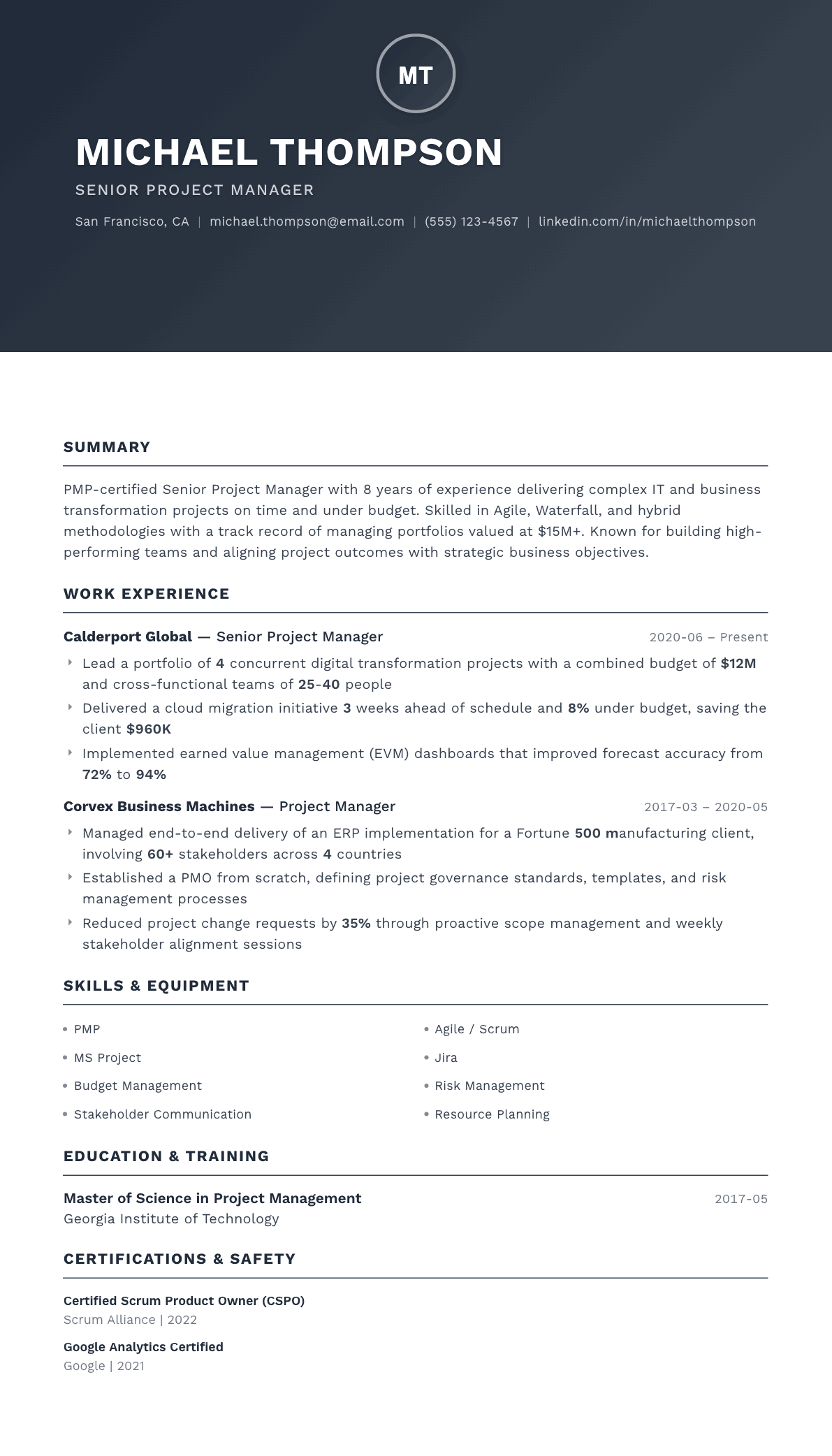
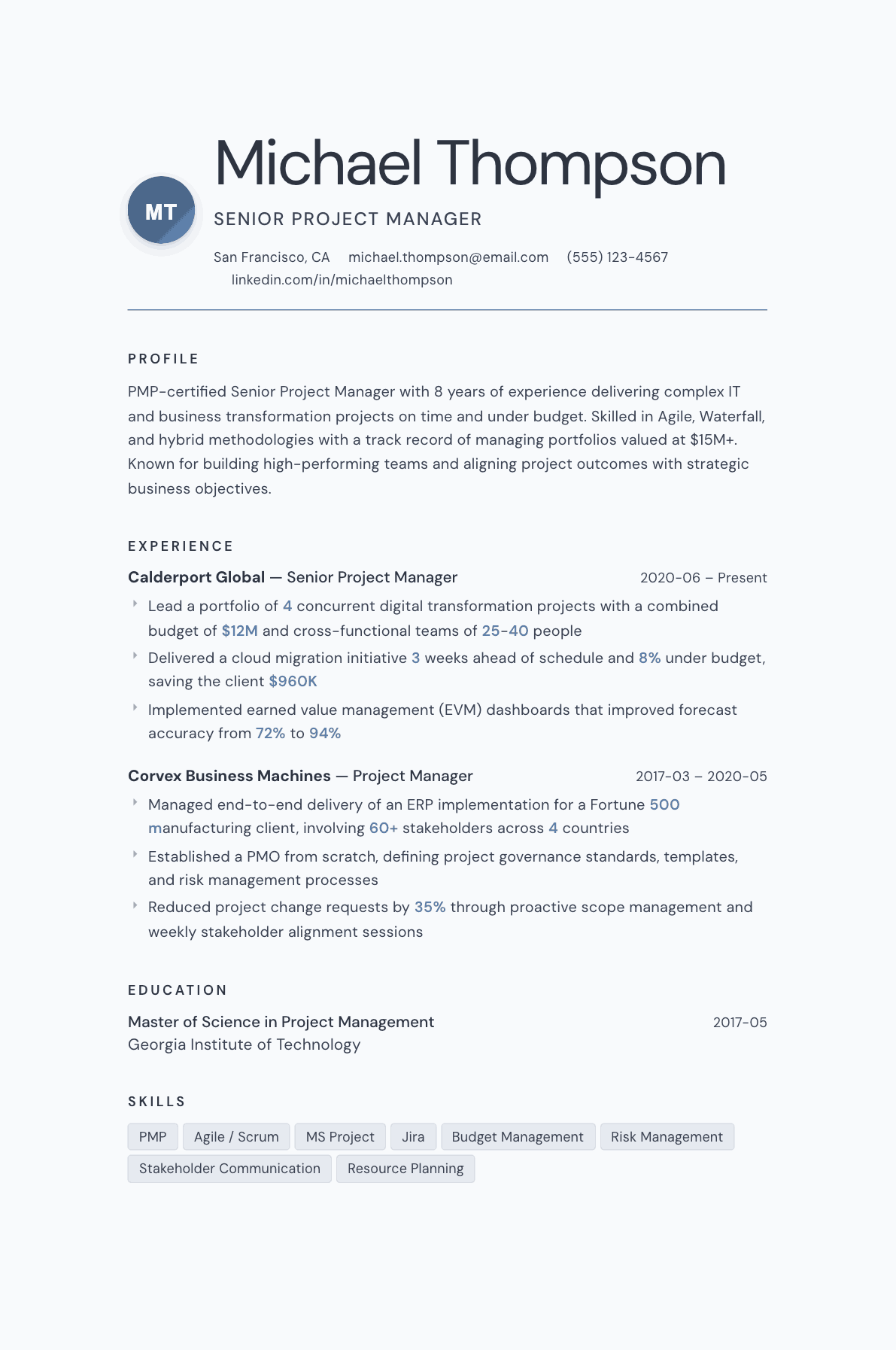
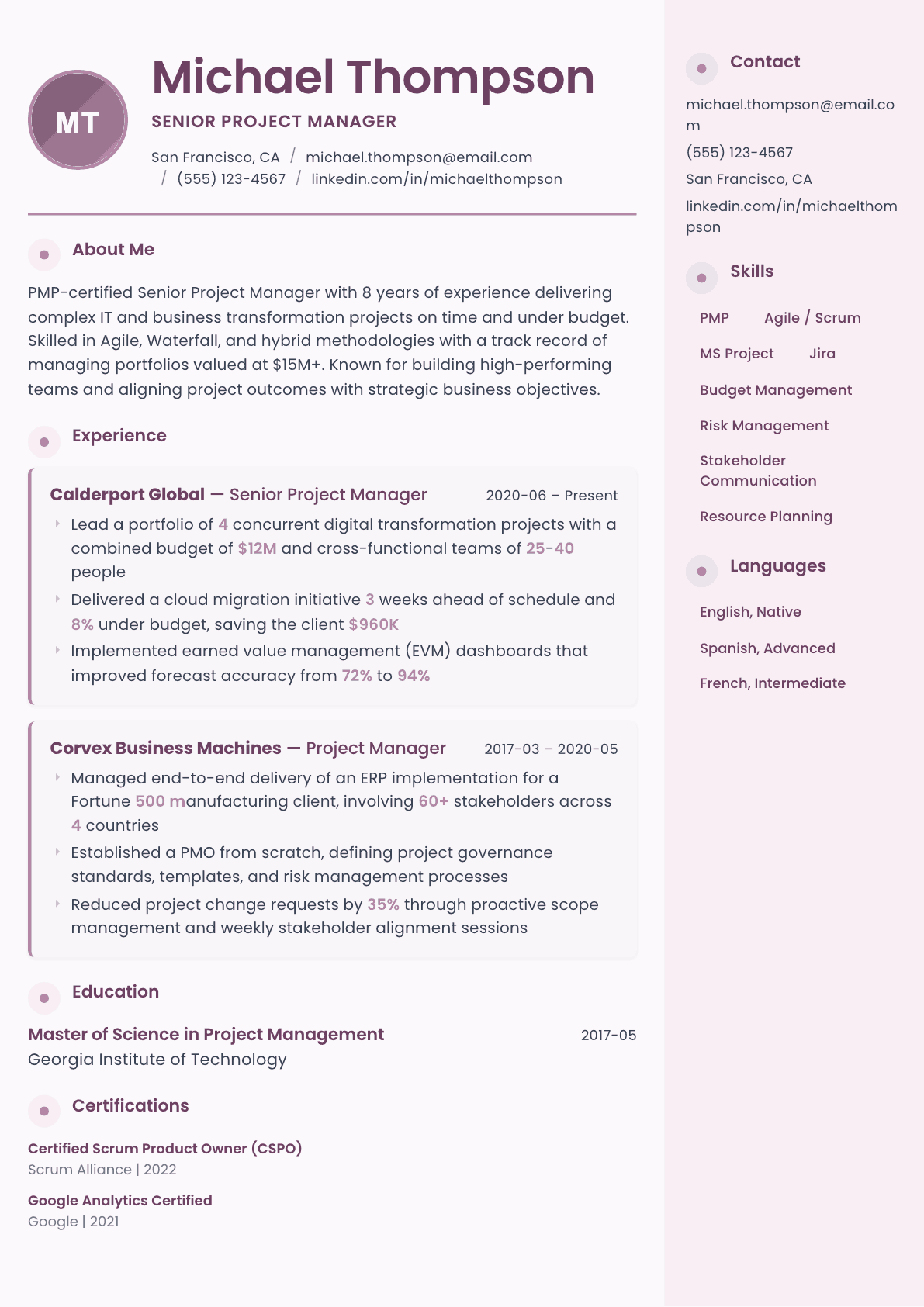
The same project manager content laid out in three CVBooster templates, so you can see what the finished document looks like before you write a word.
Example Project Manager summary
PMP certified project manager, 8 years, currently four concurrent transformation projects worth $12M with teams of 25 to 40. Delivered a cloud migration three weeks early and 8% under budget, stood up a PMO from nothing with its governance and templates, and runs earned value reporting that took forecast accuracy from 72% to 94%.
Skills to list on a Project Manager resume
- PMP
- Agile / Scrum
- Waterfall
- SAFe
- MS Project
- Jira
- Smartsheet
- Budget Management
- Risk Management
- Stakeholder Management
- Resource Planning
- Earned Value Management
- Change Management
- Vendor Management
- PMO Governance
What actually gets this resume read
- Lead every bullet with scope: budget size, team size, number of stakeholders, or geographic reach.
- Highlight methodology expertise explicitly: PMP, Agile, Scrum, SAFe, PRINCE2, or Waterfall.
- Quantify delivery performance: on-time percentage, budget variance, scope change reduction, or velocity improvements.
- Mention PM tools by name: MS Project, Jira, Smartsheet, Asana, Monday.com, or Confluence.
- Show escalation management and risk mitigation skills with specific examples of problems you resolved.
- Include certifications prominently: PMP, CSM, SAFe, PRINCE2, or PMI-ACP.
How to write a project manager resume
Project manager is one of the most applied for titles anywhere, and the volume is why the screening is so mechanical. A delivery lead or a resourcing manager opens your file to check four boxes fast: the certification, the methodology, the domain, and the size of the thing you delivered. If those are not visible in the top third of page one, the file goes on the maybe pile and usually stays there.
The second read is harder to pass. Anyone can list a project. What a hiring manager wants is proof that you controlled it: that you held a baseline, that you noticed slippage before it became a miss, that you ran change control instead of absorbing scope quietly, and that the sponsor heard the bad news from you first.
This guide covers the layout that answers the four screening questions immediately, how to write about schedule, budget and risk with the specificity a delivery lead recognizes, summaries for a coordinator, an established project manager and a senior delivery lead, the UK project management CV with a complete example, and the questions people ask when moving between waterfall and agile environments or into a new industry.
Format: certification, methodology and domain in the top third
One page under eight years, two after. Put your certification next to your name or on the line directly beneath it, because in this field it is a filter rather than a garnish. Follow with a summary that names the methodology you work in, the domain you deliver in, and the typical project size you handle. A reader should know within four seconds whether to keep going.
In the experience section, open each project with a one line profile: what was delivered, the duration, the team size and composition, the budget magnitude, the delivery approach, and the sponsor level. Grouping several projects under one employer with a shared profile format lets a reader compare them at a glance, which is how project files are actually read.
- Header: name, certification, location, contact, and the methodology if you have room.
- Project profile: deliverable, duration, team size, budget magnitude, approach, sponsor.
- Bullets: schedule control, budget control, risk handled, stakeholder outcome.
- Tools block: the scheduling tool, the tracker, the collaboration stack, the reporting layer.
Schedule control: show that you held a baseline
Delivered on time is a claim with no mechanism behind it. Show the control instead: you built the schedule from a work breakdown structure, you identified the critical path, you tracked against a baseline, and when a task slipped you recovered it with a specific action such as resequencing, fast tracking two dependent tasks, or adding a resource for a fixed window. That sentence proves you managed a schedule rather than watched one.
Say what you did with dependencies outside your control. Waiting on a vendor, a regulatory approval, a shared environment or another team is the normal cause of a missed date, and a project manager who tracked those externally owned items with named owners and agreed dates is describing a habit hiring managers are specifically looking for.
Change control and the sponsor relationship
Scope creep is the most common way a project fails quietly, so include at least one bullet on change control. Describe the route: how a change request was raised, who assessed the impact on cost and schedule, who approved it, and what you did when a stakeholder tried to slip work in outside the process. A project manager who has said no with a documented impact assessment behind them has done the hard part of the job.
Then write the sponsor relationship. Name the seniority you reported to, the cadence, and one occasion where you carried an unwelcome message early with options attached. Sponsors hire project managers who tell them about a problem while it can still be fixed, and that is difficult to demonstrate any other way.
Agile, waterfall and hybrid: be precise about what you ran
Vague methodology claims fail interviews quickly. If you ran scrum, say the ceremonies you facilitated, the sprint length, how the backlog was refined, and who held the product decisions, since a project manager in a scrum team is not the product owner. If you ran waterfall, say the phases, the gate approvals, and the documentation set you produced. If you ran hybrid, describe the split honestly: an agile build inside a stage gated program is very common and worth explaining in one clear sentence.
Name the tooling you actually operated. A schedule built and baselined in a scheduling tool, a board configured in a tracker, a portfolio view in a reporting tool, and a document set in a collaboration space are all checkable, and specificity here separates you from candidates listing tools they have only read reports from.
Keywords the screen is scanning for
Postings recycle a tight vocabulary: project plan, work breakdown structure, critical path, baseline, risk register, issue log, change control, stakeholder management, status reporting, resource allocation, budget tracking, lessons learned, and the named methodology. Place each once where it is doing work rather than clustering them into a keyword block.
Add domain vocabulary, because project management is hired by domain more often than candidates expect. Construction wants request for information, submittals and commissioning. Technology wants environments, cutover, release and regression. Pharmaceutical and medical device want validation and change control under regulation. Financial services want regulatory deadlines and audit evidence. Mirror the domain and the file stops reading as generic.
Project management CV examples for UK applications
A project management CV for a UK employer uses the same evidence with a few changes. Call it a CV, keep it to two pages, leave out the photo, date of birth and marital status, and open with a short personal profile instead of an objective. Name the method and certification UK postings ask for: PRINCE2 Foundation or Practitioner, APM Project Management Qualification, Agile or Scrum certification, or PMP for global firms. Public sector and infrastructure roles often ask for security clearance, so state it if you hold it.
The example below is invented; keep its order and replace every detail. Profile: Sarah Whitmore, PRINCE2 Practitioner, APM PMQ. Project manager with seven years delivering IT and business change projects in financial services and local government, working in hybrid agile and stage gated delivery. Leads teams of up to twelve and budgets up to two million pounds, reporting to director level sponsors and project boards.
- Project Manager, a UK building society, three years: led the replacement of the mortgage application platform, a fourteen month project with a team of ten and a budget of 1.8 million pounds; delivered to the board approved baseline after one formal exception report.
- Ran the risk and issue logs and the change control process, assessing nineteen change requests for cost and time impact before board decisions.
- Project Coordinator to Project Manager, a borough council, four years: delivered the move of three council offices to a single site, coordinated suppliers, IT and facilities, and produced highlight reports for the senior leadership board.
- Certifications and tools: PRINCE2 Practitioner, APM PMQ, Scrum Master certification; MS Project, Jira, Confluence, Power BI.
- Project management CV examples for a junior role keep the same order but lead with the coordinator work: the plan you maintained, the RAID log you ran and the reports you wrote.
Project Manager resume summary examples
Project coordinator moving up
Project coordinator with three years supporting technology delivery, now running two concurrent workstreams of six people each. Maintains the baselined schedule, chairs the weekly risk review, and recovered a two week slip on an environment dependency by resequencing test phases. Scrum certified and studying for a project management credential.
Project manager, seven years in
Certified project manager with seven years delivering enterprise technology projects of twenty to forty people in hybrid agile and stage gated environments. Delivered fourteen projects against baselined schedules with a variance under 5%, and ran change control that kept approved scope changes fully costed and sponsor approved.
Senior delivery lead
Senior project manager with twelve years in regulated financial services delivery, running projects up to eighteen months with sponsors at managing director level. Recovered two projects that arrived red, rebuilt their baselines and risk registers, and delivered both inside the revised dates agreed with the steering group.
Work experience bullets: before and after
Before: Delivered projects on time and within budget.
After: Delivered fourteen technology projects against baselined schedules with schedule variance under 5%, reforecasting monthly and clearing every variance above threshold with the sponsor before it appeared in the portfolio report.
Naming the variance discipline and the escalation threshold replaces an unverifiable claim with a control mechanism.
Before: Managed project risks and issues.
After: Ran a weekly risk review with named owners and dates, and mitigated a shared test environment conflict by booking a dedicated window four weeks ahead, avoiding a clash that had delayed the previous release.
A specific risk, the mitigation and the precedent it avoided show risk management doing real work.
Before: Handled changes to project scope.
After: Processed 23 change requests through a formal impact assessment on cost and schedule, of which nine were approved and funded, and held the remainder out of the baseline until the sponsor prioritized them for a later phase.
Counting the requests and showing what you declined proves scope control rather than scope absorption.
Before: Communicated project status to stakeholders.
After: Told the sponsor at week six that a vendor integration would miss the planned date, presented two recovery options with cost and date impact, and implemented the chosen option with the go live date preserved.
Early bad news with options is the specific behavior that sponsors hire project managers for.
Before: Coordinated a cross functional project team.
After: Coordinated a team of 28 across development, testing, infrastructure and two external suppliers, running a shared daily stand up during cutover week and a single issue log all parties worked from.
Team composition and the mechanism you used to keep separate organizations aligned show real coordination.
Hard skills
- Work breakdown structure and scheduling
- Critical path analysis
- Baseline and variance management
- Risk register and issue management
- Change control
- Budget tracking and reforecasting
- Earned value management
- Microsoft Project and Smartsheet
- Jira and Confluence
- Resource allocation and capacity planning
- Status reporting and dashboards
- Lessons learned and project closure
Soft skills
- Escalating early
- Chairing meetings that end in decisions
- Negotiating with resource owners
- Written clarity under pressure
- Holding suppliers to dates
Certifications worth listing
- Project Management Professional (PMP) (Project Management Institute)
- Certified Associate in Project Management (CAPM) (Project Management Institute)
- PMI Agile Certified Practitioner (PMI-ACP) (Project Management Institute)
- PRINCE2 Practitioner (PeopleCert)
- Certified ScrumMaster (CSM) (Scrum Alliance)
- Professional Scrum Master (PSM I) (Scrum.org)
Mistakes that cost project manager candidates the interview
- Burying the certification at the bottom of the page when it is the first filter most screens apply.
- Writing on time and within budget with no baseline, no variance and no control mechanism behind it.
- Claiming both agile and waterfall expertise without describing the ceremonies, gates or artifacts of either.
- Leaving out team size and budget magnitude, so a reader cannot rank the project against others in the stack.
- Skipping change control entirely, which reads as a project manager who absorbs scope quietly.
- Sending a domain neutral file to a construction, pharmaceutical or regulated finance employer that hires on domain.
- Listing every tool ever seen rather than the scheduling and tracking tools you built artifacts in.
Project Manager resume questions
Do I need a project management certification to get hired?
Not always, but it clears an automated or human filter at a large share of employers and it is often a stated requirement in regulated industries and consultancies. If you are studying for one, say so with the body named, and lean harder on delivery evidence in the meantime.
How do I write a project manager resume for an agile role?
Describe the team, the cadence and your actual scope of decision. Say the sprint length, the ceremonies you facilitated, how the backlog was refined, and who held product decisions. Avoid claiming product ownership you did not have, since that is the first thing an agile hiring manager probes.
What should a project management CV include for UK jobs?
A personal profile naming your method, certification such as PRINCE2 or APM PMQ, domain and project size; then four to six projects that match the posting, each with team, budget, duration and outcome; then skills, tools and education. Keep it to two pages with no photo, and summarize older projects in one line.
How do I move into project management from a coordinator or analyst role?
Lead with the pieces of the discipline you already own: the schedule you maintain, the risk log you chair, the status pack you produce, the workstream you run without supervision. Name the team sizes and the sponsor level, and add a credential in progress to signal seriousness.
What do I do about a project that failed or was canceled?
Include it when it shows judgment. Describe the point at which the evidence changed, the recommendation you made, and the controlled way it was stopped or reset. A project manager who recognizes an unviable business case early is more valuable than one who has never stopped anything.
Related resume examples
- Product Manager Resume example
- Business Analyst Resume example
- Accountant Resume example
- Program Director Resume example
- Program Manager Resume example
- PMO Manager Resume example