Customer Success Manager Resume Examples: free ATS score
Build a Customer Success Manager Resume That Drives Retention
By Mustafa Tarabya, founder of CVBooster · Published · Updated
Create a customer success manager resume highlighting your ability to reduce churn, drive adoption, and grow accounts with data-driven strategies.
Sample resumes for a customer success manager
The same customer success manager content laid out in three CVBooster templates, so you can see what the finished document looks like before you write a word.
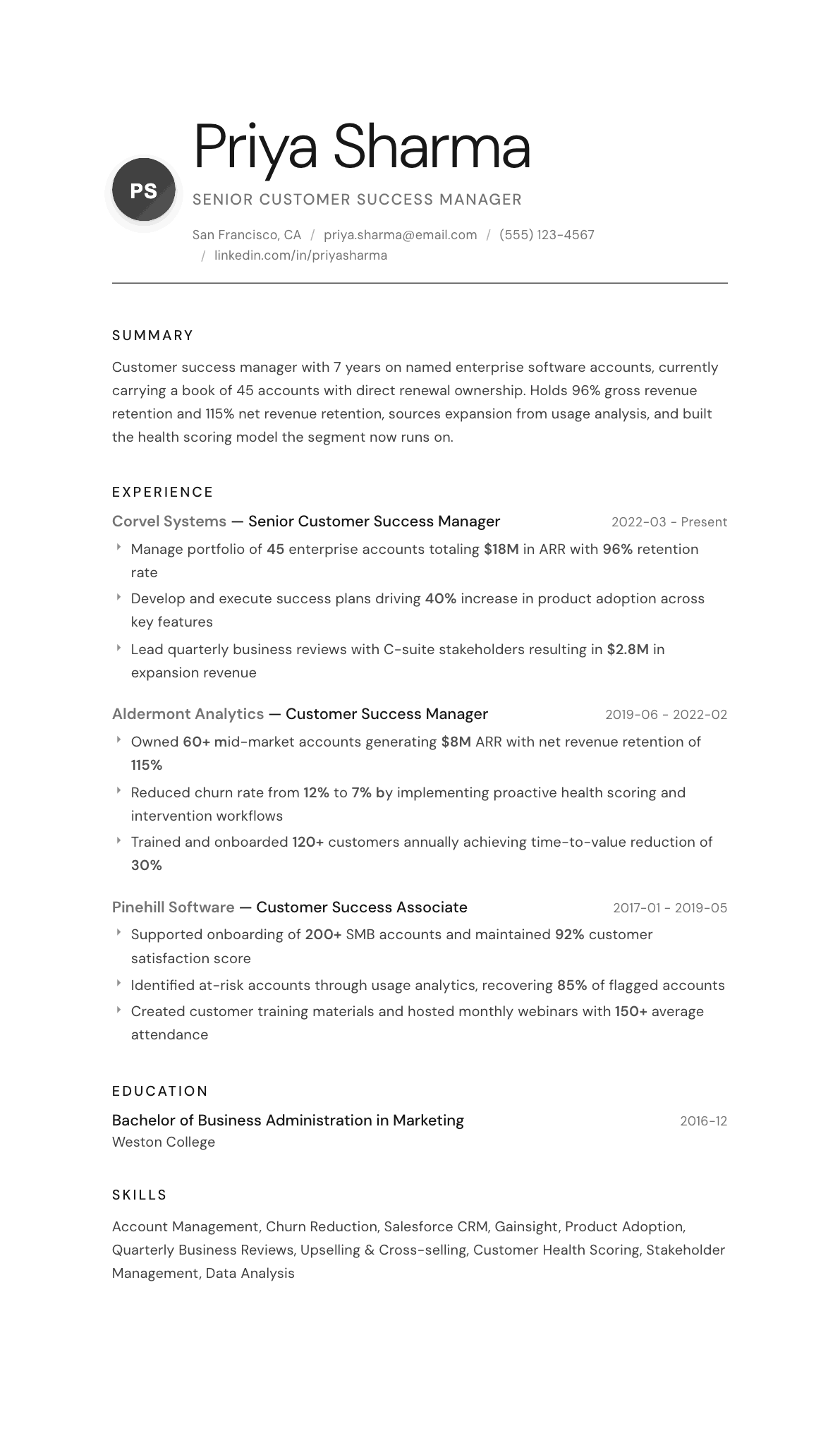
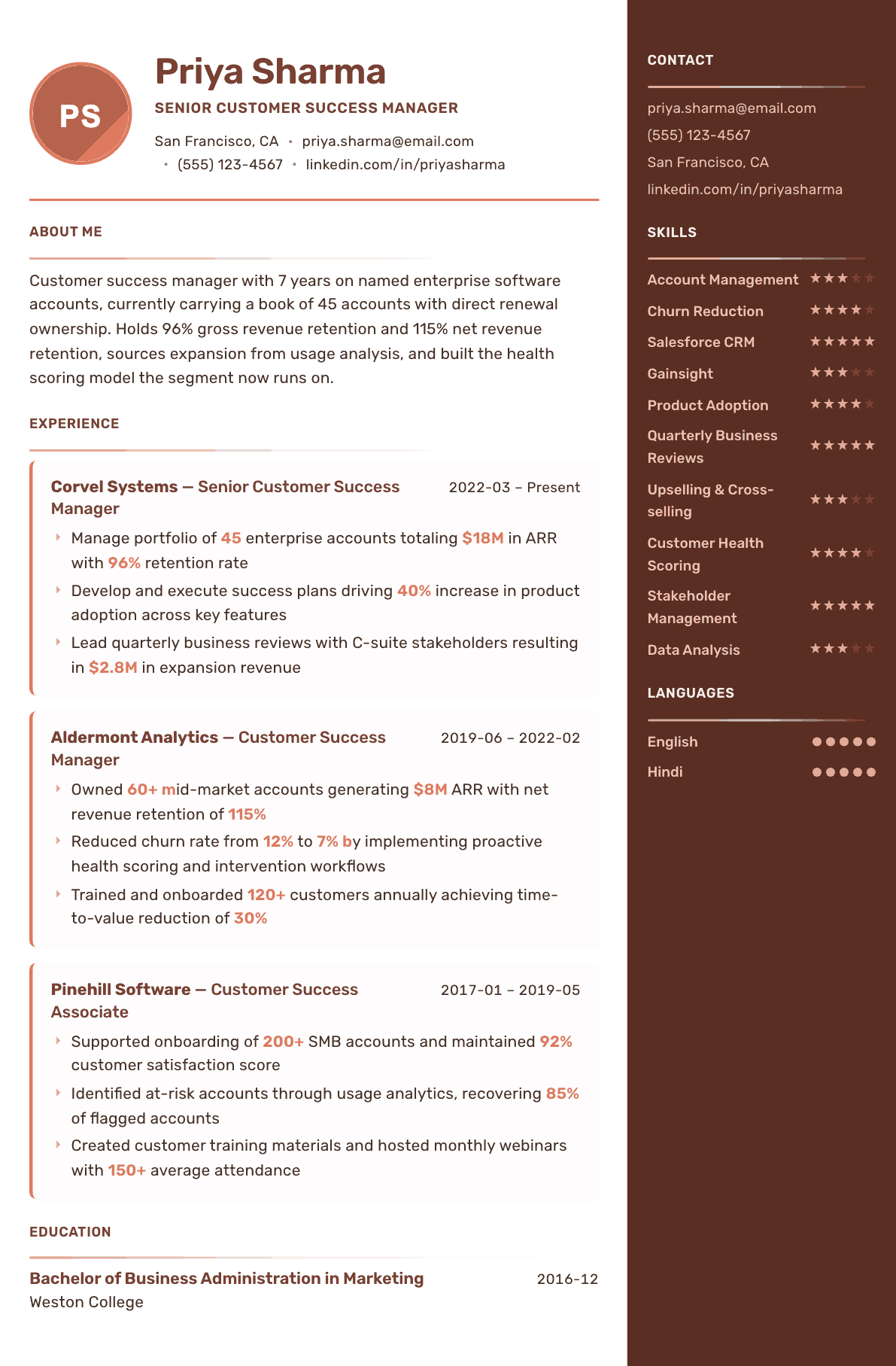
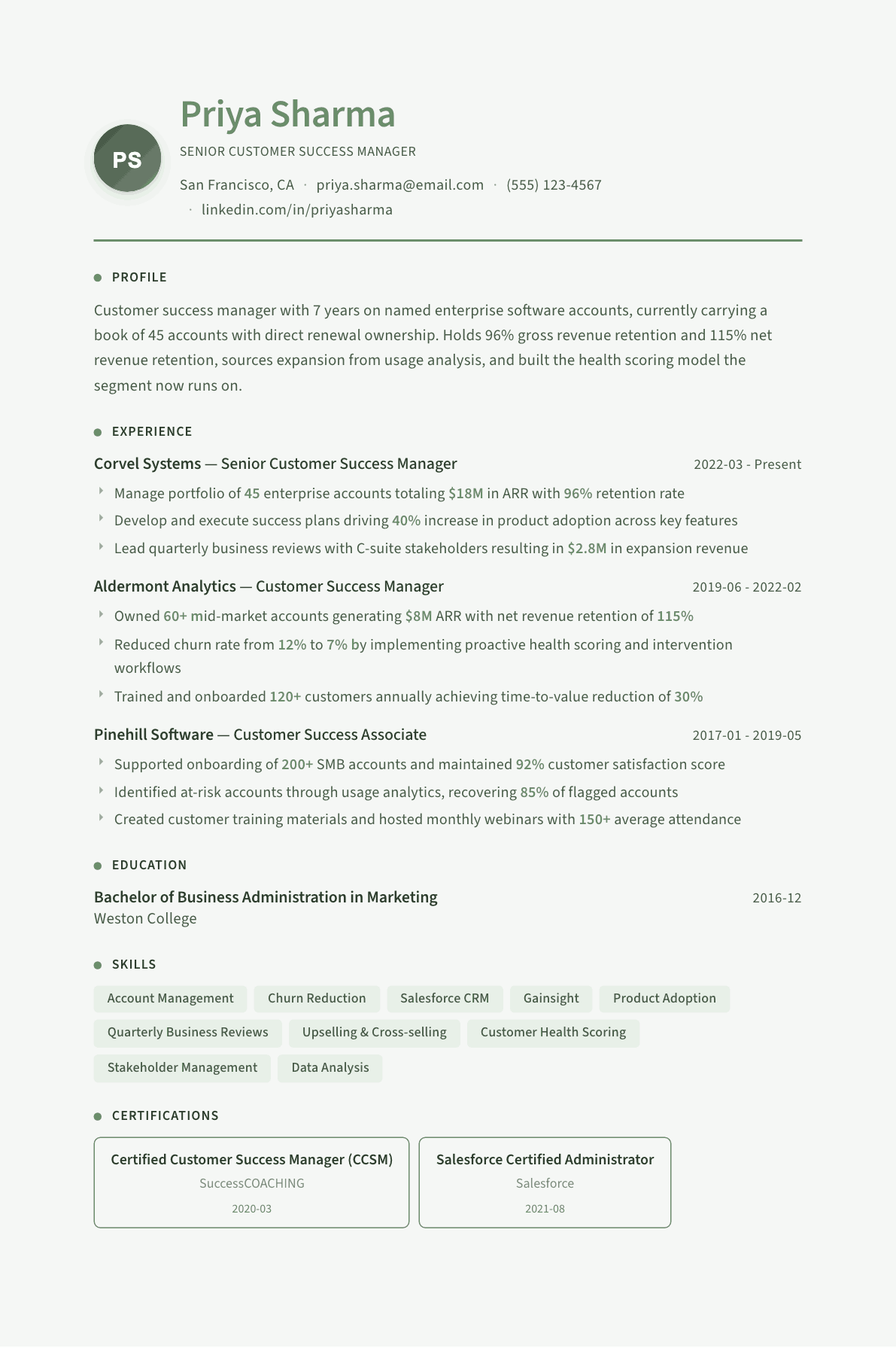
Example Customer Success Manager summary
Customer success manager with 7 years on named enterprise software accounts, currently carrying 45 accounts with direct renewal ownership and executive sponsorship. Held 96% gross revenue retention and 115% net revenue retention across two renewal cycles, sourced 18 expansion opportunities of which 11 closed, and built the health scoring model now used across the segment.
Skills to list on a Customer Success Manager resume
- Account Management
- Churn Reduction
- Net Revenue Retention
- Customer Onboarding
- Quarterly Business Reviews
- Upselling & Cross-selling
- Gainsight / ChurnZero
- Salesforce CRM
- Product Adoption
- Stakeholder Management
- Customer Health Scoring
- Data-Driven Decision Making
What actually gets this resume read
- Give the book before any result: account count, segment, coverage model, and whether the renewal was yours or a renewals team's.
- Lead with gross and net revenue retention, each with the period and the book it covers, because rates travel across companies and dollar figures do not.
- Separate expansion you sourced from expansion a sales representative closed, since inflating this is the easiest claim for an interviewer to test.
- Name the success platform, the customer relationship system and the product analytics tool, because the stack signals how you were expected to work.
- Write one bullet on how you found accounts in trouble before the renewal date, and what the intervention was, because that is where senior candidates separate.
How to write a customer success manager resume
A customer success manager resume is read commercially, whatever the job title suggests. The head of customer success wants four things on the page: the size and segment of the book you carried, the revenue retention you held, the expansion you generated, and the churn you prevented with a method she can recognize. Everything about adoption, enablement and relationship quality is supporting evidence for those four.
The role also varies enormously between companies, and the resume has to place you. A named-account enterprise customer success manager with a dozen large accounts, a mid-market manager with sixty, and a pooled or digital manager covering hundreds through campaigns are three different jobs. State which model you worked in, because a hiring manager who has to guess will assume the least demanding one.
This guide covers how to present a book of business, which retention numbers to use and how to frame them honestly, three summaries from associate to senior or team lead, before-and-after bullets, and the questions customer success managers ask when they move segments or come in from support or account management.
Format: book of business before achievements
One page under about six years, two beyond it. Under each role, before any bullet, give the book: number of accounts, segment, the revenue band described in words rather than figures, the coverage model, and whether renewal was yours or a renewals team's. Without that line every retention claim on the page is unreadable.
Keep the layout conventional. Customer success hiring runs through the same applicant tracking systems as sales, and a two-column design that scrambles your account counts and retention rates costs you the only evidence that matters.
- Section order: summary, book and results, experience, tools, education and certifications.
- Name the coverage model: named accounts, pooled, digital or hybrid.
- Say who owned the renewal, the expansion quota and the escalation path.
Summary: segment, book size, retention, expansion
Three lines carrying the segment and product category, the number of accounts and their size, the gross or net revenue retention you held, and the expansion you sourced or influenced. Where you influenced expansion rather than closing it, say influenced, because inflating this is the single easiest claim for an interviewer to test.
Skip trusted advisor. It is the most reused phrase in this field, and a reader trained on hundreds of these resumes now treats it as filler. The evidence for advisory standing is an executive business review you ran, a renewal that survived a competitive evaluation, or a product decision the customer made because you recommended it.
Experience: retention, expansion, adoption, risk
Sort your bullets into the four things the function is funded for. Retention, meaning renewals held and the rate across the book. Expansion, meaning seats, modules, upgrades or additional business units and whether the number is sourced or closed. Adoption, meaning the usage change you produced and how you measured it. And risk, meaning how you found accounts in trouble before the renewal date and what you did about them.
The risk bullet is where senior candidates separate themselves. Describe your early warning method, whether that was a health score you built, a usage threshold, an executive sponsor change, a support ticket pattern or a quiet drop in logins, then the intervention and the outcome. A save you can explain is worth more than a retention rate you cannot.
Describe your rhythm as well. Weekly touch points, monthly operational calls, quarterly business reviews, annual success planning and the executive relationship map are the operating machinery of the job, and stating your cadence tells a manager how you would run her accounts from week one.
Say what you did with product feedback. Customer success managers who route themes to product with evidence, and can point to a change that shipped as a result, are demonstrably more valuable than those who only relay complaints.
Numbers: honest framing that survives an interview
Use rates and counts rather than currency, which is usually confidential and often misleading out of context. Gross revenue retention, net revenue retention, logo retention, renewal count, expansion count, adoption change and time to first value all travel across companies without disclosing anything you should not.
Give each figure a boundary. The period, the segment and whether it was your book or the team's. A manager who reads a strong retention number will ask whether the whole team hit it and whether the accounts were inherited healthy, so answer that on the page and you arrive at the interview already credible.
- Prefer gross and net revenue retention over vague satisfaction claims.
- Distinguish sourced expansion from closed expansion.
- Name the period each figure covers.
Tools, domain and the keyword pass
Name the success platform, the customer relationship system, the product analytics tool and the support desk, because the stack signals how you were expected to work. Gainsight, ChurnZero, Totango, Vitally, Salesforce, HubSpot, Pendo, Amplitude, Mixpanel and Zendesk are the recurring names, and the analytics tools in particular show that you looked at usage rather than relying on how the last call felt.
Add domain fluency. Selling into finance, healthcare, manufacturing or the public sector requires vocabulary that takes time to build, and a manager hiring for her own segment will value that as highly as the retention number. Then mirror the posting: onboarding, adoption, renewal, churn risk, escalation, executive business review, success plan and advocacy.
Customer Success Manager resume summary examples
Customer success associate
Customer success associate with two years supporting a pooled book of 200 small business software accounts, running adoption campaigns and quarterly check-in calls. Recovered 40 at-risk accounts flagged by usage alerts and maintained a 91% logo retention rate. Seeking a named-account customer success manager role.
Four years in
Customer success manager with four years owning 55 mid-market software accounts, holding 96% gross revenue retention and 112% net revenue retention across two renewal cycles. Runs quarterly business reviews, owns renewal negotiation directly, and sourced 14 expansion opportunities in the last year.
Senior or team lead
Senior customer success manager with nine years in enterprise software, carrying 14 strategic accounts with executive sponsorship and mentoring 4 managers on the team. Built the health scoring model now used across the segment and has recovered 5 accounts that entered the renewal window at high churn risk.
Work experience bullets: before and after
Before: Managed a portfolio of customer accounts.
After: Owned a named book of 52 mid-market accounts in manufacturing and logistics, with direct renewal responsibility and a quarterly business review cycle with each operations sponsor.
The count, the segment, the renewal ownership and the review cycle define a job that portfolio leaves undefined.
Before: Reduced customer churn.
After: Held gross revenue retention at 96% across two renewal cycles and cut logo churn by a third by moving at-risk reviews from the renewal quarter to 120 days out.
A retention rate, a period and the process change behind it turn a claim into a method a new employer can adopt.
Before: Identified upsell opportunities for the sales team.
After: Sourced 18 expansion opportunities from usage analysis and business unit mapping, of which 11 closed, adding a second product line in 7 existing accounts.
Separating sourced from closed is honest and specific, and the sourcing method shows how the pipeline was found.
Before: Helped customers get more value from the product.
After: Lifted weekly active use in the assigned book from 38% to 61% of licensed seats by running role-based enablement sessions and rebuilding the default dashboards for each customer team.
An adoption measure with a before and after and two named interventions proves value delivery rather than asserting it.
Before: Escalated customer issues internally.
After: Ran the escalation process for the segment, opening 30 formal escalations with reproduction detail and business impact, and closing each with a written summary to the customer executive sponsor.
Volume, the quality of the escalation and the written close-out show discipline that internal teams actually value.
Hard skills
- Revenue retention management
- Renewal negotiation
- Expansion sourcing and forecasting
- Churn risk identification
- Customer health scoring
- Executive business reviews
- Success planning and adoption goals
- Product usage analysis
- Gainsight and ChurnZero
- Salesforce and HubSpot
- Pendo and Amplitude
- Escalation and cross-functional coordination
Soft skills
- Commercial conversation without a sales title
- Proactive outreach discipline
- Executive rapport
- Saying no clearly
- Prioritizing a large book
- Translating product to business outcomes
Certifications worth listing
- Certified Customer Success Manager (CCSM) (SuccessCOACHING)
- Gainsight Associate Administrator (Gainsight)
- Salesforce Certified Administrator (Salesforce)
- Certified Customer Experience Professional (CCXP) (Customer Experience Professionals Association)
Mistakes that cost customer success manager candidates the interview
- Describing relationships and check-in calls with no retention or expansion number anywhere on the page.
- Omitting the book size and segment, which makes every rate you quote impossible to interpret.
- Claiming expansion revenue that a sales representative actually closed, which collapses in the first interview.
- Using trusted advisor and passionate about customers in place of a single measured outcome.
- Leaving out whether you owned the renewal, since that one fact changes the seniority of the whole resume.
- Ignoring product analytics, which suggests you managed accounts on impressions rather than on usage data.
- Writing support-style bullets about tickets resolved when the posting is asking for revenue ownership.
Customer Success Manager resume questions
What is the most important number on a customer success manager resume?
Revenue retention, stated as gross or net with the period and the book it covers. Logo retention is a useful second figure, and expansion sourced or closed is the third. Adoption metrics support those but rarely replace them.
Should a customer success manager resume include revenue figures?
Use rates, account counts and descriptive bands rather than exact contract values, which are usually confidential. A hiring manager understands the discretion, and rates compare across companies far better than absolute numbers ever do.
How do I move from support into customer success?
Lead with anything account-level rather than ticket-level: customers you were the named contact for, renewals or escalations you influenced, adoption work you drove, and any usage data you analyzed. Then add the commercial vocabulary of retention and expansion.
How do I present a book of business that churned badly?
Give the context and the response. If you inherited distressed accounts or a product had a difficult period, say so briefly, then show the saves you did make, the method behind them, and what you changed in the process afterwards.
Does the coverage model really matter to a hiring manager?
Yes, more than most candidates expect. Named enterprise accounts, a mid-market book and a pooled digital motion demand different skills, and stating yours prevents you from being screened out for lacking experience you actually have in a different form.
Related resume examples
- Client Relations Manager Resume example
- Customer Experience Director Resume example
- Call Center Manager Resume example
- Customer Service Representative Resume example
- Client Services Coordinator Resume example
- Customer Service Manager Resume example