Client Relations Manager Resume Examples: free ATS score
Strengthen Partnerships with a Client Relations Manager Resume
By Mustafa Tarabya, founder of CVBooster · Published · Updated
Create a client relations manager resume demonstrating your ability to build lasting partnerships, manage key accounts, and drive client satisfaction.
Sample resumes for a client relations manager
The same client relations manager content laid out in three CVBooster templates, so you can see what the finished document looks like before you write a word.
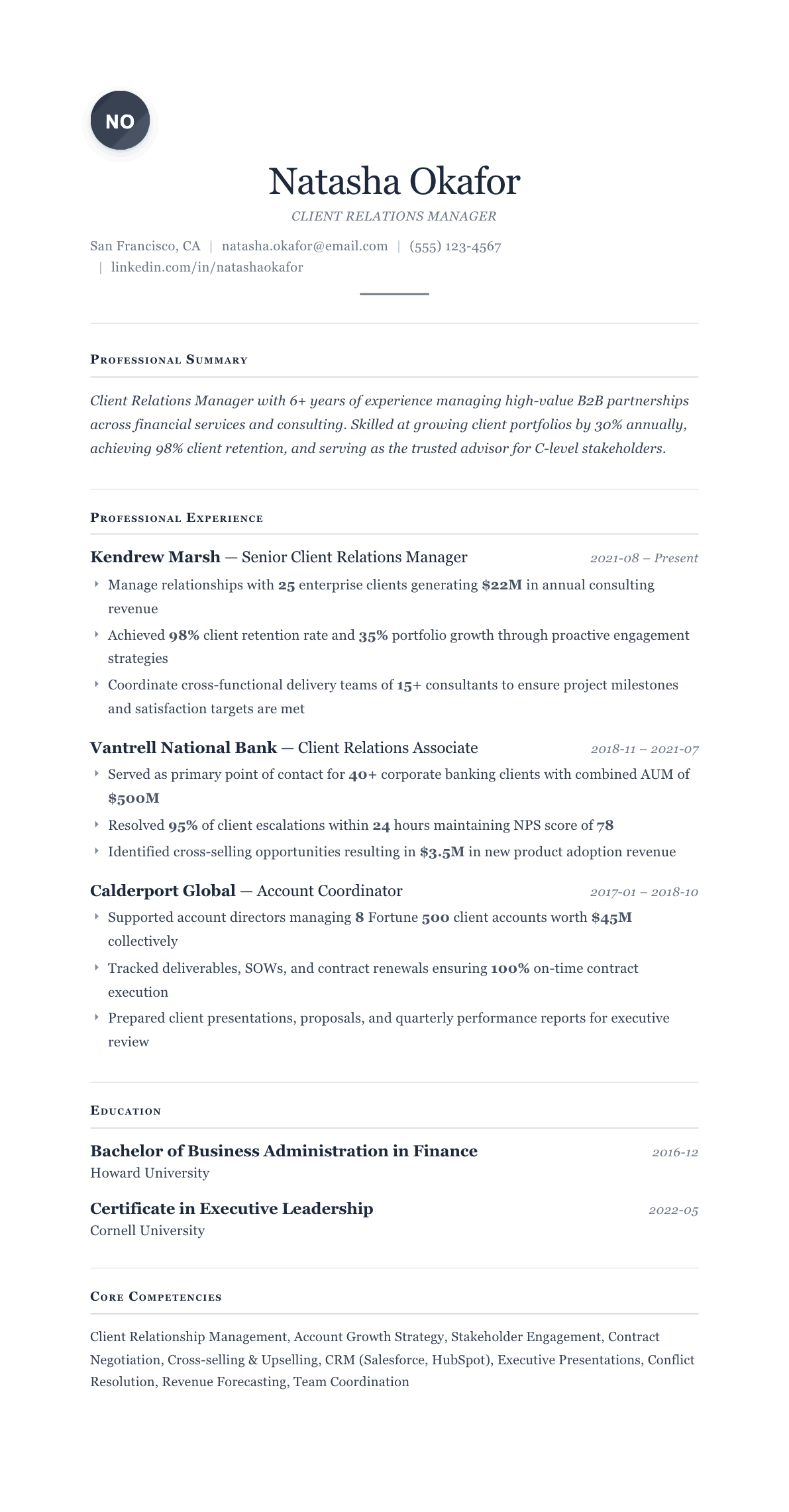
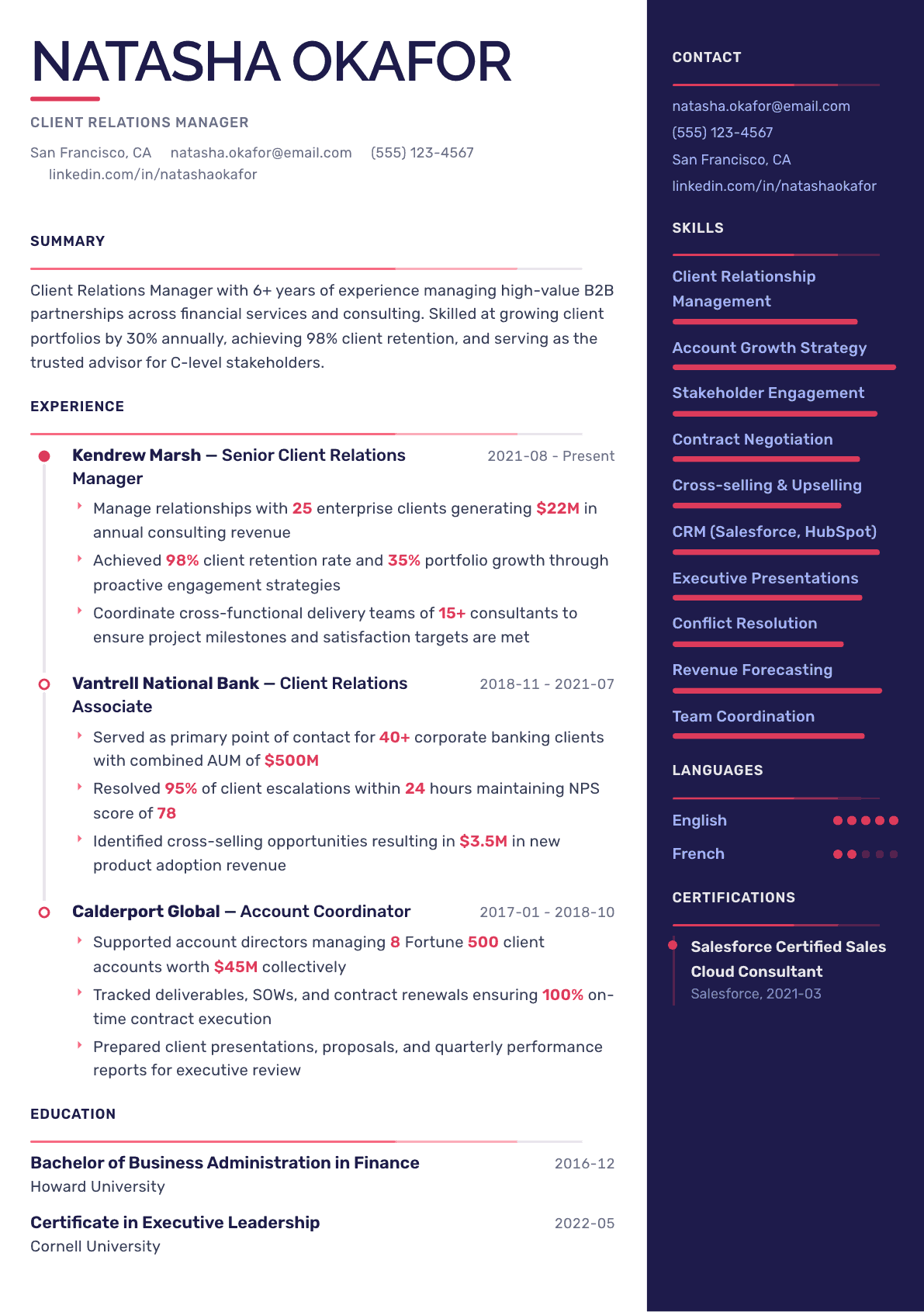
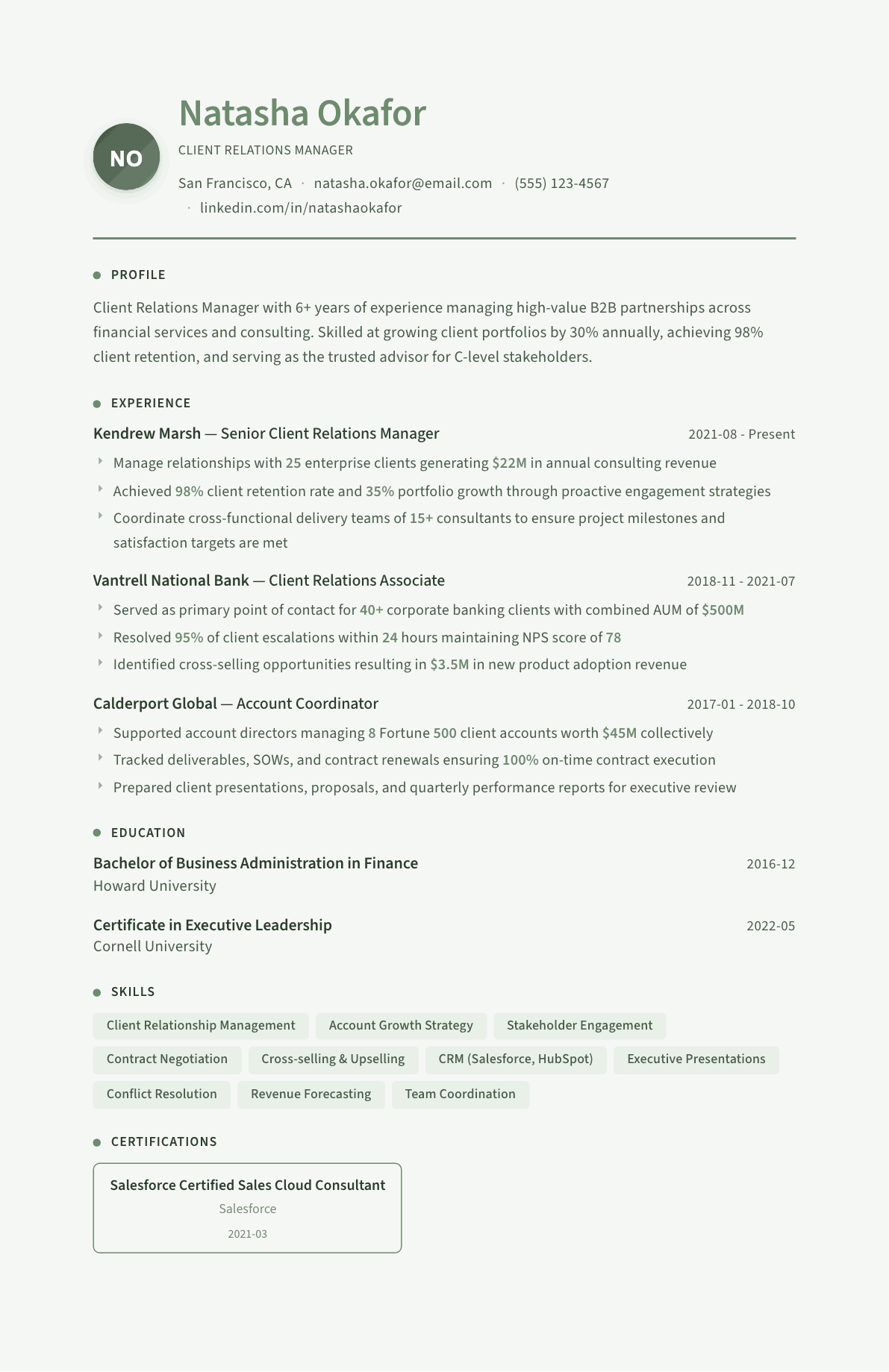
Example Client Relations Manager summary
Client Relations Manager with 6 years of experience managing $22M B2B portfolios across financial services and consulting. Achieved 98% retention, 35% portfolio growth, and NPS score of 78 through proactive stakeholder engagement.
Skills to list on a Client Relations Manager resume
- Client Relationship Management
- Account Growth & Retention
- Stakeholder Engagement
- Contract Negotiation
- Cross-selling & Upselling
- CRM Software (Salesforce)
- Executive Communication
- Conflict Resolution
- Revenue Forecasting
- Proposal Development
- Project Coordination
- Customer Satisfaction Metrics
What actually gets this resume read
- Quantify your portfolio value and number of accounts to showcase your level of responsibility.
- Include retention rates and NPS/CSAT scores as proof of relationship management effectiveness.
- Highlight revenue growth from upselling, cross-selling, or contract renewals.
- Emphasize your ability to work with C-suite stakeholders and navigate complex organizations.
- Show cross-functional coordination skills. Client relations managers bridge sales, delivery, and support.
How to write a client relations manager resume
A client relations manager resume is evaluated on the book of business you carried and what happened to it. The commercial director reading it wants to know how many accounts you owned, how large and how complex they were, who your day-to-day contact was inside them, and whether the portfolio grew, held or leaked while it was yours. Everything else on the page is supporting evidence.
The trap in this role is that the work is relational and therefore easy to describe in words that prove nothing. Built strong relationships, acted as trusted advisor and delivered excellent service appear on almost every client relations resume submitted, which means a reader has trained herself to skip them. The candidates who get called write about renewals signed, escalations closed, contracts expanded and churn avoided.
This guide covers the structure a client relations posting expects, how to present a portfolio without disclosing anything confidential, three summaries from coordinator to senior relationship owner, rewritten bullets, and the questions client relations managers ask when they move between industries.
Format: portfolio scope before achievements
Reverse chronological, one page under about seven years and two after that. Under each job, open with a scope line rather than a bullet: the industry served, the number of accounts, the segment, the seniority of your contacts and the contract structure. "Owned 25 enterprise accounts in financial services, contacts at director and chief operating officer level, annual retainers on multi-year terms" is the sentence that earns the rest of your bullets a reading.
Avoid design-heavy layouts. Client relations postings often sit inside sales or operations teams whose applicant tracking systems parse plainly, and a portfolio structure explained in a graphic is a portfolio structure the system deletes.
- Header: name, city and state, phone, email, LinkedIn.
- Section order: summary, experience, skills and systems, education, certifications.
- Name the industry of your clients, not only your own employer, because domain fluency is half of what is being bought.
Summary: segment, portfolio size, retention
Three lines that answer segment, size and result. Which market you serve, how many accounts and at what level, and the retention or growth figure you were measured against. A client relations manager who says nothing about retention has left out the only number the role exists to protect.
If you are targeting a different industry, name the transferable structure rather than the sector. Managing a small number of high-value accounts with quarterly reviews and executive contacts transfers cleanly. Managing hundreds of small accounts through a shared inbox does not, and pretending otherwise wastes the first interview.
Experience: renewals, escalations, growth and governance
Sort your bullets into the four things a client relations manager is actually held to. Retention, meaning renewals negotiated and churn prevented. Growth, meaning expansion of scope, additional services adopted and referrals generated. Escalation, meaning what you did when delivery went wrong and how the account survived it. And governance, meaning the review rhythm you ran and the reporting the client received.
The escalation bullet is the one hiring managers remember. Describe a genuine service failure, what you committed to, what changed internally as a result, and whether the client renewed. That single bullet demonstrates more judgment than a paragraph of relationship language.
Show the internal half of the job as well. A client relations manager spends much of the week pushing delivery, legal, finance and product to do things for a client who cannot ask them directly. Naming the functions you coordinated and the cadence you ran with them proves you can operate inside an organization, which is where most candidates in this role actually fail.
- Give renewal outcomes as a rate across the portfolio and as named multi-year agreements.
- Describe contract mechanics you handled: statements of work, service level agreements, amendments, renewal notice periods.
- Say which review rhythm you owned: monthly operational calls, quarterly business reviews, annual planning sessions.
Confidentiality: how to be specific without naming names
Client names are usually restricted by your agreement with your employer, and listing them anyway signals to a future employer exactly how your own accounts would be discussed. Describe the client instead of naming it: a regional bank, a national insurer, a mid-market logistics group, a public sector health body. The description carries the credibility without the breach.
The same restraint applies to figures. Portfolio value, contract terms and pricing are commercially sensitive, so use account counts, headcount served, contract length and percentage movements instead. A reader in this field understands why, and volunteering a discreet formulation is itself a demonstration of the trait being hired.
Systems, skills and the keyword pass
Name the customer relationship system, because pipeline hygiene is a real part of the job and a manager wants to know you have worked inside a discipline of logged activity, opportunity stages and renewal dates. Salesforce, HubSpot, Microsoft Dynamics, Gainsight and Zendesk are the names that recur, along with the reporting and presentation tools you build reviews in.
For keywords, mirror the posting: account management, client retention, stakeholder engagement, contract renewal, escalation management, business reviews, upselling and cross-selling, onboarding, and the industry noun. Use each once where it is claimed and once where it is proven.
Client Relations Manager resume summary examples
Account coordinator
Account coordinator with two years supporting a client relations team across 40 mid-market accounts in professional services. Prepared quarterly review decks, tracked contract renewal dates in Salesforce, and resolved 20 client requests weekly. Seeking a first client relations manager role with direct account ownership.
Five years in
Client relations manager with five years owning a portfolio of 30 mid-market accounts in software and logistics, with contacts at director level. Holds 94% annual renewal across the book, grew scope in a third of accounts, and runs quarterly business reviews with delivery and finance.
Senior relationship lead
Senior client relations lead with twelve years in enterprise services, currently responsible for 12 strategic accounts and a team of 4 relationship managers. Owns executive sponsorship, multi-year renewal negotiation and escalation governance, and has recovered 3 accounts that had issued notice of termination.
Work experience bullets: before and after
Before: Built strong relationships with clients.
After: Owned 28 enterprise accounts in insurance, holding monthly operational calls with program managers and quarterly reviews with the sponsoring director in each.
The portfolio size, the industry and the two-tier contact rhythm replace a claim nobody can verify.
Before: Retained clients and reduced churn.
After: Renewed 26 of 28 accounts across two renewal cycles, including two multi-year extensions signed after competitive tender.
Renewal counts and the competitive tender detail show retention that was fought for rather than assumed.
Before: Handled client complaints and escalations.
After: Led recovery of a national retail account after a failed data migration, running daily status calls for three weeks and agreeing a remediation plan that kept the contract through renewal.
A named failure with the actions and the outcome proves judgment under pressure in a way a category noun cannot.
Before: Worked with internal teams to deliver for clients.
After: Coordinated delivery, legal and finance on 15 contract amendments and 9 new statements of work, cutting average turnaround from four weeks to eleven days.
The internal machinery and a cycle time turn coordination into a measurable operational contribution.
Before: Grew revenue in existing accounts.
After: Expanded scope in 11 accounts by mapping unaddressed business units and introducing two additional service lines, lifting portfolio revenue by 22% year over year.
The method of finding growth matters more to a hiring manager than the growth figure alone.
Hard skills
- Portfolio and account ownership
- Contract renewal negotiation
- Statements of work and amendments
- Service level agreement management
- Quarterly business reviews
- Escalation and recovery planning
- Churn risk analysis
- Upsell and cross-sell planning
- Salesforce and Microsoft Dynamics
- Gainsight account health tracking
- Client reporting and dashboards
- Stakeholder mapping
Soft skills
- Executive presence
- Discretion with commercial information
- Negotiation under pressure
- Internal influence without authority
- Difficult conversations
- Listening for unstated risk
Certifications worth listing
- Certified Strategic Account Manager (CSAM) (Strategic Account Management Association)
- Certified Customer Experience Professional (CCXP) (Customer Experience Professionals Association)
- Salesforce Certified Administrator (Salesforce)
- Project Management Professional (PMP) (Project Management Institute)
Mistakes that cost client relations manager candidates the interview
- Opening every bullet with relationship language and never stating how many accounts you carried.
- Omitting retention entirely, which leaves a commercial director assuming the book leaked.
- Naming clients your employment agreement protects instead of describing them by sector and size.
- Describing only the pleasant half of the job and leaving out a single escalation or recovery.
- Confusing influence with ownership by claiming portfolio results that belonged to a sales team.
- Skipping the contract mechanics, so a reader cannot tell whether you negotiated or only attended.
- Reusing a sales resume that leads with new business quota for a role whose purpose is keeping existing clients.
Client Relations Manager resume questions
What is the difference between a client relations manager and an account manager on a resume?
Account management usually carries a sales quota for new business inside accounts, while client relations centers on retention, satisfaction and escalation. Read the posting and lead with whichever half it emphasizes, keeping the other visible further down.
Can I name my clients on a client relations resume?
Usually not, and a reader in this field will respect the restraint. Describe each account by sector, size and contact seniority instead. If a client is publicly referenced in your employer marketing, naming it is generally safe.
How do I quantify client relations work when I have no revenue target?
Use account counts, renewal rates, contract lengths, escalation volumes, review cadence, response times and satisfaction scores. Retention and reduced churn are commercial outcomes even when no quota was formally attached to your name.
How do I move into client relations from a support or delivery role?
Lead with the accounts you were the recognized contact for, the reviews you presented in, and any renewal or expansion conversation you influenced. Then reframe your delivery knowledge as the domain credibility clients want from a relationship owner.
Should my resume include the industries my clients came from?
Yes, because domain fluency is often the deciding factor between two similar candidates. A manager hiring for a healthcare portfolio wants to see that you have already sat across from people who talk about regulators, procurement cycles and clinical stakeholders.
Related resume examples
- Customer Success Manager Resume example
- Customer Experience Director Resume example
- Customer Onboarding Specialist Resume example
- Virtual Assistant Resume example
- Executive Coordinator Resume example
- Customer Retention Specialist Resume example