Civil Service Behaviours: 9 Examples, One Per Behaviour
By Mustafa Tarabya, founder of CVBooster · Published · Updated
23 min read
There are nine Civil Service behaviours, and this page carries one complete 250-word statement for each. The constraint is the box on Civil Service Jobs. Most adverts cap each behaviour at 250 words, and the counter does not care how good your story is. The definitions and indicators quoted below are taken verbatim from Success Profiles: Civil Service behaviours on gov.uk. Nine statements follow, all written at Higher Executive Officer level, each in a different ordinary workplace and each annotated against the indicator it evidences. Written by Mustafa Tarabya, who hired for his own company, read every application himself and now writes CVBooster's guides. Updated September 2026.
Every statement below is complete and usable as a model. None of them is yours, so take the shape and replace the facts.
What the 250-word limit is, and who sets it
The Success Profiles framework sets no word count at all. It sets the five elements a recruiting manager can draw on: Behaviours, Strengths, Ability, Experience and Technical. The framework was published in June 2018 and last updated on 29 January 2025. Civil Service Careers publishes the same nine behaviours with its own guidance on the STAR model. That update revised the behaviour examples for Grade 7 and Grade 6.
The word limit is set per vacancy by the department and enforced by the form. Two hundred and fifty words per behaviour is the most common setting, which is why it became the standard people plan around. It is not universal. You will meet 200, 300 and 400, plus a personal statement box with a much larger limit.
A workable budget inside 250 words is 40 for situation, 40 for task, 120 for action and 50 for result. The action is where the marks are. Cut the background first.
Tip: Note three things from the advert before writing: the exact behaviours named, the word limit for each, and the grade. All three change what a strong statement looks like.
Nine worked statements, one per behaviour
All nine are written at HEO level, in nine different workplaces, at 240 to 260 words each.
Seeing the big picture
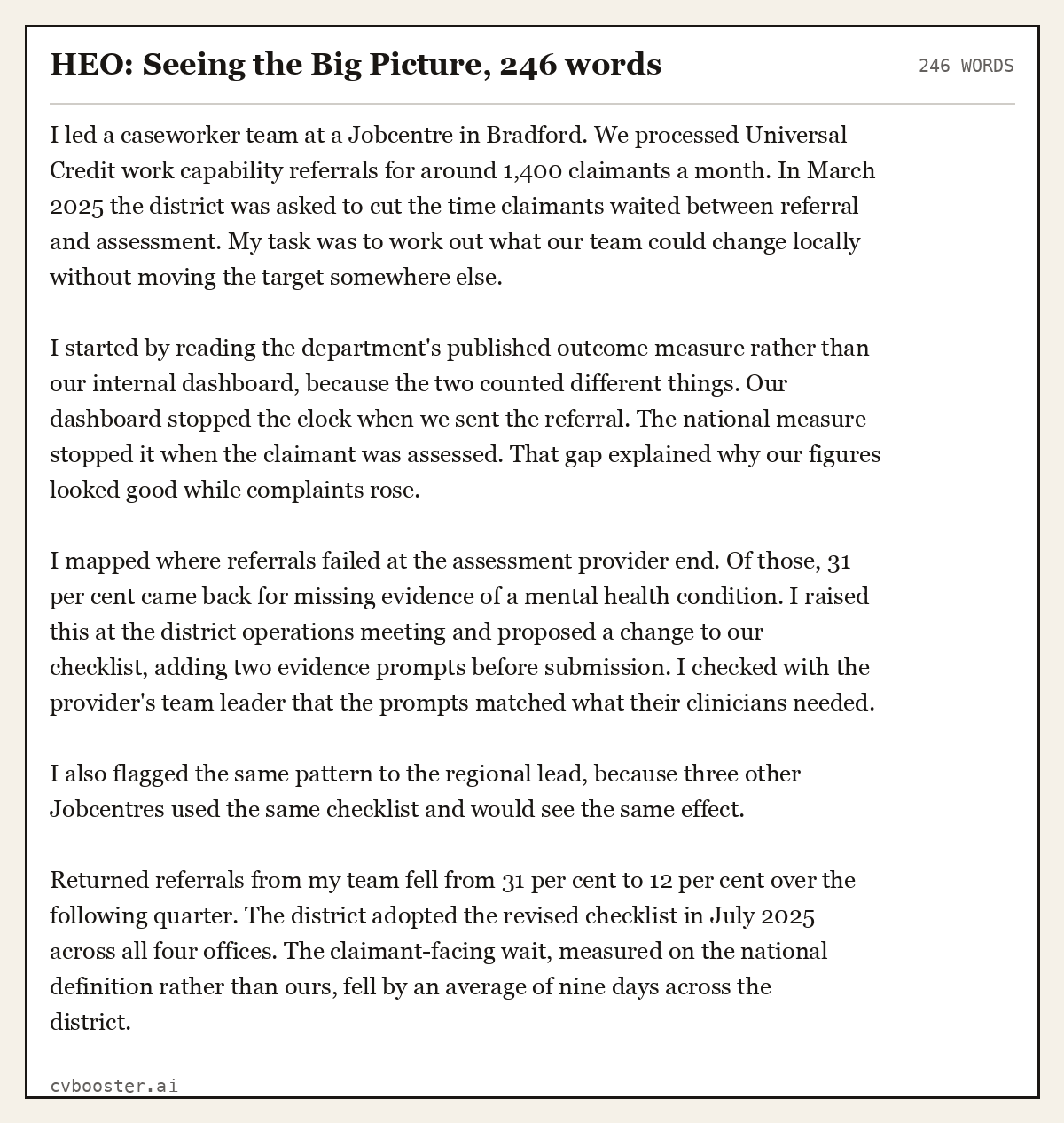
HEO: Seeing the Big Picture, 246 words (246 words)
I led a caseworker team at a Jobcentre in Bradford. We processed Universal Credit work capability referrals for around 1,400 claimants a month. In March 2025 the district was asked to cut the time claimants waited between referral and assessment. My task was to work out what our team could change locally without moving the target somewhere else.
I started by reading the department's published outcome measure rather than our internal dashboard, because the two counted different things. Our dashboard stopped the clock when we sent the referral. The national measure stopped it when the claimant was assessed. That gap explained why our figures looked good while complaints rose.
I mapped where referrals failed at the assessment provider end. Of those, 31 per cent came back for missing evidence of a mental health condition. I raised this at the district operations meeting and proposed a change to our checklist, adding two evidence prompts before submission. I checked with the provider's team leader that the prompts matched what their clinicians needed.
I also flagged the same pattern to the regional lead, because three other Jobcentres used the same checklist and would see the same effect.
Returned referrals from my team fell from 31 per cent to 12 per cent over the following quarter. The district adopted the revised checklist in July 2025 across all four offices. The claimant-facing wait, measured on the national definition rather than ours, fell by an average of nine days across the district.
What the sifter is scoring
- Indicator quoted: "align activities to contribute to wider organisational priorities" (gov.uk Success Profiles behaviours, HEO and SEO). Where the statement shows it: reading the national outcome measure instead of the local dashboard, then changing local practice to move the national number.
- Indicator quoted: "understand how the strategies and activities of the team create value and meet the diverse needs of all stakeholders" (HEO and SEO). Where the statement shows it: checking the new evidence prompts against what the assessment provider's clinicians actually needed.
Full page with three statements at EO, HEO and Grade 7: seeing the big picture civil service example.
Changing and improving
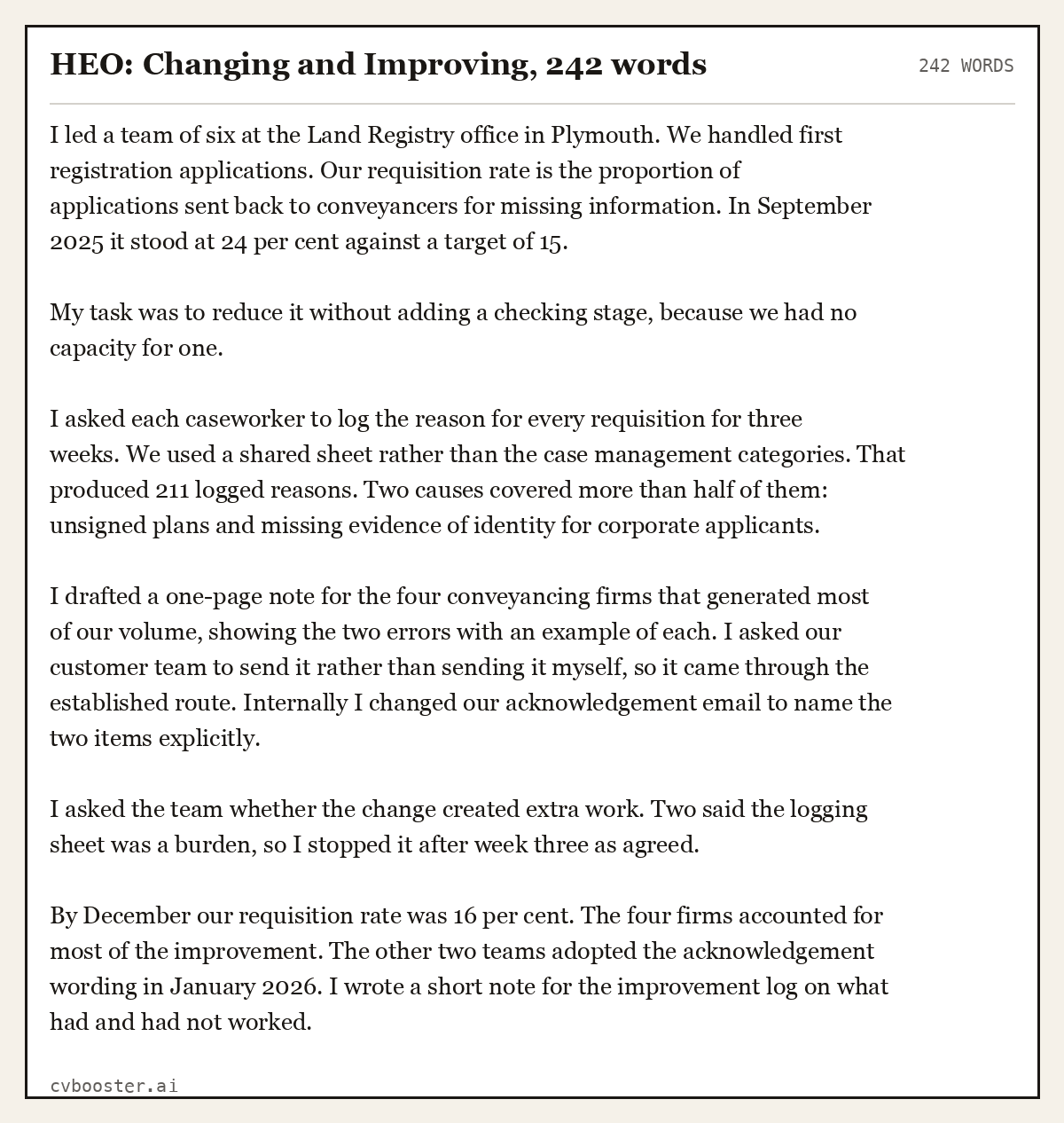
HEO: Changing and Improving, 242 words (242 words)
I led a team of six at the Land Registry office in Plymouth. We handled first registration applications. Our requisition rate is the proportion of applications sent back to conveyancers for missing information. In September 2025 it stood at 24 per cent against a target of 15.
My task was to reduce it without adding a checking stage, because we had no capacity for one.
I asked each caseworker to log the reason for every requisition for three weeks. We used a shared sheet rather than the case management categories. That produced 211 logged reasons. Two causes covered more than half of them: unsigned plans and missing evidence of identity for corporate applicants.
I drafted a one-page note for the four conveyancing firms that generated most of our volume, showing the two errors with an example of each. I asked our customer team to send it rather than sending it myself, so it came through the established route. Internally I changed our acknowledgement email to name the two items explicitly.
I asked the team whether the change created extra work. Two said the logging sheet was a burden, so I stopped it after week three as agreed.
By December our requisition rate was 16 per cent. The four firms accounted for most of the improvement. The other two teams adopted the acknowledgement wording in January 2026. I wrote a short note for the improvement log on what had and had not worked.
What the sifter is scoring
- Indicator quoted: "work with others to identify areas for improvement and simplify processes to use fewer resources" (HEO and SEO). Where the statement shows it: the three-week logging exercise done by the team, and the removal of a checking stage rather than the addition of one.
- Indicator quoted: "encourage an environment where colleagues know that they can challenge decisions and issues safely" (HEO and SEO). Where the statement shows it: stopping the logging sheet when two colleagues said it was a burden.
Full page with three statements at EO, HEO and Grade 7 is in preparation. Meanwhile see the civil service behaviours framework for the indicator wording at every level.
Making effective decisions
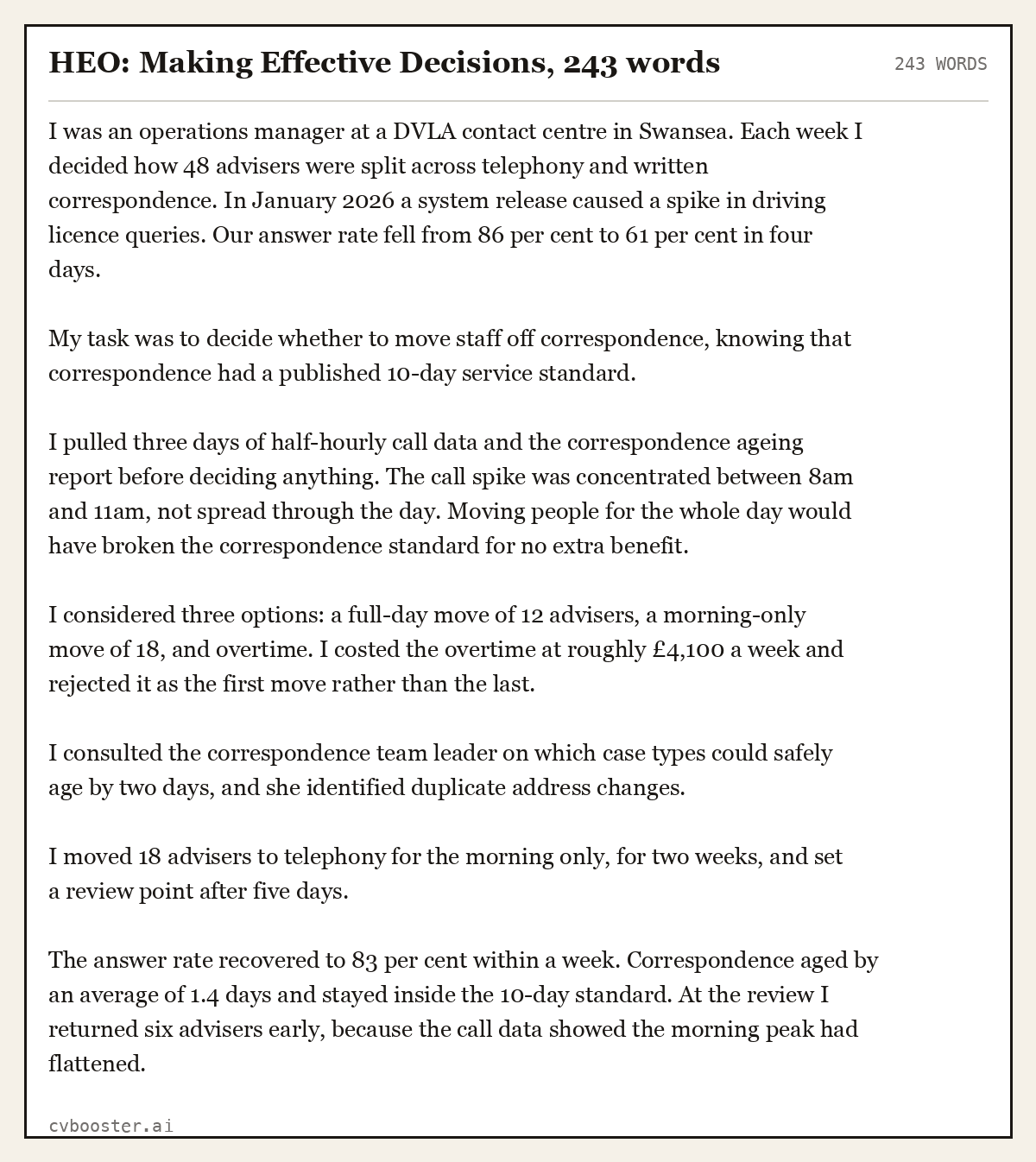
HEO: Making Effective Decisions, 243 words (243 words)
I was an operations manager at a DVLA contact centre in Swansea. Each week I decided how 48 advisers were split across telephony and written correspondence. In January 2026 a system release caused a spike in driving licence queries. Our answer rate fell from 86 per cent to 61 per cent in four days.
My task was to decide whether to move staff off correspondence, knowing that correspondence had a published 10-day service standard.
I pulled three days of half-hourly call data and the correspondence ageing report before deciding anything. The call spike was concentrated between 8am and 11am, not spread through the day. Moving people for the whole day would have broken the correspondence standard for no extra benefit.
I considered three options: a full-day move of 12 advisers, a morning-only move of 18, and overtime. I costed the overtime at roughly £4,100 a week and rejected it as the first move rather than the last.
I consulted the correspondence team leader on which case types could safely age by two days, and she identified duplicate address changes.
I moved 18 advisers to telephony for the morning only, for two weeks, and set a review point after five days.
The answer rate recovered to 83 per cent within a week. Correspondence aged by an average of 1.4 days and stayed inside the 10-day standard. At the review I returned six advisers early, because the call data showed the morning peak had flattened.
What the sifter is scoring
- Indicator quoted: "analyse and use a range of relevant, credible information from internal and external sources to support decisions" (HEO and SEO). Where the statement shows it: half-hourly call data and the correspondence ageing report pulled before any decision.
- Indicator quoted: "present strong recommendations in a timely manner outlining the consideration of other options, costs, benefits and risks" (HEO and SEO). Where the statement shows it: three named options, a costed rejection, and a set review point.
Full page with three statements at EO, HEO and Grade 7: making effective decisions civil service example.
Leadership
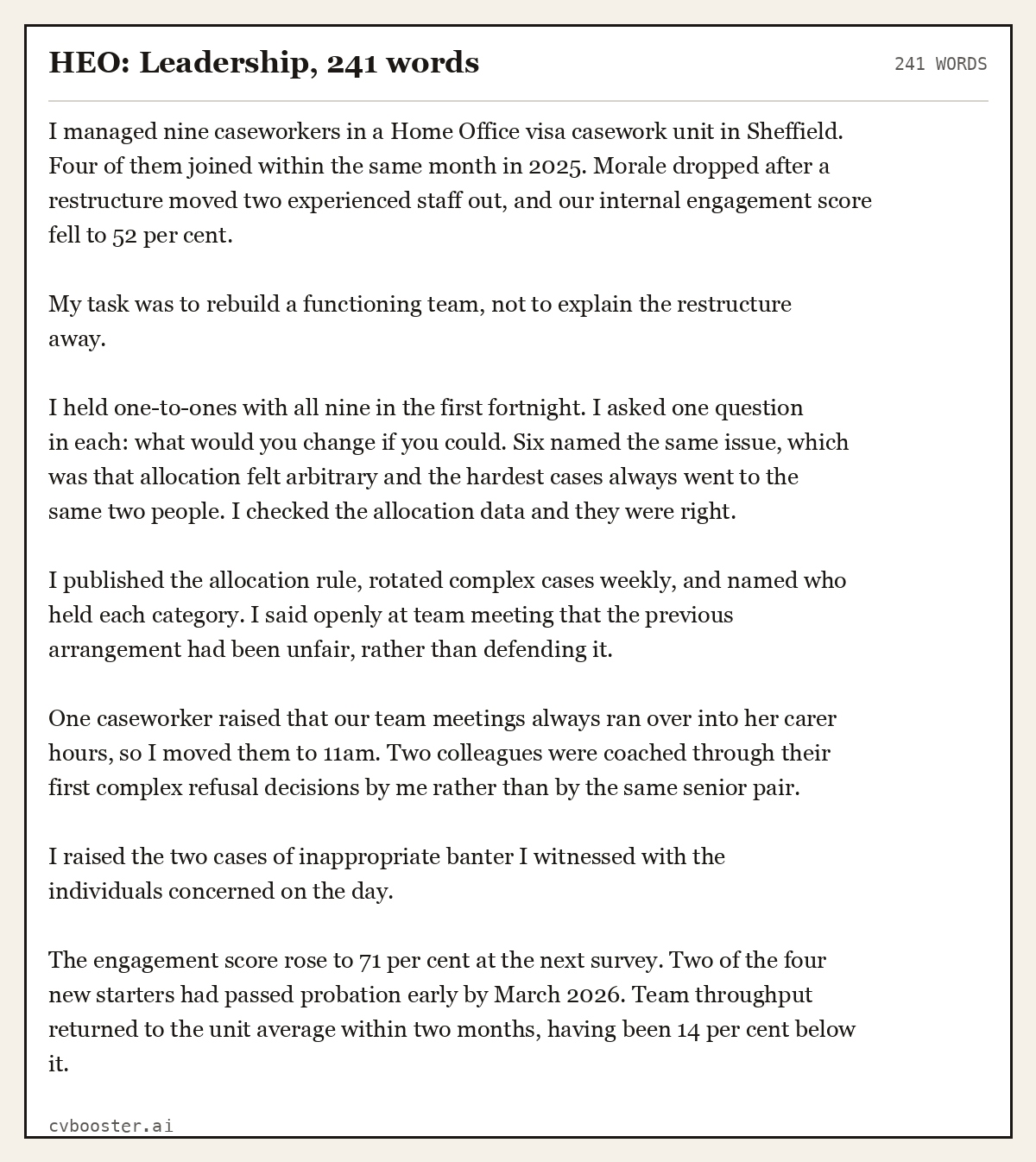
HEO: Leadership, 241 words (241 words)
I managed nine caseworkers in a Home Office visa casework unit in Sheffield. Four of them joined within the same month in 2025. Morale dropped after a restructure moved two experienced staff out, and our internal engagement score fell to 52 per cent.
My task was to rebuild a functioning team, not to explain the restructure away.
I held one-to-ones with all nine in the first fortnight. I asked one question in each: what would you change if you could. Six named the same issue, which was that allocation felt arbitrary and the hardest cases always went to the same two people. I checked the allocation data and they were right.
I published the allocation rule, rotated complex cases weekly, and named who held each category. I said openly at team meeting that the previous arrangement had been unfair, rather than defending it.
One caseworker raised that our team meetings always ran over into her carer hours, so I moved them to 11am. Two colleagues were coached through their first complex refusal decisions by me rather than by the same senior pair.
I raised the two cases of inappropriate banter I witnessed with the individuals concerned on the day.
The engagement score rose to 71 per cent at the next survey. Two of the four new starters had passed probation early by March 2026. Team throughput returned to the unit average within two months, having been 14 per cent below it.
What the sifter is scoring
- Indicator quoted: "take into account different individual needs, views, and ideas, championing inclusion and equality of opportunity for all" (HEO and SEO). Where the statement shows it: moving the meeting for a carer, and publishing the allocation rule.
- Indicator quoted: "effectively manage conflict, misconduct and non-inclusive behaviour, raising with senior managers where appropriate" (HEO and SEO). Where the statement shows it: addressing the banter on the day it happened.
Full page with three statements at EO, HEO and Grade 7 is in preparation. See the civil service success profiles guide for how Leadership sits alongside Strengths.
Communicating and influencing
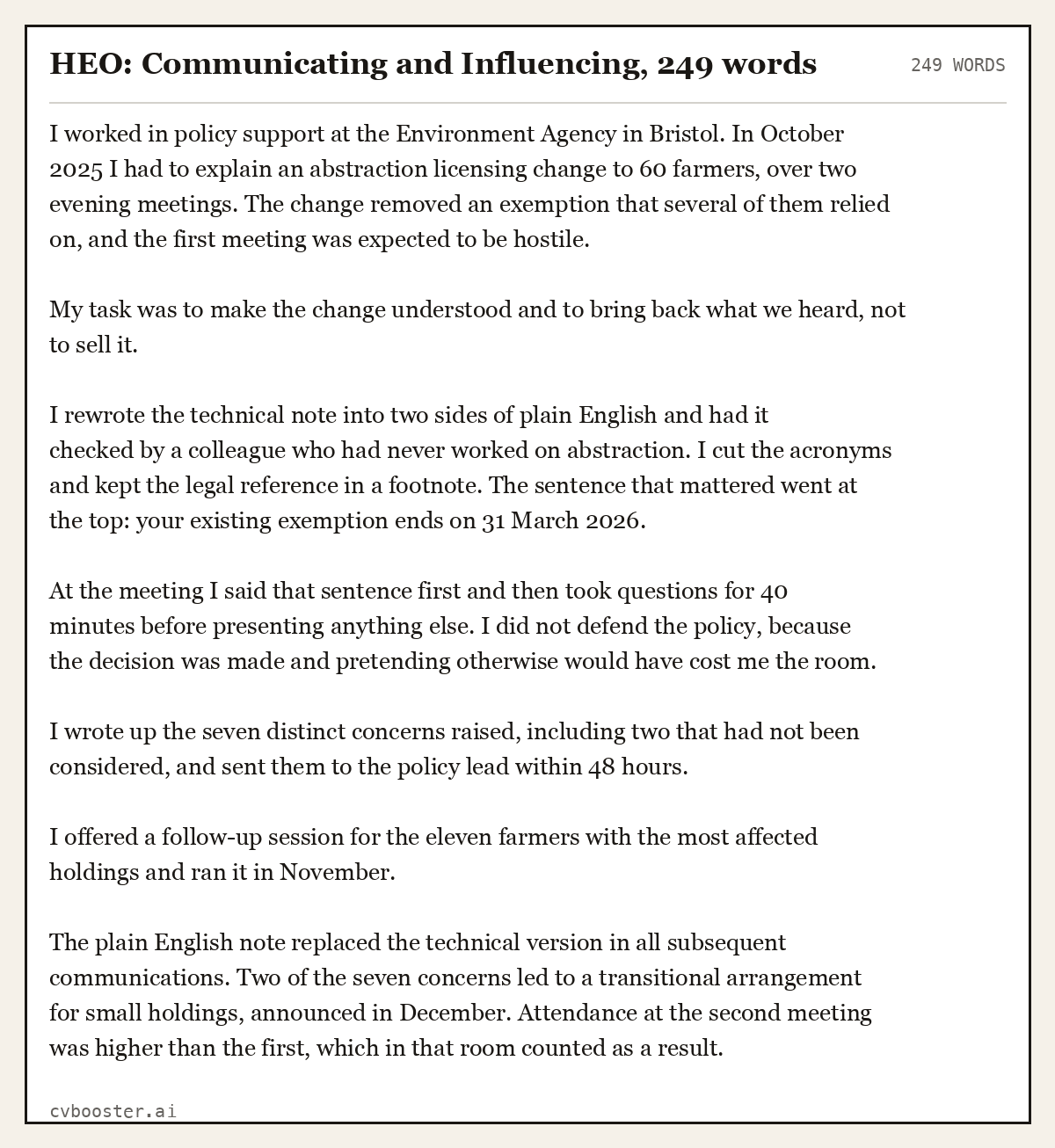
HEO: Communicating and Influencing, 249 words (249 words)
I worked in policy support at the Environment Agency in Bristol. In October 2025 I had to explain an abstraction licensing change to 60 farmers, over two evening meetings. The change removed an exemption that several of them relied on, and the first meeting was expected to be hostile.
My task was to make the change understood and to bring back what we heard, not to sell it.
I rewrote the technical note into two sides of plain English and had it checked by a colleague who had never worked on abstraction. I cut the acronyms and kept the legal reference in a footnote. The sentence that mattered went at the top: your existing exemption ends on 31 March 2026.
At the meeting I said that sentence first and then took questions for 40 minutes before presenting anything else. I did not defend the policy, because the decision was made and pretending otherwise would have cost me the room.
I wrote up the seven distinct concerns raised, including two that had not been considered, and sent them to the policy lead within 48 hours.
I offered a follow-up session for the eleven farmers with the most affected holdings and ran it in November.
The plain English note replaced the technical version in all subsequent communications. Two of the seven concerns led to a transitional arrangement for small holdings, announced in December. Attendance at the second meeting was higher than the first, which in that room counted as a result.
What the sifter is scoring
- Indicator quoted: "communicate in a straightforward, honest and engaging manner - choosing appropriate styles to maximise understanding and impact" (HEO and SEO). Where the statement shows it: the rewritten note, the acronyms cut, and the key sentence first.
- Indicator quoted: "ensure that important messages are communicated with colleagues and stakeholders respectfully, taking into consideration the diversity of interests" (HEO and SEO). Where the statement shows it: taking questions for 40 minutes before presenting, and reporting the concerns upward.
Full page with three statements at EO, HEO and Grade 7: communicating and influencing civil service example.
Working together
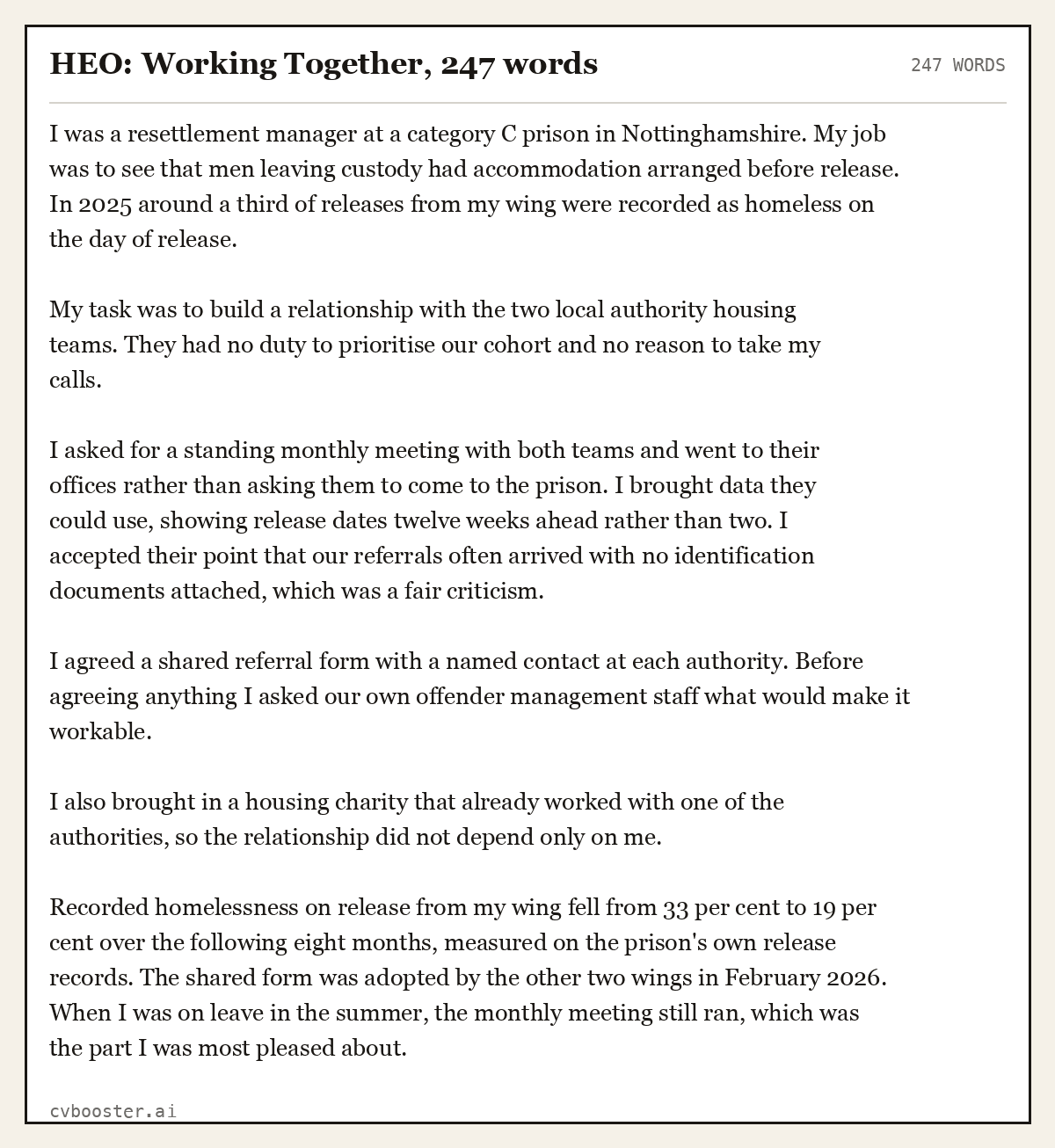
HEO: Working Together, 247 words (247 words)
I was a resettlement manager at a category C prison in Nottinghamshire. My job was to see that men leaving custody had accommodation arranged before release. In 2025 around a third of releases from my wing were recorded as homeless on the day of release.
My task was to build a relationship with the two local authority housing teams. They had no duty to prioritise our cohort and no reason to take my calls.
I asked for a standing monthly meeting with both teams and went to their offices rather than asking them to come to the prison. I brought data they could use, showing release dates twelve weeks ahead rather than two. I accepted their point that our referrals often arrived with no identification documents attached, which was a fair criticism.
I agreed a shared referral form with a named contact at each authority. Before agreeing anything I asked our own offender management staff what would make it workable.
I also brought in a housing charity that already worked with one of the authorities, so the relationship did not depend only on me.
Recorded homelessness on release from my wing fell from 33 per cent to 19 per cent over the following eight months, measured on the prison's own release records. The shared form was adopted by the other two wings in February 2026. When I was on leave in the summer, the monthly meeting still ran, which was the part I was most pleased about.
What the sifter is scoring
- Indicator quoted: "establish professional relationships with a range of stakeholders" and "collaborate with these to share information, resources and support" (HEO and SEO). Where the statement shows it: the standing meeting held on their ground, and the twelve-week release data shared with them.
- Indicator quoted: "actively seek and consider input of people from diverse backgrounds and perspectives" (HEO and SEO). Where the statement shows it: asking offender management staff what would be workable before agreeing the form.
Full page with three statements at EO, HEO and Grade 7: working together civil service example.
Developing self and others
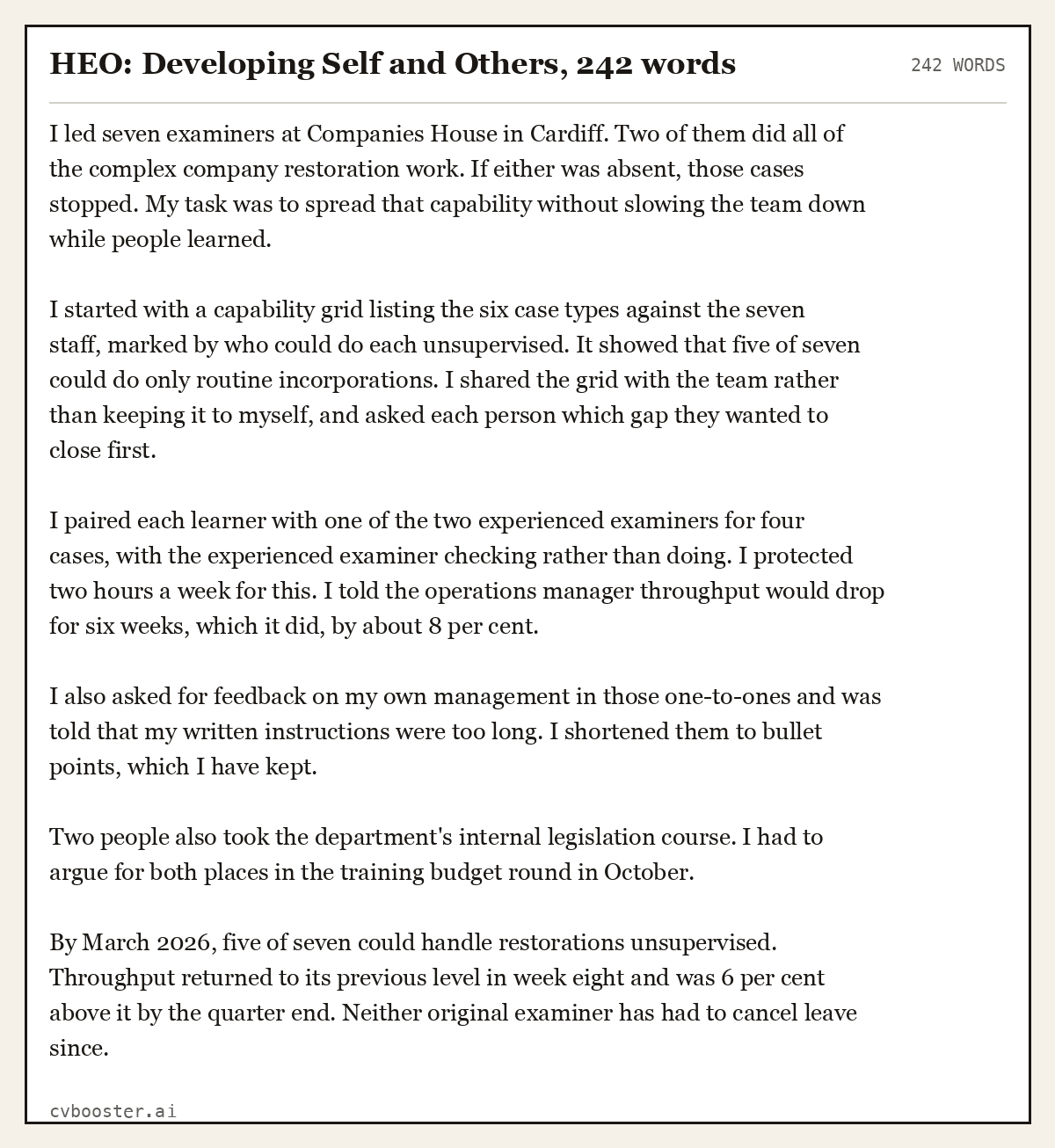
HEO: Developing Self and Others, 242 words (242 words)
I led seven examiners at Companies House in Cardiff. Two of them did all of the complex company restoration work. If either was absent, those cases stopped. My task was to spread that capability without slowing the team down while people learned.
I started with a capability grid listing the six case types against the seven staff, marked by who could do each unsupervised. It showed that five of seven could do only routine incorporations. I shared the grid with the team rather than keeping it to myself, and asked each person which gap they wanted to close first.
I paired each learner with one of the two experienced examiners for four cases, with the experienced examiner checking rather than doing. I protected two hours a week for this. I told the operations manager throughput would drop for six weeks, which it did, by about 8 per cent.
I also asked for feedback on my own management in those one-to-ones and was told that my written instructions were too long. I shortened them to bullet points, which I have kept.
Two people also took the department's internal legislation course. I had to argue for both places in the training budget round in October.
By March 2026, five of seven could handle restorations unsupervised. Throughput returned to its previous level in week eight and was 6 per cent above it by the quarter end. Neither original examiner has had to cancel leave since.
What the sifter is scoring
- Indicator quoted: "identify capability gaps for yourself and your team" (HEO and SEO). Where the statement shows it: the capability grid and the honest count of five of seven.
- Indicator quoted: "reflect on your own work, continuously seek and act on feedback to improve own and team's performance" (HEO and SEO). Where the statement shows it: asking for feedback and shortening the written instructions.
Full page with three statements at EO, HEO and Grade 7 is in preparation. See the civil service behaviours framework for the Developing Self and Others indicators at each grade.
Managing a quality service
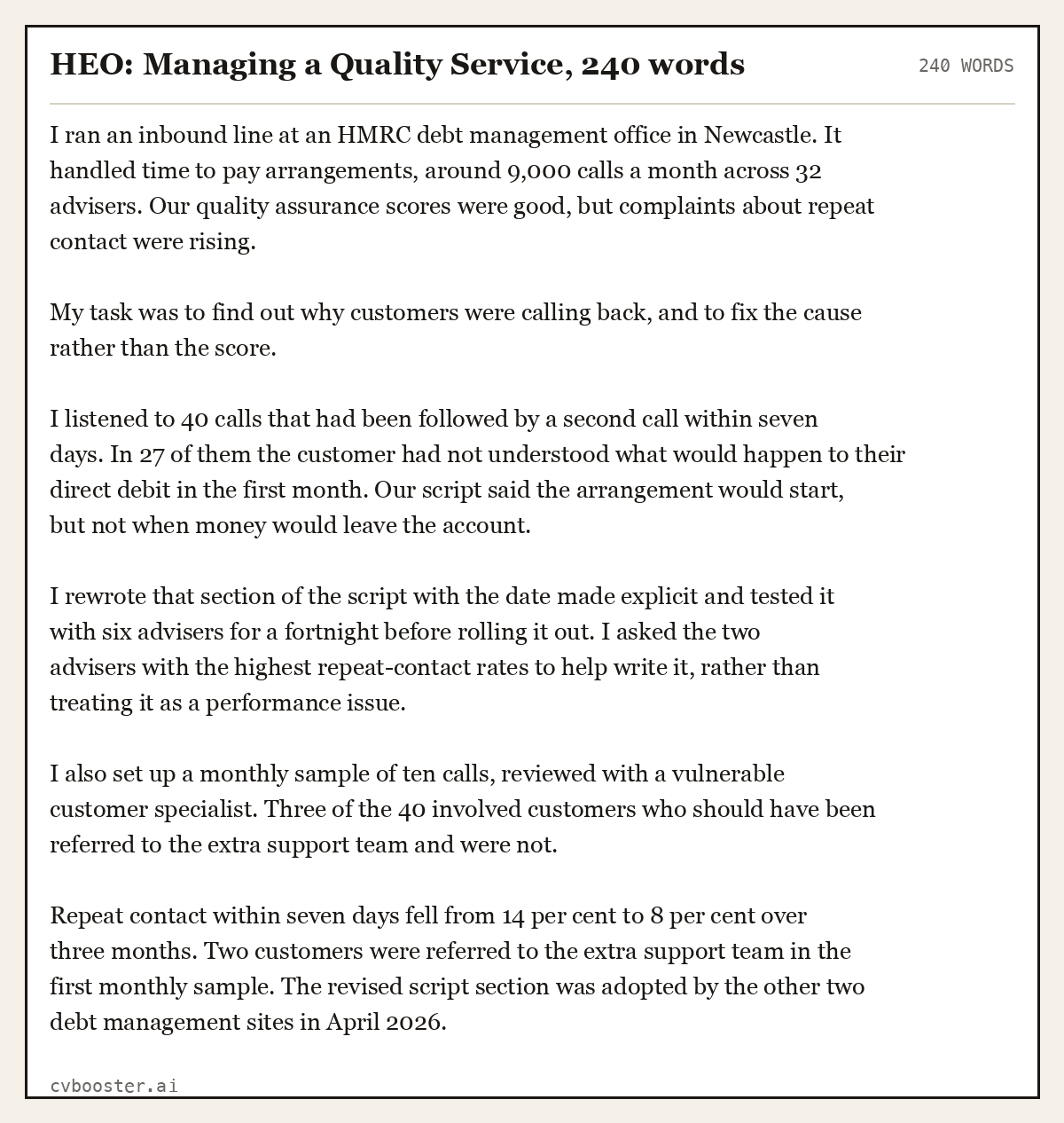
HEO: Managing a Quality Service, 240 words (240 words)
I ran an inbound line at an HMRC debt management office in Newcastle. It handled time to pay arrangements, around 9,000 calls a month across 32 advisers. Our quality assurance scores were good, but complaints about repeat contact were rising.
My task was to find out why customers were calling back, and to fix the cause rather than the score.
I listened to 40 calls that had been followed by a second call within seven days. In 27 of them the customer had not understood what would happen to their direct debit in the first month. Our script said the arrangement would start, but not when money would leave the account.
I rewrote that section of the script with the date made explicit and tested it with six advisers for a fortnight before rolling it out. I asked the two advisers with the highest repeat-contact rates to help write it, rather than treating it as a performance issue.
I also set up a monthly sample of ten calls, reviewed with a vulnerable customer specialist. Three of the 40 involved customers who should have been referred to the extra support team and were not.
Repeat contact within seven days fell from 14 per cent to 8 per cent over three months. Two customers were referred to the extra support team in the first monthly sample. The revised script section was adopted by the other two debt management sites in April 2026.
What the sifter is scoring
- Indicator quoted: "establish ways to find and respond to feedback from customers about the services provided" (HEO and SEO). Where the statement shows it: listening to 40 repeat-contact calls rather than reading the quality score.
- Indicator quoted: "successfully deliver high quality outcomes that meet the customers' needs and gives value for money" (HEO and SEO). Where the statement shows it: the drop in repeat contact and the referrals to extra support.
Full page with three statements at EO, HEO and Grade 7: managing a quality service civil service example.
Delivering at pace
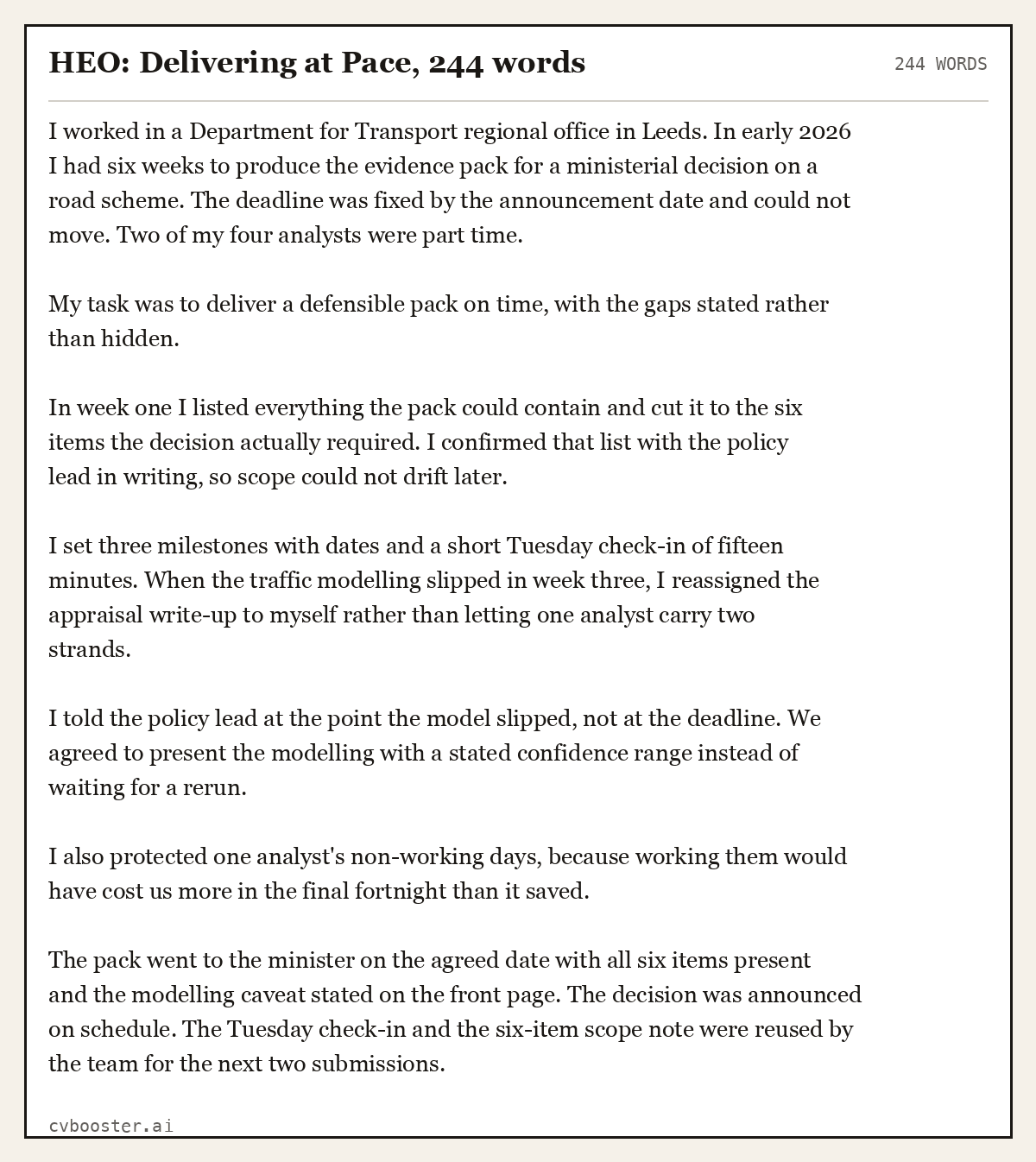
HEO: Delivering at Pace, 244 words (244 words)
I worked in a Department for Transport regional office in Leeds. In early 2026 I had six weeks to produce the evidence pack for a ministerial decision on a road scheme. The deadline was fixed by the announcement date and could not move. Two of my four analysts were part time.
My task was to deliver a defensible pack on time, with the gaps stated rather than hidden.
In week one I listed everything the pack could contain and cut it to the six items the decision actually required. I confirmed that list with the policy lead in writing, so scope could not drift later.
I set three milestones with dates and a short Tuesday check-in of fifteen minutes. When the traffic modelling slipped in week three, I reassigned the appraisal write-up to myself rather than letting one analyst carry two strands.
I told the policy lead at the point the model slipped, not at the deadline. We agreed to present the modelling with a stated confidence range instead of waiting for a rerun.
I also protected one analyst's non-working days, because working them would have cost us more in the final fortnight than it saved.
The pack went to the minister on the agreed date with all six items present and the modelling caveat stated on the front page. The decision was announced on schedule. The Tuesday check-in and the six-item scope note were reused by the team for the next two submissions.
What the sifter is scoring
- Indicator quoted: "act promptly to reassess workloads and priorities when there are conflicting demands to maintain performance" (HEO and SEO). Where the statement shows it: the reassignment in week three and the early warning to the policy lead.
- Indicator quoted: "regularly monitor your own and team's work against milestones ensuring individual needs are considered when setting tasks" (HEO and SEO). Where the statement shows it: three dated milestones and protected non-working days.
Full page with three statements at EO, HEO and Grade 7: delivering at pace civil service example.
The nine behaviours, quoted from gov.uk
These are the definitions as published. Use the behaviour names exactly as they appear, because sifters scan for them.
| Behaviour | Definition, quoted from gov.uk |
|---|---|
| Seeing the big picture | "Understand how your role fits with and supports organisational objectives. Recognise the wider Civil Service priorities and ensure work is in the national interest." |
| Changing and improving | "Seek out opportunities to create effective change and suggest innovative ideas for improvement. Review ways of working, including seeking and providing feedback." |
| Making effective decisions | "Use evidence and knowledge to support accurate, expert decisions and advice. Carefully consider alternative options, implications and risks of decisions." |
| Leadership | "Show pride and passion for public service. Create and engage others in delivering a shared vision. Value difference, diversity and inclusion, ensuring fairness and opportunity for all." |
| Communicating and influencing | "Communicate purpose and direction with clarity, integrity and enthusiasm. Respect the needs, responses and opinions of others." |
| Working together | "Form effective partnerships and relationships with people both internally and externally, from a range of diverse backgrounds, sharing information, resources and support." |
| Developing self and others | "Focus on continuous learning and development for self, others and the organisation as a whole." |
| Managing a quality service | "Deliver service objectives with professional excellence, expertise and efficiency, taking account of diverse customer needs." |
| Delivering at pace | "Take responsibility for delivering timely and quality results with focus and drive." |
Which grades each behaviour is usually assessed at
The framework publishes indicator sets at six levels: AA and AO, EO, HEO and SEO, Grade 7 and Grade 6, Deputy Director, and Director and Director General. Departments then choose which behaviours to assess for each vacancy. The table below is the pattern you meet in adverts, not a rule from the framework.
| Behaviour | Where it is most often assessed | Note |
|---|---|---|
| Seeing the big picture | HEO and above | Rare at AO, common from HEO up |
| Changing and improving | EO to Grade 7 | Almost universal in operational roles |
| Making effective decisions | All grades | The most frequently assessed of the nine |
| Leadership | HEO and above | Appears at EO where the role has no reports |
| Communicating and influencing | All grades | Written and spoken both count |
| Working together | AO to HEO | Most common at the operational grades |
| Developing self and others | HEO and above | Usually paired with a line management role |
| Managing a quality service | EO to Grade 7 | Standard in customer-facing and casework roles |
| Delivering at pace | EO to Grade 7 | Standard in delivery and operational roles |
The framework states the level expectation plainly: "The following examples of the behaviours are designed to give an overview of what is expected of individuals at each level." It also says there is "no expectation that you need to demonstrate every part of each example to be successful".
What changes between EO and HEO
The same story written at the wrong grade is the commonest reason a statement scores low. Below is Making Effective Decisions again, this time at EO, in a different office. Compare it with the HEO version above.
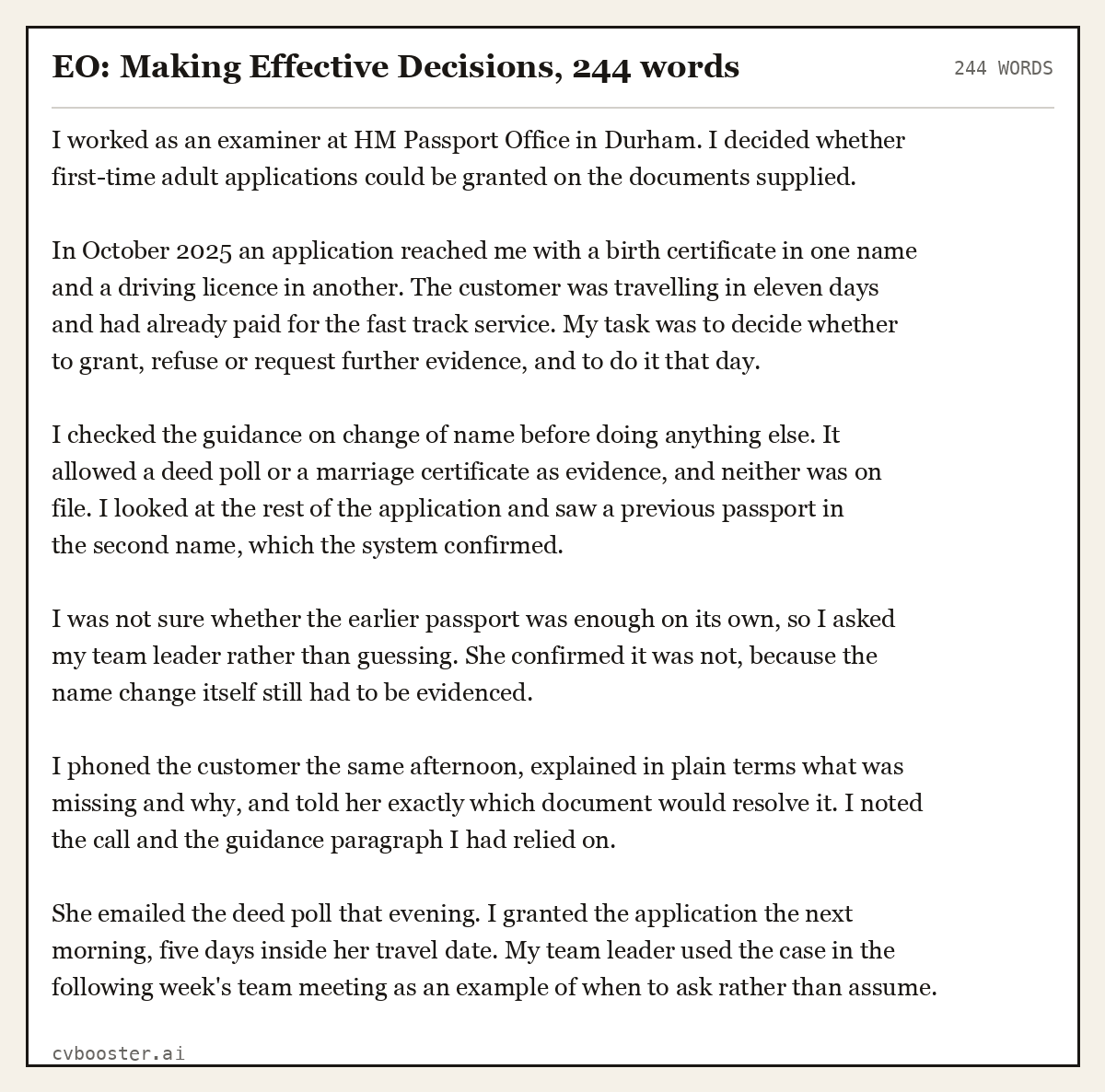
EO: Making Effective Decisions, 244 words (244 words)
I worked as an examiner at HM Passport Office in Durham. I decided whether first-time adult applications could be granted on the documents supplied.
In October 2025 an application reached me with a birth certificate in one name and a driving licence in another. The customer was travelling in eleven days and had already paid for the fast track service. My task was to decide whether to grant, refuse or request further evidence, and to do it that day.
I checked the guidance on change of name before doing anything else. It allowed a deed poll or a marriage certificate as evidence, and neither was on file. I looked at the rest of the application and saw a previous passport in the second name, which the system confirmed.
I was not sure whether the earlier passport was enough on its own, so I asked my team leader rather than guessing. She confirmed it was not, because the name change itself still had to be evidenced.
I phoned the customer the same afternoon, explained in plain terms what was missing and why, and told her exactly which document would resolve it. I noted the call and the guidance paragraph I had relied on.
She emailed the deed poll that evening. I granted the application the next morning, five days inside her travel date. My team leader used the case in the following week's team meeting as an example of when to ask rather than assume.
What the sifter is scoring
- Indicator quoted: "talk to relevant people to get advice and information when unsure how to proceed" (gov.uk Success Profiles behaviours, EO). Where the statement shows it: asking the team leader instead of guessing on the earlier passport.
- Indicator quoted: "explain how decisions have been reached in a clear and concise way, both verbally and in writing" (EO). Where the statement shows it: the phone call in plain terms, and the note recording the guidance paragraph relied on.
The HEO version of the same behaviour weighs options against cost and sets a review point. The EO version applies published guidance correctly and escalates when unsure. Neither is better. They are answers to different questions.
The sentences that cost marks
Five real patterns, with the fix. All five come from the same failure: describing a team's work instead of yours.
- Before: "We identified that the process was inefficient and made improvements." After: "I logged the reason for every requisition for three weeks, and two causes covered more than half of them."
- Before: "I have excellent communication skills." After: "I rewrote the technical note into two sides of plain English and had it checked by a colleague outside the policy area."
- Before: "The project was delivered successfully." After: "The pack went to the minister on the agreed date with all six items present and the modelling caveat on the front page."
- Before: "I worked closely with stakeholders." After: "I held a standing monthly meeting at the two housing teams' offices and brought them release dates twelve weeks ahead."
- Before: "I made a difficult decision under pressure." After: "I costed overtime at roughly £4,100 a week and rejected it, then moved 18 advisers to mornings only for two weeks."
Tip: Count your own verbs. If "we" outnumbers "I" in a 250-word statement, the sifter cannot score you.
Before you submit
- The behaviour name appears in your first sentence, spelled exactly as the advert spells it.
- The word count is inside the limit on the form, not in your document.
- The action section is about half the statement. Situation and task together are under a third.
- There is at least one number in the result, and it is a number you could defend in an interview.
- Each behaviour uses a different example. Sifters notice when one story is recycled three times.
- You have read the indicators for the grade you are applying to, not the grade you hold.
For the test some departments run alongside the sift, see civil service judgement test examples. For the five elements the behaviours sit inside, see the civil service success profiles guide.
Frequently asked questions
What are the civil service behaviors?
There are nine. Seeing the big picture, changing and improving, making effective decisions, leadership, and communicating and influencing. Then working together, developing self and others, managing a quality service, and delivering at pace. They are published with a definition and level-by-level indicators in Success Profiles: Civil Service behaviours on gov.uk. Adverts usually assess three or four of them, not all nine. The Civil Service Careers behaviours page lists the same nine.
How to write a civil service behaviour statement?
Name the behaviour in the first sentence. Then use STAR: roughly 40 words of situation, 40 of task, 120 of action and 50 of result. Write "I" rather than "we" in the action. Finish with a number you can defend at interview. Nine complete statements in that shape are above, one per behaviour.
What is a good example of a behaviour statement?
A good one names a single real situation, spends half its words on what you personally did, and ends with a measurable result. The Making Effective Decisions statement above is a fair model. It names three options, costs one, rejects it, sets a review point, and gives the outcome with a number.
Can you provide some examples of how civil service behaviours demonstrate seeing the big picture?
Yes, the first statement above does it. A Jobcentre team leader reads the national outcome measure instead of the local dashboard. The two count different things, so local practice changes to move the national figure. That is the behaviour in one move, aligning local activity to the published organisational priority rather than to the internal number.
More in this series: Civil Service applications
- Civil Service Behaviours Framework: All 9, Level by Level
- Civil Service Judgement Test: 8 Questions and Answers
- Civil Service Success Profiles: the Five Elements, Explained
- Communicating and Influencing: 4 Civil Service Examples
- Delivering at Pace: 4 Civil Service Examples, EO to G7
- Making Effective Decisions: 4 Civil Service Examples
- Managing a Quality Service: 4 Worked Examples, EO to G7
- Seeing the Big Picture Civil Service Example: AO to G7
- Working Together Civil Service Example: AO to Grade 7
Related articles
- Civil Service Behaviours Framework: All 9, Level by Level
- Seeing the Big Picture Civil Service Example: AO to G7
- Working Together Civil Service Example: AO to Grade 7
- Civil Service Interview Questions and 15 Full Answers