Software Engineer Resume Examples: the lines they read
Software Engineer Resume Examples, Including Computer Engineering Grads
By Mustafa Tarabya, founder of CVBooster · Published · Updated
Software engineer resume examples and a resume for computer engineering graduates moving into software: format, bullets that survive a technical read, and summaries by level.
Sample resumes for a software engineer
The same software engineer content laid out in three CVBooster templates, so you can see what the finished document looks like before you write a word.
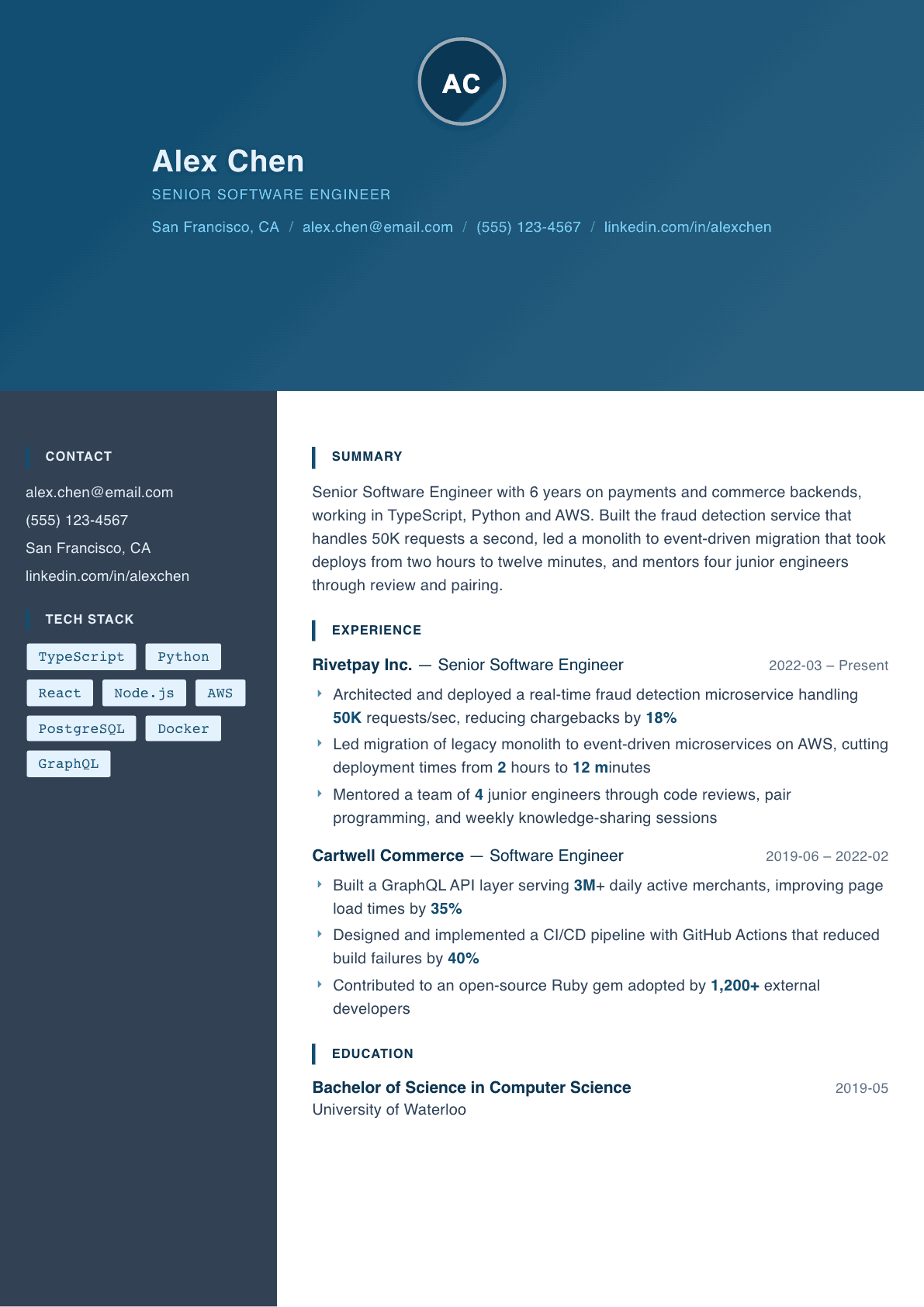
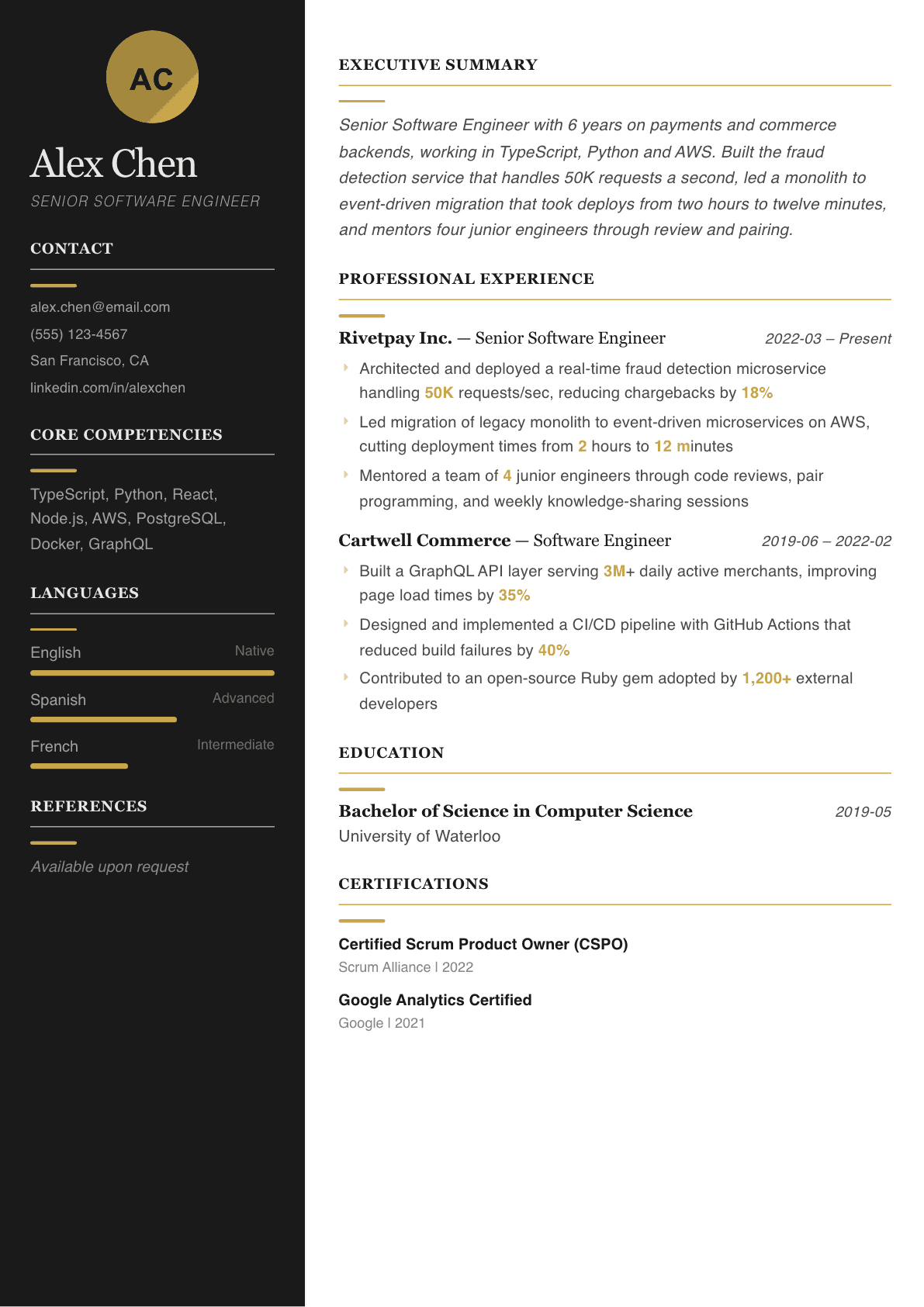
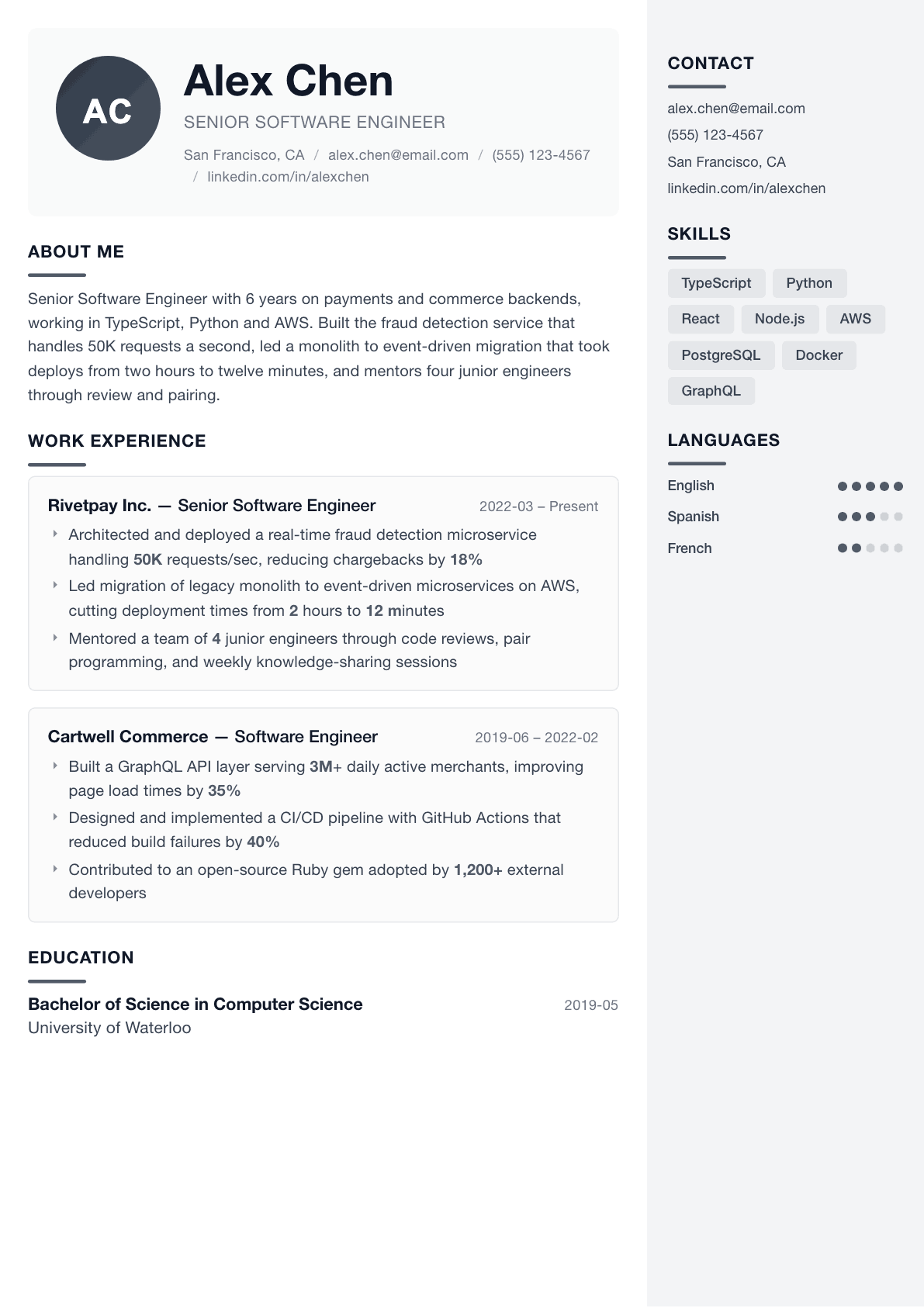
Example Software Engineer summary
Software engineer, 6 years, backend and full stack in TypeScript, Python and AWS on systems that carry real payment traffic. Cut API response times 45% and infrastructure cost 30% on a merchant-facing GraphQL layer, and now owns architecture decisions and code review for a team of four. Looking for a senior or staff role with system design ownership.
Skills to list on a Software Engineer resume
- JavaScript
- TypeScript
- Python
- Java
- React
- Node.js
- AWS
- Docker
- Kubernetes
- PostgreSQL
- GraphQL
- REST APIs
- CI/CD
- Git
- System Design
What actually gets this resume read
- Lead with measurable impact: quantify improvements in performance, uptime, revenue, or team velocity.
- List specific technologies in each job description so ATS systems can match them to the posting.
- Include a dedicated "Technical Skills" section organized by category (languages, frameworks, cloud, tools).
- Link to your GitHub, portfolio, or notable open-source contributions near the top of the resume.
- Tailor your summary to the seniority level you are targeting: IC depth for staff roles, leadership scope for engineering management.
- Keep your resume to one page if you have fewer than 8 years of experience; two pages maximum otherwise.
How to write a software engineer resume
Software engineering resumes fail for a boring reason: they describe the project instead of the engineer. A hiring manager already knows what an e-commerce checkout does. What she cannot tell from most resumes is which parts you designed, which parts you inherited, what you chose to build versus buy, and whether the thing you built is still running.
The screening path is usually a recruiter first, an engineer second. The recruiter matches language and framework names against the requisition. The engineer skims for scope signals: system size, traffic, team size, whether you owned a service or contributed tickets to one. Your resume has to answer both readers inside the first third of the page.
This guide covers the format engineering managers expect, a resume for computer engineering graduates moving into software, how to write experience bullets that survive a technical read, three summaries from new graduate to staff, before-and-after bullets, and the questions engineers ask most often when their applications go quiet.
Format: one page until roughly eight years, links in the header
Reverse-chronological, single column, one readable font. Put a technical skills section immediately under the summary and group it by category: languages, frameworks, data stores, cloud and infrastructure, tooling. Grouping matters because a reviewer is checking for a specific stack match and should not have to read a forty-item alphabetical list to find it.
Header links carry real weight in engineering hiring. A GitHub profile with recent commits, a personal site, or a package you maintain gives the interviewer something to open before the call. If the profile is empty, leave the link off rather than invite a disappointing click.
- Order: summary, technical skills, experience, projects if early career, education, open source.
- Put education above experience only until you have about a year of full-time engineering work.
- Name the primary language of each role in the scope line so a reviewer never has to guess.
Experience: system, ownership, decision, outcome
Start each role with one line of context: the product, the traffic or data volume, the team size and your position in it. "Backend engineer on a four-person team owning the billing service, roughly nine thousand requests per minute" tells a reviewer more than three vague achievement bullets.
Then write bullets that name a technical decision. The pattern engineers respect is a constraint, the approach you chose, and the measurable result. Latency, error rate, build time, deploy frequency, infrastructure cost and defect escape rate are all fair game. Avoid outcomes you cannot connect to your own work; claiming revenue growth for a feature you shipped as one of nine engineers reads as inflation.
Distinguish authorship from participation. "Designed and implemented" is a strong claim, so use it only where it is true, and use "contributed to" or "one of three engineers on" where it is not. Technical interviewers probe exactly these verbs, and a bullet you cannot defend in detail costs more than a modest bullet you can.
Seniority: what changes as you move up
A junior resume is judged on evidence that you can write and ship correct code, so it leans on projects, internships, code quality and testing. A mid-level resume shows service ownership: you are on call for something, you designed part of it, you review other people's work. A senior or staff resume must show influence beyond your own keyboard: design documents that others built from, migrations you led across teams, standards you set, engineers you grew.
The most common seniority mistake is a staff-level candidate writing mid-level bullets. If eight years of work is described entirely as features implemented, the reader concludes you have never operated above the ticket. Add the architecture decisions, the cross-team migration, the mentoring, the technical direction you argued for and won.
- Junior: projects with real users, tests written, tools learned, code review participation.
- Mid: a service you own, an incident you handled, a design you authored, a junior you unblocked.
- Senior and above: cross-team migrations, design review leadership, hiring, technical strategy.
Projects and open source, when they help
Personal projects belong on the resume while your paid experience is thin, and they should be described like work: the problem, the stack, the interesting engineering choice, and any real usage. A tutorial clone with no users adds nothing. A small tool that other people installed, or a contribution merged into a library the team uses, adds a great deal.
Once you have several years of production experience, cut the projects section down to one or two lines or drop it. The exception is open source with visible traction, which stays valuable at every level because it is public, reviewable evidence of how you actually write code.
Keywords engineering postings reuse
Job descriptions in this field repeat a narrow vocabulary: distributed systems, microservices, REST and GraphQL APIs, relational and document databases, containerization, continuous integration, test coverage, code review, agile delivery, and the named stack. Use the posting wording exactly once in your skills block and once inside a bullet where you demonstrate the practice.
Be specific about versions and variants where it distinguishes you. React with server components, Python with asynchronous frameworks, Java on a recent long-term-support release, or Postgres with logical replication all read differently to an engineer than the bare language name does.
Resume for computer engineering graduates applying to software roles
A resume for computer engineering usually belongs to someone who studied both sides of the machine and now wants a software title. The risk is that the page reads like a hardware candidate who wandered into the wrong pile. Lead with the software evidence, keep the hardware as proof that you understand what your code runs on, and put the degree name exactly as the transcript says it.
Order it as a new graduate software resume: education with relevant courses, a skills block grouped by category, then projects and internships. Describe the capstone like a job, with the system, your part of it and the result. Embedded C, an operating systems course, a real time project or a field programmable gate array build all count, written as engineering decisions rather than coursework titles.
If you are applying for hardware, firmware or digital design roles instead, the computer engineer resume guide is the better model, because it leads with verification and circuit work rather than services and deploys.
- Header: name, city, email, GitHub with recent commits, and a portfolio link only if it shows working code.
- Education: Bachelor of Science in Computer Engineering, expected graduation month, relevant courses such as operating systems, computer architecture, data structures and embedded systems.
- Skills: languages first (C, C plus plus, Python, Java), then tools (Git, Linux, Docker), then hardware only where the posting mentions it.
- Capstone: team of four, built a sensor gateway in C on a microcontroller with a Python service collecting the data, you owned the firmware update path and its tests.
- Internship: one line of scope, then two bullets that name a technical decision and its outcome.
- Projects: one or two with real users or merged contributions, each with the stack and the hardest choice you made.
Software Engineer resume summary examples
New graduate
Computer science graduate with two internships building backend services in Python and Go, plus a capstone scheduling application used by 400 students. Comfortable with Postgres, Docker and unit testing, and looking for a first full-time backend role on a team that reviews code seriously.
Five years in
Backend software engineer with five years building payment and identity services in TypeScript and Go. Owns two production services on AWS handling twelve thousand requests per minute, cut p99 latency by 40% through query and caching work, and mentors two junior engineers through code review.
Staff engineer
Staff software engineer with eleven years across distributed systems and developer platforms. Led the migration of a monolith into 14 services without customer-visible downtime, authored the design review process now used by six teams, and interviewed and onboarded 20 engineers.
Work experience bullets: before and after
Before: Worked on the backend of a large web application.
After: Owned three Go services behind the checkout flow, handling 9,000 requests per minute at peak with a 99.9% success rate.
Ownership, language, traffic and a reliability figure let an engineer picture the system instead of guessing at it.
Before: Improved application performance.
After: Cut p99 API latency from 820ms to 210ms by adding covering indexes, batching two chatty downstream calls and caching a hot lookup in Redis.
The reader can see the diagnosis and the three specific changes, which is what a technical interviewer will ask about anyway.
Before: Wrote unit tests and helped with code quality.
After: Raised service test coverage from 34% to 78% and added contract tests at the service boundary, dropping production defects per release from 6 to 1.
Coverage alone is a weak signal, so pairing it with contract tests and an escaped-defect trend makes the quality claim real.
Before: Part of a team that migrated to microservices.
After: Led the extraction of the billing domain out of the monolith into a standalone service, running dual writes for six weeks before cutover with no customer-visible downtime.
It names your role, the domain, and the migration technique, which turns a team achievement into a personal one.
Before: Mentored junior developers.
After: Mentored three junior engineers through their first on-call rotations and ran a weekly design review that produced 15 written technical proposals.
Concrete mentoring mechanics read as leadership, while the word mentored on its own reads as a personality claim.
Hard skills
- TypeScript
- Python
- Go
- React
- Node.js
- REST and GraphQL API design
- PostgreSQL
- Redis
- Docker and Kubernetes
- AWS
- CI/CD and GitHub Actions
- Unit, integration and contract testing
- System design
- Git and code review
Soft skills
- Technical writing and design documents
- Code review feedback
- Debugging under ambiguity
- Scoping and estimation
- Mentoring
- Cross-functional communication
Certifications worth listing
- AWS Certified Developer, Associate (Amazon Web Services)
- AWS Certified Solutions Architect, Associate (Amazon Web Services)
- Microsoft Certified: Azure Developer Associate (Microsoft)
- Google Cloud Professional Cloud Developer (Google Cloud)
- Oracle Certified Professional, Java SE Developer (Oracle)
- Certified Kubernetes Application Developer (CKAD) (Cloud Native Computing Foundation)
Mistakes that cost software engineer candidates the interview
- Listing every technology ever touched, which dilutes the four or five you can genuinely be interviewed on.
- Describing the product rather than your engineering, so the reader learns what the company sells and nothing about you.
- Claiming business outcomes such as revenue growth that a single engineer on a large team cannot credibly own.
- Writing staff-level years of experience in mid-level language, with no architecture, migration or mentoring evidence.
- Linking a GitHub profile that is empty or has not been touched in years, which invites an unflattering click.
- Padding with tutorial projects once you have real production experience to write about instead.
- Using vague verbs like assisted, helped and involved in, which technical interviewers read as an absence of ownership.
Software Engineer resume questions
How long should a software engineer resume be?
One page up to roughly eight years of experience, two pages beyond that or when you have led large migrations and multiple teams. Never three. Cutting older roles down to a single line each is the fastest way to reclaim space.
Do I need a GitHub link on my resume?
Only if the profile helps you. Recent commits, a maintained project or merged contributions to something recognizable give an interviewer real material. An empty profile with three forked tutorials is worse than no link at all, so leave it off.
Should I list personal projects as a software engineer?
Yes while your paid experience is under about two years, described with the same rigor as work: the problem, the stack, the hard decision, any real usage. After that, keep only projects with users or open source contributions people can inspect.
How do I show seniority without a senior title?
Describe the scope you actually held: designs you authored, services you owned and were paged for, migrations you led, engineers you unblocked, decisions you argued for. Many companies hand out titles slowly, and hiring loops calibrate on described scope rather than the label.
How do I write a resume for computer engineering grads applying to software jobs?
Lead with software evidence: languages, a capstone described like a job, internships with a technical decision and its result. Keep embedded and architecture coursework as proof you understand the hardware underneath. Then tailor the summary and skills order to each posting stack rather than rewriting the whole page.
Related resume examples
- Data Scientist Resume example
- UX Designer Resume example
- Product Manager Resume example
- Technical Lead Resume example
- Junior Software Engineer Resume example
- Web Developer Resume example