DevOps Engineer Resume Examples: the lines they read
Build a DevOps Engineer Resume That Deploys Results
By Mustafa Tarabya, founder of CVBooster · Published · Updated
DevOps Engineer resume examples with expert tips, ATS keywords, and professional templates. See exactly what a winning senior devops engineer resume looks like.
Sample resumes for a devops engineer
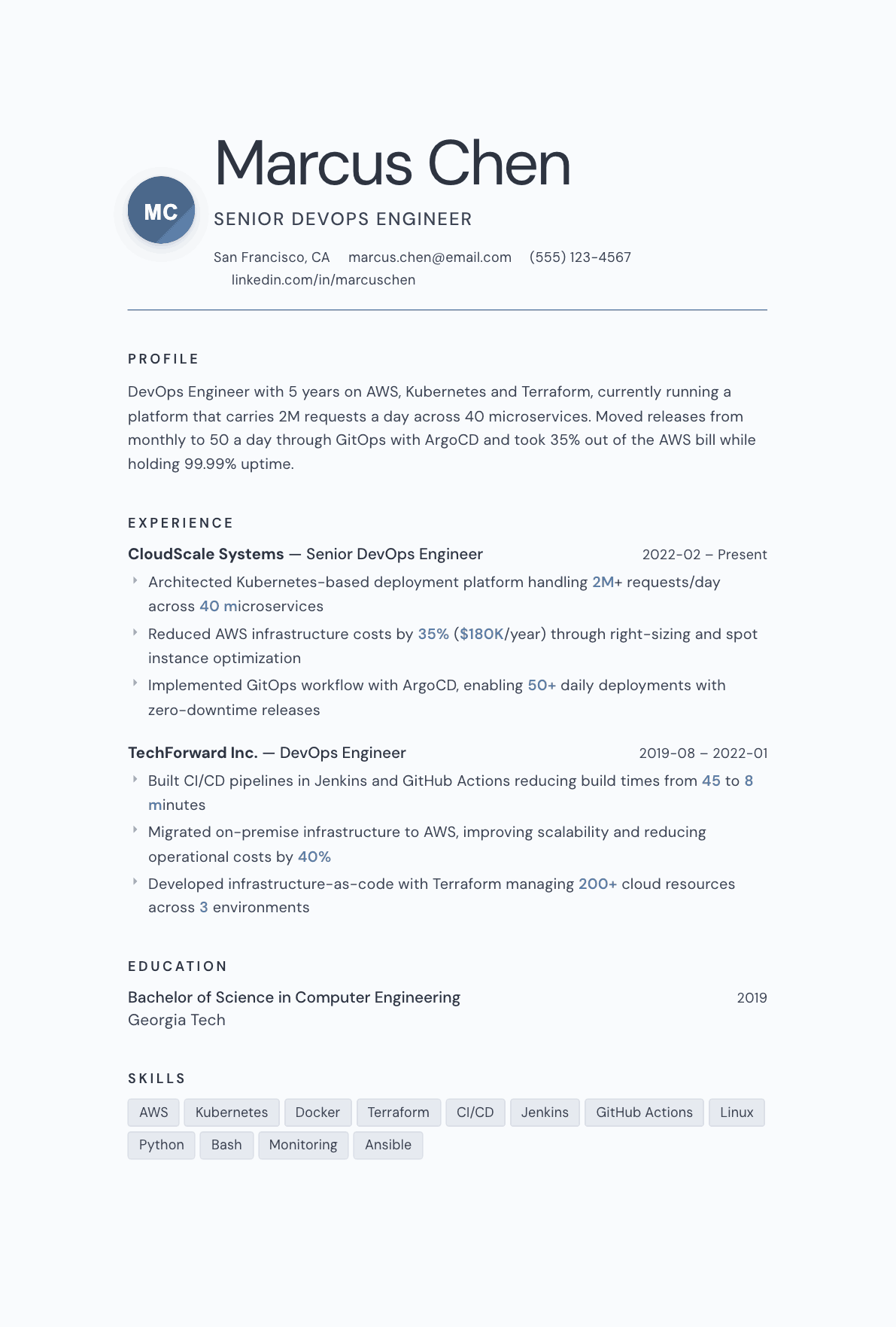
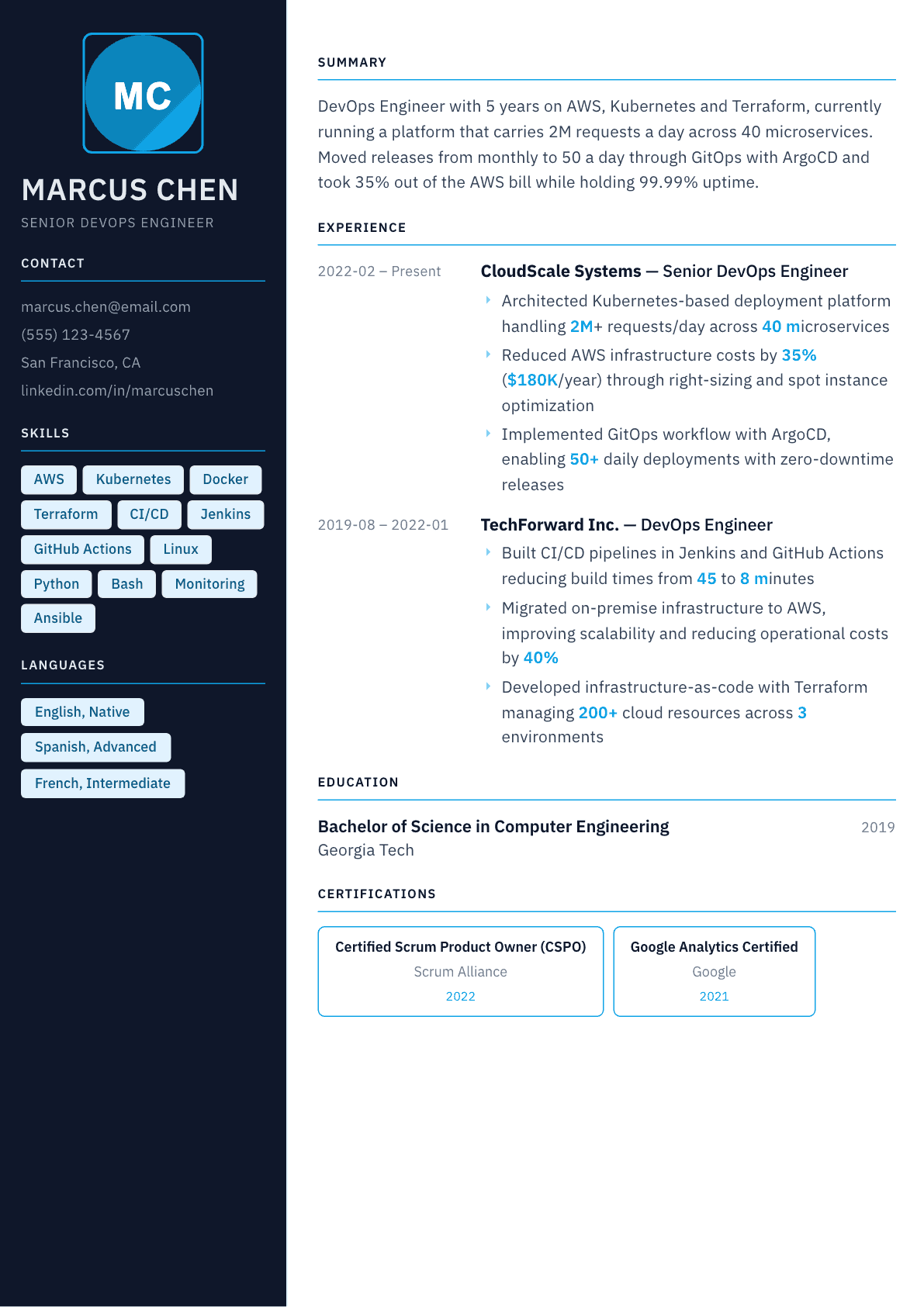
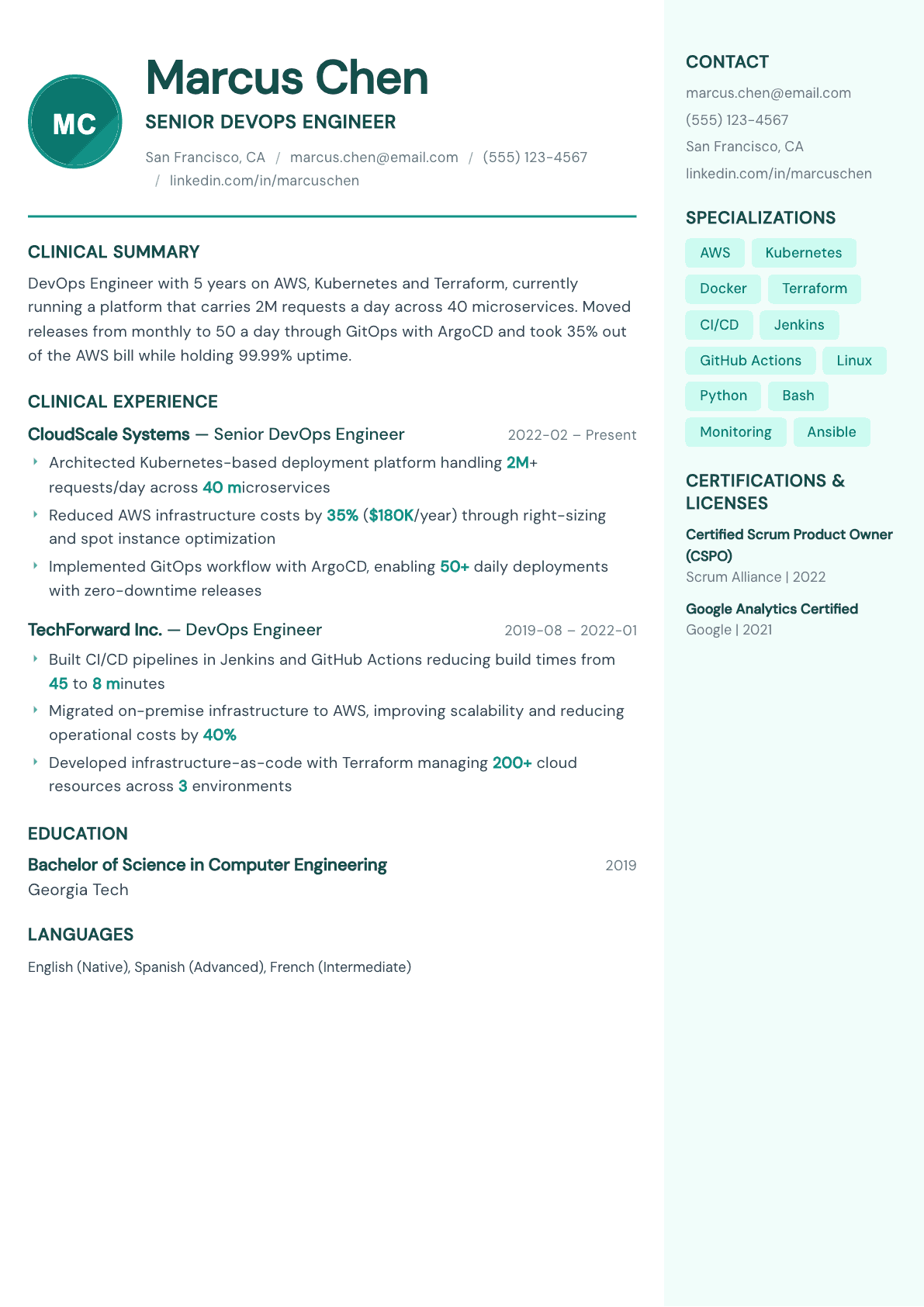
The same devops engineer content laid out in three CVBooster templates, so you can see what the finished document looks like before you write a word.
Example DevOps Engineer summary
DevOps engineer, 5 years, Kubernetes and Terraform on AWS with infrastructure defined in code across three environments. Cut build times from 45 minutes to 8, saved $180K a year by right-sizing and using spot capacity, and runs zero-downtime releases through ArgoCD.
Skills to list on a DevOps Engineer resume
- AWS
- Kubernetes
- Docker
- Terraform
- CI/CD
- Jenkins
- GitHub Actions
- Linux
- Python
- Bash
- Monitoring
- Ansible
What actually gets this resume read
- Quantify infrastructure improvements: uptime, deployment frequency, cost savings.
- List cloud certifications (AWS, GCP, Azure). They carry significant weight.
- Show both automation skills and incident response experience.
- Mention monitoring and observability tools (Prometheus, Grafana, Datadog).
- Include security practices: IAM policies, secrets management, compliance.
How to write a devops engineer resume
A DevOps engineer resume is read by a platform lead who has interviewed a long line of candidates who can name Kubernetes, Terraform and a continuous integration system but have never owned a production incident. The filter they apply is simple: does this page describe someone who built the road other engineers drive on, or someone who followed instructions on a ticket.
The evidence that survives that filter is operational. Deployment frequency and how it changed, what happens when a deploy goes wrong, how long a rollback takes, what pages a human at night and what does not, and what the platform costs to run. Those are the numbers a lead lives with, and a resume that contains none of them reads as a list of installed software.
This guide covers the sections in the order a platform lead reads them, with three summaries at levels teams recognize, before-and-after bullets that turn tool names into engineering outcomes, and the questions engineers ask when moving in from system administration or backend development.
Format: one to two pages, environment described before the tools
One page under five years, two after. Reverse chronological, single column, no icon grids for tools. Under each job title, describe the environment in one line: the cloud, the orchestration platform, the number of services and environments, and the team size you supported.
That environment line is what makes the rest of the page legible. Running a pipeline for 6 services with one team is a different job from running the platform for 200 services and 40 teams, and the tools list is identical in both cases.
- Header: name, title, location, email, GitHub, and cloud certifications in short form.
- Order: summary, technical stack, experience, selected platform work, certifications, education.
- Say whether you carried a pager, and for what. On-call ownership is a hiring signal in this field.
Summary: the platform, the scale, and the delivery outcome
Three lines. Name the cloud and the orchestration platform, the number of services and teams you support, and the delivery outcome you are known for: raising deploy frequency, cutting lead time, removing a manual release process, or bringing a platform under a real service level objective.
Then name the surface you own. Continuous delivery, infrastructure as code, observability, developer experience or cost. DevOps is broad enough that a summary without a center leaves the reader guessing where you are strongest.
Experience: pipelines, infrastructure, reliability, developer experience
Cover all four. Pipeline bullets say what a change goes through between merge and production: build, tests, security scanning, artifact promotion, deployment strategy, and how long it takes end to end. Naming the deployment strategy matters, because a blue-green cutover, a canary with automated analysis and a rolling update carry different levels of skill.
Infrastructure bullets belong in code. Terraform modules, Helm charts or Kustomize overlays, the environment promotion model, and how drift is caught. Say who else uses what you built, because a module three teams depend on is a platform contribution, not a personal script.
Reliability bullets need the operational reality: the service level objective, the error budget, what alerting rules exist, the on-call rotation, and one incident described properly with detection, mitigation and the change that followed. Then developer experience: the local environment, the time from a new engineer joining to their first merged deploy, and the toil you deleted.
Kubernetes: say what you operate, not that you have used it
Almost every applicant lists it, so the differentiator is depth. Cluster lifecycle and upgrades, the ingress and service mesh choices, autoscaling both at the pod and node level, resource requests and limits tuned against real usage, network policies, and the operators or controllers you deployed or wrote.
If your clusters are managed by a cloud provider, say so plainly. Running a managed cluster well is a legitimate skill and pretending to have built control planes falls apart in one question.
Security and cost: the two conversations that reach leadership
Security work belongs in a DevOps resume because the pipeline is where it now lives. Secrets management, image scanning and base image policy, signed artifacts, least-privilege deployment identities, and dependency scanning at the pull request. Say what you blocked and where.
Cost belongs there for the same reason. Right-sized requests, spot or preemptible capacity for the right workloads, cluster autoscaling tuned so nodes actually go away, and log retention brought under control. A platform engineer who has cut a bill has had a conversation with a finance partner and can have it again.
DevOps Engineer resume summary examples
Moving in from system administration
Linux administrator with 3 years, now working full time on delivery. Replaced a manual release checklist with a GitHub Actions pipeline for 8 services, wrote the first Terraform for the staging environment, and holds the AWS Solutions Architect Associate certification.
Four years in
DevOps engineer with 4 years supporting 6 product teams and 45 services on AWS and managed Kubernetes. Owns the delivery pipelines and the on-call rotation, took the median lead time from merge to production from 3 days to 40 minutes, and runs the observability stack.
Lead or platform engineer
Lead platform engineer with 9 years, currently responsible for the internal delivery platform used by 30 teams and 200 services. Introduced progressive delivery with automated canary analysis, cut change failure rate 45%, and reduced cluster spend 28% through request tuning and autoscaling.
Work experience bullets: before and after
Before: Built CI/CD pipelines using Jenkins and GitHub Actions.
After: Rebuilt delivery for 45 services on GitHub Actions with a shared reusable workflow: build, unit and contract tests, image scanning and signing, then a canary deployment with automatic rollback on error rate, taking merge to production from 3 days to 40 minutes.
Describing what a change passes through and the lead time change turns a tool list into a delivery outcome.
Before: Managed Kubernetes clusters in production.
After: Operated 6 managed Kubernetes clusters across 3 environments: quarterly version upgrades with node pool rotation, network policies isolating regulated workloads, and horizontal and cluster autoscaling tuned so idle nodes drain within 10 minutes.
Upgrades, isolation and autoscaling behavior show operational ownership rather than deployment of manifests.
Before: Improved system reliability and uptime.
After: Defined service level objectives with the two highest-traffic teams, replaced 60 threshold alerts with 9 symptom-based ones tied to error budgets, and cut out-of-hours pages by more than half without missing a customer-visible outage.
Alert consolidation tied to objectives shows reliability engineering, while uptime alone is a claim anyone can make.
Before: Used Terraform to manage infrastructure.
After: Wrote 18 Terraform modules covering networking, cluster and database provisioning, adopted by 5 teams to build their own environments, with policy checks in the plan stage and drift detection reporting daily.
Adoption by other teams and policy enforcement mark the difference between platform work and personal automation.
Before: Responded to production incidents.
After: Led the response to a certificate expiry that broke internal service calls: detected from a symptom alert in 4 minutes, restored with a rotated certificate in 20, then automated renewal and added an expiry alert 30 days out.
Detection time, mitigation time and the permanent fix are the three things an incident review actually cares about.
Hard skills
- Kubernetes operations
- Terraform
- Docker and container image hygiene
- GitHub Actions and GitLab CI
- Jenkins
- AWS
- Linux systems administration
- Helm and Kustomize
- Prometheus and Grafana
- Distributed tracing and structured logging
- Ansible
- Python and Bash
- Secrets management
- Progressive delivery and rollback strategies
Soft skills
- Incident command
- Writing blameless postmortems
- Treating developers as customers
- Prioritizing toil reduction
- Explaining risk before a release
- Documentation other teams can follow
Certifications worth listing
- Certified Kubernetes Administrator (Cloud Native Computing Foundation)
- Certified Kubernetes Application Developer (Cloud Native Computing Foundation)
- AWS Certified DevOps Engineer Professional (Amazon Web Services)
- HashiCorp Certified: Terraform Associate (HashiCorp)
- Microsoft Certified: DevOps Engineer Expert (Microsoft)
- Google Cloud Professional DevOps Engineer (Google Cloud)
Mistakes that cost devops engineer candidates the interview
- Presenting a logo wall of tools with no environment behind it, which tells a lead nothing about scale or ownership.
- Claiming uptime figures for a service you did not operate or measure.
- Leaving out on-call, which makes a platform resume read as project work rather than operations.
- Describing pipelines without lead time or failure rate, so there is no way to tell whether delivery actually improved.
- Listing Kubernetes without any cluster lifecycle detail, when upgrades and capacity are where the real work is.
- Ignoring cost and security in the pipeline, the two areas that most often bring a platform team to leadership attention.
- Writing every bullet as a team achievement, which leaves the reader unable to identify what you personally built.
DevOps Engineer resume questions
What is the difference between a DevOps engineer and a site reliability engineer resume?
A DevOps page leads with delivery: pipelines, infrastructure as code, environments and developer experience. A reliability page leads with service level objectives, error budgets, capacity and incident work. Reorder the same experience to match whichever posting you are answering.
Which DevOps certifications are worth having?
The Kubernetes administrator credential and a professional-level cloud certification carry the most weight with screeners, and the Terraform associate helps for infrastructure-heavy roles. They open doors but never substitute for described production ownership.
How do I move from system administration into DevOps?
Convert your existing work into delivery language: the scripts become automation, the change windows become deployment process, the monitoring becomes observability. Then add one project where you built a pipeline and infrastructure as code from nothing, even at small scale.
Should I include metrics if my company never measured them?
Use what you can reconstruct honestly, such as releases per month from the repository history or the number of manual steps you removed. Never invent an uptime number, because a lead will ask how it was measured and which service it covered.
How much programming do I need for a DevOps role?
More than scripting, less than a backend engineer. Python or Go for tooling and controllers, plus fluency in Bash, covers most work. Teams building internal platforms will ask for real code review experience, so mention pull requests and tests.
Related resume examples
- Software Engineer Resume example
- IT Specialist Resume example
- Web Developer Resume example
- Site Reliability Engineer Resume example
- Release Manager Resume example
- Cloud Architect Resume example