Environmental Lawyer Resume Examples: what gets the call
Create an Environmental Lawyer Resume That Makes an Impact
By Mustafa Tarabya, founder of CVBooster · Published · Updated
Build an environmental lawyer resume highlighting your regulatory compliance, litigation, and sustainability expertise with professional legal templates.
Sample resumes for a environmental lawyer
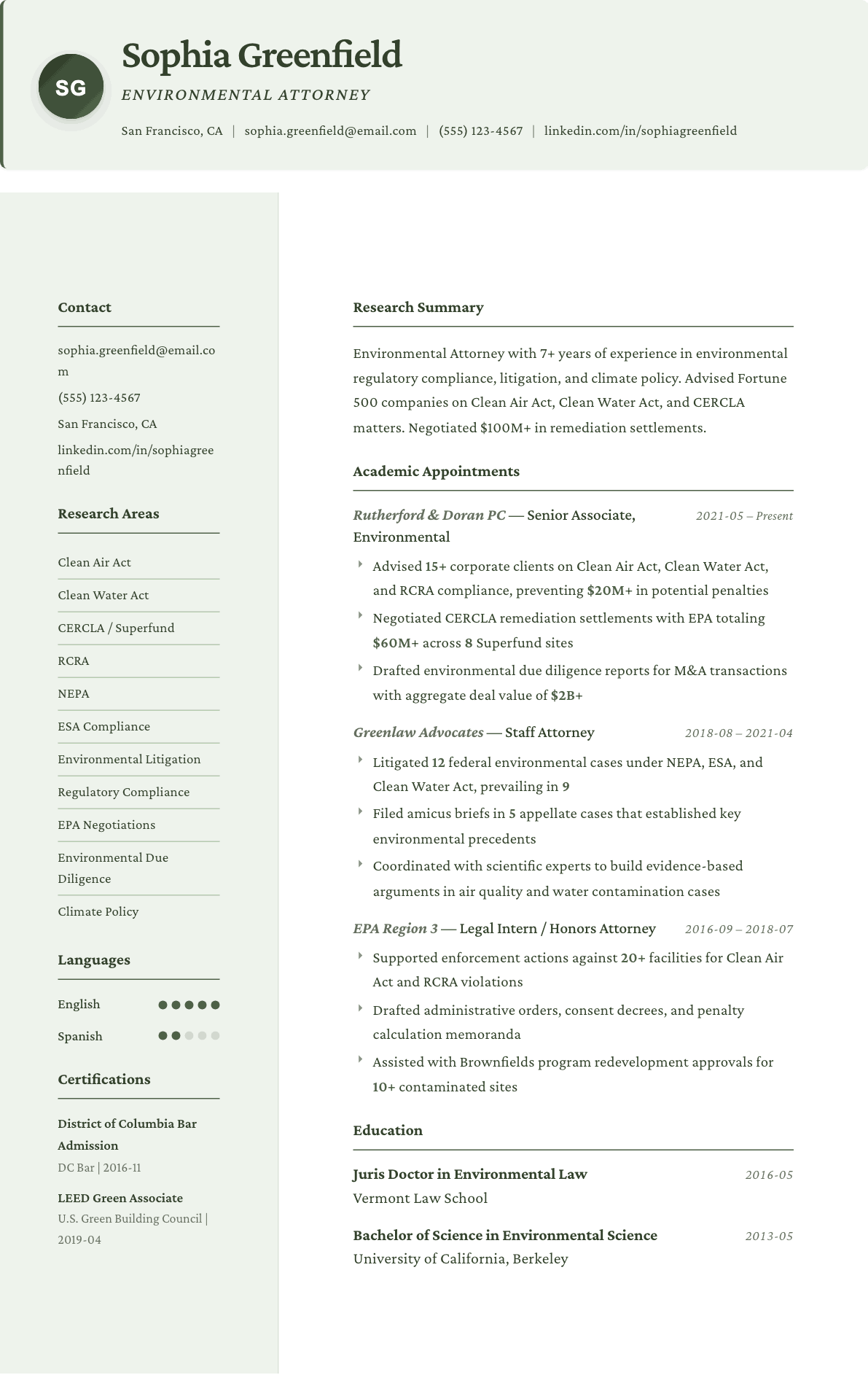
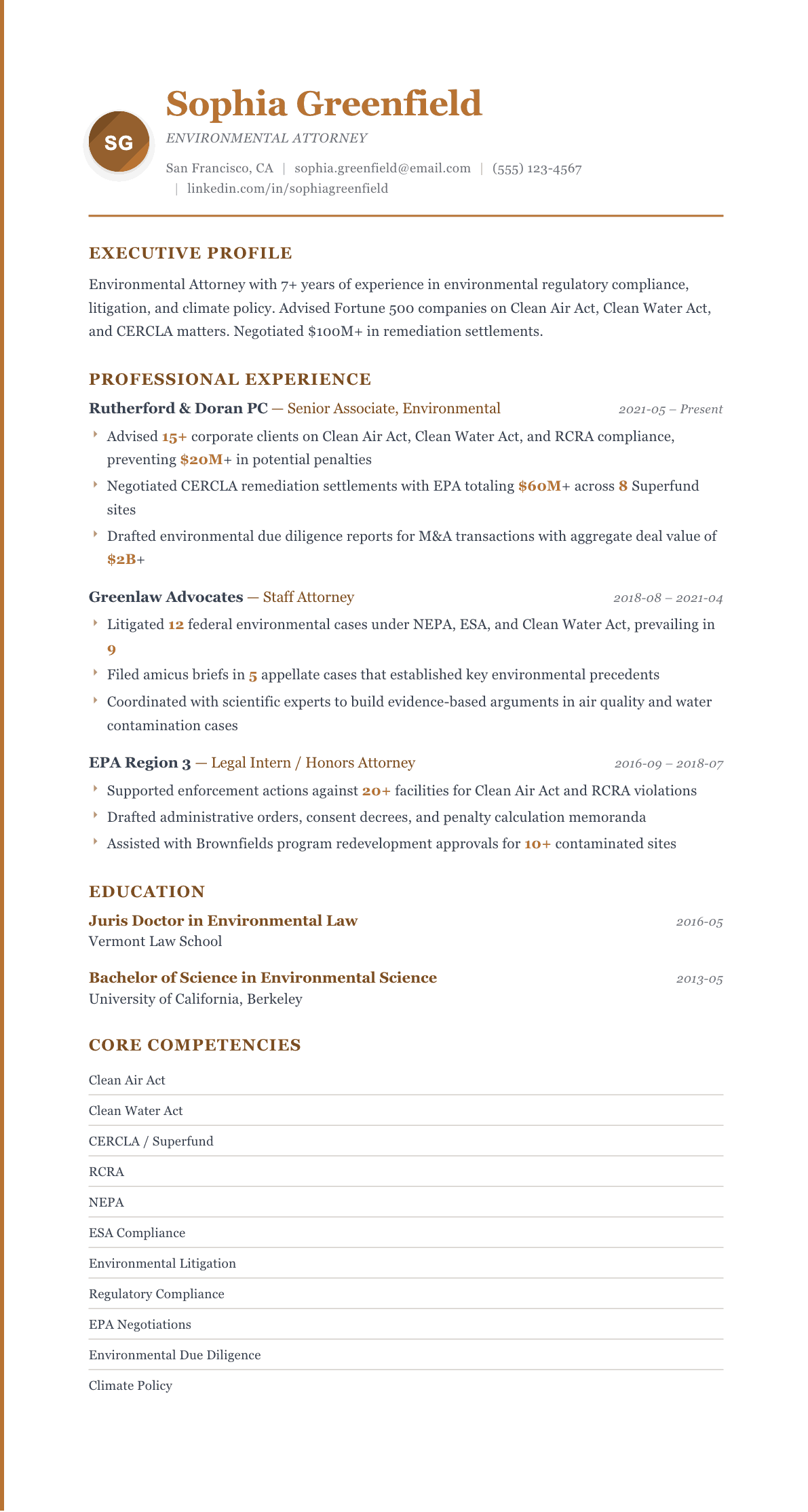
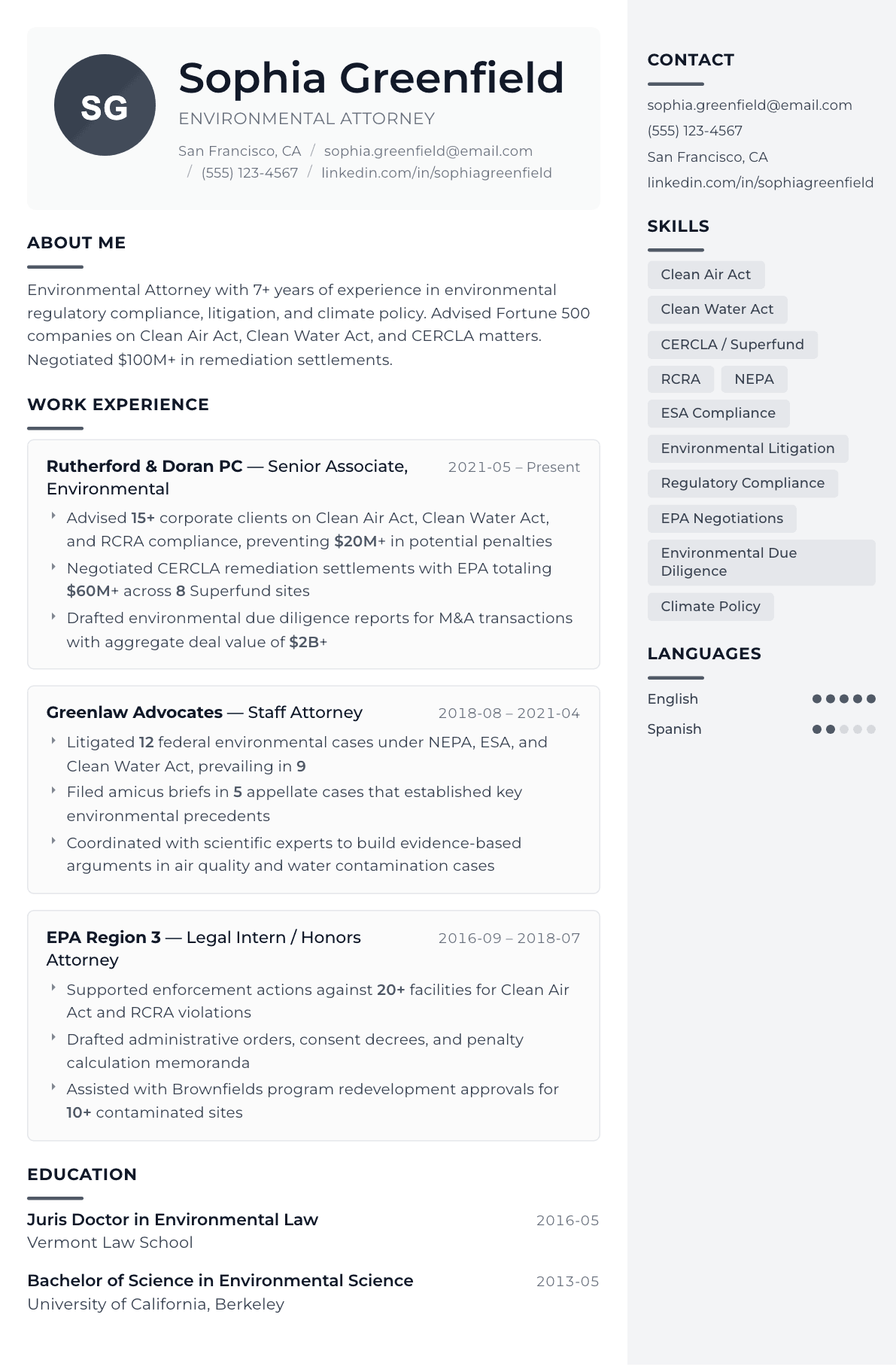
The same environmental lawyer content laid out in three CVBooster templates, so you can see what the finished document looks like before you write a word.
Example Environmental Lawyer summary
Environmental Attorney with 7 years of experience in regulatory compliance, litigation, and EPA negotiations. Advised Fortune 500 clients on Clean Air Act, Clean Water Act, and CERCLA matters. Negotiated $100M+ in remediation settlements and prevailed in 9 of 12 federal environmental cases.
Skills to list on a Environmental Lawyer resume
- Clean Air Act
- Clean Water Act
- CERCLA / Superfund
- RCRA
- NEPA
- ESA
- Environmental Litigation
- Regulatory Compliance
- EPA Negotiations
- Environmental Due Diligence
- Climate Policy
- ESG Advisory
- Brownfields Redevelopment
- Consent Decrees
What actually gets this resume read
- Specify the environmental statutes you work with: Clean Air Act, Clean Water Act, CERCLA, RCRA, NEPA, ESA.
- Mention both government and private practice experience -- the combination is highly valued.
- Quantify: settlement values, penalties prevented, sites remediated, cases won.
- Include scientific or technical background if applicable -- environmental law often requires understanding of science.
- Highlight ESG, climate policy, or sustainability advisory work as it is a growing practice area.
- Show litigation and transactional experience: enforcement, compliance counseling, and M&A due diligence.
How to write a environmental lawyer resume
Environmental practice is unusually fragmented, and a resume that ignores that fact gets screened out fast. Regulatory counseling and permitting, contaminated site and cleanup work, enforcement defense, citizen suit and impact litigation, transactional environmental diligence, and energy and climate policy are separate lanes. Practitioners in one lane are frequently unqualified for another, and hiring partners know it.
So the first job of the resume is to declare your lane and prove it with statutes. Naming the specific programs you have worked under, the agencies you have dealt with and the procedural posture of your matters does more than any adjective. A resume that says advised clients on environmental compliance without a single named statute tells a reviewer nothing they can act on.
This guide covers how to structure an environmental lawyer resume, how to present regulatory, litigation and transactional work, three summaries across career stages, before-and-after bullets, and the questions lawyers ask when moving between agency practice, firm practice and in-house environmental roles.
Format: admissions, then a statute and program block
Reverse-chronological, conservative layout, one page early in practice and two once your matter record justifies it. Bar admissions with jurisdictions come near the top. Directly under the summary, add a block naming the statutory programs and agencies you actually work under, because that block functions as the technical skills section of an environmental resume.
Be specific rather than exhaustive. Clean air permitting, water discharge permitting, hazardous waste handling and corrective action, contaminated site liability and allocation, environmental review of federal actions, protected species consultation, chemical registration and reporting, and state analogues each imply different work. List the ones you have genuinely practiced.
- Header: name, city, phone, email, bar admissions, and any technical degree you hold.
- Order: summary, admissions, statutory programs and agencies, experience, representative matters, education.
- Say which agencies you have dealt with directly, at federal, state and local level.
Experience: name the statute, the posture and the result
Every matter description should carry three things: the regulatory program, the procedural posture, and what happened. A permit application defended through a public comment period, an administrative enforcement action resolved by consent order, a cost recovery claim allocated among responsible parties, or a challenge to an agency environmental review each read very differently to a partner deciding what to staff you on.
Environmental work is technical, so show your comfort with the science. Working with hydrogeologists on a groundwater plume, reviewing emissions modeling, evaluating a risk assessment, interpreting sampling data, or supervising a site investigation are all credible bullets that separate a practitioner from a lawyer who only reads regulations.
Give outcomes in the currency of the practice: a permit issued or renewed, an enforcement matter closed, a penalty reduced through a settlement structure, a cleanup standard negotiated, a site closed out with regulatory sign-off, or a redevelopment unblocked. Avoid framing results only as avoided penalties, which is difficult to substantiate.
Litigation, counseling and transactional work are different resumes
For litigation roles, show the procedural record: complaints and answers drafted, dispositive motions briefed, expert discovery managed, administrative hearings argued, appellate briefs filed, and any argued matters. Environmental litigation is expert-heavy, so managing technical experts is a genuine differentiator and belongs on the page.
For counseling and permitting roles, show the regulatory calendar you carried: applications prepared, agency negotiations, compliance audits, self-disclosure decisions, training delivered to operations staff, and management systems built. For transactional work, show diligence depth: how many sites, what liability you identified, how it was allocated in the agreement, and what indemnity or insurance structure resulted.
- Litigation evidence: motions briefed, hearings argued, experts managed, appeals filed.
- Counseling evidence: permits obtained, audits run, disclosures made, programs built.
- Transactional evidence: sites reviewed, liabilities found, allocation and indemnity structures used.
Agency background, technical degrees and where they help
Time at a federal or state environmental agency is a strong credential in private practice, because it means you understand how decisions actually get made inside the regulator. Say which office, which program, and what you handled: enforcement referrals, permit reviews, rulemaking support, or administrative litigation. Note any restrictions that apply to matters you touched in government service.
Technical degrees carry real weight here. Geology, engineering, chemistry, environmental science and public health backgrounds should sit visibly on the page, because they shorten the learning curve on expert work and clients pay for that. If you do not have one, show the technical fluency you have built through matter work instead.
Keywords environmental legal postings reuse
The recurring vocabulary includes regulatory compliance, permitting, enforcement defense, cleanup and remediation, cost recovery and allocation, environmental due diligence, administrative law, citizen suits, agency negotiation, climate and sustainability advising, and environmental justice considerations. Mirror the posting phrasing once in the program block and once inside a matter description.
Watch how postings signal the client side. Industry-side defense work, agency practice and public interest advocacy hire from partly different pools, and framing your record for the wrong side is a common reason strong candidates are passed over. Name the interests you have represented plainly.
Environmental Lawyer resume summary examples
Junior associate
Second-year associate with a geology degree and a growing environmental practice, admitted in California. Supports permitting and enforcement matters for industrial clients, drafts comment letters on proposed rules, and has managed document review across four contaminated site matters with technical consultants.
Seven years in
Environmental attorney with seven years advising manufacturing and energy clients on air and water permitting, hazardous waste compliance and enforcement defense. Has resolved 12 administrative enforcement matters by consent order, obtained permits for 6 facility expansions, and led diligence on 30 industrial sites.
Practice lead
Environmental practice lead with fifteen years spanning agency enforcement and private practice, including four years at a state environmental agency. Has argued administrative and appellate matters, negotiated cleanup standards at 20 contaminated sites, and supervises a team of five attorneys and technical consultants.
Work experience bullets: before and after
Before: Advised clients on environmental compliance issues.
After: Advised manufacturing clients on air permitting and hazardous waste handling obligations across 14 facilities, including permit renewals and operating condition changes.
Naming the programs and the facility count turns a generic advisory claim into a description of an actual practice.
Before: Handled environmental enforcement matters.
After: Defended an administrative enforcement action over discharge exceedances, negotiating a consent order with a compliance schedule and a supplemental environmental project in place of part of the penalty.
The posture and the settlement structure show how you resolved the matter, which is the part a partner evaluates.
Before: Worked on contaminated site cleanups.
After: Represented a property owner through site investigation and remedy selection on a groundwater plume, coordinating hydrogeologists and negotiating cleanup standards with the state agency.
The technical coordination and the negotiated standard demonstrate substantive remediation practice rather than file management.
Before: Did environmental due diligence for transactions.
After: Led environmental diligence on 30 industrial sites in an acquisition, identifying legacy waste liabilities and structuring the indemnity and insurance allocation in the purchase agreement.
Finding liability is half the job; showing how it was allocated in the documents is what transactional partners want.
Before: Litigated environmental cases in federal court.
After: Briefed and argued summary judgment in a cost recovery action among four responsible parties, managing three technical experts on allocation methodology.
A named posture with expert management shows litigation depth instead of general courtroom exposure.
Hard skills
- Environmental permitting and renewals
- Air quality regulation
- Water discharge and wetlands regulation
- Hazardous waste and corrective action
- Contaminated site liability and allocation
- Enforcement defense and consent orders
- Environmental due diligence
- Administrative law and rulemaking comment
- Environmental review of agency actions
- Expert and consultant management
- Compliance audits and self-disclosure
- Climate and sustainability advising
- Legal research and regulatory analysis
Soft skills
- Translating technical data for clients
- Agency negotiation
- Community and stakeholder engagement
- Long-horizon matter management
- Judgment on disclosure decisions
- Clear written advice under uncertainty
Certifications worth listing
- Admission to the State Bar (State Bar Association)
- Admission to the United States District Court (United States District Court)
- Certified Hazardous Materials Manager (CHMM) (Institute of Hazardous Materials Management)
- ISO 14001 Environmental Management Systems Lead Auditor (Exemplar Global)
Mistakes that cost environmental lawyer candidates the interview
- Writing about environmental compliance without naming a single statutory program or agency.
- Blurring the lanes, so a reader cannot tell whether you are a litigator, a permitting lawyer or a transactional adviser.
- Avoiding the technical side, which makes you look like a reader of regulations rather than a practitioner.
- Framing every result as a penalty avoided, a claim that is difficult to substantiate and easy to challenge.
- Leaving agency experience vague, when the office and program are exactly what private practice values.
- Burying a science or engineering degree at the bottom of the page where clients and partners will not see it.
- Presenting industry-side defense work in language that reads as advocacy work, or the reverse.
Environmental Lawyer resume questions
Do I need a science degree to be an environmental lawyer?
No, but it helps and it is common in the field. Without one, show technical fluency through your matters: sampling data you have interpreted, experts you have managed, remedies you have evaluated. Demonstrated comfort with the science substitutes for the credential.
How do I move from agency practice into a law firm?
Lead with the programs you administered and the decisions you made or reviewed, which firms value as insight into agency reasoning. Name the office and your caseload, and be clear about any post-employment restrictions on matters you handled in government.
Should I list every environmental statute I have touched?
No. List the programs you could be interviewed on in detail, usually four to eight. A long statutory list with shallow experience behind it invites a question that will expose the gap, and it hides the areas where you are genuinely strong.
How do I present environmental due diligence experience?
Give the number of sites and the transaction context, the categories of liability you identified, and how the risk was allocated in the agreement through indemnities, escrows, insurance or price adjustment. Diligence without an allocation outcome reads as document review.
Is climate and sustainability work worth including?
Yes, when it is real advisory work rather than interest. Disclosure obligations, permitting for renewable projects, supply chain due diligence requirements and internal policy development are all substantive, and demand for that experience is growing across in-house teams.