Patent Attorney Resume Examples: the lines they read
Build a Patent Attorney Resume That Protects Your Career
By Mustafa Tarabya, founder of CVBooster · Published · Updated
Create a patent attorney resume showcasing your prosecution, litigation, and technical expertise with professional legal templates optimized for IP roles.
Sample resumes for a patent attorney
The same patent attorney content laid out in three CVBooster templates, so you can see what the finished document looks like before you write a word.
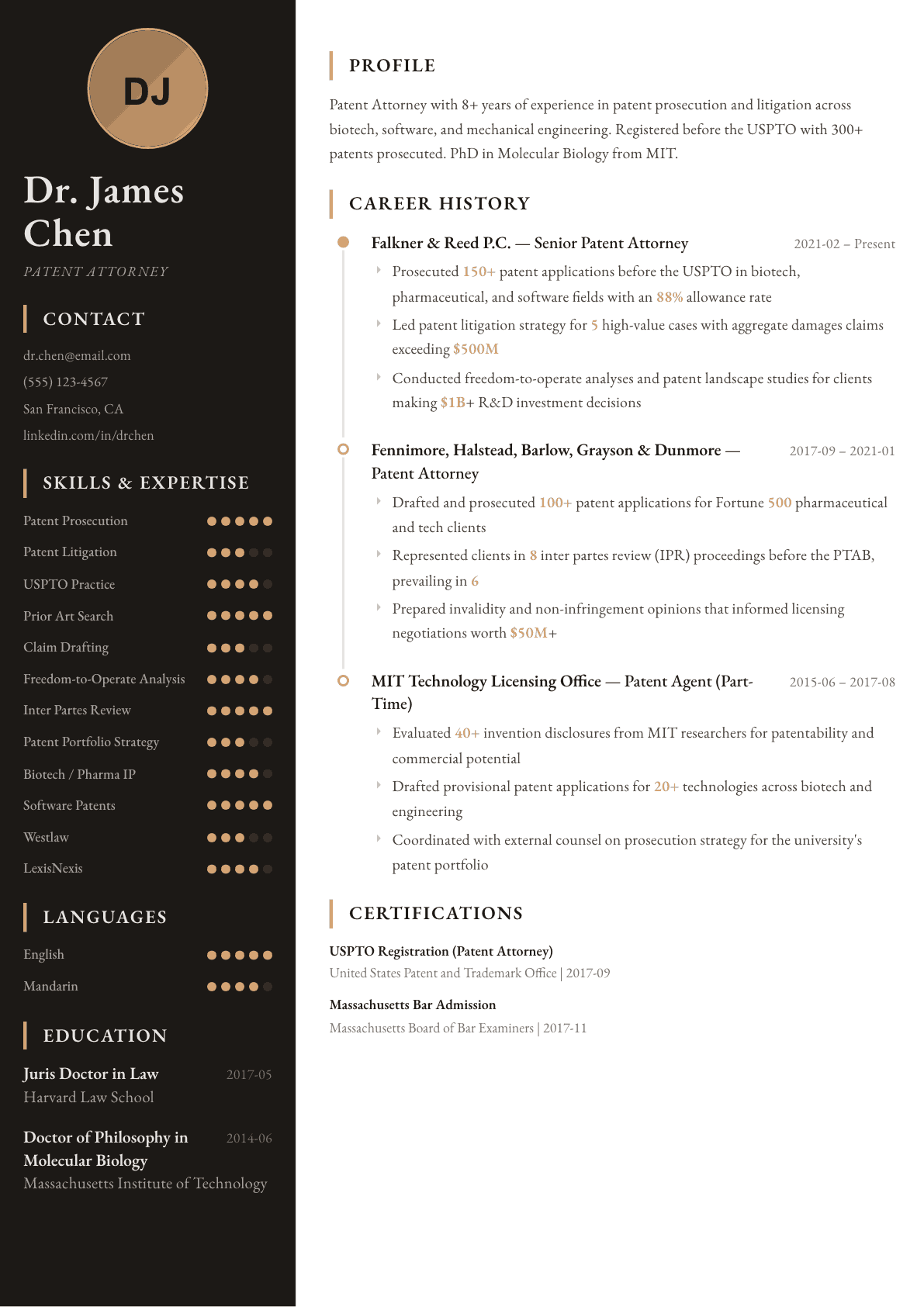
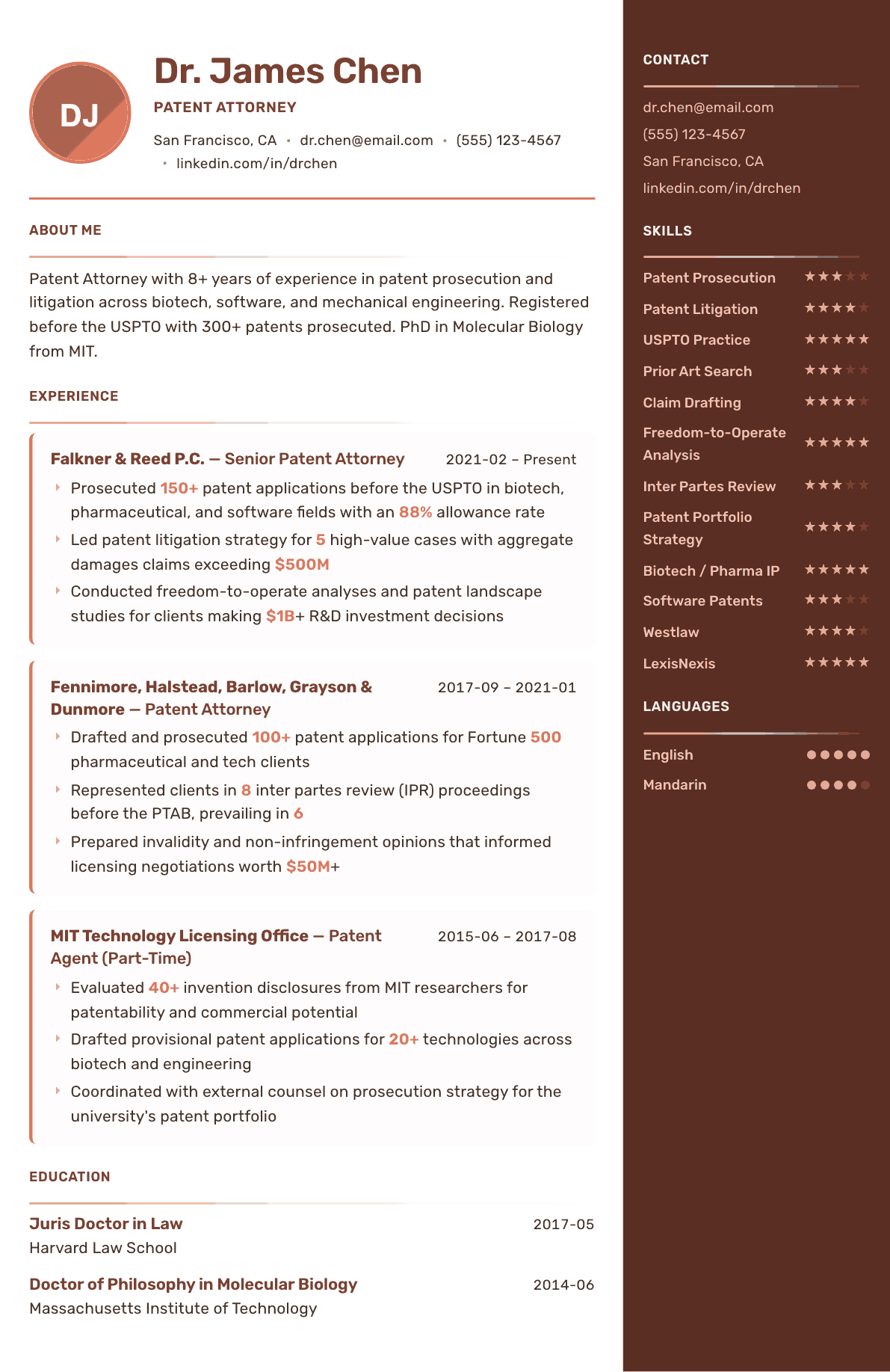
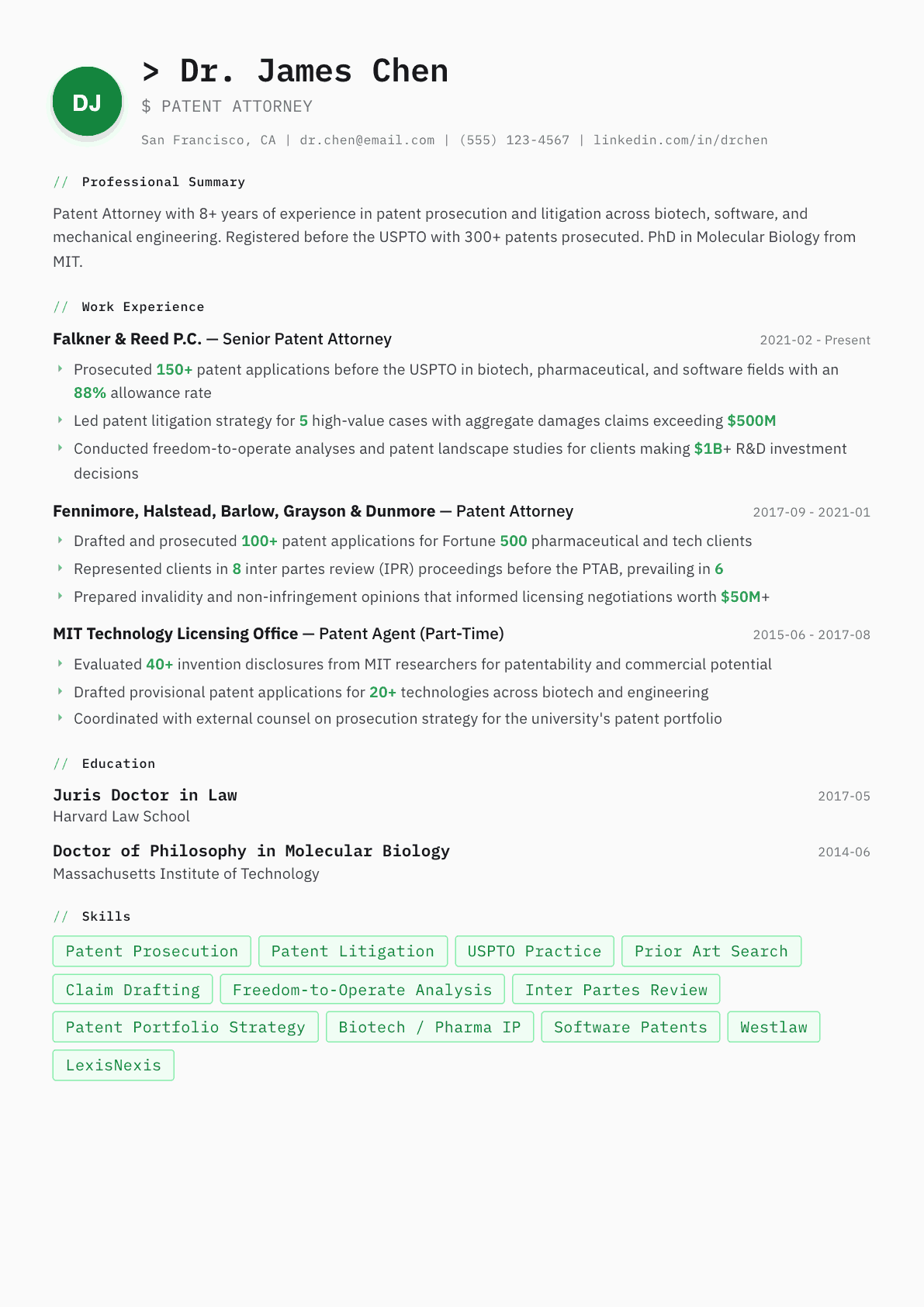
Example Patent Attorney summary
USPTO-registered Patent Attorney with 8 years of experience in prosecution and litigation across biotech, software, and pharma. PhD in Molecular Biology with 300+ patents prosecuted at an 88% allowance rate. Led litigation strategies for cases exceeding $500M in aggregate damages.
Skills to list on a Patent Attorney resume
- Patent Prosecution
- Patent Litigation
- USPTO Practice
- Claim Drafting
- Prior Art Search
- Freedom-to-Operate
- Inter Partes Review (IPR)
- Patent Portfolio Strategy
- Licensing Negotiations
- Due Diligence (IP)
- Biotech / Pharma IP
- Software Patents
- Westlaw
- LexisNexis
What actually gets this resume read
- List your USPTO registration number and bar admissions prominently -- they are non-negotiable requirements.
- Highlight your technical background (PhD, MS, BS) as it differentiates you from general litigators.
- Specify technology areas: biotech, pharma, software, electrical, mechanical, chemical.
- Quantify: patents prosecuted, allowance rates, case values, licensing revenues influenced.
- Include both prosecution and litigation experience if applicable -- versatility is valued.
- Mention any PTAB experience (IPR, PGR) as it is increasingly important in patent practice.
How to write a patent attorney resume
Patent hiring starts with two facts that are either true or not: you hold a qualifying technical degree, and you are registered to practice before the United States Patent and Trademark Office. A recruiter can verify both in a public database in about a minute, so the resume gains nothing from softening either one and loses everything by overstating them.
After that the sort is technological. A partner is not staffing a patent attorney, she is staffing someone who can sit with an inventor working on radio frequency front ends, monoclonal antibodies, or distributed database architecture and come out with claims that survive prosecution. The technology areas on your resume are the match criterion, and they belong near the top.
This guide covers the header conventions specific to patent practice, how to describe prosecution volume and outcomes, how litigation and post-grant work should be framed, three career-stage summaries, and the bullet rewrites that make technical and claim-drafting depth visible on paper.
Format: degree, registration number, admissions, technology areas
The header carries more weight in patent practice than in any other legal specialty. Put your technical degrees with the field and the level, your USPTO registration number, and your state bar admissions in the first block under your name. A patent agent who has not yet been admitted to a state bar should say patent agent plainly rather than leaving the reader to guess.
Immediately below, add a technology areas line: the fields you have drafted or litigated in. Semiconductor processing, optics, wireless communications, machine learning systems, medical devices, small molecule chemistry, biologics or mechanical systems. This is the line a staffing partner actually reads.
One page through the junior years, two pages once you have a substantial docket, post-grant proceedings or a trial record. Reverse-chronological, single column, no design flourishes.
- Header: name, degrees with technical field, USPTO registration number, bar admissions.
- Section order: summary, technology areas, experience, representative matters or publications, education including thesis or research area, technical skills.
- Technical specialists and patent agents in law school should list the degree, the research and the registration first, then the law study in progress.
Summary: prosecution or litigation, and in what technology
Say which practice you are in. Prosecution means drafting applications, responding to office actions, conducting examiner interviews and building portfolios. Litigation means infringement and validity, claim construction, expert work and district court or International Trade Commission practice. Post-grant work at the Patent Trial and Appeal Board sits between the two and is worth naming separately.
Then the technology and the client type. Prosecuting for a semiconductor company with an internal invention disclosure committee is a different rhythm from prosecuting for university technology transfer or for startups filing provisionals before a financing round.
Prosecution: applications drafted, office actions, allowance
Give the volume with the shape. Applications drafted per year, families managed, whether you handle continuations and divisionals, and whether you manage foreign counterparts under the Patent Cooperation Treaty and national stage entries. Say whether the applications were yours from the inventor interview or handed to you as a disclosure.
Office action practice is the daily work, so describe it precisely: responses to rejections for anticipation and obviousness, claim amendments with support identified in the specification, arguments on prior art combinations, examiner interviews conducted and appeals to the Patent Trial and Appeal Board. Say how many interviews you have run, because that is where allowances get made and juniors rarely have them.
Allowance rate is a real metric but only means something with context. Give the technology area and the art units, because allowance rates differ sharply between art units and a sophisticated reader knows it.
Litigation, post-grant and counseling
For litigation, name the forums and your role: infringement contentions, invalidity contentions, claim construction briefing and hearings, source code review, inventor and expert depositions, and any trial or hearing you appeared at. For post-grant, say whether you drafted or defended petitions for inter partes review, prepared expert declarations, and appeared at oral hearing.
Counseling work belongs on the page too, because it is where clients spend steadily: invalidity and non-infringement opinions, freedom to operate analysis, portfolio landscaping, competitive monitoring, and diligence on patent assets during a transaction. Say if you have advised on filing strategy and budget, which is what turns an associate into a client relationship.
Technical credibility and the terms screeners match
Keep your research on the resume longer than most lawyers keep undergraduate detail. Name your thesis area, publications, and any industry work as an engineer or scientist, because a partner deciding who takes the inventor call is weighing exactly that.
Mirror the vocabulary the postings use: patent prosecution, claim drafting, office action response, examiner interview, continuation practice, patentability and freedom to operate opinions, inter partes review, claim construction, infringement and validity analysis, prior art searching and Patent Cooperation Treaty national stage. Include your art units and technology centers if you have worked with them consistently.
Patent Attorney resume summary examples
Junior associate or patent agent
Registered patent agent with a master of science in electrical engineering and a thesis on radio frequency circuit design, now in the third year of law school. Drafted 18 patent applications in wireless and power management, and responded to 30 office actions under partner supervision.
Six years in
Patent attorney with a doctorate in chemistry, drafting roughly 35 applications a year in small molecule and formulation technology and managing 90 families through prosecution. Conducts 40 examiner interviews annually, handles continuation strategy, and coordinates Patent Cooperation Treaty national stage filings across eight jurisdictions.
Prosecution partner
Patent partner with sixteen years in semiconductor and optics prosecution, managing portfolios for two device manufacturers with more than 400 active families. Handles appeals and inter partes review defense, delivers freedom to operate and invalidity opinions, and supervises four associates and two technical specialists.
Work experience bullets: before and after
Before: Drafted patent applications for technology clients.
After: Drafted roughly 35 utility applications a year in wireless communications and power management, conducting inventor interviews, defining claim scope with the business objective and preparing figures with the drafting team.
Volume, technology and the inventor-to-claim process show you originate applications rather than edit them.
Before: Responded to office actions from the patent office.
After: Prepared responses to anticipation and obviousness rejections across 120 office actions, amending claims with specification support identified, distinguishing prior art combinations and requesting examiner interviews on contested rejections.
Naming the rejection types and the amendment discipline demonstrates prosecution judgment, not correspondence.
Before: Worked on patent litigation and validity issues.
After: Prepared invalidity contentions and claim construction briefing in two district court cases, mapping asserted claims to prior art references and supporting expert declarations on the level of ordinary skill.
The specific litigation deliverables prove substantive contribution instead of unspecified case involvement.
Before: Advised clients on their patent portfolios.
After: Set filing strategy for a portfolio of 90 families, recommending continuations to cover competitor product changes, pruning families with low commercial value and aligning annual filing volume with the client budget.
Strategy, pruning and budget alignment are client counseling work, while advised on portfolios describes nothing.
Before: Handled international patent filings.
After: Managed Patent Cooperation Treaty applications through national stage entry in eight jurisdictions, instructing foreign associates on claim amendments and reconciling office practice differences between the European and Japanese examinations.
Jurisdiction count and the practice differences show real foreign coordination rather than forwarding instructions.
Hard skills
- Patent application drafting
- Claim drafting and claim scope strategy
- Office action response and after final practice
- Examiner interviews
- Continuation and divisional strategy
- Patent Cooperation Treaty and national stage filings
- Patentability and freedom to operate opinions
- Inter partes review petitions and responses
- Invalidity and infringement analysis
- Claim construction briefing
- Prior art searching
- Patent portfolio landscaping and diligence
Soft skills
- Inventor interviewing
- Technical explanation for lay readers
- Docket discipline
- Precision in written argument
- Budget conversations with clients
- Mentoring technical specialists
Certifications worth listing
- Registration to Practice Before the USPTO in Patent Cases (United States Patent and Trademark Office)
- State bar admission (State bar admitting authorities)
- European Qualifying Examination (European Patent Attorney) (European Patent Office)
Mistakes that cost patent attorney candidates the interview
- Leaving the USPTO registration number off the resume, when it is the first thing a patent recruiter checks and takes a minute to verify.
- Putting a technical degree at the bottom under education, where a staffing partner will never see the field she is matching on.
- Describing yourself as a patent attorney while holding only a technical background and no registration, which the public register contradicts.
- Giving an allowance rate with no technology area or art unit context, which an experienced reader immediately discounts.
- Omitting examiner interview counts, since interviews are where allowances are negotiated and few junior candidates have run any.
- Listing prosecution and litigation with equal weight, which leaves both hiring partners assuming you are shallow in theirs.
Patent Attorney resume questions
What technical degrees qualify for the patent bar?
The patent office publishes a category list covering most engineering and hard science degrees, with alternative routes based on coursework or a combination of credits. Name your degree and field precisely on the resume and let the reader match it to the requirement.
Should a patent agent apply for patent attorney roles?
Apply for the roles that match your status and say patent agent plainly. Many firms hire agents and support them through law school, and misdescribing yourself as an attorney before bar admission is the fastest way to end a candidacy.
How do I show prosecution experience numerically?
Give applications drafted per year, families under your management, office actions responded to and examiner interviews conducted. Those four numbers describe a prosecution practice more accurately than any narrative paragraph could.
Does litigation experience help a prosecution candidate?
It helps if you frame it as claim quality. Say how validity challenges and claim construction shaped how you draft, since prosecution partners value attorneys who write claims with the eventual invalidity attack already in mind.
How much of my scientific research should stay on the resume?
Keep the thesis area, publications and any industry research work permanently. In patent practice your technical depth is a staffing criterion for the whole career, unlike most legal fields where undergraduate detail fades after a few years.