Legal Analyst Resume Examples: free ATS score and gap list
Craft a Legal Analyst Resume That Proves Analytical Depth
By Mustafa Tarabya, founder of CVBooster · Published · Updated
Legal analyst resume example with regulatory research and contract review keywords, plus a writing guide for analyst roles inside legal teams.
Sample resumes for a legal analyst
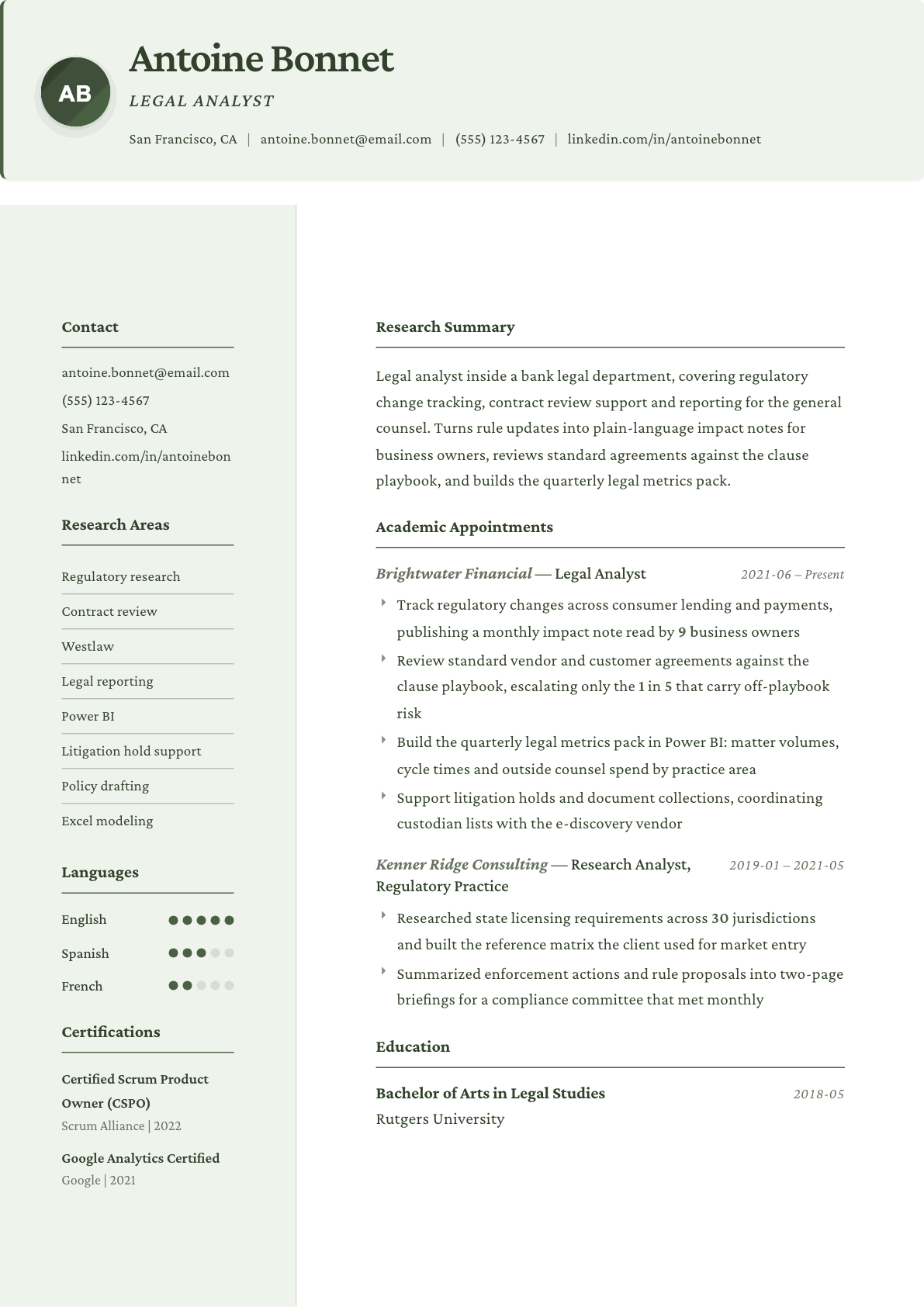
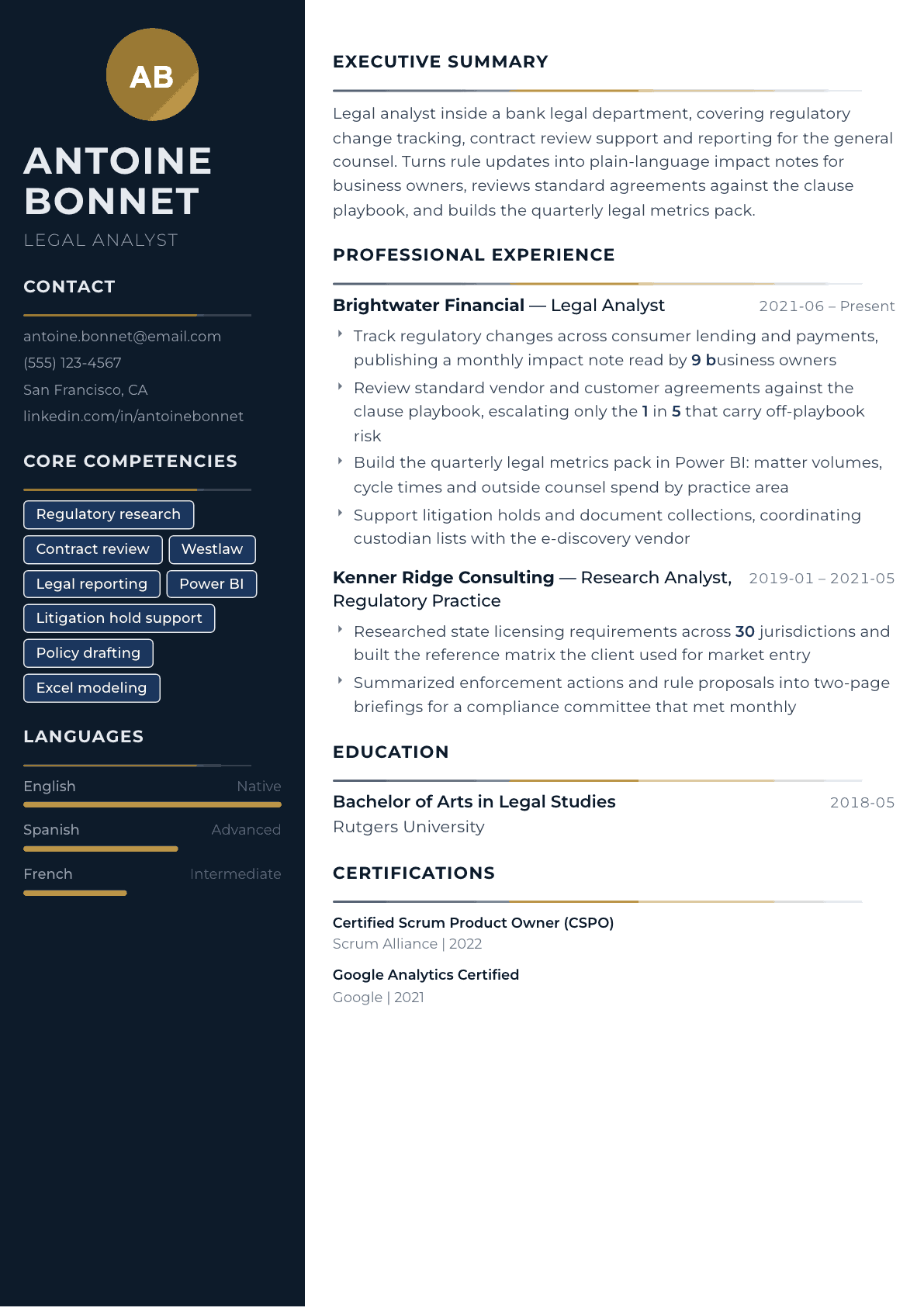
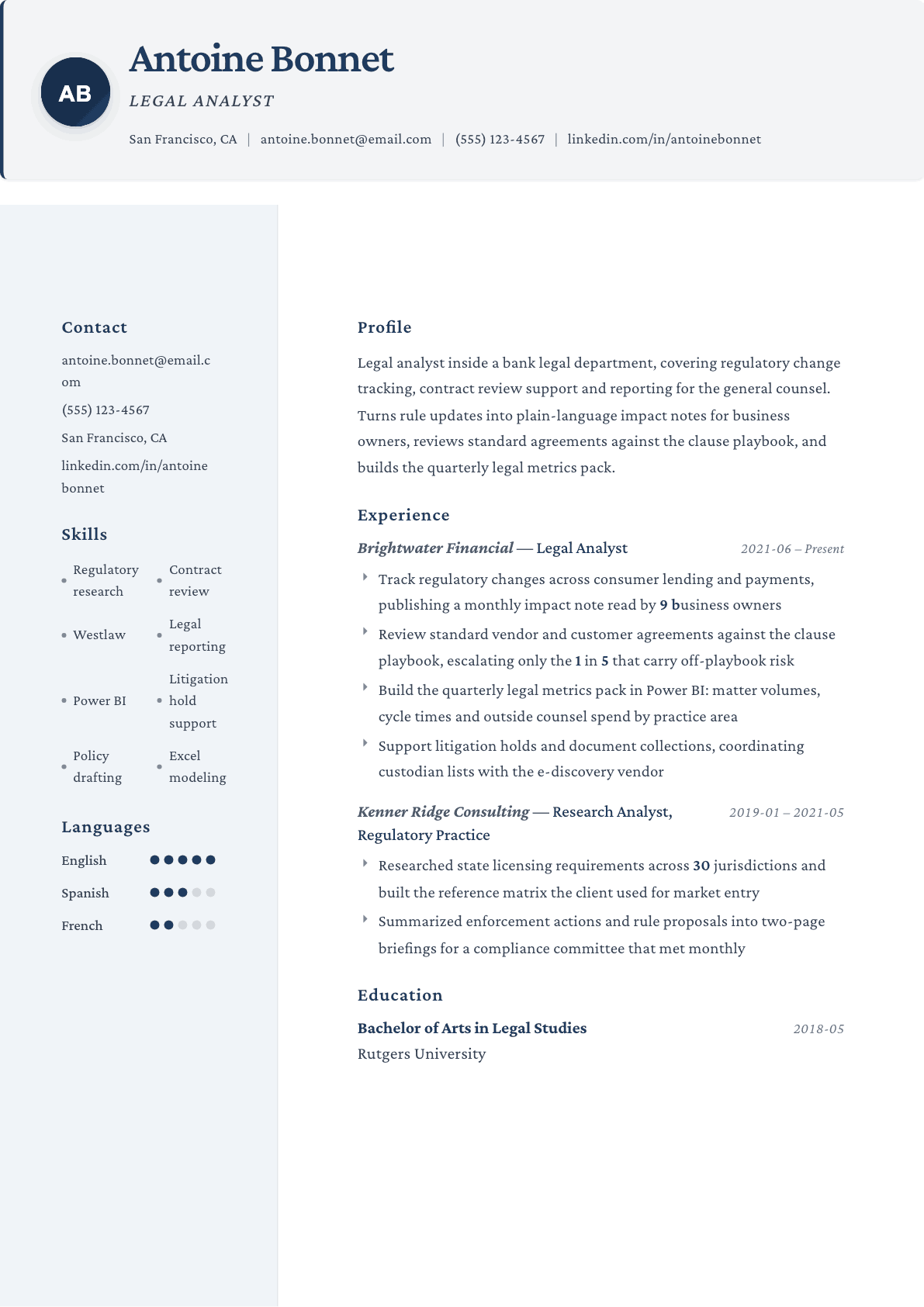
The same legal analyst content laid out in three CVBooster templates, so you can see what the finished document looks like before you write a word.
Example Legal Analyst summary
Legal analyst with four years supporting a corporate legal department on regulatory change, contract review and reporting. Translates rule updates into short impact notes business owners act on, reviews agreements against a clause playbook, and produces the quarterly metrics pack on matter volume and outside counsel spend. Strong with research databases and analysis tools.
Skills to list on a Legal Analyst resume
- Regulatory research
- Legal research databases
- Contract review
- Clause playbooks
- Legal writing
- Policy analysis
- Litigation support
- E-discovery coordination
- Data analysis
- Reporting and dashboards
- Risk assessment
- Matter management systems
- Stakeholder briefings
- Records management
What actually gets this resume read
- Say what you analyze: regulation, contracts, litigation data or legal spend, because those are four different jobs with one title.
- Pair every research line with what the reader did next, since analysis nobody used is not evidence of value.
- Name your research and reporting tools, because a legal analyst posting screens on both the legal side and the data side.
- Quantify the volume of documents, jurisdictions or matters you cover so the reader can size the workload you handle.
- Show writing range: a memo, a matrix and a dashboard prove you can move between depth and summary.
- Keep the summary free of attorney language if you are not admitted, and state your degree clearly instead.
How to write a legal analyst resume
Legal analyst is one job title covering at least four jobs. In a bank it usually means regulatory change tracking and control mapping. In a legal department it can mean contract review against a playbook, or matter and spend reporting. In a litigation setting it means document review, chronologies and e-discovery coordination. The first job your resume has to do is tell the reader which one you are.
The second job is proving that your analysis reached a decision. Hiring managers for analyst roles are wary of candidates who produce research nobody uses, so every research line needs the sentence after it: what changed, who acted, which control was updated, which clause was renegotiated. Analysis with no consequence attached reads as coursework.
This guide sets out the section order that works for a legal analyst, example summaries for three career stages, bullet rewrites that add the missing outcome, and the questions that come up when someone with a legal studies background is competing against candidates with data skills.
Format: declare your specialization in the first two lines
Because the title is ambiguous, the top of the page must be unambiguous. Use a headline under your name that names the domain, for example regulatory analysis in consumer lending, or contract analysis and legal reporting. A reader who has to reach the third job to work out what you do will usually not get there.
Reverse chronological order, one clean column, one page for under six years. Keep a distinct skills block because analyst postings screen for both legal vocabulary and analytical tooling, and those two lists rarely appear together in the experience section.
- Header: name, domain headline, city and state, phone, email.
- Order: summary, experience, skills split into legal and analytical, education, certifications.
- Keep any writing sample or publication reference to a single line at the end.
Summary: what you analyze, for whom, and what they do with it
Three sentences. The domain and the setting. The scope, expressed in jurisdictions, agreement volume, matter count or regulatory scope. Then the audience: business owners, a compliance committee, a general counsel, outside counsel. The audience matters because writing a two-page briefing for an executive is a different craft from writing a research memo for a lawyer.
If you are not admitted to practice, do not use language that implies you are. Say analyst, say your degree, and let the work speak. Overstating status here is the fastest way to lose a legal department reader.
Experience: pair every analysis with its consequence
Structure each bullet as input, method, output, effect. Tracked proposed rules across two agencies, summarized the operational impact for nine business owners, and updated four procedures before the effective date. That shape survives any editing pass because each part carries weight.
Show range across three kinds of writing. The long form research memo. The comparison matrix across jurisdictions or contracts. The recurring report or dashboard. A legal analyst who can only do one of the three gets stuck at the level of the person who assigns the work.
Include the operational work honestly, because it is most of the job in many teams: litigation hold administration, custodian interviews, document collection coordination, matter intake triage, and keeping the reporting data clean enough to trust.
Skills: legal research on one side, analysis tooling on the other
Split the block visually. On the legal side put the research databases, regulatory sources, contract review, clause playbooks, e-discovery platforms and matter management systems you have used. On the analytical side put spreadsheets at the level you truly work, plus any reporting or query tools.
Be precise about tooling depth. Pivot tables and lookups are worth stating if that is the honest ceiling. If you build models or write queries, say what you built and what it answered, because that is the differentiator between a legal analyst and a legal assistant with a spreadsheet.
Keywords analyst postings actually screen on
Recurring terms include regulatory change management, contract review, legal research, risk assessment, matter management, e-discovery, policy analysis, reporting and stakeholder briefings. Match the posting language exactly once, then support it with a bullet. If the posting names a platform you have used, put the platform name in the experience bullet as well as the skills list so the human reader sees it in context.
Legal Analyst resume summary examples
First analyst role
Legal studies graduate with a year supporting a compliance team on regulatory research and policy updates. Tracks rule changes across 3 state regulators, drafts two-page summaries for business owners, and maintains the control mapping spreadsheet. Comfortable with legal research databases and building comparison matrices from scratch.
Four years in
Legal analyst in a financial services legal department covering regulatory change, contract review and reporting. Publishes a monthly impact note used by nine business owners, reviews standard agreements against a clause playbook and escalates only off-playbook risk, and builds the quarterly matter and spend pack for the general counsel.
Senior analyst
Senior legal analyst with eight years across regulatory analysis and litigation support, now leading a team of three. Owns the regulatory change workflow from horizon scanning to procedure update, runs litigation hold and collection coordination with the e-discovery vendor, and reports risk trends to the audit committee each quarter.
Work experience bullets: before and after
Before: Conducted legal research for the department.
After: Researched state licensing requirements across 30 jurisdictions and built the reference matrix the business used to sequence its market entry plan.
The jurisdiction count and the decision the matrix supported turn research into something the reader can value.
Before: Monitored regulatory changes.
After: Tracked proposed and final rules across consumer lending and payments, published a monthly impact note for 9 business owners, and drove 4 procedure updates ahead of their effective dates.
The scope, the audience and the downstream updates show a closed loop rather than passive monitoring.
Before: Reviewed contracts.
After: Reviewed roughly 400 standard vendor and customer agreements a year against the clause playbook, resolving most in a single pass and escalating only the 1 in 5 carrying off-playbook risk.
Volume plus an escalation ratio shows judgment about what deserves an attorney and what does not.
Before: Created reports for management.
After: Built the quarterly legal metrics pack covering matter volumes, cycle times and outside counsel spend by practice area, and presented the trend commentary to the general counsel.
Naming the measures and the audience proves the reporting was used at a level where it counts.
Before: Assisted with e-discovery.
After: Coordinated litigation holds and custodian interviews for 6 matters, assembled the collection scope with the e-discovery vendor, and tracked review progress against the production deadline.
The specific workstream and the deadline pressure demonstrate ownership rather than assistance.
Hard skills
- Regulatory research and horizon scanning
- Legal research databases
- Contract review against playbooks
- Policy and procedure analysis
- Risk and control mapping
- Matter management systems
- E-discovery coordination
- Litigation hold administration
- Legal spend analysis
- Reporting and dashboards
- Advanced spreadsheet analysis
- Legal writing and briefing
- Records and retention analysis
- Jurisdiction comparison matrices
Soft skills
- Concise written summary
- Questioning assumptions
- Working with non-legal stakeholders
- Prioritizing competing requests
- Accuracy under time pressure
- Presenting to senior readers
Certifications worth listing
- Certified E-Discovery Specialist (CEDS) (Association of Certified E-Discovery Specialists)
- Certified Compliance and Ethics Professional (CCEP) (Compliance Certification Board)
- Certified Paralegal (CP) (National Association of Legal Assistants)
Mistakes that cost legal analyst candidates the interview
- Leaving the title ambiguous so the reader cannot tell regulatory analysis from contract analysis from litigation support.
- Listing research projects without the decision, filing or procedure change that followed them.
- Overstating analytical tooling, which collapses in an interview that asks how a specific report was built.
- Using attorney phrasing such as advised on legal matters when you are not admitted to practice.
- Burying the reporting work at the bottom when legal departments hire analysts precisely for visibility into their own numbers.
- Writing long paragraphs in the experience section, which contradicts the claim that you can summarize.
Legal Analyst resume questions
Do I need a law degree to be a legal analyst?
Usually not. Most postings ask for a bachelor degree plus legal exposure through paralegal work, compliance or regulatory research. A law degree helps in analysis-heavy roles, but demonstrated research, writing and reporting output carries more weight in the screening.
How do I show analytical skills without a data background?
Describe artifacts, not adjectives. A jurisdiction comparison matrix, a control mapping, a recurring metrics pack and a clause frequency review are all analytical products. Say what each one contained, who read it and what decision it supported.
Should a legal analyst resume include a writing sample?
Not in the document itself, but a single line offering a redacted research memo or briefing on request is useful. Legal analyst hiring often turns on writing quality, and signaling that you have publishable work ready invites the conversation.
How is a legal analyst different from a paralegal on paper?
A paralegal resume centers on case and filing support. An analyst resume centers on evaluation and reporting: comparing rules, testing terms against a standard and producing recurring measures. If you have done both, keep them in separate bullet groups so neither dilutes the other.
What belongs in a legal analyst summary if my experience is mixed?
Lead with the domain the posting names, then mention the second domain as supporting breadth. A candidate targeting regulatory work should open with regulatory analysis and mention contract review afterward, rather than presenting both as equal and leaving the reader to choose.