Intellectual Property Lawyer Resume Examples: free score
Build an IP Lawyer Resume That Protects Your Career Assets
By Mustafa Tarabya, founder of CVBooster · Published · Updated
Create an intellectual property lawyer resume showcasing your patent, trademark, copyright, and trade secret expertise with professional legal templates.
Sample resumes for a intellectual property lawyer
The same intellectual property lawyer content laid out in three CVBooster templates, so you can see what the finished document looks like before you write a word.
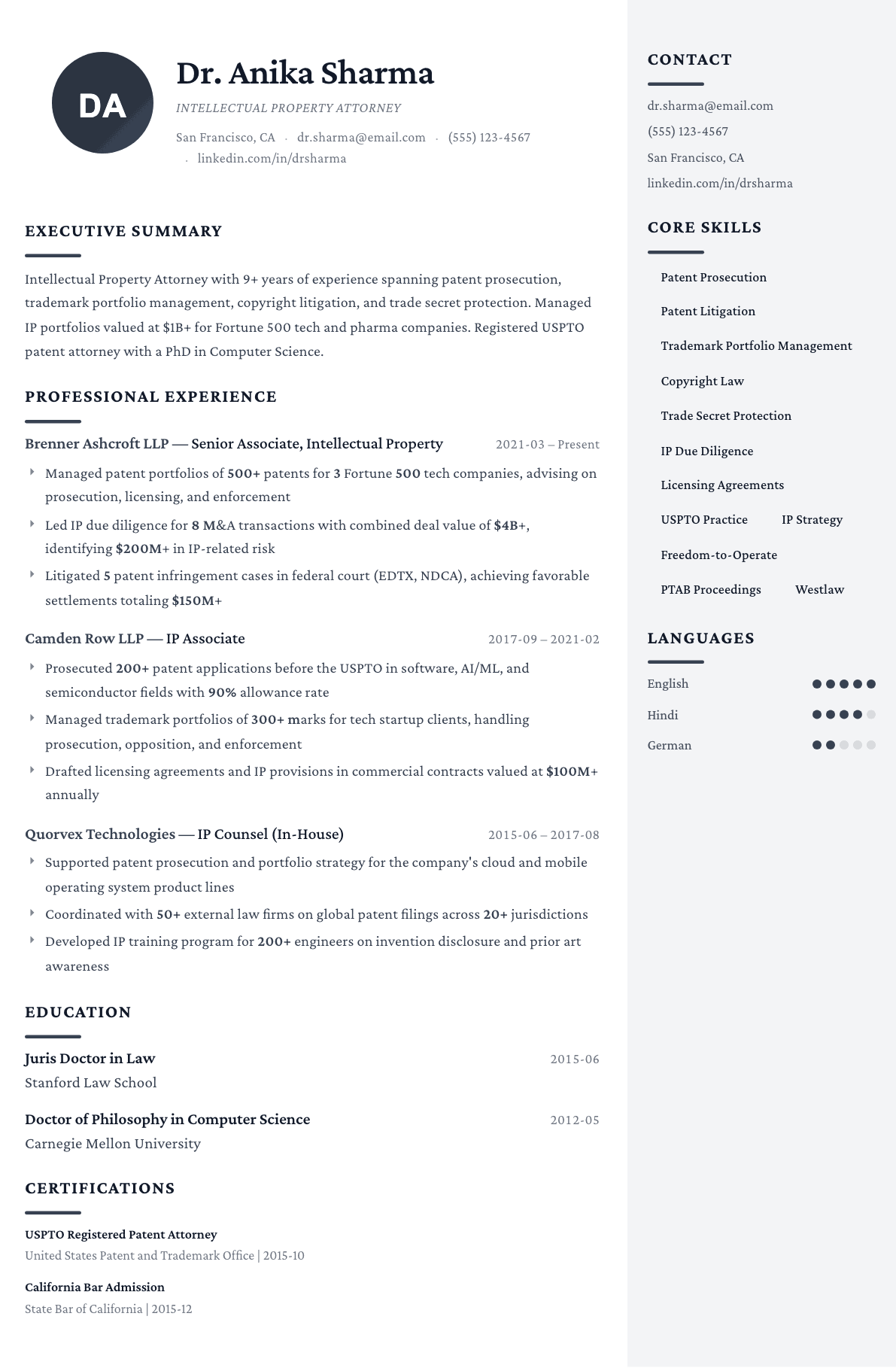
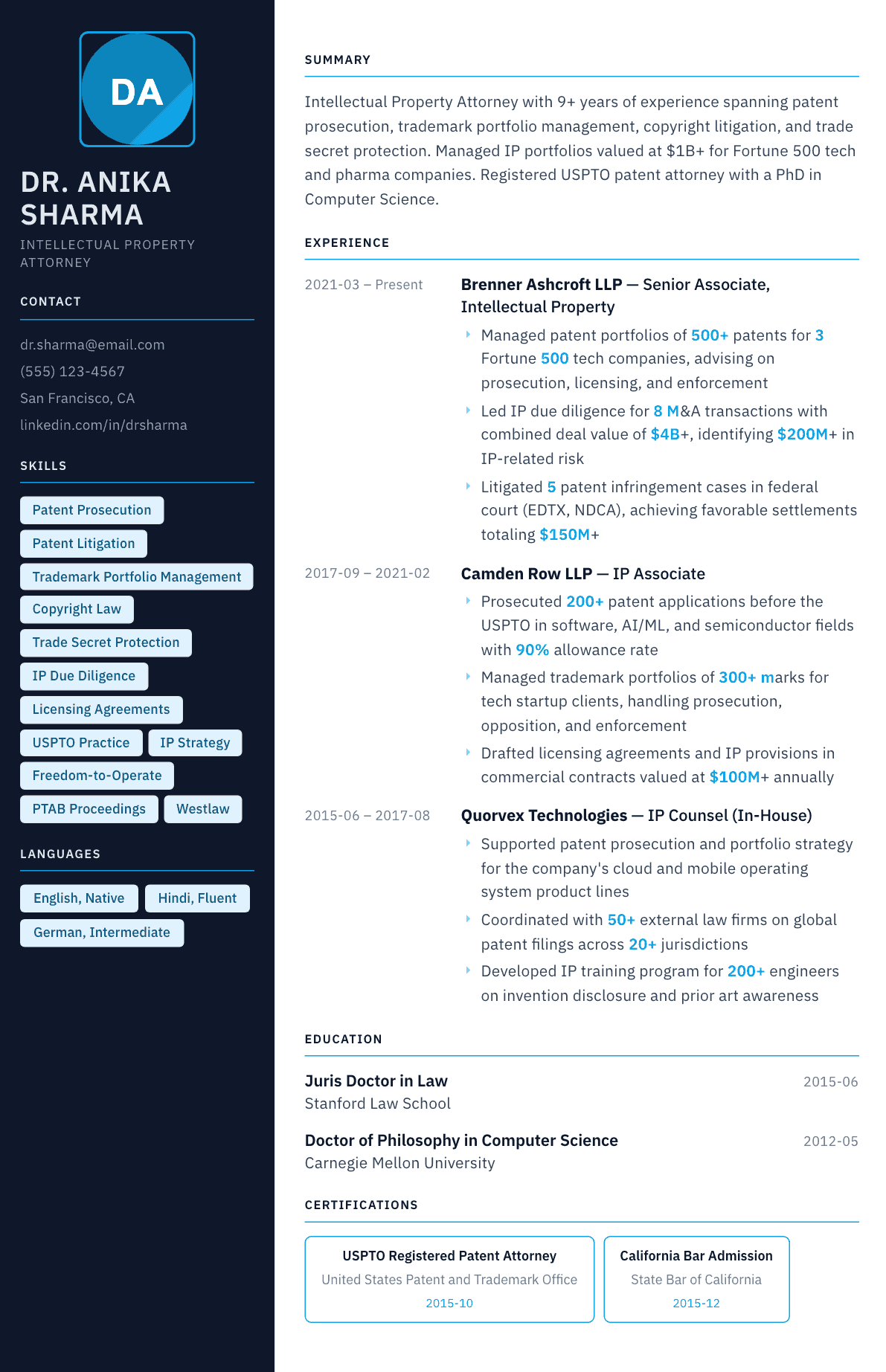
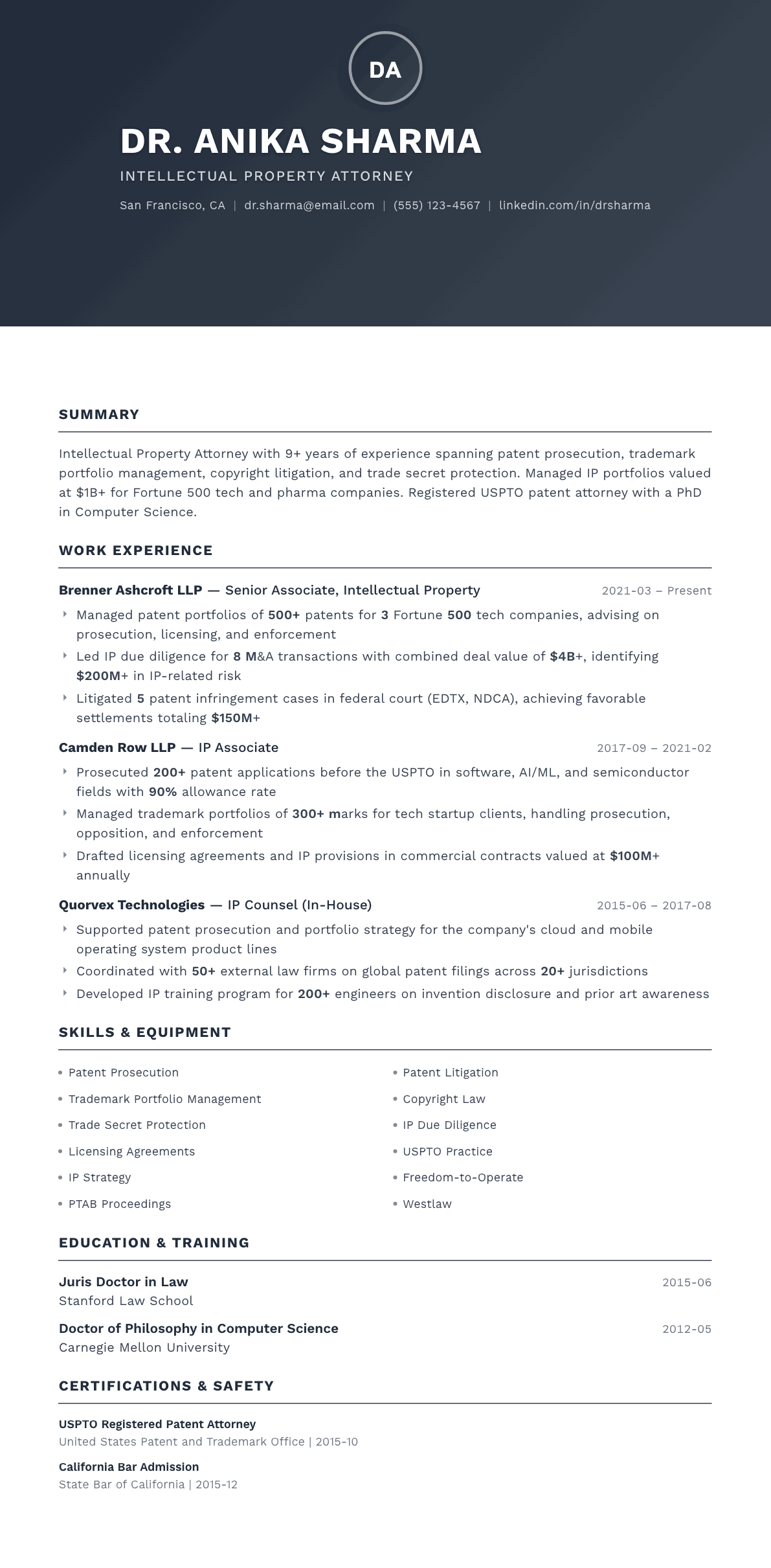
Example Intellectual Property Lawyer summary
IP Attorney with 9 years across patent prosecution, trademark portfolios, copyright litigation, and trade secret protection, in-house and at firms. USPTO-registered with a PhD in Computer Science and a 90% allowance rate on 200+ software and semiconductor applications. Managed $1B+ IP portfolios and settled 5 patent suits for $150M+.
Skills to list on a Intellectual Property Lawyer resume
- Patent Prosecution
- Patent Litigation
- Trademark Law
- Copyright Law
- Trade Secrets
- IP Due Diligence
- Licensing & Transactions
- USPTO Practice
- IP Portfolio Strategy
- Freedom-to-Operate
- PTAB Proceedings
- Open Source Compliance
- Westlaw
- LexisNexis
What actually gets this resume read
- Specify all areas of IP you practice: patents, trademarks, copyrights, trade secrets, licensing.
- Highlight your technical background (PhD, MS, BS in STEM) -- it is a major differentiator in IP law.
- List USPTO registration and all bar admissions prominently.
- Quantify: portfolio size managed, deal values for IP due diligence, settlement amounts, allowance rates.
- Show both law firm and in-house experience if you have it -- the combination is highly valued.
- Mention specific technology areas: AI/ML, biotech, pharma, semiconductors, software, medical devices.
How to write a intellectual property lawyer resume
Intellectual property is four practices wearing one label, and the partner reading your resume is sorting you into one of them before the second bullet. Trademark prosecution and enforcement is a portfolio and opposition practice. Copyright is licensing, fair use analysis and takedown work. Trade secrets is employment mobility litigation. Patent work splits again between prosecution, which requires a technical degree and registration, and patent litigation, which does not.
The most common failure in an IP lawyer resume is refusing to choose. A file that lists all four areas with equal weight reads as a generalist, and IP groups do not hire generalists at any level above summer associate. Pick the practice you want and let the rest sit in a secondary line.
This guide covers how to structure an IP resume around a chosen practice, how to describe portfolios and disputes without exposing client confidences, summaries for three career stages, and the bullet rewrites that make technical depth visible.
Format: technical background and registration status up top
If you hold a technical or scientific degree, it belongs in the header block with your bar admissions, not at the bottom under education. An IP group screening for a chemistry or electrical engineering background will not scroll to find it. If you are registered to practice before the United States Patent and Trademark Office, state that on the same line, and if you are not, do not imply it.
Use reverse-chronological order with a clean, single-column layout. One page under five years, two pages once you have a portfolio, a trial record or reported decisions. A short representative matters block after experience is common in IP and is worth including once you have three or four disputes worth naming.
- Header: name, JD, technical degree and field, bar admissions, USPTO registration number if registered.
- Section order: summary, admissions and technical background, experience, representative matters, education, technical skills, publications and speaking.
- Students lead with education, technical coursework, an IP clinic, and any journal note on a patent or trademark topic.
Summary: the practice, the technology, the posture
Three lines. Name the practice area, the technology or industry sectors, and whether your work is transactional, prosecution or contentious. An intellectual property lawyer handling trademark portfolio management and opposition practice for consumer brands is a different hire from one handling trade secret and patent litigation for medical device companies, and the reader is deciding which chair you fill.
Then add the forums. Trademark Trial and Appeal Board practice, district court litigation, proceedings before the Patent Trial and Appeal Board, and International Trade Commission investigations are all specific enough that naming them places you instantly.
Experience: portfolios, disputes and the technology behind them
For prosecution and portfolio work, give the scale and the shape: the number of marks or families you manage, the countries covered, the docketing rhythm, and the strategy you set. Managing a trademark portfolio across dozens of classes and foreign associates is an operational job as much as a legal one, and firms hire for the operational half.
For contentious work, describe the dispute type, the forum and your role. Say whether you took depositions, argued claim construction, handled the discovery of source code under a protective order, drafted the opposition or the petition for cancellation, or wrote the appellate brief. Second-chair experience counts and should be labeled honestly as such.
Technology is the differentiator in IP. Name the subject matter you have actually worked in: wireless communications, semiconductor fabrication, biologics, software architecture, mechanical devices, or consumer packaging. A partner staffing a case wants to know whose file she can hand the technical tutorial to.
Licensing and counseling: the work that keeps clients
Much of an IP practice never reaches a courtroom. Show the counseling: freedom to operate analysis, clearance searches, opinion work, brand clearance for new product launches, licensing and assignment agreements, technology transfer, open source review, and intellectual property diligence in a corporate transaction.
Enforcement outside litigation belongs here too. Cease and desist programs, domain name proceedings under the Uniform Domain-Name Dispute-Resolution Policy, customs recordation, and online marketplace takedown programs are ordinary brand-protection work and are frequently the thing a client actually pays for month to month.
Keywords and systems an IP screener scans for
Mirror the posting language: prosecution, portfolio management, office action response, opposition, cancellation, infringement, validity, claim construction, licensing, freedom to operate, trade secret misappropriation, and diligence. Add the systems, since IP practice is docket-driven: the docketing platform you have used, the searching databases for prior art and trademark clearance, and the electronic filing systems at the trademark and patent offices.
Publications and speaking carry more weight in IP than in most specialties, because clients choose counsel partly on visible expertise. List articles, chapters and panels with the publication or organizing body, not just the titles.
Intellectual Property Lawyer resume summary examples
First-year associate
Attorney with a bachelor of science in mechanical engineering and an intellectual property clinic placement drafting trademark applications and office action responses for 15 small business clients. Journal note on design patent scope, and a summer with a brand protection team running marketplace takedowns.
Six years in
Intellectual property attorney managing a trademark portfolio of 900 marks across 40 countries for consumer goods clients, with 25 oppositions and cancellations before the Trademark Trial and Appeal Board. Also handles clearance opinions for new product launches and coordinates a network of foreign associates.
IP group leader
Litigation partner leading an intellectual property group focused on patent and trade secret disputes in medical devices and wireless technology. Tried four cases to verdict, argued claim construction in eleven matters, and handled parallel proceedings before the Patent Trial and Appeal Board. Supervises six associates and two technical advisors.
Work experience bullets: before and after
Before: Managed intellectual property portfolios for clients.
After: Managed a trademark portfolio of roughly 900 registrations and pending applications across 40 jurisdictions, setting filing strategy, instructing foreign associates and running renewal and use-declaration deadlines.
Portfolio size, geography and the docket mechanics show operational command, which is what portfolio clients buy.
Before: Worked on patent litigation matters in federal court.
After: Second-chaired two patent infringement cases in the Eastern District of Texas, taking four inventor depositions, drafting claim construction briefing and managing source code review under a protective order.
Naming the forum and the specific litigation tasks proves what you personally did rather than what the team did.
Before: Advised clients on trademark clearance.
After: Delivered 60 clearance opinions for new consumer product names, running full availability searches, assessing likelihood of confusion against prior registrations and common law uses, and recommending coexistence terms.
The count and the analytical steps turn advice into a documented deliverable a client can price.
Before: Handled anti-counterfeiting for a brand client.
After: Built a brand protection program covering marketplace takedowns, domain name proceedings under the UDRP and customs recordation, removing 1,200 infringing listings in the first year.
A named program with its enforcement channels and a result reads as ownership rather than task assistance.
Before: Reviewed intellectual property in corporate deals.
After: Led intellectual property diligence on nine acquisitions, auditing patent chain of title, open source license obligations and inbound license assignability, and drafting the schedules and representations.
The specific diligence workstreams show a corporate partner exactly which part of the deal you can be handed.
Hard skills
- Trademark prosecution and portfolio management
- Opposition and cancellation practice
- Patent litigation and claim construction
- Trade secret misappropriation claims
- Copyright licensing and fair use analysis
- Freedom to operate and clearance opinions
- Licensing and technology transfer agreements
- Intellectual property diligence
- UDRP and domain name disputes
- Anti-counterfeiting and marketplace enforcement
- Prior art searching
- Open source license review
Soft skills
- Technical translation for lay audiences
- Client brand counseling
- Foreign associate coordination
- Docket discipline
- Cross-examination preparation
- Commercial judgment
Certifications worth listing
- Registration to Practice Before the USPTO in Patent Cases (United States Patent and Trademark Office)
- Certified Licensing Professional (Certified Licensing Professionals, Inc.)
- Certified Information Privacy Professional (International Association of Privacy Professionals)
Mistakes that cost intellectual property lawyer candidates the interview
- Presenting all four intellectual property areas with equal weight, which makes the reader assume you have real depth in none of them.
- Hiding a technical degree under education when an engineering or science background is the screening criterion for the role.
- Implying patent bar registration you do not hold, which is checkable in a public database within a minute.
- Describing litigation with team verbs so the reader cannot tell whether you argued the motion or proofread the brief.
- Omitting the technologies and industries you have worked in, leaving a staffing partner with no way to match you to a case.
- Leaving out counseling, licensing and enforcement program work, which is the recurring revenue that keeps an IP practice alive.
Intellectual Property Lawyer resume questions
Do I need a technical degree to be an intellectual property lawyer?
Only for patent prosecution, which requires a qualifying science or engineering background for registration. Trademark, copyright, trade secret and patent litigation practices hire without one, so lead with your subject matter familiarity instead.
Should I include a representative matters section?
Yes, once you have three or four disputes or transactions worth naming. Describe each by technology, forum and your role, keep it to a line or two, and only include matters that are public or that you can describe without client-identifying facts.
How do I show trademark portfolio experience?
Give the scale and the operations, not just the word portfolio. State the number of marks, the number of jurisdictions, whether you set filing strategy, how you instructed foreign associates and how you managed renewals and use declarations.
How much technical detail should go on the resume?
Enough to prove you can hold a tutorial with an inventor. Name the technology areas and the kinds of systems or compounds involved, but leave the deep explanation for the interview, where a partner will test it directly.
Do publications and speaking matter for an IP resume?
More than in most legal specialties, because clients pick counsel on visible expertise. List articles with the publishing journal or bar section, panels with the organizing body, and any continuing legal education sessions you taught.