Family Law Attorney Resume Examples: what gets the call
Create a Family Law Attorney Resume That Builds Trust
By Mustafa Tarabya, founder of CVBooster · Published · Updated
Build a family law attorney resume showcasing your divorce, custody, and mediation experience with professional legal templates designed for client-facing roles.
Sample resumes for a family law attorney
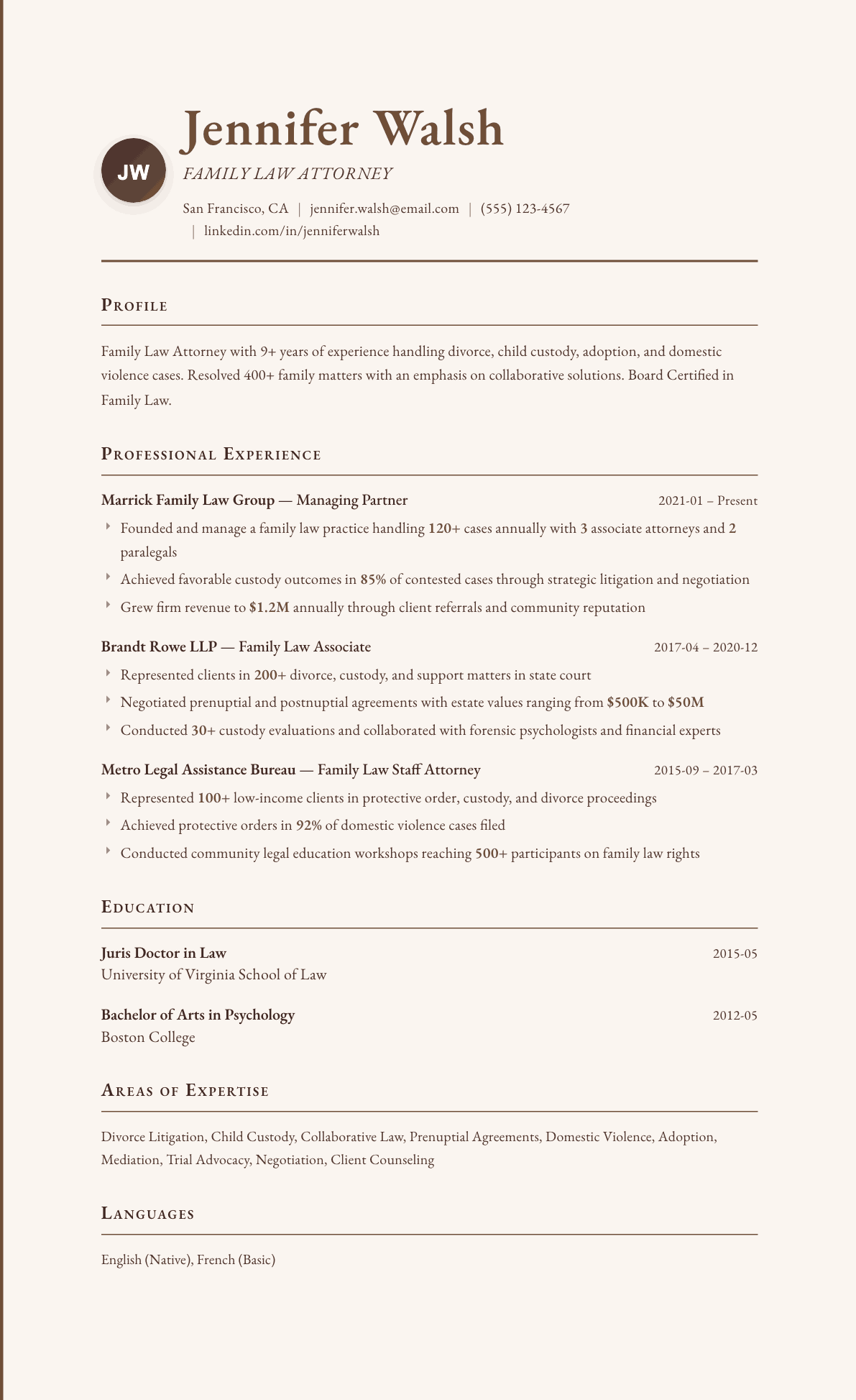
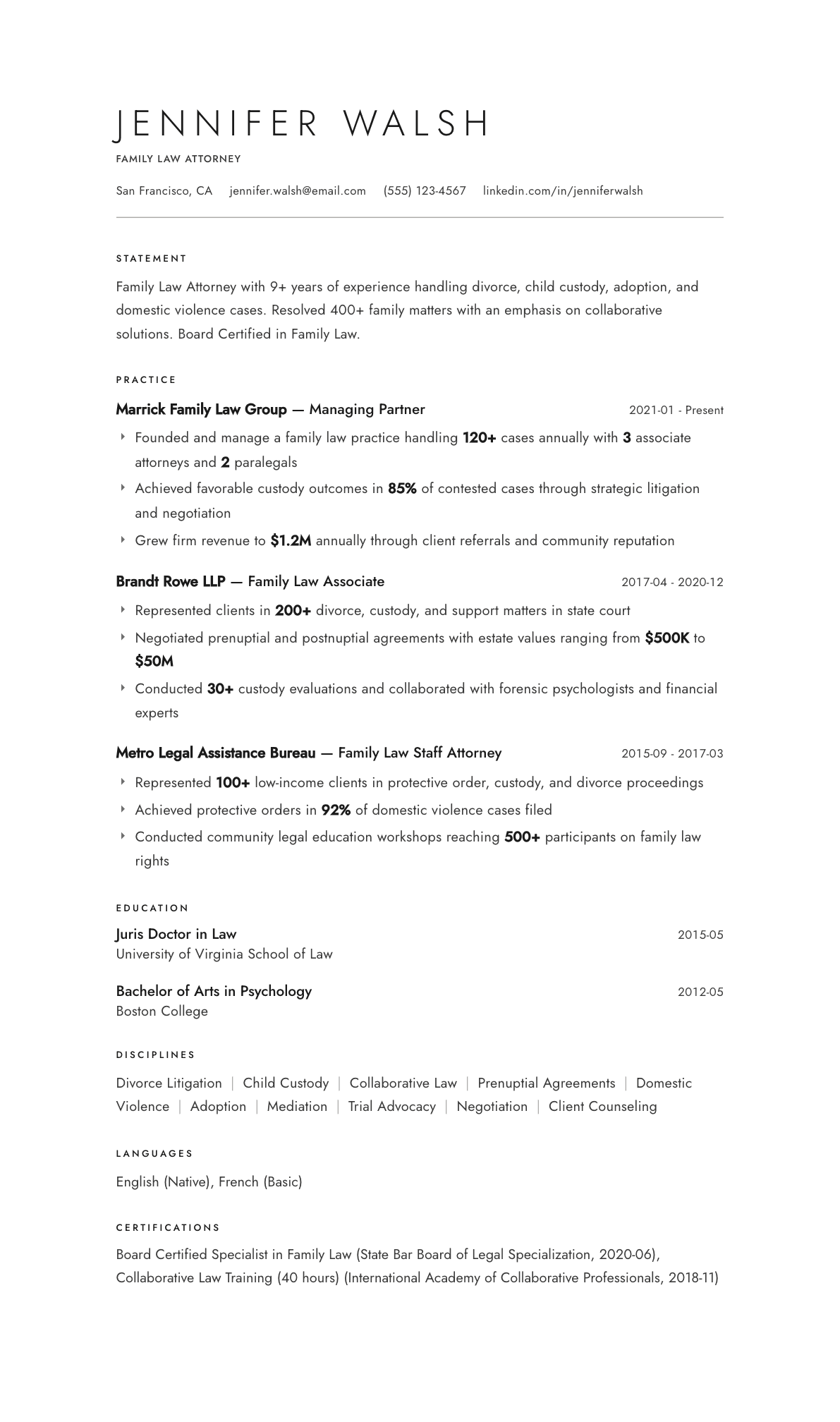
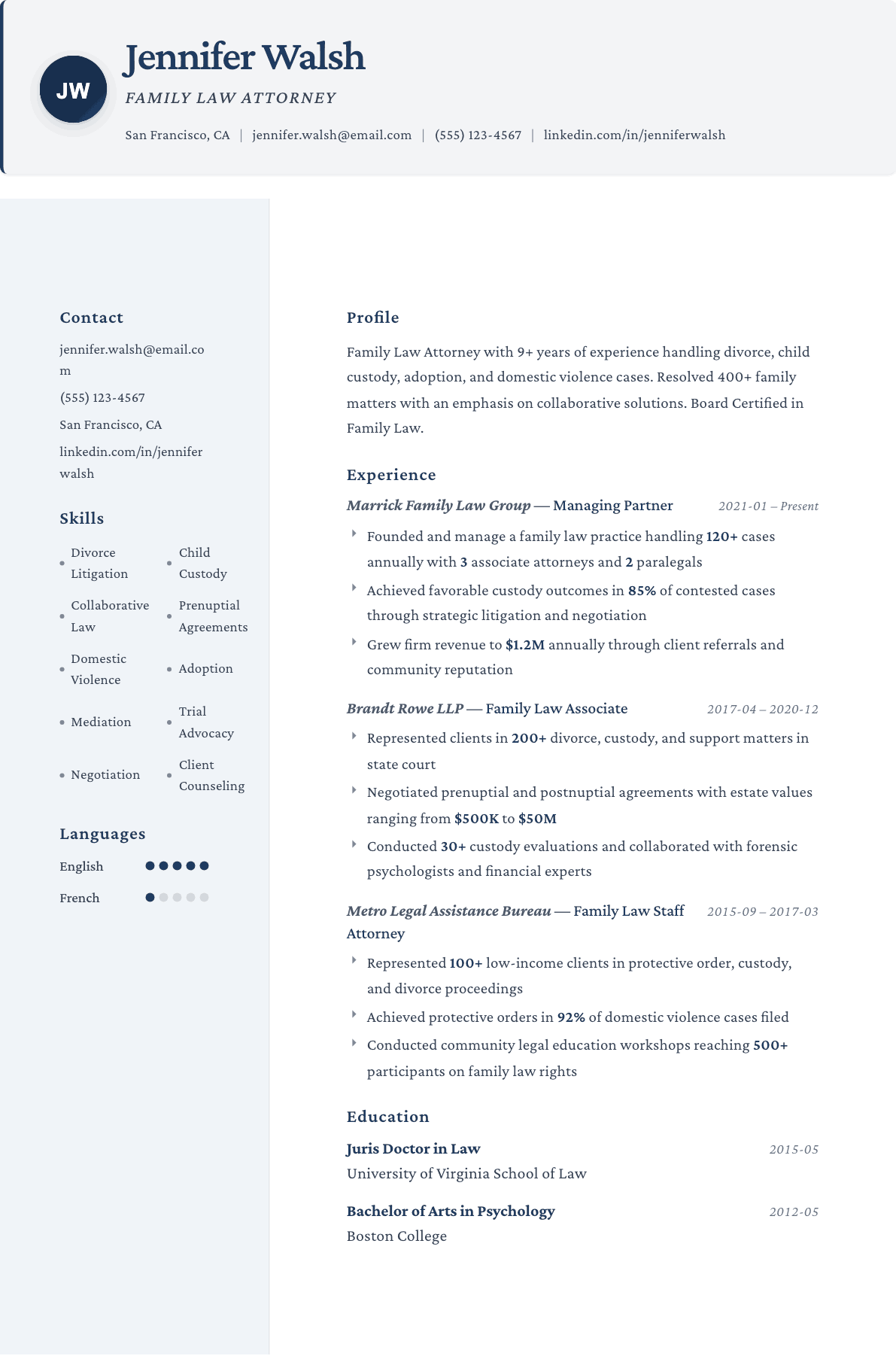
The same family law attorney content laid out in three CVBooster templates, so you can see what the finished document looks like before you write a word.
Example Family Law Attorney summary
Board-certified Family Law Attorney with 9 years of experience in divorce, custody, and domestic violence matters. Resolved 400+ cases with 85% favorable custody outcomes. Founded and manages a thriving practice generating $1.2M in annual revenue. Committed to collaborative solutions that protect families.
Skills to list on a Family Law Attorney resume
- Divorce Litigation
- Child Custody
- Child Support
- Collaborative Law
- Prenuptial Agreements
- Domestic Violence
- Adoption
- Guardianship
- Mediation
- Trial Advocacy
- Negotiation
- Client Counseling
- Forensic Accounting Coordination
- Community Outreach
What actually gets this resume read
- Highlight your case outcomes: favorable custody results, protective order success rates, settlement percentages.
- Mention board certifications in family law -- they immediately set you apart from general practitioners.
- Show empathy and client focus: family law clients are going through difficult times and want to feel heard.
- Specify case types: divorce, custody, adoption, guardianship, domestic violence, prenuptial agreements.
- Include collaborative law and mediation training -- alternative dispute resolution is increasingly preferred.
- Quantify: cases handled, firm revenue, client satisfaction ratings, or pro bono contributions.
How to write a family law attorney resume
Family law hiring is unusual among legal specialties because the person reading your resume is usually a partner who will hand you a caseload, not a recruiter filling a class of associates. She wants to know how many contested custody trials you have actually stood up for, whether you can run a temporary orders hearing without supervision, and whether clients in the worst month of their lives will stay with the firm after meeting you.
That means the resume has to do two jobs at once. It has to prove courtroom competence in a jurisdiction the firm practices in, and it has to prove client handling, because a family practice lives or dies on referrals from former clients and from the therapists, financial planners and guardians ad litem who send work.
This guide covers the section order a family law partner expects, how to describe a caseload without breaching confidentiality, summaries for a first-year associate through a managing partner, and the rewrites that turn a task list into evidence of judgment.
Format: bar admissions and jurisdiction before anything else
Family law is county-level practice. A firm in one judicial district cares that you know its judges, its standing orders and its local rules on parenting plans, so the state bar admission and the counties you appear in belong in the header area, not buried under education. Reverse-chronological order, one clean serif or sans face, and no graphics: many firms still print the file for the hiring committee.
One page is right for a first- or second-year associate. Two pages is normal once you have trial results, board certification or a book of business. Add a short reported-matters or trial-history block only if you have appellate opinions or published decisions to name.
- Header: name, JD, bar admissions with state and admission status, city, phone, email.
- Section order: summary, bar admissions and certifications, experience, notable matters, education, skills, community and bar service.
- Law students and new admittees put education first and add family law clinic, judicial externship and moot court.
Summary: case types, forum, and volume
Give the reader the practice mix in one line: divorce, contested custody, modification, paternity, adoption, guardianship, protective orders, prenuptial and postnuptial agreements, and whether you handle high-asset property division or collaborative and mediated matters. A partner is deciding whether your file mix maps onto her open caseload.
Then add the forum and the volume. Saying that you carry an active docket of roughly sixty matters and try contested custody cases to the bench in two named counties says more than any adjective. Avoid the phrase compassionate advocate; every applicant in the stack uses it and none of them prove it in the next line.
Experience: describe the caseload, not the client
Every position needs the firm, your title, the practice area, the size of your active docket and how the work reached you. Then three to five bullets built around what you personally did: drafted and argued the temporary orders motion, took the deposition of the opposing party, prepared the forensic accountant, examined the custody evaluator, negotiated the marital settlement agreement.
You cannot name clients, so describe matters by type and complexity instead. A contested relocation case involving an out-of-state move, a business valuation dispute over a closely held company, and an interstate custody matter under the Uniform Child Custody Jurisdiction and Enforcement Act are all recognizable to a family lawyer without identifying anyone.
Include the unglamorous mechanics that show you can run a file: discovery responses, financial affidavits, qualified domestic relations orders, income determinations for support, and compliance with local disclosure rules. Partners hire for the ability to keep a file moving, not only for trial flair.
Outcomes: results a family lawyer can verify
Outcome claims in family law have to be careful. You can state how many matters you resolved by agreement rather than trial, how many contested hearings you argued, how many protective order petitions you obtained or defended, and how often you carried the primary residential designation for a client. Do not claim a win rate you cannot explain in an interview, because you will be asked.
Board certification in family law, where the state bar offers it, is the single strongest signal on the page. So is service as a guardian ad litem, parenting coordinator, or on a family law bar section, because it shows the local bench and bar already trust you with the work.
Skills and keywords the firm screens for
Use the language of the postings: child custody, parenting time, spousal maintenance, equitable distribution, community property, marital estate valuation, contempt and enforcement, modification, adoption, termination of parental rights, and domestic violence. Add the practice systems, because small family firms run on them: case management software, e-filing portals, child support calculators, and the document assembly tools your state bar publishes.
Languages matter more here than in most legal specialties, since clients often bring extended family into the room. List any language you can conduct a client interview in, and say so plainly.
Family Law Attorney resume summary examples
First-year associate
Newly admitted attorney with a family law clinic placement and a judicial externship in a domestic relations division. Drafted parenting plans and support worksheets for 40 clinic clients, second-chaired two contested custody hearings, and completed 40 hours of mediation training. Seeking an associate seat in a litigation-focused family practice.
Six years in
Family law attorney with six years handling divorce, contested custody and modification matters across three counties, carrying an active docket of roughly 70 files. Tried 18 contested custody hearings to the bench and resolved 80% of assigned matters by settlement or mediation. Fluent in Spanish for client interviews.
Managing partner
Board Certified family law specialist and managing partner of a four-attorney practice, personally handling high-asset property division, business valuation disputes and interstate custody matters. Supervises two associates and two paralegals, and serves as a court-appointed guardian ad litem and parenting coordinator in the local judicial district.
Work experience bullets: before and after
Before: Handled divorce and custody cases for clients.
After: Carried an active docket of 65 dissolution and custody matters, taking each file from initial consultation through temporary orders, discovery, mediation and final decree.
The docket size and the full arc of a file show a partner you can run matters end to end rather than assist on them.
Before: Represented clients in court hearings.
After: Argued 24 contested temporary orders hearings on custody, exclusive possession of the residence and interim support, appearing before six judges in two judicial districts.
Naming the hearing type, the count and the forum proves courtroom exposure that the word hearings hides.
Before: Worked with expert witnesses on complex cases.
After: Prepared and examined forensic accountants and custody evaluators in matters involving closely held business valuation and relocation, including two multi-day trials.
The expert types and matter complexity tell the reader exactly which hard cases you have already survived.
Before: Drafted legal documents and agreements.
After: Drafted marital settlement agreements, parenting plans, qualified domestic relations orders and prenuptial agreements, including retirement division for state pension and defined contribution plans.
Listing the actual instruments shows drafting range, while legal documents could describe any attorney anywhere.
Before: Built good relationships with clients and referral sources.
After: Generated 30% of new matters through referrals from therapists, financial planners and prior clients, and presented twice yearly to a local domestic violence shelter on protective order procedure.
Referral origin and community work are the business development evidence a family firm actually values.
Hard skills
- Divorce and dissolution litigation
- Contested child custody and parenting plans
- Child and spousal support calculation
- Equitable distribution and community property
- Marital estate and business valuation
- Protective orders and domestic violence petitions
- Adoption and guardianship
- Prenuptial and postnuptial agreements
- Qualified domestic relations orders
- Mediation and collaborative practice
- Discovery and financial disclosure
- Appellate briefing in domestic relations
Soft skills
- Client counseling under distress
- De-escalation
- Negotiation
- Expert coordination
- Judgment on when to settle
- Confidentiality discipline
Certifications worth listing
- Board Certification in Family Law (State bar legal specialization boards, including the Texas Board of Legal Specialization)
- Family Law Specialist (Certified Specialist) (The State Bar of California Board of Legal Specialization)
- Family Law Mediator Certification (State court mediator certification programs)
- Collaborative Practice Training (International Academy of Collaborative Professionals)
Mistakes that cost family law attorney candidates the interview
- Omitting bar admissions and the counties you appear in, which forces the hiring partner to guess whether you can cover her existing calendar.
- Writing that you are passionate about helping families instead of naming the matter types and hearings you have actually handled.
- Claiming a custody win rate that cannot be explained, since a family lawyer will ask how contested was defined and how many cases settled first.
- Listing every motion you ever drafted while leaving out mediation, collaborative work and settlement conferences, which is where most family files end.
- Naming clients or including facts specific enough to identify a family, which reads as a confidentiality risk rather than a strong example.
- Burying board certification, guardian ad litem appointments or bar section service in a final line, when those are the credentials the local bench recognizes.
Family Law Attorney resume questions
How do I describe cases on a family law resume without breaching confidentiality?
Describe the matter by type and complexity rather than by party. A contested relocation with an out-of-state move, or a property division involving a closely held business, is recognizable to another family lawyer and identifies nobody.
Should a family law attorney list a trial record?
List counts rather than a scoreboard. Give the number of contested hearings and trials you argued, the issues involved and the courts, and be ready to talk through two of them in detail during the interview.
Does mediation training belong on a family law attorney resume?
Yes. Most family matters resolve short of trial, and many courts require mediation before a final hearing. List the training hours, the approving body and whether you have served as the neutral rather than only as counsel.
How do I move from general civil practice into family law?
Lead the summary with the move, then pull forward every transferable file: evidentiary hearings, financial discovery, valuation disputes and settlement negotiation. Add mediation training and any pro bono protective order or custody work to show real commitment.
Should I include a business development section?
If you have a book of business, yes, and put it in the experience entry rather than a separate block. Say where the matters came from, since referral sources from therapists, financial planners and former clients are what a family practice buys when it hires you.