Mediator Resume Examples: free score, then the gap list
Craft a Mediator Resume That Resolves Doubt
By Mustafa Tarabya, founder of CVBooster · Published · Updated
Create a professional mediator resume highlighting your conflict resolution, negotiation, and facilitation expertise with authoritative legal templates.
Sample resumes for a mediator
The same mediator content laid out in three CVBooster templates, so you can see what the finished document looks like before you write a word.
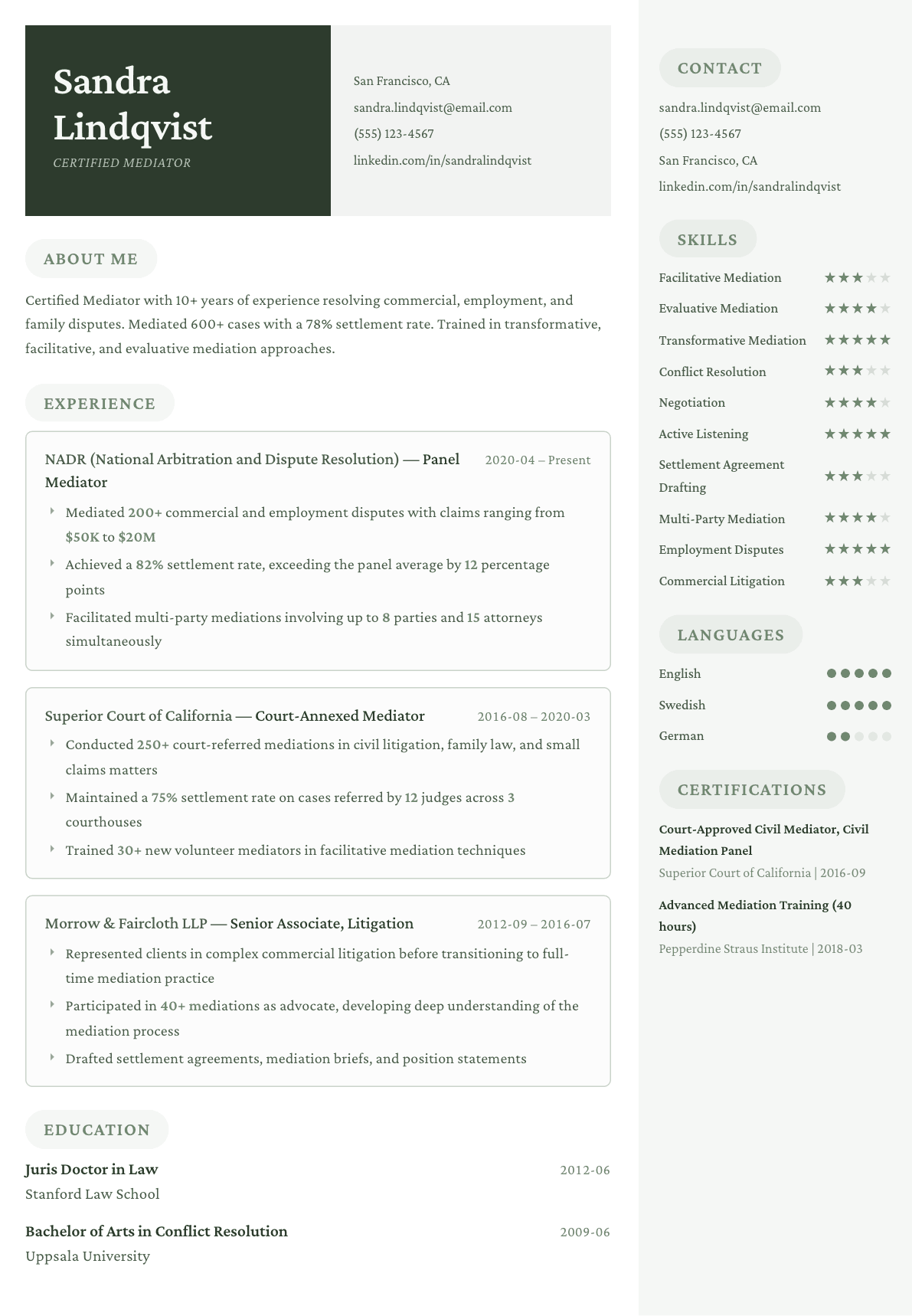
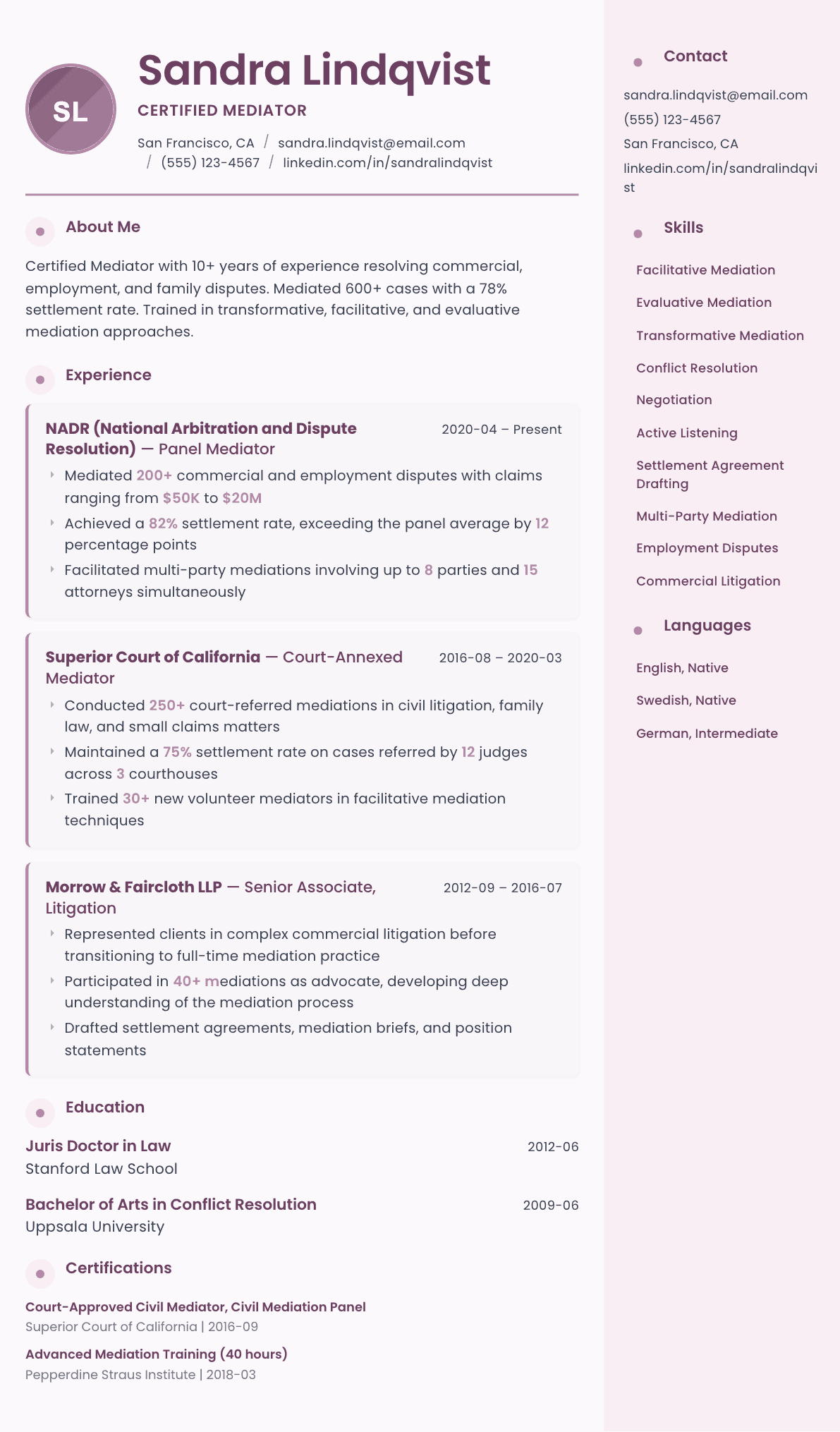
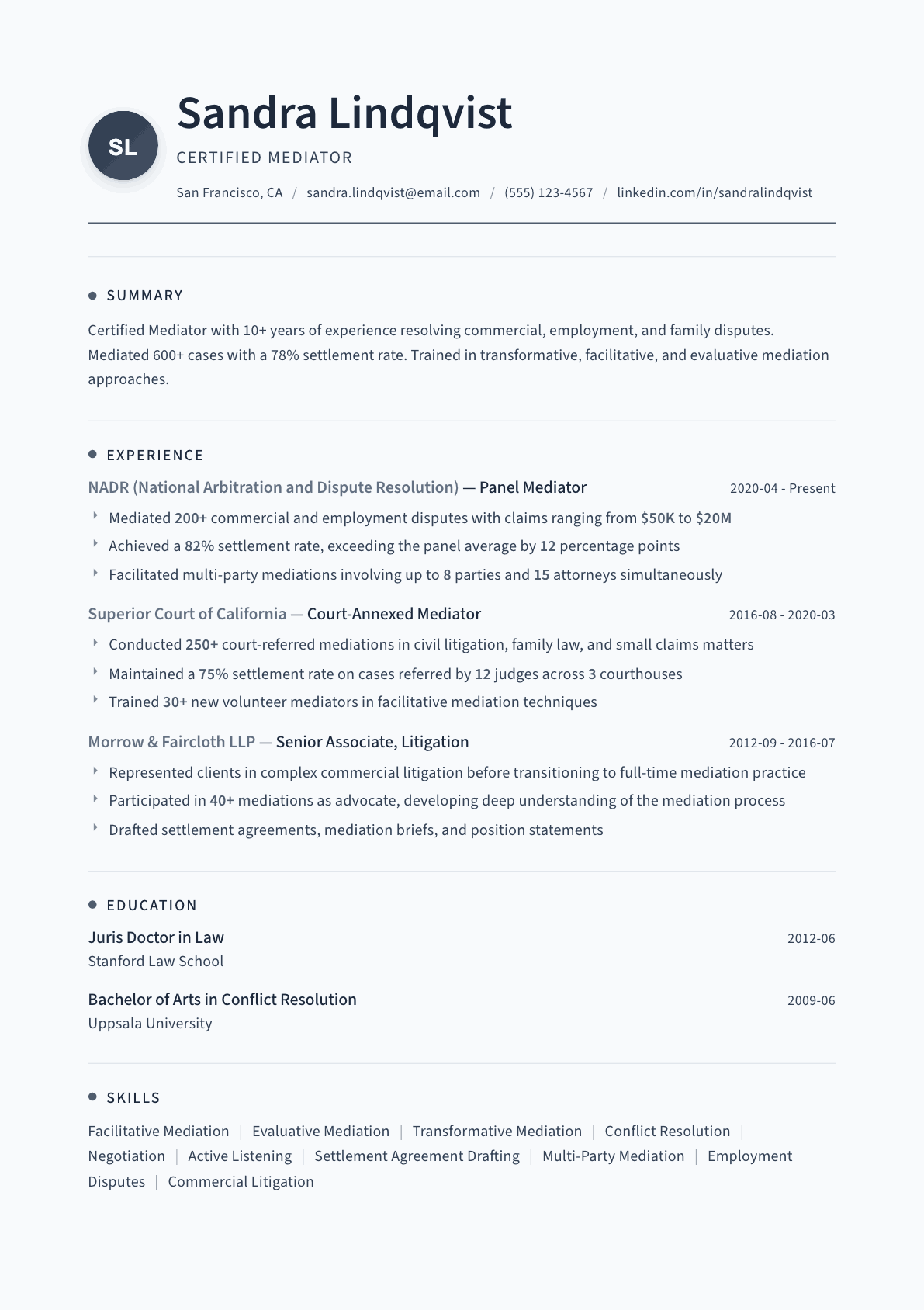
Example Mediator summary
Certified Mediator with 10 years of experience resolving commercial, employment, and family disputes. Mediated 600+ cases with a 78% settlement rate across a national ADR panel and court-annexed programs. Expert in facilitative and evaluative techniques. Former BigLaw litigator bringing deep subject matter knowledge to the table.
Skills to list on a Mediator resume
- Facilitative Mediation
- Evaluative Mediation
- Transformative Mediation
- Conflict Resolution
- Negotiation
- Active Listening
- Settlement Drafting
- Multi-Party Mediation
- Employment Disputes
- Commercial Disputes
- Family Mediation
- Cross-Cultural Communication
- Emotional Intelligence
- Impartiality
What actually gets this resume read
- Lead with your settlement rate -- it is the single most important metric for a mediator.
- Specify dispute types: commercial, employment, family, construction, personal injury, international.
- Mention mediation training hours and certifications -- many courts require minimum thresholds.
- Highlight your mediation approach: facilitative, evaluative, transformative, or narrative.
- Quantify: cases mediated, settlement rates, claim ranges, multi-party experience.
- Include any panel memberships: JAMS, AAA, court panels, community mediation centers.
How to write a mediator resume
Mediators are not hired the way employees are hired. A court roster administrator, an alternative dispute resolution provider panel, a corporate ombuds office and a law firm choosing a neutral for a specific case all read the same document with different questions, and none of them are asking whether you are a nice person. They are asking whether you have handled this dispute type, whether you meet the training and roster requirements, and whether the parties on the other side will accept you as neutral.
That last point shapes the whole resume. Anything that reads as advocacy for one side, a long career representing only employers or only plaintiffs stated without balance, undermines the impartiality the role depends on. Experience in a field is an asset; an unexamined allegiance to one side of it is a liability.
This guide covers how to structure a mediator resume around training hours, roster eligibility and case types, how to state settlement outcomes without overclaiming, three career-stage summaries, and the rewrites that show process skill rather than a list of disputes.
Format: training, roster status and case types before biography
Court rosters and provider panels have hard eligibility rules, usually a minimum number of hours of approved basic mediation training, additional hours for family or specialized matters, observation and co-mediation requirements and continuing education. Put the training hours, the approving body and your roster memberships in the first third of the page, because the administrator screening you is checking a list.
Two pages is normal here even mid-career, because the credentials, training and case type inventory take real space. Reverse-chronological for employment history, but consider a separate mediation practice section that sits above your other professional history, since your prior career is context and the neutral work is the product.
- Header: name, credentials, city and state, phone, email, and any professional license that supports the practice.
- Section order: summary, training and roster memberships, mediation practice and case types, outcomes, other professional experience, education, teaching and writing.
- New mediators put training, observations and co-mediations first, then volunteer and community dispute resolution work.
Summary: dispute types, forum, and mediation style
Name the dispute categories you take: commercial and contract, employment and workplace, construction defect, personal injury and insurance, family and divorce, probate and trust, landlord and tenant, community disputes, or cross-border commercial matters. Then say where the cases come from: court-annexed referrals, provider panels, private party selection or an internal ombuds function.
Say something honest about approach. Facilitative, evaluative and transformative are recognizable terms, and stating which you use and when tells a referring attorney whether you will give a reality check in caucus or hold the parties to their own process. Vagueness here loses referrals, because counsel choose neutrals precisely on this.
Case experience: volume, complexity and the room
Give the number of mediations conducted, the range of matter sizes, and the party configurations. Two-party disputes are one skill; a multi-party construction case with several insurers, a general contractor and subcontractors is another, and multi-day sessions with attorneys, adjusters and technical experts in the room is another still.
Describe the process work explicitly: pre-mediation calls with counsel, exchanging position statements, structuring joint sessions and caucuses, handling impasse, drafting the memorandum of understanding or settlement terms at the table, and follow-up when a party needs authority it did not bring.
Say what you do when the room is difficult. Mediating with self-represented parties, managing power imbalance, screening for domestic violence in family matters, working through interpreters, and conducting online sessions are all specific competencies that referral sources look for and few resumes name.
Outcomes: settlement rates stated so they survive a question
A settlement rate is the number people look for, so give it with its denominator and its definition. State the total sessions, what counted as a resolution, and whether partial agreements or post-session settlements are included. A bare figure with no definition invites doubt from exactly the sophisticated readers you want.
Add the qualitative outcomes too. Agreements that held without enforcement motions, matters resolved before a scheduled trial date, and repeat selection by the same counsel or provider are all evidence, and repeat selection is arguably the strongest signal a neutral can offer.
Credibility: training, teaching and neutrality
List basic and advanced training with the hours and the provider, continuing education, and any mentorship or observation program you completed. If you teach negotiation or dispute resolution, train other mediators, or serve on a bar dispute resolution section, put it in its own block, because teaching is how the field verifies expertise.
Protect the appearance of neutrality throughout. If your prior career was in one industry or on one side of a dispute type, present it as subject matter knowledge and show balance in the case list. Also state your practices on conflict checks and disclosure, since every provider and court roster requires them and few candidates mention them at all.
Mediator resume summary examples
Newly rostered
Mediator with 40 hours of approved basic civil mediation training and 20 additional hours in family mediation, plus 12 observations and 8 co-mediations completed. Rostered with a county small claims program and a community dispute resolution center, and handling landlord and tenant and consumer matters.
Seven years in
Full-time mediator with seven years and roughly 600 sessions in employment, commercial contract and personal injury disputes, resolving 78% of matters at or shortly after the session. Rostered with two court programs and a private provider panel, and comfortable with multi-party insurance matters and online sessions.
Panel neutral and trainer
Panel neutral with eighteen years and more than 2,000 mediations, concentrated in construction defect, complex commercial and multi-party insurance disputes involving several carriers. Teaches a 40-hour basic mediation training, mentors new neutrals through observation programs, and is repeatedly selected by counsel on both sides.
Work experience bullets: before and after
Before: Mediated a wide range of disputes between parties.
After: Conducted roughly 120 mediations a year in employment, commercial contract and insurance coverage disputes, including multi-party matters with three or more represented interests at the table.
Annual volume, named dispute types and party complexity let a referring attorney judge fit for a specific case.
Before: Helped parties reach settlement agreements.
After: Resolved 78% of 430 sessions at the table or within 14 days after, drafting memoranda of understanding at the session so terms were captured before parties left the room.
A rate with its denominator and the drafting practice behind it is a claim that survives a skeptical follow-up.
Before: Prepared for mediation sessions in advance.
After: Ran pre-mediation calls with counsel on every matter to set the agenda, confirm settlement authority, exchange position statements and identify the decision maker who needed to attend.
Naming the preparation steps shows the process discipline that drives settlement, not just that you showed up ready.
Before: Worked with difficult parties and high emotions.
After: Mediated matters with self-represented parties and significant power imbalance, screening family cases for safety concerns and structuring shuttle sessions and interpreter support where joint session was inappropriate.
Concrete techniques for the hard room replace an adjective that every neutral would apply to themselves.
Before: Trained others in mediation skills.
After: Designed and delivered a 40-hour basic mediation training approved for court roster eligibility, and mentored 15 new neutrals through observation and co-mediation to independent practice.
An approved curriculum and a mentee count are the field verification a general training claim never provides.
Hard skills
- Facilitative mediation
- Evaluative mediation and reality testing
- Caucus and shuttle negotiation
- Multi-party and multi-insurer dispute management
- Employment and workplace dispute resolution
- Commercial contract dispute resolution
- Family and divorce mediation
- Construction defect mediation
- Settlement agreement and memorandum drafting
- Conflict checks and disclosure practice
- Online dispute resolution platforms
- Impasse breaking techniques
Soft skills
- Impartiality
- Active listening
- Reframing
- Patience through impasse
- Reading the room
- Confidentiality discipline
Certifications worth listing
- Court-approved basic mediation training (40 hours) (State court dispute resolution offices and approved training providers)
- Family Mediation Certification (State court family mediation certification programs)
- Advanced Practitioner Membership (Association for Conflict Resolution)
- Panel neutral admission (American Arbitration Association and other dispute resolution providers)
Mistakes that cost mediator candidates the interview
- Burying training hours and roster memberships at the bottom when the administrator screening you is checking eligibility first.
- Giving a settlement rate with no denominator and no definition of resolution, which invites doubt from the sophisticated readers you want.
- Presenting a prior career on one side of a dispute type without balance, which reads as partiality rather than subject matter depth.
- Describing sessions only as facilitating communication, so a referring attorney learns nothing about how you break impasse.
- Leaving out party configuration, since a two-party small claims practice and a multi-insurer construction practice require different neutrals.
- Omitting conflict check and disclosure practices, which every provider and court roster requires and almost no candidate mentions.
Mediator resume questions
How do I present my settlement rate as a mediator?
Give the rate with the number of sessions behind it and say what counted as resolved, including whether partial agreements and settlements reached shortly after the session are included. An undefined figure raises more questions than it answers.
Do I need to be a lawyer to work as a mediator?
No. Many court rosters and community programs accept non-attorney neutrals who meet the training requirements, and backgrounds in construction, human resources, insurance, therapy and accounting bring valuable subject knowledge to specific dispute types.
How much mediation training should I list?
List the basic training hours, the provider and the approving court or body, plus any advanced or specialty hours such as family or workplace training. Add observations, co-mediations and continuing education, since rosters count all of these.
How do I show neutrality if I came from one side of a practice?
Frame the prior career as subject matter expertise, then show balance in the case list and in who selects you. Repeat selection by counsel representing opposing interests is the most persuasive evidence of impartiality you can put on a page.
Should I list individual cases I have mediated?
Not by name. Mediation is confidential, so describe matters by type, size, party configuration and industry instead, and keep the detail general enough that no participant could be identified from the description.