Estate Planning Attorney Resume Examples: free ATS score
Write an Estate Planning Attorney Resume Clients Trust
By Mustafa Tarabya, founder of CVBooster · Published · Updated
Estate planning attorney resume examples with trusts, probate and tax keywords, and a guide to writing plans, funding and client work.
Sample resumes for a estate planning attorney
The same estate planning attorney content laid out in three CVBooster templates, so you can see what the finished document looks like before you write a word.
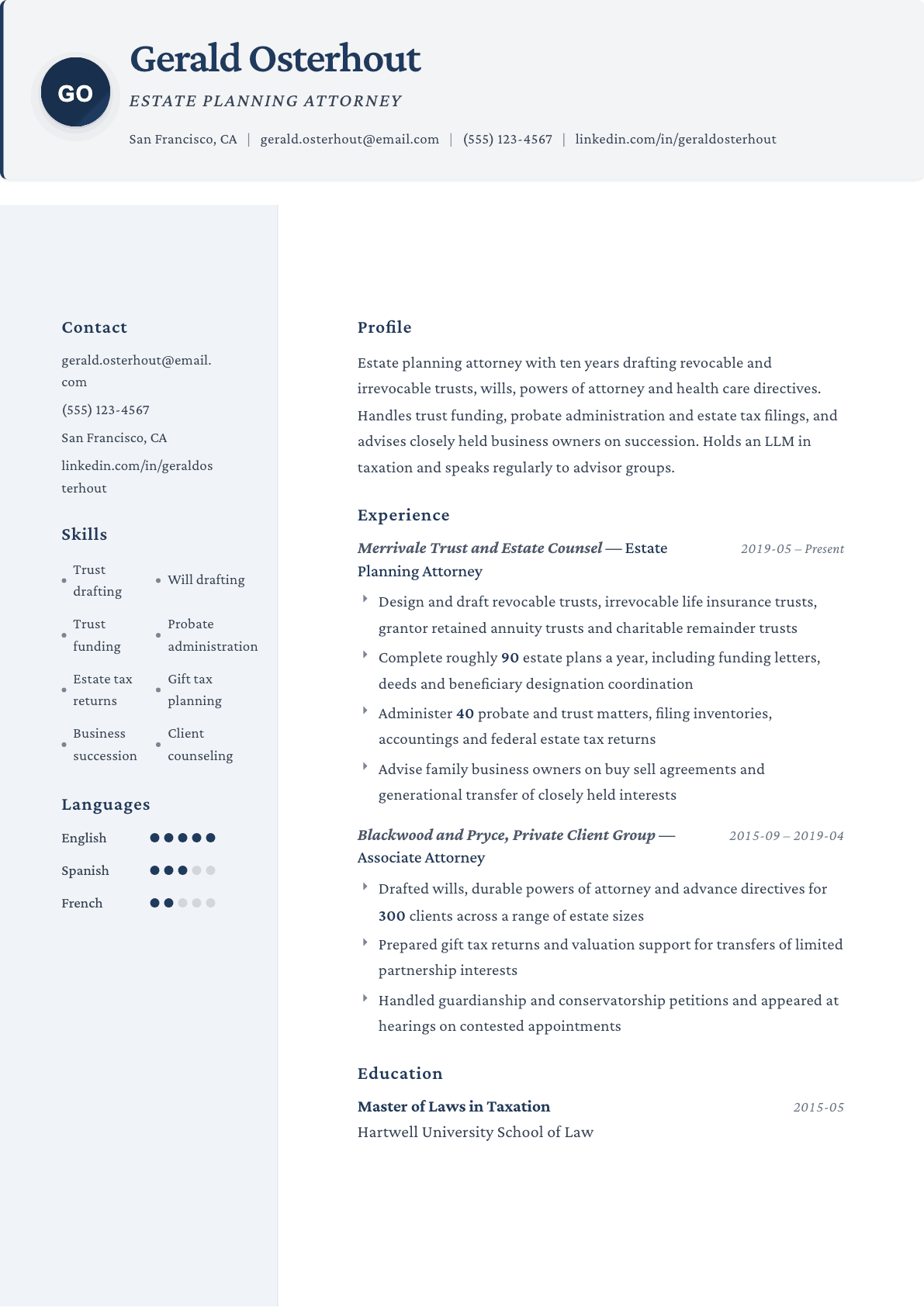
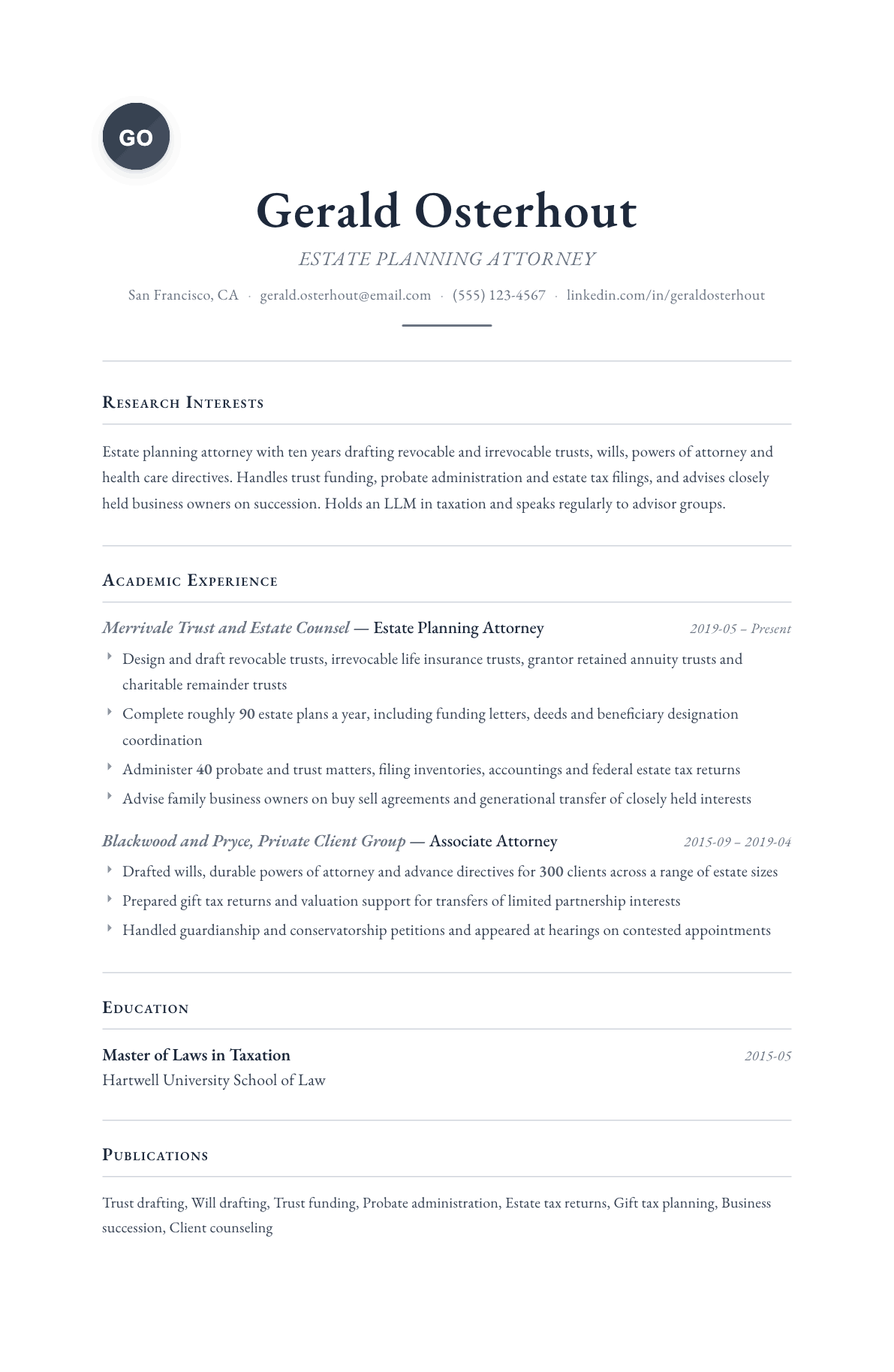
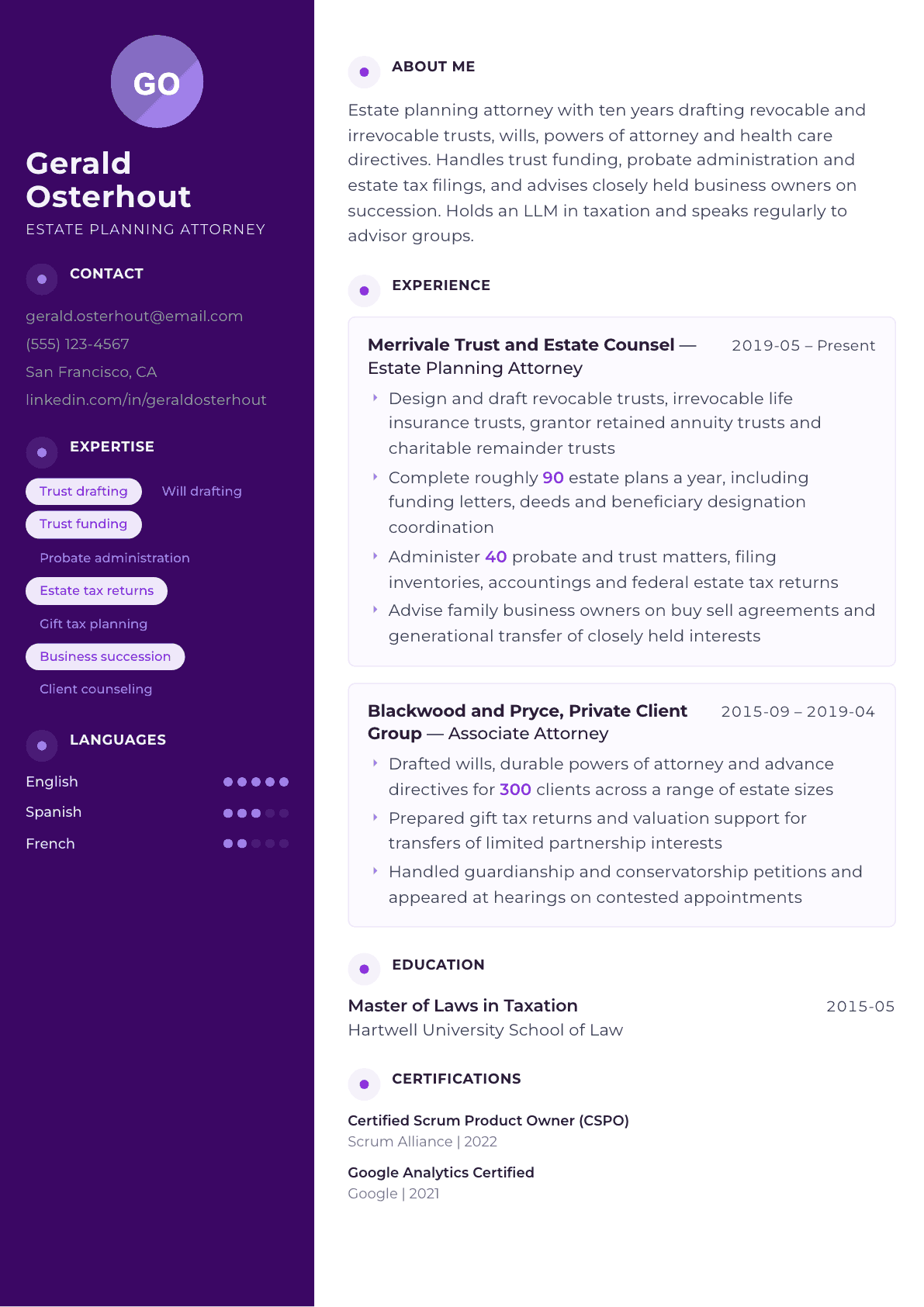
Example Estate Planning Attorney summary
Estate planning attorney with ten years designing and drafting revocable and irrevocable trusts, wills, powers of attorney and health care directives for families and closely held business owners. Completes about ninety plans a year, funds every plan through deeds and beneficiary coordination, and administers probate and trust matters including federal estate tax filings. Holds an LLM in taxation.
Skills to list on a Estate Planning Attorney resume
- Revocable trust drafting
- Irrevocable trust drafting
- Will drafting
- Powers of attorney
- Advance health care directives
- Trust funding and deeds
- Probate administration
- Trust administration
- Federal estate tax returns
- Gift tax returns
- Generation skipping transfer planning
- Charitable giving vehicles
- Business succession planning
- Guardianship petitions
- Fiduciary accounting
What actually gets this resume read
- Name the specific instruments you draft, because a firm hiring in this practice reads for trust types before anything else.
- Include trust funding work explicitly, since unfunded plans are the most common failure and firms hire for that discipline.
- List your probate and trust administration volume separately from planning, because the two skills are staffed differently.
- Put an LLM in taxation or a certified specialist designation in the header where a hiring partner will see it immediately.
- Mention the drafting software you use, such as WealthCounsel or a firm document assembly system, plus fiduciary accounting tools.
- Show client facing work: initial design meetings, family conversations, and coordination with financial advisors and accountants.
How to write a estate planning attorney resume
An estate planning attorney resume is read by a private client partner who is measuring two things: the sophistication of the instruments you can draft, and whether you finish. Plans that are drafted and signed but never funded are the standing problem of this practice, and a partner who has cleaned up unfunded trusts will read your resume looking for evidence that you do not leave that behind.
The other thing being measured is the client conversation. This is a practice where the technical work happens after a long meeting about a second marriage, a child with an addiction, a family business one sibling runs and two do not, and a parent nobody wants to discuss. A resume that shows only drafting skill describes half the job.
This guide covers how to list instruments so a reader can gauge your level, why administration volume should be reported separately from planning, how to present tax credentials, and what to include when the practice extends into elder law, special needs planning or business succession.
Format: credentials that signal level, immediately
Put an advanced tax degree, a board certification in estate planning or a fiduciary credential directly under your name. Private client hiring uses those markers as a first sort, and they should not be discoverable only on page two under education.
Keep the layout conservative and single column. The clients in this practice are conservative, the partners are conservative, and a resume with graphics reads as a mismatch before a word of it is processed.
- Header: name, city and state, phone, email, and any advanced degree or certification.
- Bar admissions with years, and any accountancy license if you hold one.
- Experience split between planning and administration.
- Education, then speaking, publications and advisor group involvement.
List the instruments, because they set your level
A reader gauges an estate planning attorney by what you can draft without supervision. Simple wills and revocable trusts sit at one level. Irrevocable life insurance trusts, grantor retained annuity trusts, qualified personal residence trusts, intentionally defective grantor trusts, dynasty trusts and charitable split interest vehicles sit well above it.
Name the ones you have actually drafted rather than the ones you have studied. Then add the supporting documents that make a plan work: powers of attorney, health care directives, assignment documents, promissory notes, sale agreements to grantor trusts and beneficiary designation instructions.
Special needs planning, elder law and long term care eligibility work should be labeled separately. Firms hire for those specifically, and blending them into general planning hides a capability a posting may be built around.
Funding, the part that separates finishers from drafters
Say plainly that you handle funding. Deeds transferring real property into trust, entity interest assignments, retitling of accounts with the custodian, beneficiary designation coordination with insurance carriers and retirement plan administrators, and the follow up that confirms it happened.
This is the single most differentiating paragraph you can write in this field, because unfunded plans generate malpractice exposure and unhappy families. Give the volume, describe the tracking process you use, and name any funding checklist system you maintain.
Administration and tax filings, reported separately
Probate and trust administration is staffed as a separate function at many firms, so give it its own numbers: estates administered, trusts administered, inventories and accountings filed, and any contested matters such as will contests, trust reformations or fiduciary removal petitions.
Then list the returns you have prepared or supervised: federal estate tax returns, gift tax returns, generation skipping allocations and fiduciary income tax returns. Preparing a return is materially different from reviewing one, so use the verb that is true.
Valuation support belongs here as well: appraisals coordinated, discounts documented for closely held interests, and the substantiation you assembled behind a reported transfer.
The client relationship and the advisor network
Show the front of the practice. Design meetings, family conversations that surface the real concern, and the ability to explain a trust structure to a client who will otherwise sign something they do not understand. Partners hire for this because it drives both plan quality and referrals.
Name the advisor relationships you have built with financial planners, accountants, trust officers and insurance professionals. Private client practices grow through that network, and an attorney who speaks at advisor meetings and takes referrals is describing business development in the only language this field uses.
Estate Planning Attorney resume summary examples
New private client associate
Estate planning attorney in the second year of practice drafting wills, revocable trusts, powers of attorney and advance directives for a private client group. Prepares funding deeds and beneficiary designation instructions on every plan, and supports probate administration including inventories and accountings. Admitted in one state.
Ten years in
Estate planning attorney with ten years drafting revocable and irrevocable trusts, including insurance trusts, grantor retained annuity trusts and charitable remainder vehicles. Completes about ninety plans a year with full funding, administers probate and trust matters, and prepares federal estate and gift tax returns. Holds an advanced degree in taxation.
Private client partner
Private client partner with twenty two years advising families and closely held business owners on generational transfer, charitable giving and succession. Designs multi entity structures, supervises associates and paralegals across planning and administration, and speaks regularly to accountant and financial advisor groups.
Work experience bullets: before and after
Before: Prepared wills and trusts for clients.
After: Designed and drafted revocable trusts, irrevocable life insurance trusts, grantor retained annuity trusts and charitable remainder trusts for individual and business owner clients.
Naming the specific vehicles is how a private client partner gauges the level you can work at.
Before: Made sure client plans were complete.
After: Completed roughly 90 plans a year including funding deeds, entity interest assignments and beneficiary designation coordination with carriers and plan administrators.
Funding is the failure point of the practice, and showing you own it separates you immediately.
Before: Handled probate for families.
After: Administered 40 probate and trust matters, filing inventories and accountings, and prepared federal estate tax returns with supporting valuation documentation.
Administration volume plus the specific filings shows a second staffed capability, not an occasional favor.
Before: Advised business owners about the future of their companies.
After: Advised family business owners on buy sell agreements and generational transfer of closely held interests, coordinating appraisals and discount substantiation.
Succession work is a distinct practice and naming the mechanics proves you have done it.
Before: Met with clients about their estate plans.
After: Led design meetings covering blended family concerns, incapacity planning and beneficiary protection, then translated each decision into instrument terms the client could restate.
The client conversation drives plan quality and referrals, and this shows it as skill rather than courtesy.
Hard skills
- Revocable trust drafting
- Irrevocable trust drafting
- Will and codicil drafting
- Durable powers of attorney
- Advance health care directives
- Trust funding and deed preparation
- Beneficiary designation coordination
- Probate administration
- Trust administration and accountings
- Federal estate and gift tax returns
- Generation skipping transfer planning
- Charitable giving vehicles
- Special needs and supplemental trusts
- Business succession and buy sell agreements
Soft skills
- Sensitive family conversations
- Explaining structures in plain language
- Discretion with private information
- Advisor network relationships
- Patience with indecisive clients
- Follow through on long timelines
Certifications worth listing
- State Bar Admission (State Bar Association)
- Accredited Estate Planner (AEP) (National Association of Estate Planners and Councils)
- Certified Trust and Fiduciary Advisor (CTFA) (American Bankers Association)
- Certified Public Accountant (State Board of Accountancy)
- Certified Elder Law Attorney (CELA) (National Elder Law Foundation)
Mistakes that cost estate planning attorney candidates the interview
- Writing wills and trusts as a category instead of naming the specific vehicles you can draft unsupervised.
- Saying nothing about funding, which is the failure mode partners in this field worry about most.
- Merging planning volume with administration volume so neither capability can be sized.
- Burying an advanced tax degree or fiduciary certification in the education section at the bottom of the page.
- Claiming return preparation when you reviewed returns prepared by an accountant.
- Leaving out the advisor referral network, which is how private client practices actually grow.
Estate Planning Attorney resume questions
What matters most on an estate planning attorney resume?
The list of instruments you draft without supervision, followed by evidence that you fund the plans you draft. Those two together tell a private client partner your technical level and whether your files close cleanly.
Should I list probate administration separately from planning?
Yes, because many firms staff them as different roles. Give estates and trusts administered, inventories and accountings filed, and any contested proceedings, then keep your planning volume in its own entry with its own numbers.
Is an advanced degree in taxation necessary for this practice?
It is not required, but it is a strong sorting signal for sophisticated planning work and belongs near your name if you hold one. Without it, demonstrate tax depth through the vehicles you draft and the returns you have prepared.
How do I show client counseling ability on paper?
Describe the design meeting itself: the concerns you surface, how you translate a family decision into instrument terms, and how you confirm the client understands what they are signing. Generic references to compassion carry no weight here.
Should elder law and special needs work go on the same resume?
Yes, but under their own heading. Long term care eligibility, supplemental needs trusts and guardianship work are staffed as a specialty, and separating them makes you visible to postings written specifically for that capability.