First Job Resume Examples: free ATS score and gap list
Build a First Job Resume From What You Have Already Done
By Mustafa Tarabya, founder of CVBooster · Published · Updated
First job resume example and guide for people with no paid work yet: what counts as experience, availability, references and how to fill one page.
Sample resumes for a first job
The same first job content laid out in three CVBooster templates, so you can see what the finished document looks like before you write a word.
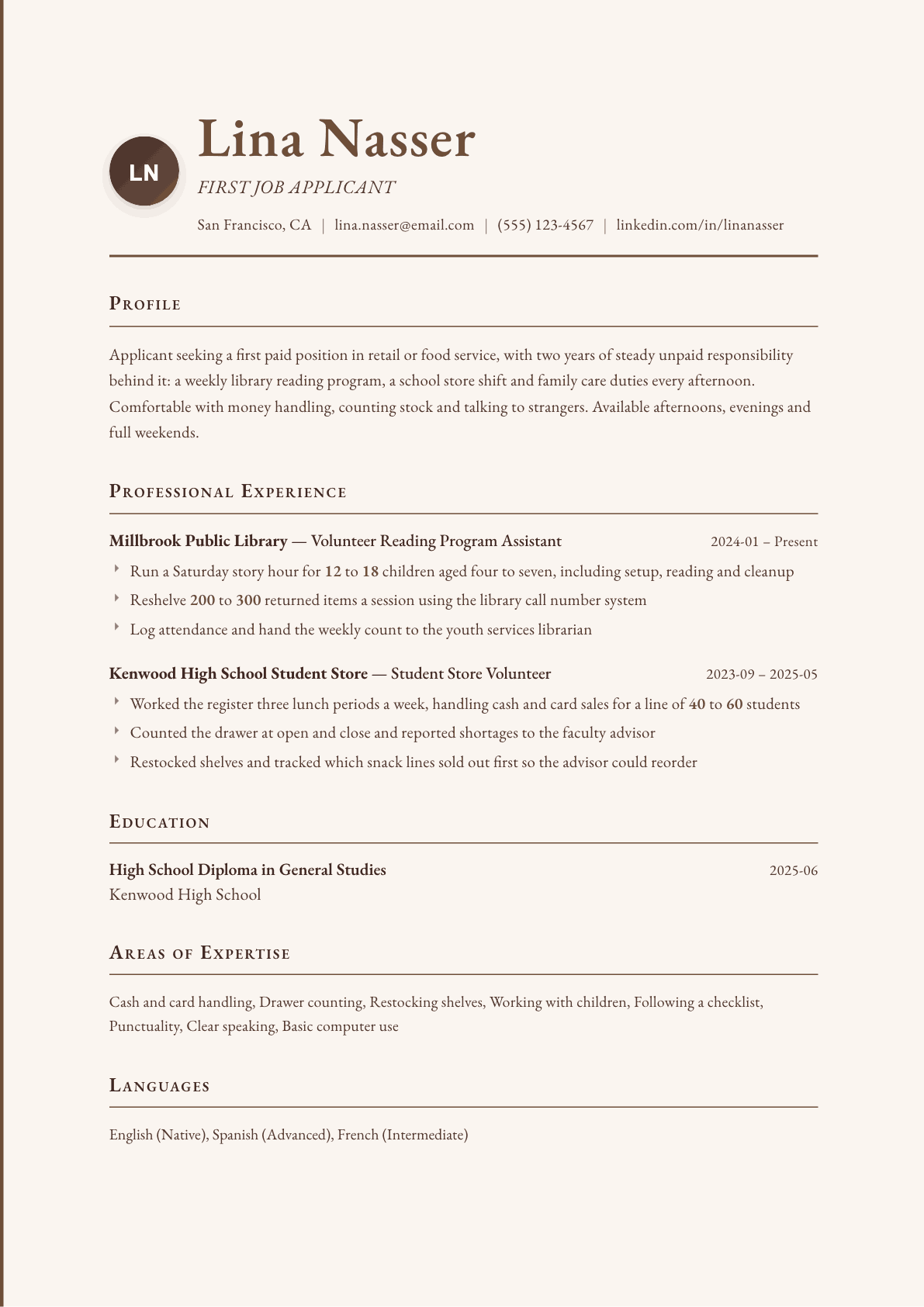
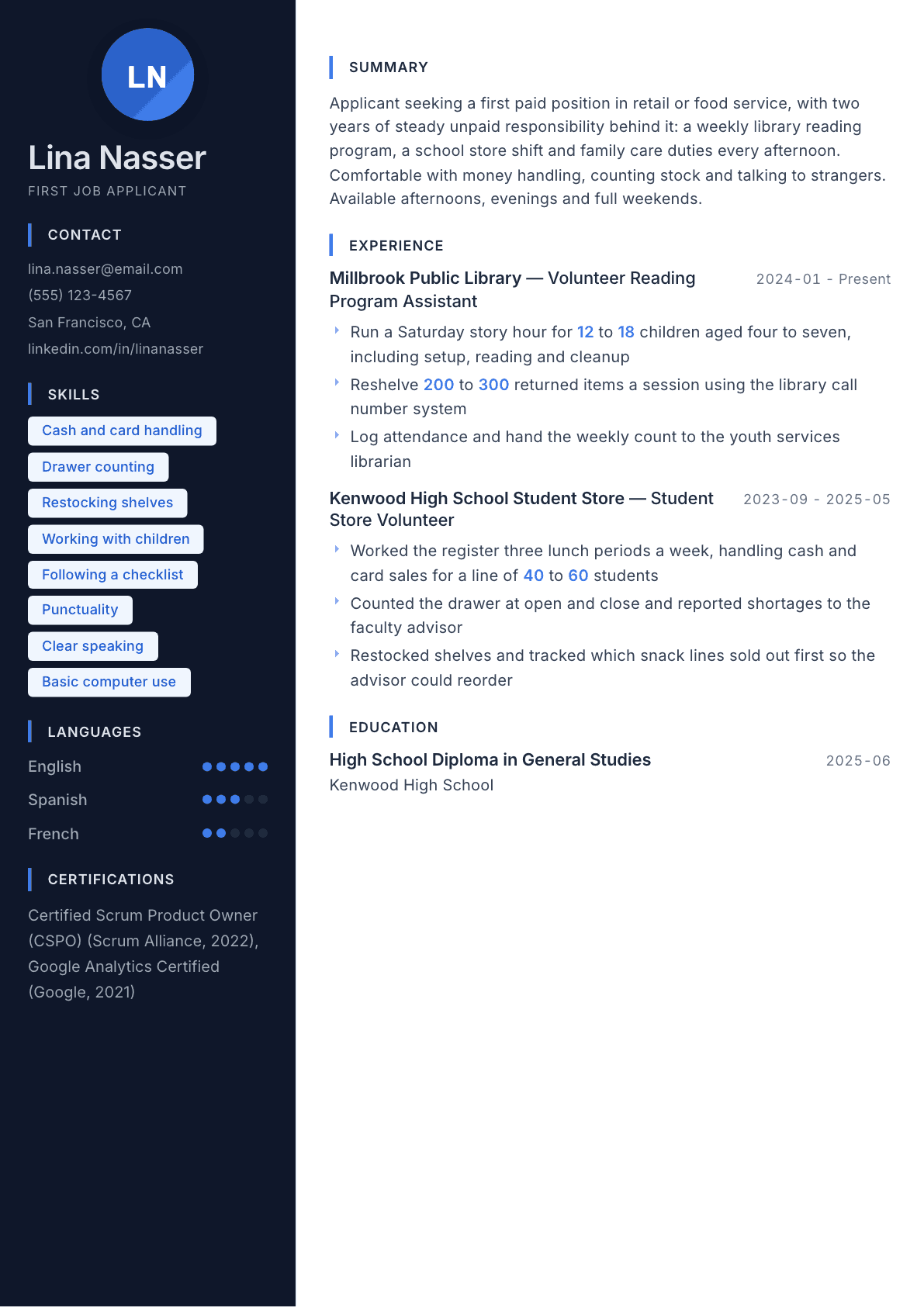
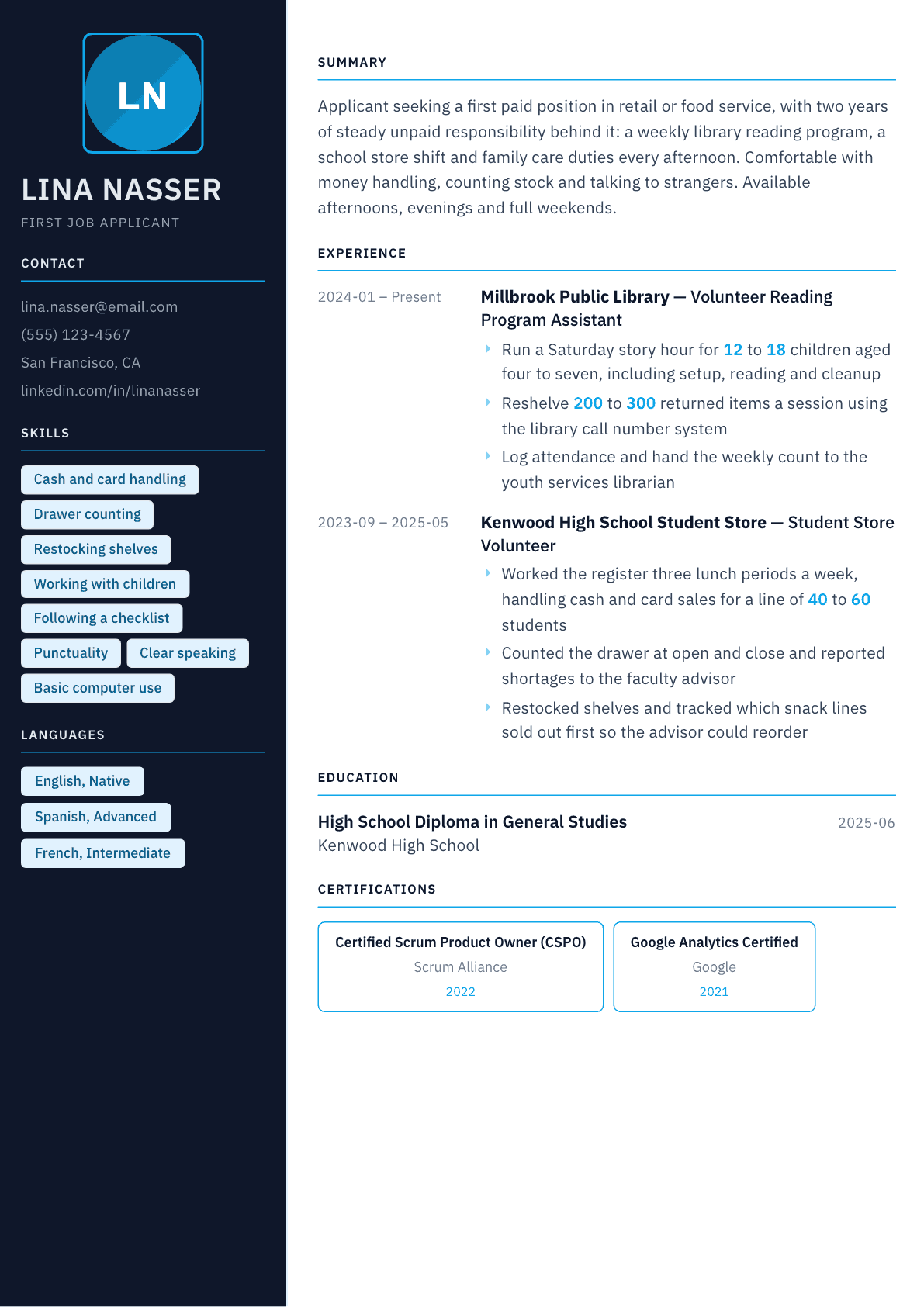
Example First Job summary
Applicant looking for a first paid job in retail or food service, with two years of scheduled unpaid work already behind it. Runs a weekly library story hour for up to 18 children, worked a school store register three lunch periods a week, and counted the drawer at open and close. Handles money carefully, follows a checklist, and is available afternoons, evenings and full weekends.
Skills to list on a First Job resume
- Cash and card handling
- Drawer counting and reconciliation
- Restocking and shelf facing
- Customer greeting
- Working with children
- Following a written checklist
- Cleaning and closing routines
- Punctuality and attendance
- Clear spoken communication
- Basic computer and tablet use
- Taking direction
- Weekend and evening availability
What actually gets this resume read
- Count everything you have already done that had a schedule, including volunteering, a school store shift or family care.
- Put availability on the page in real terms, because a first job is usually offered to whoever covers the awkward shifts.
- Give each unpaid entry a start date and an end date so a manager can see how long you stuck with it.
- Write a short objective line naming the job you want, since a screener cannot infer it from an empty work history.
- List two references with their role and phone number ready, and ask them before you write the names anywhere.
- Keep the page to one side, use one readable font, and save the file as your own name before you send it.
- Say plainly that you are willing to train, then name a task you learned quickly to make the claim credible.
How to write a first job resume
Writing a resume for your first paid job is mostly a problem of nerve. The page looks empty, the experience section has no employer names in it, and the instinct is either to leave it blank or to inflate something. Both lose. What actually works is treating every scheduled commitment you have ever kept as an entry, and writing it with the same seriousness you would give a job.
It helps to know what the person hiring is risking. For a first job, usually retail, food service, warehouse work, childcare or a front counter, the manager is not buying skill. She is buying attendance and coachability. She has hired people before who did not turn up on day three, and every line on your page is being read for evidence that you will not be one of them.
This guide is for anyone taking a first paid position, whether you are leaving school, returning to work after years at home, or arriving in a new country. It covers what counts as experience when nothing was paid, how to write an objective that gives the reader a target, how references substitute for employers, how to present availability, and how to talk about having never been employed without sounding apologetic.
What counts as experience when nobody has paid you yet
The test is not whether money changed hands. The test is whether somebody outside your household expected you at a particular time and would notice if you did not arrive. That standard captures far more than most first time applicants realize: a volunteer shift, a school store rota, a church or temple duty, a sports team you kept for a season, a family business you helped in, a neighbor whose dog you walked every weekday.
Give each one a start month, an end month, a title you can defend, and two or three bullets with numbers. A Saturday reading session for a dozen children is a shift. Reshelving two hundred returned books is a workload. A manager reading those lines is not thinking about whether it was paid. She is counting how many consecutive months you kept showing up.
- Volunteering with a fixed schedule, and how long you kept it.
- School store, cafeteria, library or office duties, with the periods a week.
- Family business help, written as the role and the tasks rather than as a favor.
- Regular paid errands for neighbors, such as yard work, pet care or babysitting.
- Team or club responsibilities where you held equipment, money or a key.
Open with an objective, because nothing else on the page states your target
Experienced candidates can skip the objective, since their last job title tells the reader what they are. You cannot. Two lines at the top should name the type of work you are applying for, the availability you bring, and the one thing you want the manager to believe about you. Keep it concrete: the job type, the hours, and a fact rather than an adjective.
Avoid the standard opening about seeking an opportunity to grow with a dynamic company. It says nothing and every applicant in the pile has used it. A line that says you are seeking weekend and evening counter shifts, are available from a specific month, and have run a Saturday program for a year is doing real work in the same space.
References do the job an employment history usually does
With no former manager to call, your references carry the verification load, so choose them deliberately. A teacher, a coach, a volunteer coordinator, a religious leader, a neighbor you have worked for regularly. Ask before you list them, tell them what you applied for, and give them a sentence about what you would like them to be able to confirm.
Put a short line on the resume saying references are available and keep a separate sheet ready with each name, their role, how they know you and a phone number that they answer. Bring that sheet to the interview. For a first job, a manager who can call two people and hear that you are reliable will often decide on that alone.
Availability, transportation and the practical facts that decide the hire
The reason first jobs exist is that somebody needs the shifts nobody else wants. Say clearly which of those you can take. Weekday evenings, weekend mornings, holiday periods, the closing shift, split shifts. Write it as a short block rather than burying it in a sentence, and be accurate, because promising open availability and then declining Sundays ends a new hire quickly.
Pair it with how you get there and back. A manager will hesitate over a closing shift if she is imagining a candidate waiting for a bus that stopped running an hour ago. Naming your transportation removes a doubt she will otherwise never mention to you.
- Days and hours you can work, listed rather than described.
- The earliest date you can start.
- How you travel to work and whether it covers late finishes.
- Any period you already know you will be away, stated up front.
- Whether you are looking for permanent hours or a seasonal contract.
Layout, honesty and the interview question you should expect
Keep it to one page, in one plain font, with your name and phone number at the top and an email address built from your name. Do not stretch the margins to fill the sheet. A short honest page reads as confident, while a padded one reads as an attempt to hide the obvious, and the obvious is fine here.
Never invent an employer. It is the single fastest way to end a first job application, because these employers do call, and a fabricated reference is remembered by managers who talk to each other locally. Expect the interviewer to ask directly why you have never worked before. Answer it in one sentence, without apology, and follow it with an example of something you committed to and finished.
First Job resume summary examples
School leaver with volunteering
Applicant seeking a first paid role in retail or food service, available afternoons, evenings and full weekends. Runs a Saturday library story hour for up to 18 children and worked a school store register three lunch periods a week for two years. Comfortable handling cash and counting a drawer.
Returning to work after years at home
Seeking a first paid position in reception or retail after 9 years managing a household of five. Organized budgets, appointments and school paperwork on a fixed weekly schedule, and coordinated a 26 person volunteer rota at a community food pantry. Available weekdays between school hours and Saturday mornings.
New arrival seeking a first local job
Seeking a first position in this country in warehouse or kitchen work, with 4 years of unpaid family business experience abroad handling stock counts and deliveries. Speaks two languages and completed a workplace safety short course. Available for early, late and weekend shifts and able to start immediately.
Work experience bullets: before and after
Before: Volunteered at the local library.
After: Ran a Saturday story hour for 12 to 18 children aged four to seven for 14 months, covering setup, reading and cleanup without a supervisor present.
Duration, group size and working unsupervised are the details a manager weighs for a first hire.
Before: Helped out at the school store.
After: Worked the school store register three lunch periods a week for two school years, serving a line of 40 to 60 students and counting the drawer at open and close.
A register, a queue size and drawer counting are directly transferable to the job being applied for.
Before: Babysat for neighbors sometimes.
After: Cared for two children aged three and six every Tuesday and Thursday evening for a year, including dinner, homework and bedtime routine.
A fixed weekly commitment held for a year is exactly the reliability evidence the page needs.
Before: I am a hard worker and a fast learner.
After: Learned the library call number system in one session and now reshelve 200 to 300 returned items a shift without a second check.
The claim is replaced by how fast you learned something and the volume you now handle.
Before: Available to work whenever needed.
After: Available weekday afternoons from three, all day Saturday and Sunday, and full days during school breaks, with my own transport for closing shifts.
A specific grid can be scheduled against, and the transport note removes a late shift concern.
Hard skills
- Cash and card handling
- Drawer counting and reconciliation
- Register and point of sale basics
- Restocking and shelf facing
- Cleaning and closing routines
- Stock counting
- Child supervision
- Basic computer and tablet use
- Written message taking
- Following a safety checklist
Soft skills
- Turning up on time for a commitment nobody is paying for
- Speaking to adults and strangers at a counter
- Learning a task from one demonstration
- Staying calm when a queue builds
- Telling a supervisor early when something went wrong
Mistakes that cost first job candidates the interview
- Leaving the experience section empty when unpaid commitments would have filled it honestly.
- Opening with a generic objective about growing with a company instead of naming the shifts you want.
- Listing references without asking them, so the first they hear of it is a manager calling.
- Claiming open availability and then declining the shifts you were hired for.
- Inventing an employer or a job title, which local managers verify faster than applicants expect.
- Widening margins and enlarging the font to fill a page that is honestly two thirds long.
- Using an email address made of a nickname when the same account can be rebuilt from your own name in minutes.
First Job resume questions
What do I write in the experience section for my first job?
Anything with a schedule and an outside party: volunteering, a school duty, a family business, regular babysitting or yard work. Give dates, a title and bullets with numbers, and the section stops looking empty without a word of invention.
Do I need a cover letter for a first job application?
A short one helps, because it is where you name the branch you applied to and the shifts you can cover. Three paragraphs is plenty: why this employer, what you have committed to before, and when you can start.
Who should I use as a reference if I have never had a manager?
A teacher, coach, volunteer coordinator or a neighbor you have worked for regularly. Ask permission first, tell them what you applied for, and give them the one thing you would most like them to be able to confirm about you.
How do I answer why I have never worked before?
Say it plainly in one sentence, whether it was school, family responsibilities, health or a move, then immediately give an example of a commitment you kept for months. Interviewers accept the reason easily; they are listening for what comes after it.
Should I apply for many jobs at once or focus on a few?
Apply widely but track what you sent and where, and follow up by phone about a week later. First job hiring moves on availability and timing, so being the applicant who calls back at the right moment matters more than a perfect page.