Remote Worker Resume Examples: free ATS score and gap list
Write a Remote Worker Resume That Proves You Work Unsupervised
By Mustafa Tarabya, founder of CVBooster · Published · Updated
Remote worker resume example, keyword list and writing guide covering async communication, time zone overlap, remote tooling and output evidence.
Sample resumes for a remote worker
The same remote worker content laid out in three CVBooster templates, so you can see what the finished document looks like before you write a word.
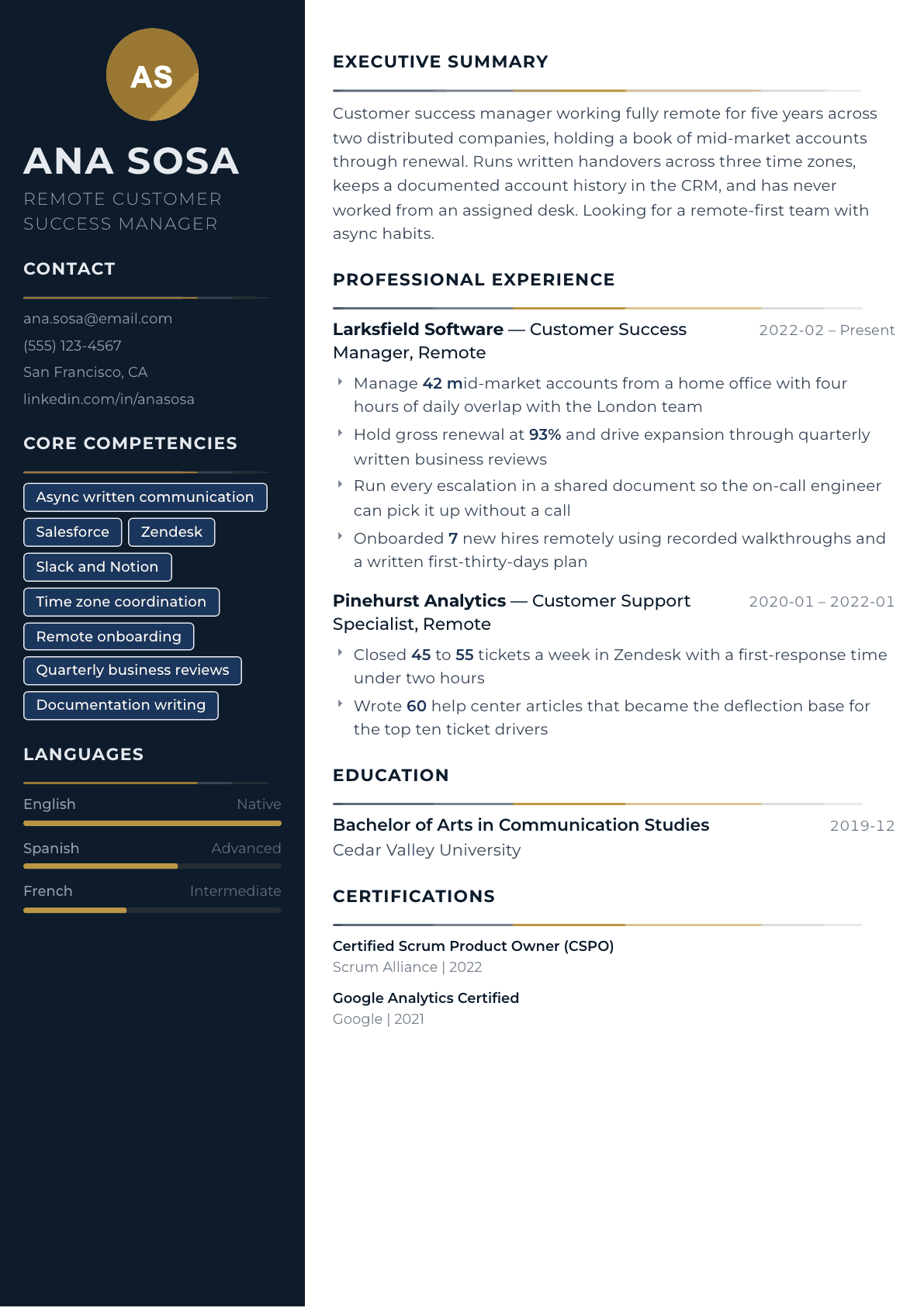
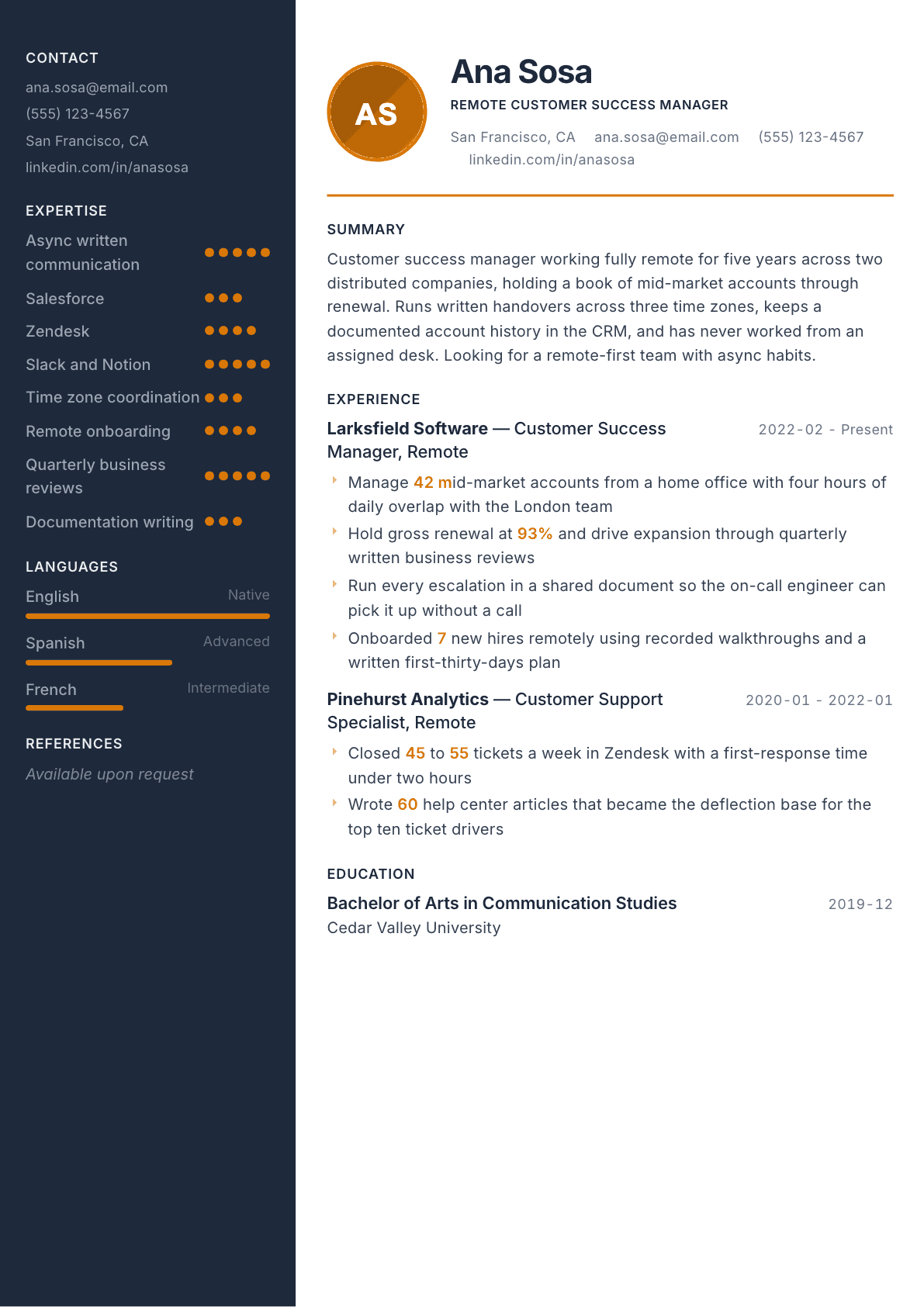
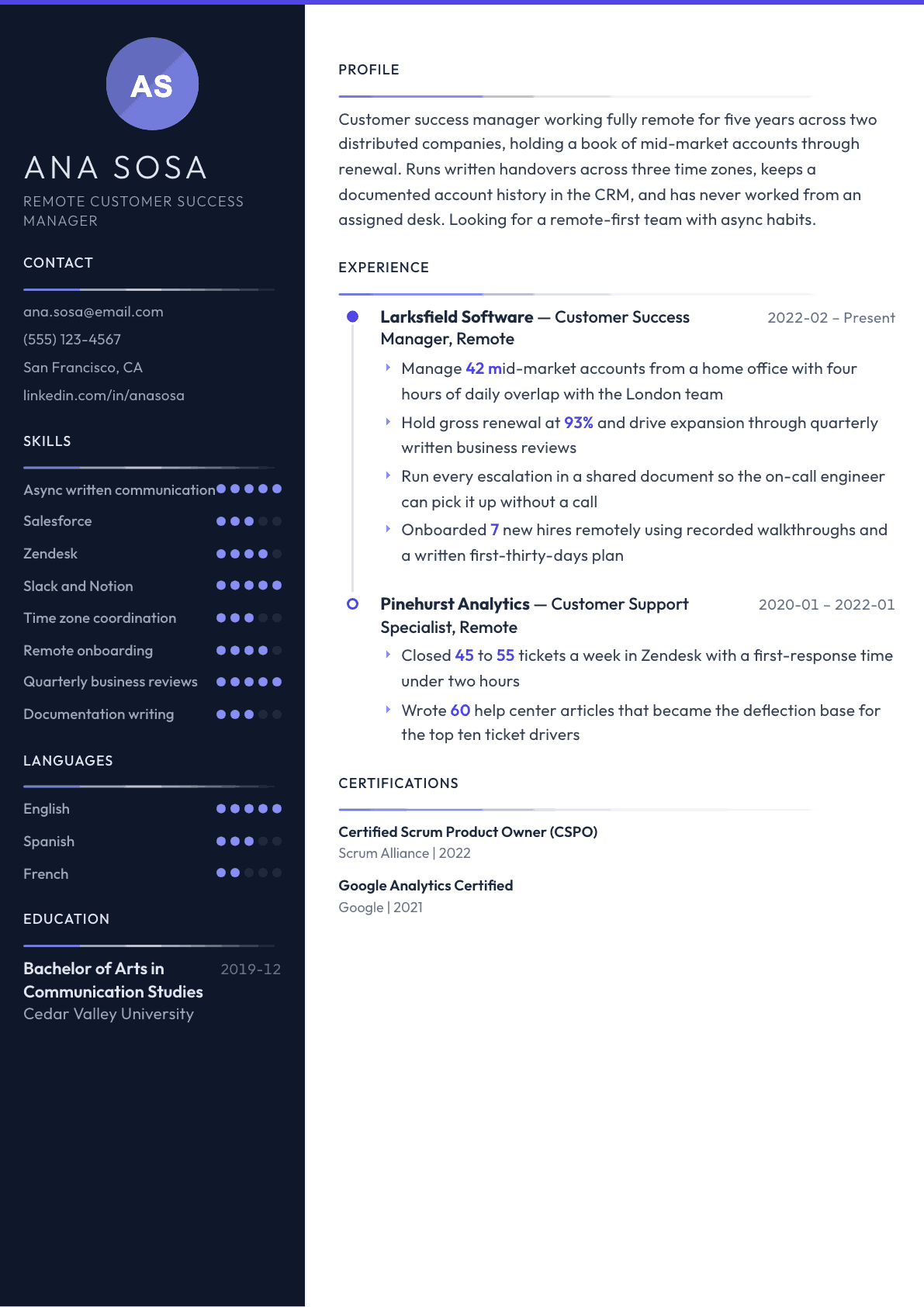
Example Remote Worker summary
Customer success manager with five years of fully remote work across two distributed companies, holding 42 mid-market accounts at 93% gross renewal. Runs escalations and business reviews in writing so colleagues in other time zones can act without a meeting, and onboarded seven hires using recorded walkthroughs. Seeking a remote-first team that documents decisions rather than scheduling calls.
Skills to list on a Remote Worker resume
- Asynchronous communication
- Written status reporting
- Time zone overlap planning
- Video conferencing discipline
- Documentation and runbooks
- Remote onboarding
- Self-directed prioritization
- Distributed team collaboration
- CRM and ticketing systems
- Digital security practices
- Home office reliability
- Screen recording and walkthroughs
- Remote escalation handling
What actually gets this resume read
- Label each remote job as remote in the location field so nobody assumes it was a pandemic arrangement.
- State your home time zone and the hours you can overlap with a team elsewhere on the map.
- Name the async stack you live in: documents, ticket queues, recorded walkthroughs and status updates.
- Show output rather than presence, because a remote manager cannot see effort and only reads results.
- Mention your home office setup briefly when the job asks for a wired connection or a quiet call space.
- Add one example of solving a problem across time zones without waiting for a synchronous meeting.
How to write a remote worker resume
A remote hiring manager is buying something an office manager never has to think about: the ability to produce results nobody will watch you produce. She cannot see whether you were stuck for two days, whether you asked for help early, whether you wrote the update before the question was asked. All she can see is output and the written trail around it, so the resume that wins a distributed role is the one that shows both.
Most remote applications fail on the same three points. The location field says a city and nothing else, so the reader cannot tell which jobs were actually remote. The tools list names video conferencing and calls it collaboration. And the bullets describe activity rather than delivery, which is fatal in a setting where presence proves nothing. A candidate who fixes those three things reads completely differently from one who simply says they enjoy working from home.
This guide covers labeling remote roles so a screener can see the history at a glance, showing time zone overlap as a scheduling fact, evidencing the written habits that make distributed teams function, and handling the case where your remote experience came only from a temporary company-wide arrangement.
Label every role so the remote history is visible in five seconds
Put the working arrangement in the location field of each job: Remote, Hybrid with two office days, or the city where you sat. A recruiter filling a distributed role scans for that word, and a resume that lists only cities forces her to guess, which usually resolves against you.
Add your own base too, with the time zone. A distributed team is a scheduling problem before it is anything else, and a candidate who states a location and an overlap window has answered the first operational question in the process. Where a role advertises required overlap hours, name yours in the summary rather than leaving it to a later email.
- Working arrangement in the location field of every entry: remote, hybrid or on site.
- Your base city and time zone in the header, with the overlap hours you can offer.
- Length of continuous remote experience, stated as years rather than implied by the dates.
- Whether each remote role was remote-first across the company or an exception you negotiated.
- The countries or regions your colleagues sat in, which shows real distributed coordination.
Show the written habits, not the video calls
Every applicant lists a video platform and a chat tool. That is table stakes and it proves nothing, because attending meetings is the least remote part of remote work. What distinguishes a strong distributed worker is what happens between the meetings: the written update that removed the need for one, the decision recorded where the next person could find it, the recorded walkthrough that replaced a live training session.
Name the artifacts. A weekly written status that goes out on a fixed day, an escalation run in a shared document so an engineer in another region can pick it up cold, a runbook that let a colleague cover your accounts during leave, a recorded onboarding sequence used for new hires. Each of these is verifiable and each of them describes a habit a remote manager is desperate to hire.
Documentation quality is also the sample she has. If your bullets are vague and misspelled, she will conclude that your written updates are too, because in a remote role the resume is the first work sample.
- A regular written update with a fixed cadence and a named audience.
- Decisions and escalations recorded in a shared document rather than in a call.
- Runbooks or handover notes that let someone else cover your work.
- Recorded walkthroughs used for onboarding or training.
- Ticket and project systems where your written trail lives: the CRM, the tracker, the help center.
Prove output, because presence is invisible
In an office, effort is partly credited by being seen. Remotely it is not, and the bullets have to carry the whole load. Convert every duty into a delivered quantity or a moved measure: accounts held and their renewal rate, tickets closed per week with a response time, releases delivered, articles published, onboarding cycles run.
Pair the number with the constraint that makes it remote. Holding forty-two accounts with four hours of daily overlap with another region is a harder job than holding forty-two accounts down the corridor from all of them, and saying so shows you understand what the arrangement costs.
Include one example of unblocking yourself across time zones without waiting for a meeting. That single bullet answers the deepest fear a distributed manager has, which is hiring someone whose progress stops every evening when the other region logs off.
The practical section: setup, security and availability
Some employers ask about the home working environment, particularly for support, sales and any role with scheduled calls. A brief line covering a dedicated workspace, a wired connection and a quiet space for calls is enough. Do not turn it into a paragraph about your desk.
Where the role touches customer or health data, mention the security practices you already follow: a company-managed device, a password manager, multifactor authentication and a locked screen policy. Remote roles carry a compliance dimension that on-site roles handle with a badge reader, and a candidate who already thinks about it is easier to onboard.
Finally, be honest about your working pattern. If you need school-run hours or you are a night owl who delivers after eight, say what you can commit to. Remote teams accommodate a lot, but only when the pattern is agreed at the start instead of discovered in month three.
If your only remote experience was the temporary period everyone had
Working from home during a company-wide arrangement counts, but it is weaker evidence, because everyone was doing it and the team stayed synchronized in one time zone. Strengthen it by naming what you personally changed: a process you moved into writing, a document you created because the hallway conversation had disappeared, a metric you held or improved while distributed.
Add anything else that proves independent operation. Freelance clients, a distributed volunteer committee, an open source project with contributors elsewhere, a side business run entirely online. What a hiring manager is testing for is self-direction and written communication, and those can be evidenced from outside a job.
Remote Worker resume summary examples
First fully remote role
Support specialist with 2 years in a hybrid help desk and 8 months fully remote, closing 45 to 55 tickets a week with a first response under two hours. Wrote 30 help center articles covering the top ticket drivers. Based in Central time with full overlap available to Eastern teams.
Five years fully distributed
Customer success manager with 5 years of fully remote work across two distributed companies, holding 42 mid-market accounts at 93% gross renewal with four hours of daily overlap with a London team. Runs escalations and business reviews in writing so colleagues elsewhere can act without a meeting.
Managing a distributed team
Support manager leading 9 people across 4 time zones with no shared working hours, running a follow-the-sun queue and a written handover at each shift boundary. Cut weekend backlog by 40% by rebuilding the handover template and the on-call escalation path.
Work experience bullets: before and after
Before: Worked remotely with a distributed team.
After: Managed 42 mid-market accounts from a home office with four hours of daily overlap with the London team, holding gross renewal at 93% across two years.
The overlap window and the retained book show remote work as a scheduling and delivery fact, not a location.
Before: Used Slack, Zoom and Notion daily.
After: Ran every escalation in a shared document with a decision log, so the on-call engineer in another region could pick it up without a handover call.
The artifact and its purpose demonstrate async practice, where a tool list only demonstrates access to software.
Before: Helped train new team members remotely.
After: Onboarded 7 new hires remotely using recorded product walkthroughs and a written first-thirty-days plan, cutting live training time to two sessions per hire.
Replacing live sessions with reusable assets is exactly the leverage a distributed manager wants to see.
Before: Communicated well with colleagues in other countries.
After: Published a Monday written status covering account risk and open escalations, which replaced the recurring cross-region sync for the whole team.
A named cadence with a meeting it retired is concrete evidence of written communication that worked.
Before: Self-motivated and able to work independently.
After: Cleared a billing integration blocker overnight by documenting the reproduction steps and the two possible fixes, so the engineering team acted at the start of their day.
One unblocking story proves self-direction better than the adjective every remote applicant uses.
Hard skills
- Asynchronous written communication
- Written status reporting on a cadence
- Documentation and runbook authoring
- Time zone overlap planning
- Screen recording and walkthrough creation
- Remote onboarding design
- Ticketing and CRM systems
- Project trackers and shared boards
- Video conferencing facilitation
- Digital security and device management
- Remote escalation and on-call handover
- Output-based goal tracking
Soft skills
- Asking for help before being blocked for a day
- Writing clearly enough to remove a meeting
- Setting boundaries between home and work hours
- Building trust with colleagues you never meet
- Working through ambiguity without a desk neighbor
Mistakes that cost remote worker candidates the interview
- Leaving the location field as a city so a screener cannot tell which roles were actually remote.
- Listing video and chat tools as collaboration skills when attending calls is the least remote part of the job.
- Describing duties rather than delivered output, which carries no weight when nobody can observe the effort.
- Omitting your time zone and overlap hours from a resume for a role that spans regions.
- Presenting a temporary company-wide work-from-home period as years of distributed experience.
- Writing bullets with typos and vague phrasing when the resume is the first sample of your written work.
- Saying nothing about home setup or data handling for a role that runs scheduled calls or touches customer data.
Remote Worker resume questions
How do I show on my resume that a job was remote?
Put Remote in the location field of that entry, and add your own base city and time zone in the header. Recruiters scan for it, and a page that lists only cities makes them assume every role was on site.
Does working from home during a company-wide period count as remote experience?
It counts, but it is weaker because the whole team shared one time zone and moved together. Strengthen it by naming what you personally moved into writing and any measure you held or improved while distributed.
What should I say about my home office?
One line is enough: a dedicated workspace, a wired connection and a quiet room for calls. Add device and access security if the role touches customer or health data. Anything longer starts to read as padding.
How do employers judge productivity when they cannot see me working?
By output and by the written trail around it. Put quantities and moved measures on every bullet, and show the artifacts that let others work without you: status updates, decision logs, runbooks and recorded walkthroughs.
Should I mention that I want a remote-only role?
Yes, state it in the summary so nobody wastes a stage on a hybrid requirement you will decline. Pair it with your overlap hours, which turns a preference into a scheduling proposal a manager can accept or reject quickly.