High School Student Resume Examples: what gets the call
Start Strong with a High School Student Resume
By Mustafa Tarabya, founder of CVBooster · Published · Updated
High School Student resume examples with expert tips, ATS keywords, and professional templates. See exactly what a winning high school student resume looks like.
Sample resumes for a high school student
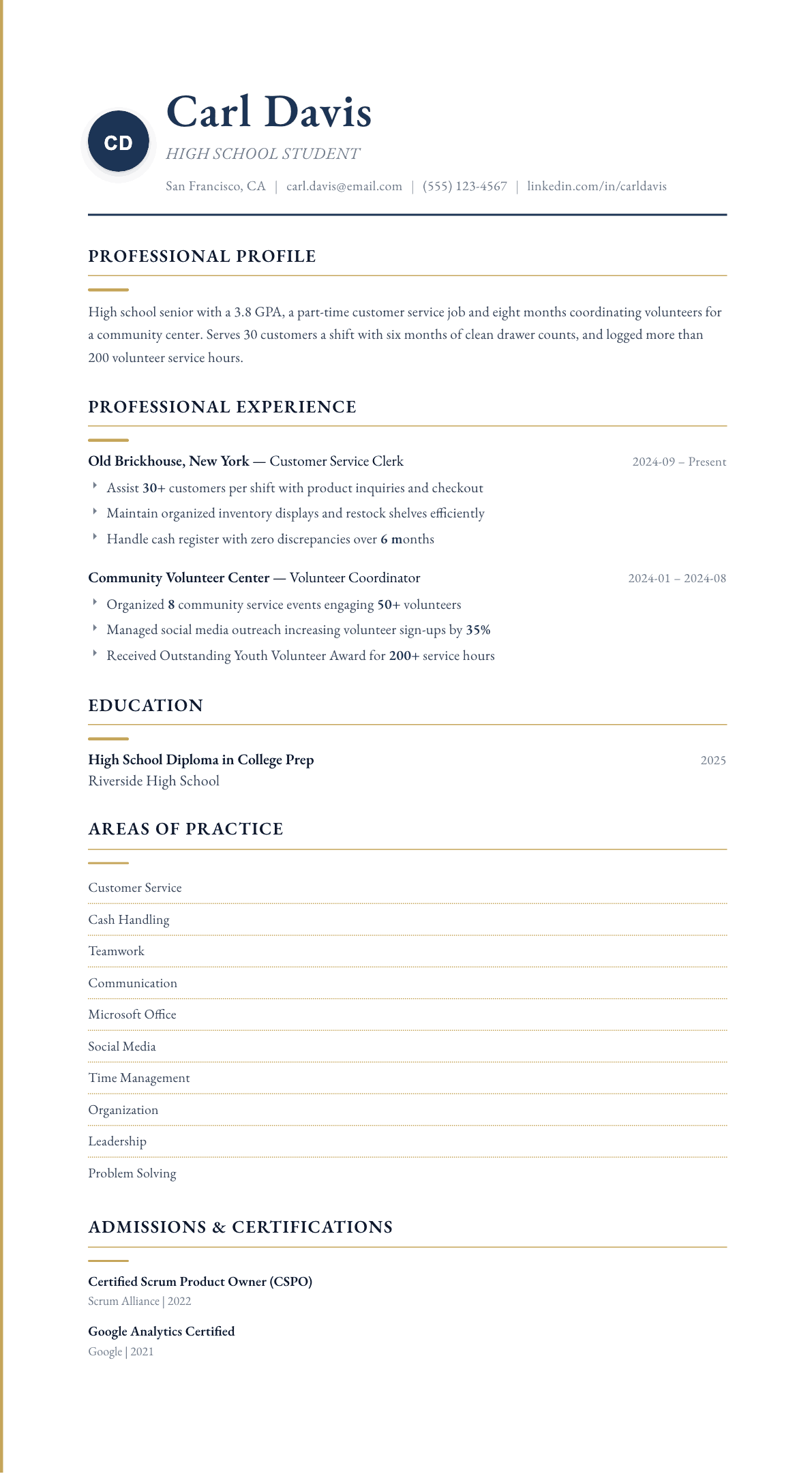
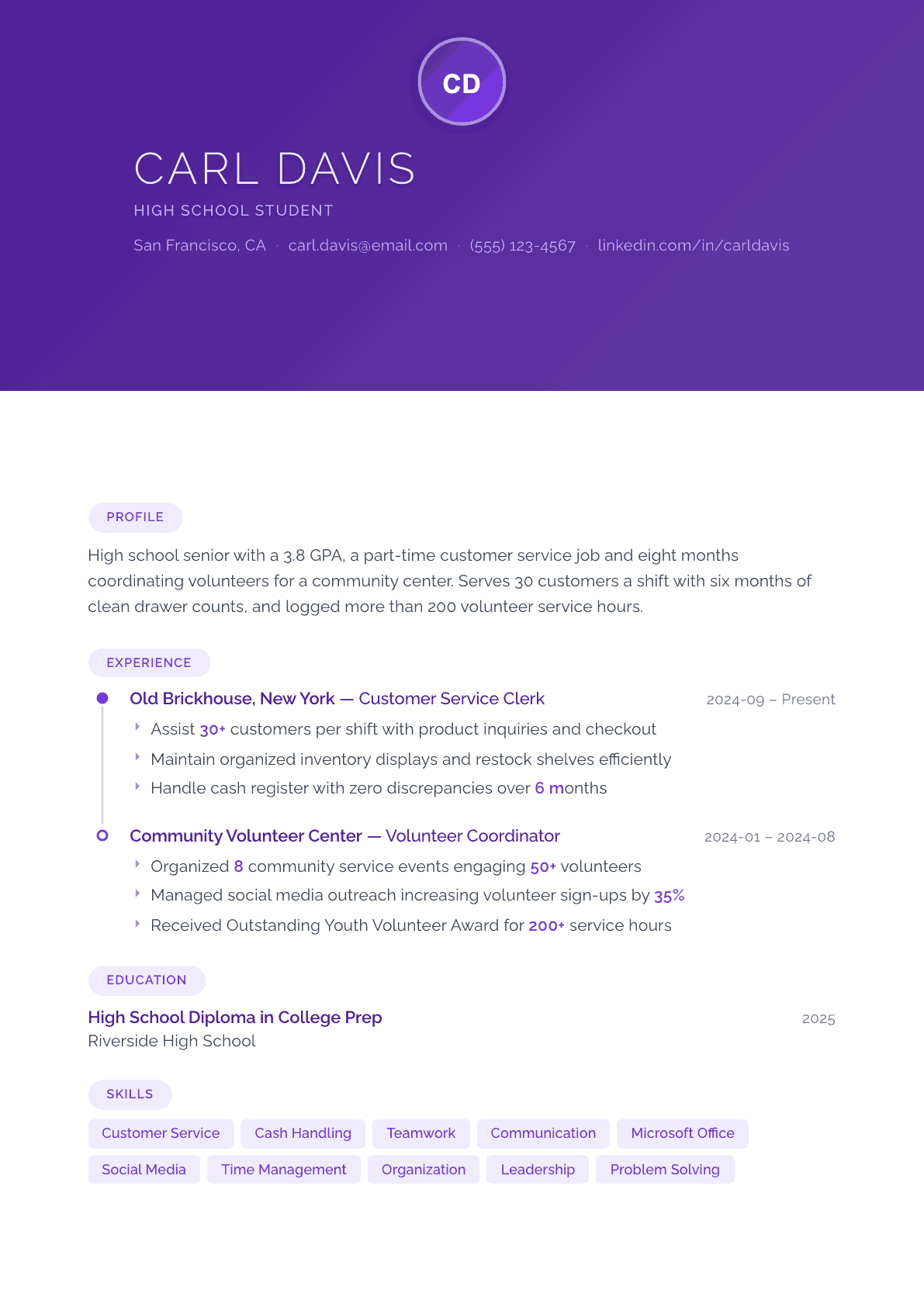
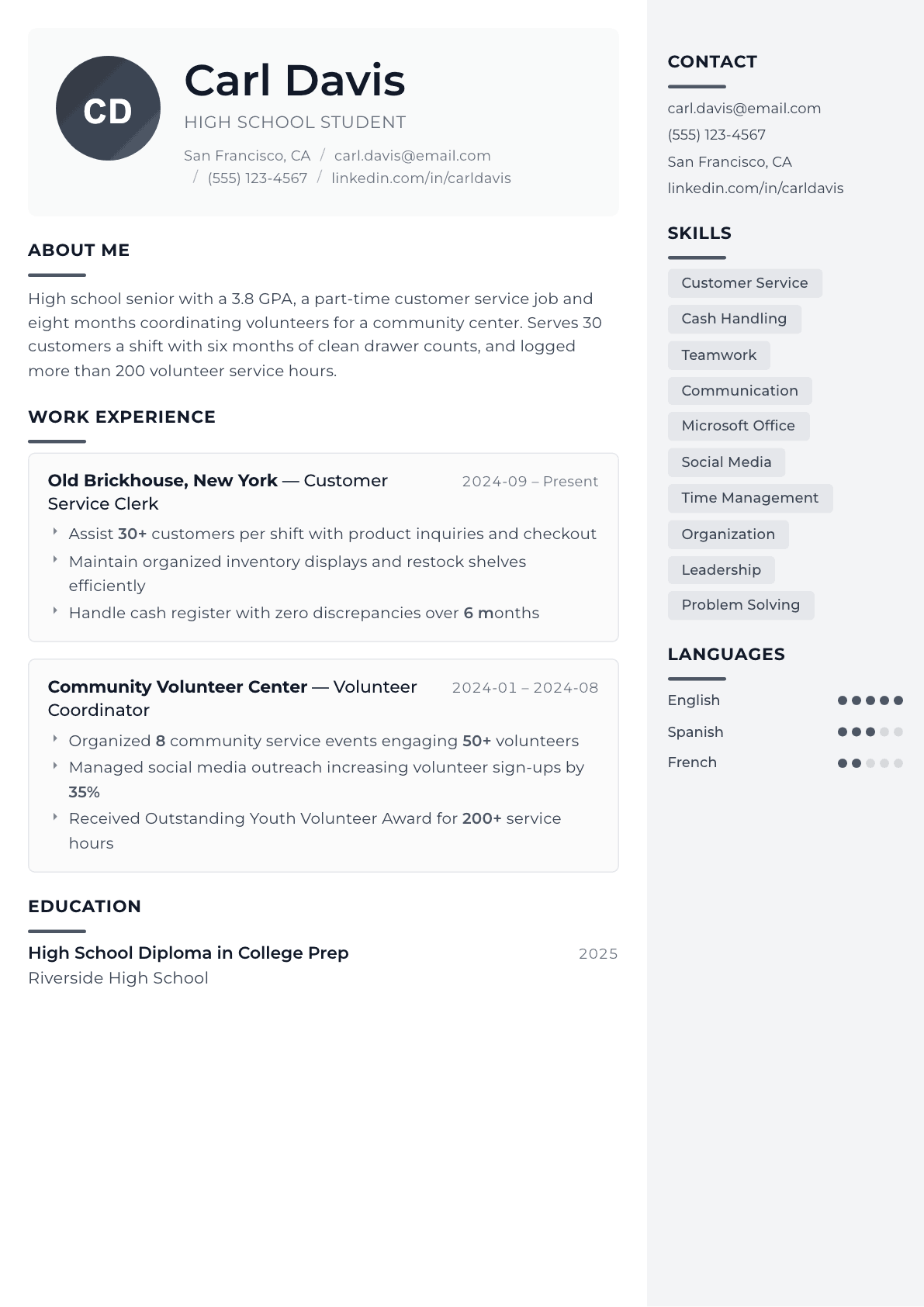
The same high school student content laid out in three CVBooster templates, so you can see what the finished document looks like before you write a word.
Example High School Student summary
High school senior, 3.8 GPA, graduating in 2025, with a year of retail customer service and volunteer coordination behind it. Organized eight community service events for 50 volunteers, lifted volunteer sign-ups 35% through social media, and handles a register with no shortages. Looking for part-time work after school.
Skills to list on a High School Student resume
- Customer Service
- Cash Handling
- Teamwork
- Communication
- Microsoft Office
- Social Media
- Time Management
- Organization
- Leadership
- Problem Solving
What actually gets this resume read
- Focus on transferable skills gained from school, volunteering, and part-time jobs.
- Include GPA if 3.0 or higher, along with honors and AP courses.
- Highlight extracurricular activities and leadership positions.
- List volunteer work and community service hours.
- Keep it to one page. Quality over quantity at this stage.
How to write a high school student resume
A high school student resume is read by a shift manager at a grocery store, a pool supervisor, a camp director or a small business owner, and none of them expect work history. What they are actually checking is narrower and easier to satisfy than students think: can this person get to a shift on time, will a parent or teacher vouch for them, are they old enough for the tasks the job involves, and how many hours a week can they give once school is back.
That means the resume is not a weaker version of an adult resume. It is a different document. Availability, school activities, volunteering, and any responsibility an adult trusted you with carry the weight that job history carries later. A student who says he opened and closed a concession stand alone, counted the till and locked up has told a manager everything the manager needs to know.
This guide covers the one-page layout for a first job, how to turn school and volunteer work into experience entries, what to do about age and work permits, three summaries from a first application to a senior with two years of part-time work, before-and-after bullets, and the questions students ask about their first resume.
Format: one page, education first, availability in the header
One page, and it will not be full, which is fine. Use a plain layout with clear headings, a readable font at a normal size, and no photo. Resist stretching to fill the page with padding, because a short honest page reads better than a long one made of filler.
Put availability in the header or the summary. A manager scheduling a rotation cares whether you can work weekends, whether sports season blocks your weekday afternoons, and how late you can stay under state hour rules for your age. Saying it up front saves the phone call that would otherwise decide against you.
- Header: name, city, phone, a professional email address, and your availability in one short line.
- Sections in this order: summary, education, experience, activities and leadership, volunteering, skills.
- Use a plain email address built from your name, not a nickname account made in middle school.
- Mention that references are available and have two adults ready who are not family.
Education: the section doing the most work
Name the high school, the city, and your expected graduation month and year. Add your grade point average when it is strong, honors or advanced courses, and any academic recognition. Coursework belongs here when it connects to the job, so an applicant to a hardware store lists a woodworking or engineering elective and an applicant to a veterinary office lists biology.
Class projects count. A marketing unit where you built a campaign, a business class where you ran a mock company, or a computer course where you built a working site are all things you did, and they belong in a short line under education rather than being left out because they were assignments.
Experience: babysitting, yard work and the school store all count
Any arrangement where someone relied on you and you delivered is experience. Babysitting, lawn care, dog walking, tutoring a younger student, helping at a family business, running the concession stand at home games, or working a summer camp all belong in the experience section with a title, a rough date range and two bullets.
Write the bullets around responsibility, money and people. How many children you watched and for how long. How many customers you served in a shift. Whether you handled cash and closed out a drawer. Whether you opened, locked up, or worked without a supervisor present. Managers are hiring for reliability, and those details are what reliability looks like on paper.
Keep the dates honest and simple. Summer of one year, or a school year range, is enough. Nobody expects month-level precision from a student, but they will notice invented job titles.
- Include a title, the place or family, the season or school year, and two bullets each.
- Say the volume: children supervised, customers served, tables cleared, tickets sold, lawns maintained per week.
- Say the trust: handled cash, opened or closed, worked unsupervised, held a key, trained a newer helper.
- Say the outcome: repeat clients, a raise, more hours, or being asked back the following season.
Activities, volunteering and leadership
Sports, band, debate, robotics, student government, theater and clubs all show commitment over time, which is the quality a manager is trying to predict. Give each one the years involved, any position held, and the hours per week during the season, because a sport that takes fifteen hours a week is evidence of stamina and scheduling as much as of athletic ability.
Volunteering deserves its own section with the organization, the role and the total hours. Food bank shifts, animal shelter work, tutoring, church or community service and clean-up events all show up here. Many students already have service hours logged for a graduation requirement, and those hours are worth writing down properly rather than mentioning in passing.
Skills, work permits and the tone of the page
Keep the skills list short and real. Cash handling, point-of-sale systems, customer service, food safety, spreadsheets, video editing, a second language, or a specific piece of software you actually use. Do not list ten qualities like hardworking and motivated, because every applicant claims those and no manager believes a list of adjectives.
If your state requires a work permit or age certificate for minors, note that you have one or that you can obtain it quickly. Employers who hire students deal with hour restrictions and equipment rules constantly, and an applicant who already understands that is easier to schedule.
Write plainly. A first resume that sounds like a corporate press release is more suspicious than one that sounds like a serious sixteen-year-old.
High School Student resume summary examples
First job application
High school sophomore with a 3.6 GPA seeking a first part-time job in retail or food service. Two years of babysitting for three neighborhood families and 40 volunteer hours at a community food bank. Available weekends and weekday evenings after 4 pm.
Junior with work experience
High school junior with one year as a weekend cashier handling a register and closing shift counts, plus two seasons on the varsity track team. Maintains a 3.8 GPA while working 12 hours a week. Looking for a summer position with more responsibility and full-time hours.
Senior with two years part-time
High school senior with two years of customer-facing work at a grocery store, promoted to shift lead training new cashiers. Student government treasurer managing a class budget and event planning for 300 students. Seeking a full-time summer role before starting college in the fall.
Work experience bullets: before and after
Before: Babysat for neighbors.
After: Supervised three children aged 4 to 10 for two families on weekday evenings, preparing meals, managing bedtime routines and staying alone in the home for shifts up to five hours.
The ages, the duration and the fact that you were unsupervised are exactly what a manager reads as proof of responsibility.
Before: Worked as a cashier at a grocery store.
After: Ran a register for 40 to 60 customers a shift, counted the drawer at close, and covered the self-checkout area during the two busiest evenings of the week.
Customer volume, cash accountability and being trusted at peak hours are the details a hiring manager can act on.
Before: Member of the student council.
After: Served as student government treasurer for one school year, tracking a class budget across six events and reporting balances at monthly meetings.
A named position with a real duty beats membership, and money handling transfers directly to a job.
Before: Volunteered at a food bank.
After: Completed 40 volunteer hours over two school years sorting donations and packing family boxes, and trained two new volunteers on the sorting line.
Hours make the commitment measurable, and training someone else shows you learned the work well enough to teach it.
Before: Played on the soccer team.
After: Competed on varsity soccer for three seasons at roughly 14 hours a week during the season, serving as team captain in the final year.
The weekly hours prove you can hold a schedule, which is the real question behind any activity on a student resume.
Hard skills
- Cash handling and register operation
- Point-of-sale systems
- Customer service
- Food safety basics
- Stocking and inventory counts
- Microsoft Word and Excel
- Google Docs and Sheets
- Social media content creation
- Basic photo and video editing
- Typing and data entry
Soft skills
- Punctuality
- Following instructions
- Working with a team
- Politeness with customers
- Willingness to learn
- Handling a busy shift
Certifications worth listing
- Lifeguarding with First Aid and CPR/AED (American Red Cross)
- Babysitting Basics (American Red Cross)
- ServSafe Food Handler (National Restaurant Association)
- Microsoft Office Specialist (Certiport)
- OSHA 10-Hour General Industry (Occupational Safety and Health Administration)
Mistakes that cost high school student candidates the interview
- Padding the page with filler so it looks longer, when a clean short page reads as honest and a stretched one reads as inexperienced.
- Using an old joke email address, which is the single fastest way to lose a first job application.
- Leaving availability off, forcing a manager to guess whether school and sports make you unschedulable.
- Listing adjectives like hardworking and motivated instead of things you actually did.
- Skipping babysitting, yard work and family business help because they were not official jobs, which empties the most useful section.
- Naming a teacher or coach as a reference without asking them first.
- Copying an adult resume template with an objective about long-term career growth that no shift manager is reading for.
High School Student resume questions
Do I need a resume to apply for a first job in high school?
Many employers hand you an application form instead, but bringing a one-page resume puts you ahead of applicants who did not. It gives the manager your availability, your activities and a reference list in one piece of paper they can keep.
What do I put on a resume if I have never had a job?
Education first with your grade point average and relevant courses, then informal work such as babysitting, lawn care or tutoring, then activities and volunteering with hours attached. Every one of those shows reliability, which is what a first employer is buying.
Should I include my GPA on a high school resume?
Include it when it is around 3.0 or higher, with the scale, and add honors or advanced courses next to it. If your grade point average is lower, leave it off and use the space for work, activities and volunteer hours instead.
How long should a high school student resume be?
One page, and often only half of it. Nobody expects a full page from a student, and a clear half page beats a padded full one. Add sections as you gain jobs and activities rather than inflating what you have now.
Who should I list as references?
Two or three adults who are not relatives: a teacher, a coach, a club advisor, a neighbor you worked for, or a volunteer coordinator. Ask each of them first, give them the job you are applying for, and make sure their phone number is current.