No Experience Resume Examples: free ATS score and gap list
Write a No Experience Resume That Still Proves Something
By Mustafa Tarabya, founder of CVBooster · Published · Updated
No experience resume example and guide: which format to use, what counts as evidence, and how to fill a page without inventing job history.
Sample resumes for a no experience
The same no experience content laid out in three CVBooster templates, so you can see what the finished document looks like before you write a word.
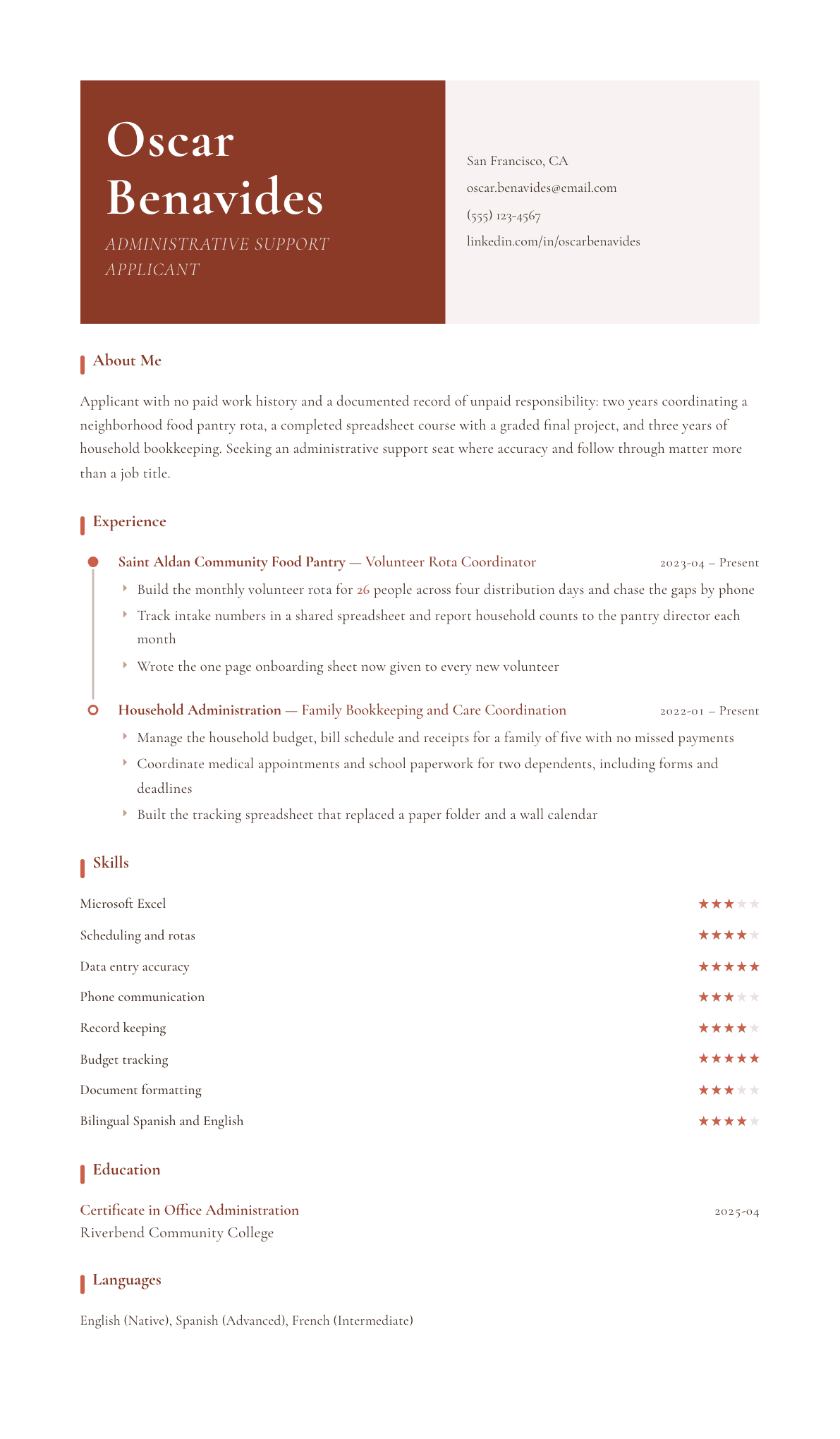
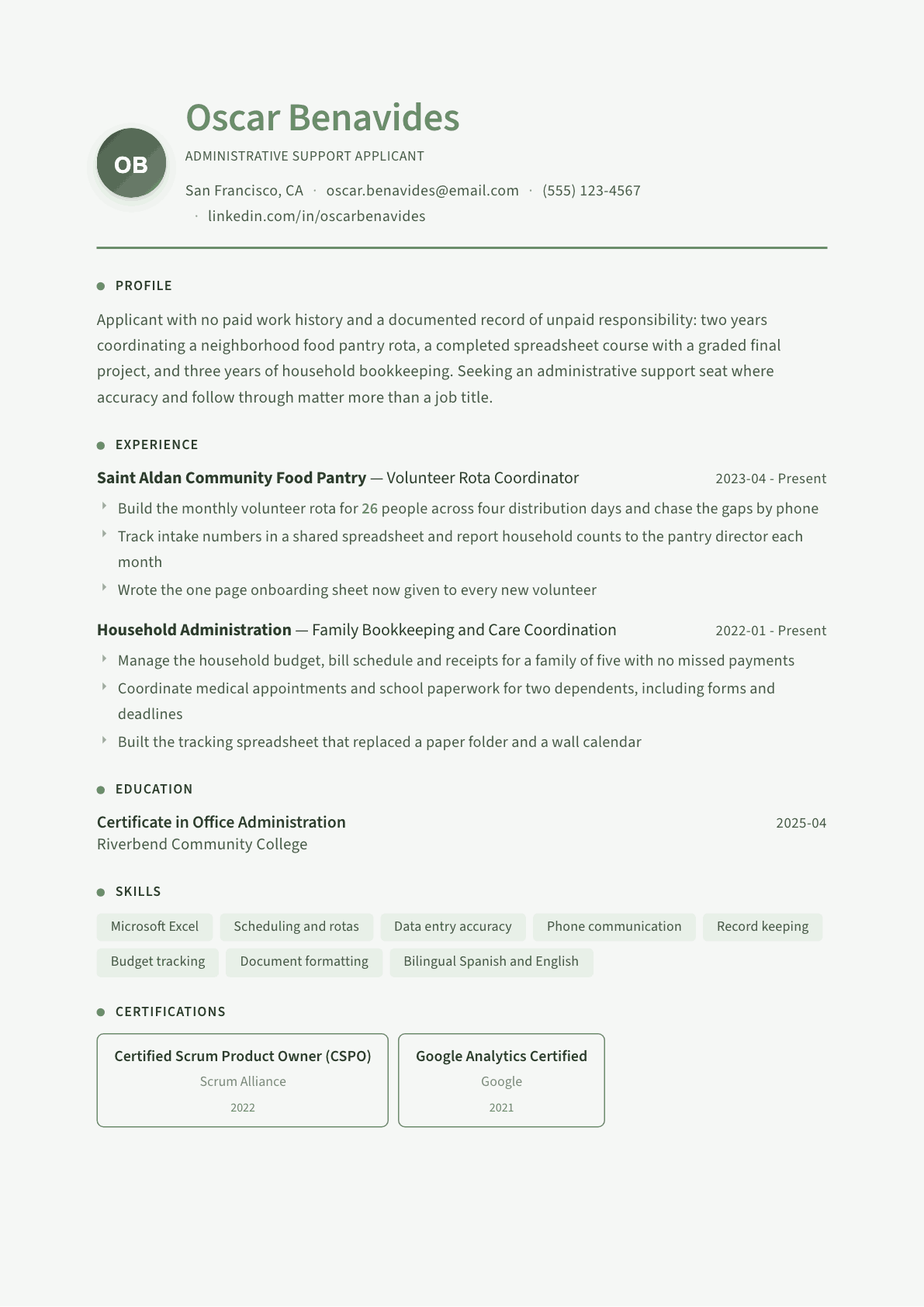
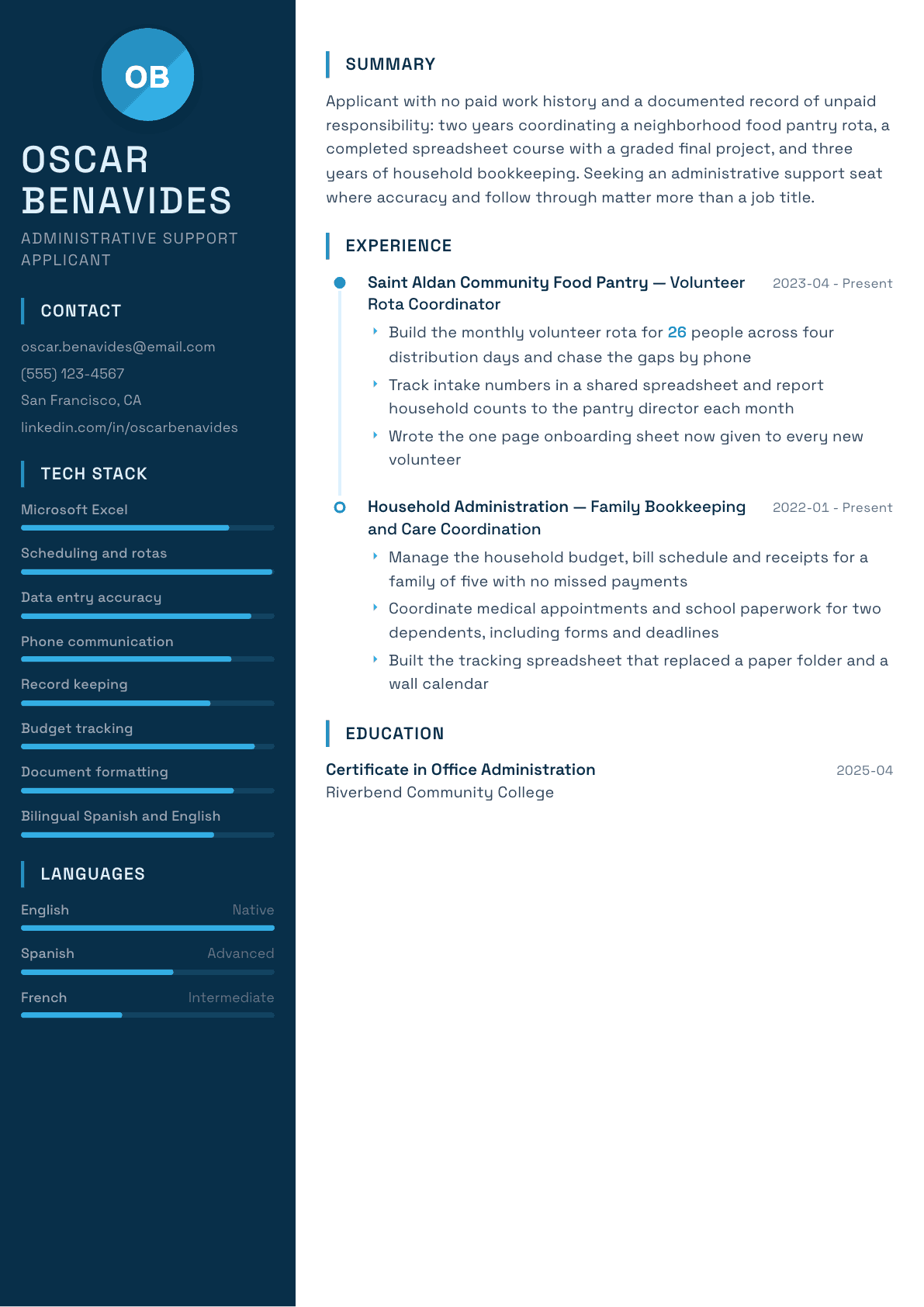
Example No Experience summary
Administrative support applicant with no paid employment history and a clear record of unpaid responsibility. Coordinates a volunteer rota of 26 people across four distribution days a month, tracks intake numbers in a shared spreadsheet, and manages a household budget with no missed payments. Completed an office administration certificate this year. Accurate with numbers, comfortable on the phone, and used to owning a deadline nobody is checking.
Skills to list on a No Experience resume
- Microsoft Excel
- Data entry accuracy
- Scheduling and rota building
- Record keeping
- Budget and receipt tracking
- Phone and email communication
- Document formatting
- Meeting and appointment coordination
- Written instructions and checklists
- Bilingual communication
- Confidential information handling
- Self directed learning
What actually gets this resume read
- Do not leave the experience section empty; give it a truthful heading such as volunteer, community or family responsibility.
- Put a short skills summary above experience so a screener reads capability before noticing the missing job titles.
- Prove every skill with a place it was used, because an unsupported skills list reads as a wish list.
- Add a completed course or certificate with the finishing month, since it dates your effort and shows current activity.
- Never invent an employer, because reference checks are quick and a fabricated job ends the process permanently.
- Keep to one page and let white space do the work rather than stretching margins and font size to look fuller.
- Write a cover note that names why you want this specific role, since it carries more weight when history is thin.
How to write a no experience resume
Two very different people search for a resume with no experience. One has never held a paid position at all. The other has worked for years and has none of it in the field she is now applying to. The page they need is built the same way, because the underlying problem is identical: the reader cannot find a matching job title, so the resume has to supply matching evidence instead.
The failure mode is predictable. A candidate with no experience writes a long skills list, adds a paragraph about being motivated and eager to learn, and leaves the experience section blank or nearly so. That page is unarguable in the wrong sense: there is nothing in it a hiring manager can check, and nothing to check reads as nothing to offer.
This guide covers the layout that suits an unmatched history, how to decide what genuinely counts as evidence, how to write unpaid and household work without dressing it up, why a completed course changes the reading of the whole page, and how to keep the whole thing honest, since fabricating history is the one mistake that cannot be repaired later.
Choose a layout that leads with capability rather than chronology
A strict chronological page punishes anyone whose history does not match the target, because the first thing the eye reaches is a job title from the wrong world. A combination layout fixes this without hiding anything: a short capability block near the top, grouped under two or three headings that match the role, then the dated history below it in full.
The capability block is not a skills list. Each heading gets one or two lines that name where the skill was used. Record keeping, with the household budget and the pantry intake spreadsheet behind it. Scheduling, with the volunteer rota and its size. That construction survives the question a bare list never does, which is where did you do this.
- Two or three capability headings chosen from the job posting language.
- One or two lines under each, naming the setting where the skill was used.
- A full dated history below, including unpaid roles, with nothing left out.
- Courses and certificates in their own block with completion months.
- A single page, since the reader is deciding on a small number of facts.
Decide what actually counts as evidence, and what only feels like it
Evidence has three parts: someone outside your household depended on it, it repeated on a schedule, and it produced something you can describe. Coordinating a volunteer rota qualifies. Managing a household budget for years qualifies. Watching tutorials about a software package does not, until you have built something with it that another person used.
Career changers should apply the same test to their old field rather than assuming none of it transfers. A warehouse supervisor moving into office administration has scheduling, headcount, incident documentation and system data entry in her history. The work is not irrelevant; it is described in the wrong vocabulary. Rewrite each bullet in the language of the target role and most of it survives the move.
Be honest about the parts that do not transfer. A page that claims everything is relevant is less persuasive than one that names two genuine strengths and one thing you are still learning. Hiring managers who take chances on unmatched candidates are reading for self awareness as much as for capability.
Write unpaid, family and community work as work
Give unpaid roles the same structure as employment: an entity name, a role title, dates, and bullets with numbers. Saint Aldan Community Food Pantry, volunteer rota coordinator, with the volunteer count, the distribution days and the reporting you produce. If the entity is your own household, name it plainly as household administration rather than inventing a company, and describe the responsibilities in operational terms.
Numbers matter more here than anywhere else on the page, because they are the only thing separating your entries from good intentions. People coordinated, records maintained, appointments scheduled, funds tracked, documents produced. A reader who sees a rota of twenty six people across four distribution days is looking at a scheduling job, whatever it was called.
One caution: keep the tone matter of fact. Unpaid work described with emotional language invites the reader to file it as personal rather than professional. The same facts written flatly, with counts and dates, are read as operations.
A finished course is the cheapest credibility you can buy
When history is thin, a completed and dated course does something no adjective can: it proves recent, voluntary effort aimed at this specific job. A spreadsheet certificate with a graded final project, an office administration certificate, a bookkeeping short course, a food safety card, a customer service program. The completion month matters as much as the title, because it shows the effort is current.
Say what the course required rather than only naming it. A final project, a proctored assessment, a set number of hours. That detail separates a real qualification from a video series someone watched, and hiring managers have learned to tell the difference.
- Course title, issuing institution and the month you completed it.
- What the course required: hours, a graded project, an assessment.
- One artifact you produced during it that you could show if asked.
- Anything in progress, marked with the expected completion month.
Honesty, the cover letter, and what to do about the gap in the middle
Never create an employer, a title or a date range that did not exist. Reference checks are quick, employment records are verifiable, and a discovered fabrication ends more than the current application. Everything on this page can be built without a single invented fact, which is the whole argument of the guide.
The cover letter carries more weight when the resume cannot match a title. Use it to say why this role and this employer, what in your history genuinely transfers, and what you have done in the last months to prepare. Three short paragraphs. Where there is a long gap, give it one plain line with the months and the reason, and leave the rest for a conversation rather than filling the page with explanation.
No Experience resume summary examples
No paid history at all
Administrative support applicant with no paid employment and a documented record of unpaid responsibility. Coordinates a 26 person volunteer rota across four distribution days a month, tracks intake numbers in a shared spreadsheet, and completed an office administration certificate this year.
Changing fields after years of work
Warehouse supervisor of 6 years moving into office administration. Built shift schedules for 30 staff, maintained incident documentation and ran daily system data entry against a live inventory. Completed a bookkeeping short course with a graded final project. Seeking an administrative coordinator seat.
Returning after a long absence from paid work
Returning to paid work after 11 years managing a household and a school parent association. Administered a 4000 dollar annual association budget, scheduled six events a year and produced the monthly newsletter for 300 families. Recently completed a spreadsheet analysis certificate.
Work experience bullets: before and after
Before: Good with computers and spreadsheets.
After: Built the tracking spreadsheet that replaced a paper folder and a wall calendar, covering bill dates, receipts and two dependents medical appointments.
A named artifact and what it replaced is checkable in a way that a comfort claim is not.
Before: Volunteer at a community food pantry.
After: Build the monthly volunteer rota for 26 people across four distribution days and chase the gaps by phone until every slot is covered.
Headcount, frequency and the chasing work describe a scheduling role rather than an act of goodwill.
Before: Eager to learn and highly motivated.
After: Completed a 60 hour office administration certificate with a graded final project while volunteering three days a week.
Hours completed alongside a commitment demonstrate the motivation instead of asserting it.
Before: Managed things at home for several years.
After: Managed a household budget, bill schedule and receipts for a family of five for 3 years with no missed payments or late fees.
Scope, duration and a clean outcome turn domestic work into a financial administration record.
Before: Helped new volunteers get started.
After: Wrote the one page onboarding sheet now given to every new volunteer, covering the intake form, the storage layout and the reporting deadline.
A document still in use by other people is durable evidence that outlives your own shift.
Hard skills
- Microsoft Excel and Google Sheets
- Data entry accuracy
- Scheduling and rota building
- Record keeping and filing systems
- Budget and receipt tracking
- Document formatting and templates
- Phone and email correspondence
- Meeting and appointment coordination
- Basic bookkeeping
- Bilingual communication
Soft skills
- Owning a deadline that nobody is supervising
- Learning a system from documentation alone
- Handling confidential household or client information
- Asking for feedback early rather than at the end
- Describing unpaid work without underselling it
Mistakes that cost no experience candidates the interview
- Leaving the experience section blank when unpaid and community roles would have filled it truthfully.
- Publishing a long skills list with no setting attached to any item on it.
- Assuming a previous career transfers nothing, instead of rewriting it in the vocabulary of the target role.
- Describing volunteer work in emotional language, which gets it filed as personal rather than operational.
- Naming a course without the completion month, so the reader cannot tell whether the effort is current.
- Inventing an employer or stretching a date range, which is discovered quickly and remembered locally.
- Writing three paragraphs of explanation about a gap that one plain line would have closed.
No Experience resume questions
What format works best when I have no relevant experience?
A combination layout: a short capability block at the top grouped under headings taken from the posting, then the full dated history underneath. It leads with what you can do while keeping every date visible, so nothing looks concealed.
Does volunteering really count as experience?
It counts when it had a schedule, an outside organization and an output you can quantify. A rota you build monthly, records you maintain and a document others still use are all work, and employers treat them as such when they are written with numbers.
Can I put household and family responsibilities on a resume?
Yes, described operationally and labeled honestly as household administration rather than disguised as a company. Budget management, appointment coordination and record keeping for a family are genuine administrative tasks with genuine consequences for failure.
Will an online course make up for missing experience?
It will not replace it, but a completed and dated course with a graded project shifts how the whole page reads. It proves current effort aimed at this specific role, which is the main thing an employer is uncertain about.
Should I explain in the cover letter that I have no experience?
Do not lead with the deficit. Open with why this employer and this role, name the two parts of your history that genuinely transfer, then state what you have completed recently to prepare. Confidence about the gap works better than an apology for it.