Babysitter Resume Examples: free ATS score and gap list
Babysitting Resume Examples Parents Read Before They Reply
By Mustafa Tarabya, founder of CVBooster · Published · Updated
Babysitter resume sample plus babysitting on a resume example entries for families and first jobs: ages, hours, first aid, routines and references.
Sample resumes for a babysitter
The same babysitter content laid out in three CVBooster templates, so you can see what the finished document looks like before you write a word.
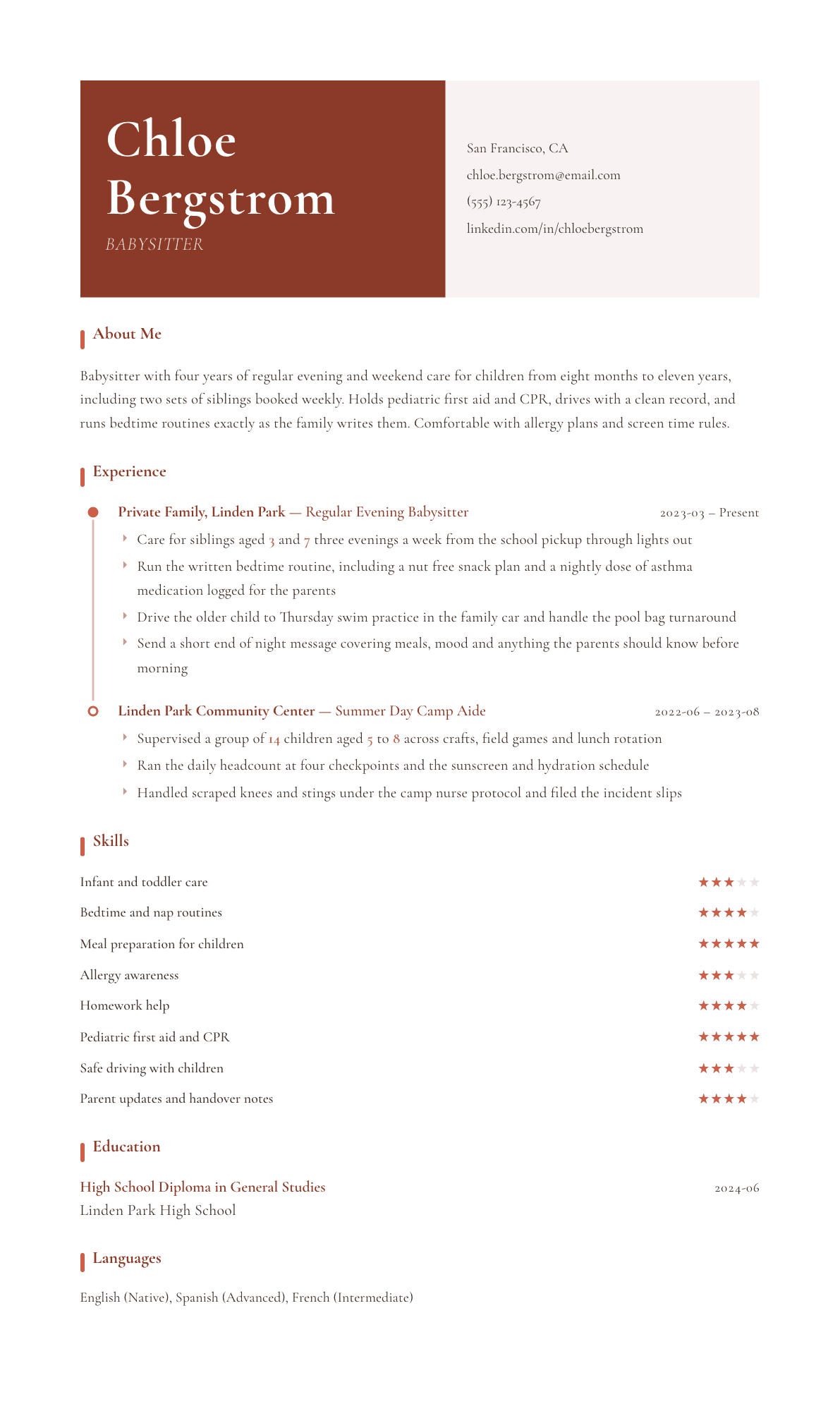
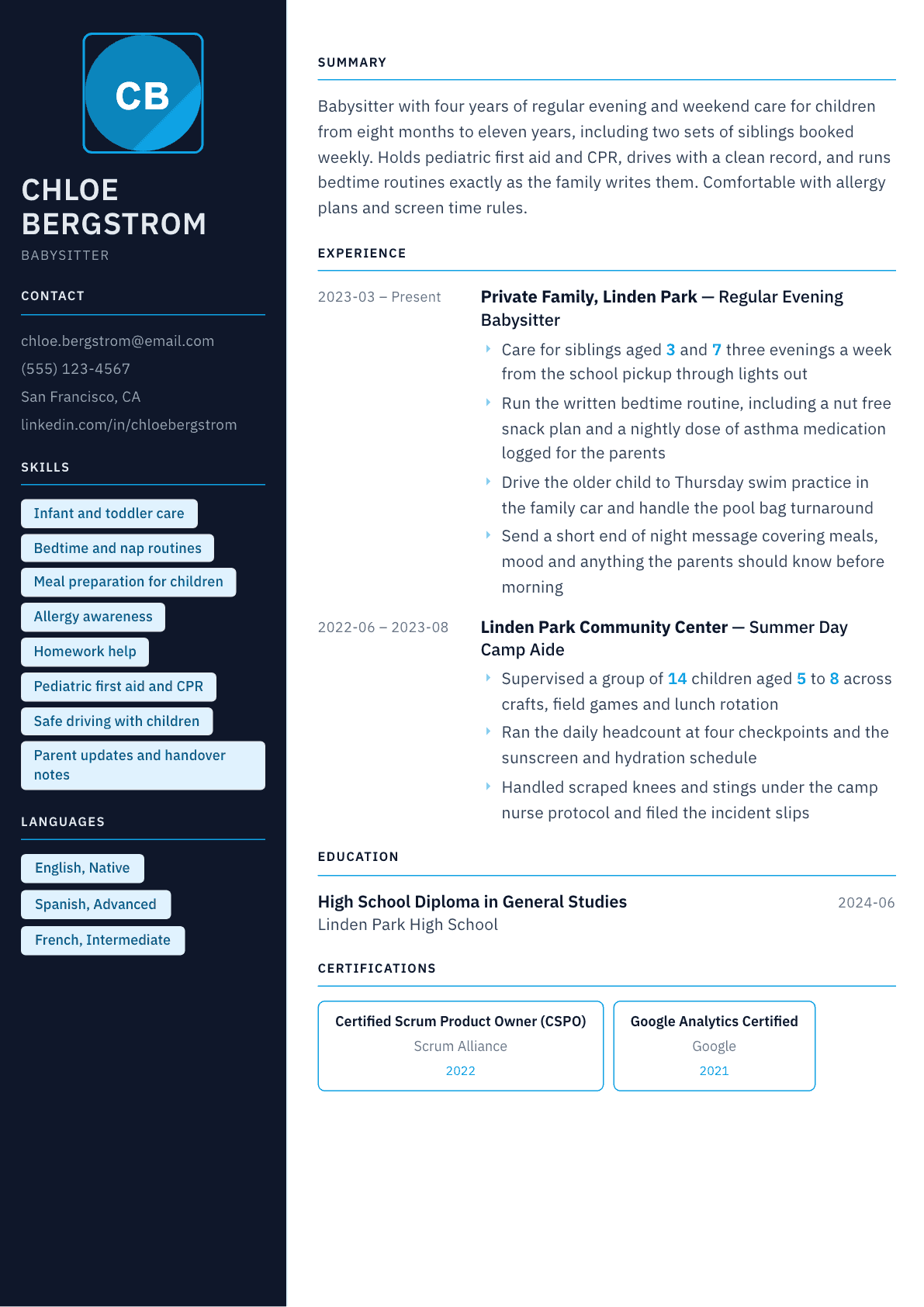
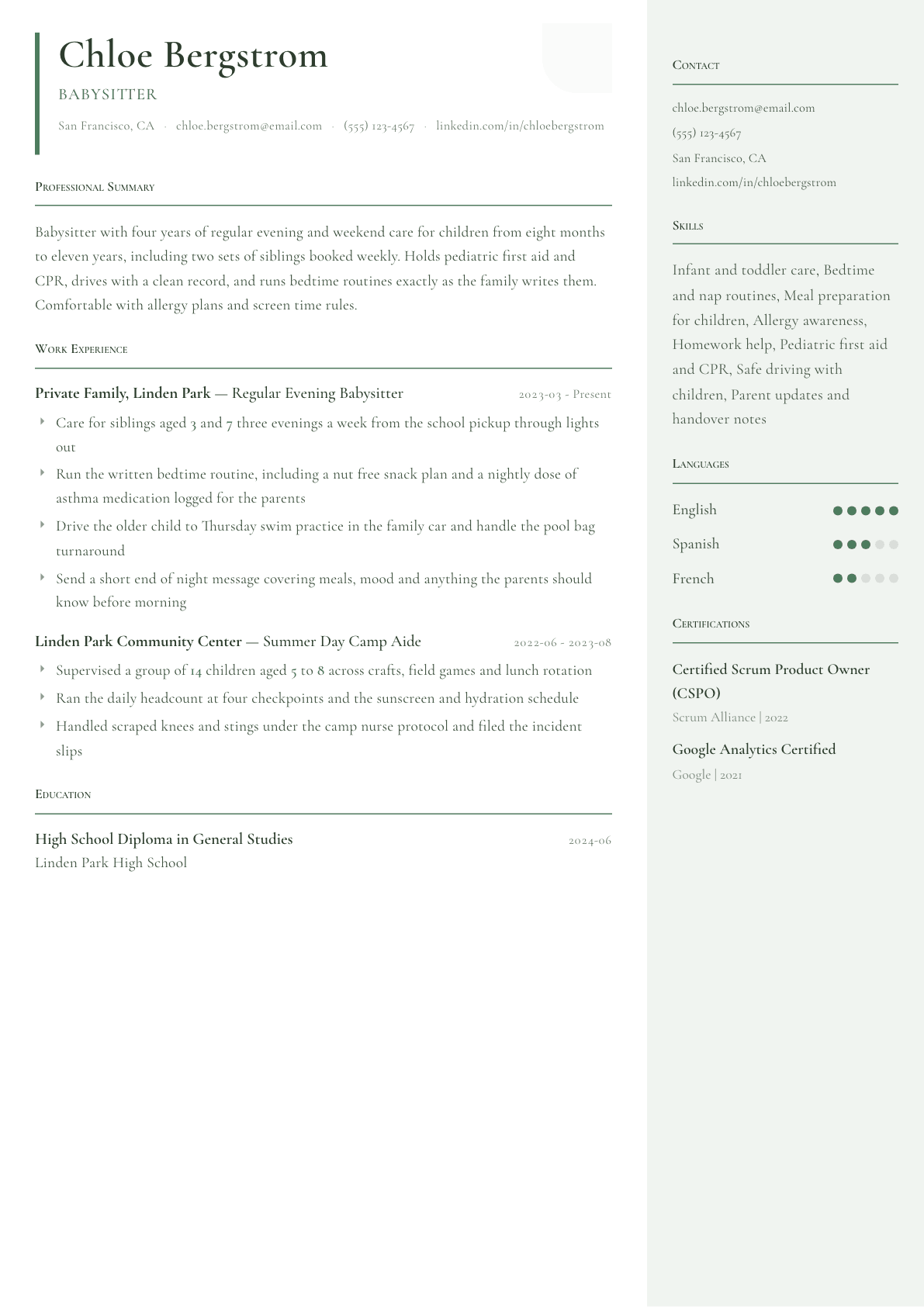
Example Babysitter summary
Babysitter with four years of steady evening and weekend care for children from eight months to eleven years, including two families booked on a weekly schedule. Runs written bedtime routines, nut free meal plans and logged medication doses exactly as parents set them. Holds pediatric first aid and CPR, drives with a clean record and handles school and practice runs. Available weeknights after four and full weekends, with two long term family references.
Skills to list on a Babysitter resume
- Infant care
- Toddler supervision
- School age activity planning
- Bedtime routines
- Meal and snack preparation
- Allergy and dietary management
- Medication administration by parent instruction
- Homework and reading support
- Pediatric first aid and CPR
- Household safety checks
- Transportation and school pickup
- Parent communication and handover
- Sibling conflict handling
- Light tidying of child areas
What actually gets this resume read
- Give the ages you have cared for in numbers, because an infant hire and a nine year old hire are different jobs.
- Put your first aid and CPR card, its issuer and its expiry date near the top where a nervous parent will see it.
- State your usual availability by day and hour, since most families are hiring a slot rather than a person.
- Say whether you drive, whose car you drive, and whether you can do school pickup, sports runs or the doctor trip.
- Name the routines you can run: bedtime, allergy plans, medication logs, screen rules, homework and the bath order.
- Offer two references with the relationship and the length of the booking, since parents call before they meet you.
How to write a babysitter resume
A babysitter resume has an unusual reader: a parent, at night, on a phone, deciding whether a stranger can be alone in the house with a sleeping three year old. There is no human resources department, no scoring rubric and no second interview round. There is one nervous person scanning for reasons to say yes and, more powerfully, for any reason to say no.
That reader has three questions in a fixed order. What ages have you actually handled? What do you do if something goes wrong? And who has already trusted you with this, for how long? Everything else on the page is decoration. A resume that answers those three in the top third gets a reply, and one that opens with a paragraph about a passion for working with children usually does not.
This guide covers how to lay out a page for a parent rather than an employer, babysitting on a resume example entries for every situation, how to write ages and hours precisely, where the first aid card belongs, how to describe routines and medical plans without overpromising, and how to present references so a parent can make one short call and be done.
Format for a parent reading on a phone
One page, wide margins, and the top block carries four things: the age range you care for, your availability, your first aid and CPR status, and whether you drive. A parent who reads those four lines knows within seconds whether to keep going. Bury them and the page competes with five other candidates who did not.
Skip the objective statement. It is the section parents skip fastest, because every version of it says the same warm thing. Replace it with three plain sentences: how long you have been sitting, the ages, and the kind of booking you are looking for, whether that is regular weeknights, occasional date nights or full weekend days.
- Age range in numbers, from the youngest infant you have cared for to the oldest child.
- Availability by day and hour window, plus how much notice you need for a last-minute booking.
- First aid and CPR card with the issuing body and the expiration month.
- Driving status: license, own car or family car, and whether you are insured to carry children.
Ages, hours and how many children at once
Caring for one seven year old and caring for a nine month old with a two year old are unrelated jobs, and parents know it better than anybody. Give every family entry the ages of the children at the time you started, the number of children you handled at once, and the hours per booking. Those three facts let a parent match you to their own house without asking.
Say whether the care was daytime, evening through bedtime, overnight, or whole days. Bedtime is the dividing line most parents care about, because a sitter who has actually run a bath, a story and a lights-out on a child who resists it is a different proposition from one who has only covered afternoons.
If you have handled a newborn, say so explicitly and say under what supervision. Parents of infants read this section with more suspicion than anyone else and will assume the worst about a vague claim.
Routines, allergies and medication, written without overreaching
The strongest sentences on a babysitter resume are the ones that show you follow somebody else's instructions exactly. Parents are not looking for your philosophy of bedtime. They are looking for evidence that the routine written on the fridge is the routine that happens. Say that you run the routine as written, and give one concrete example of a household you did it in.
Handle allergies and medication carefully and specifically. Name the type of plan you have followed, whether that is a nut-free kitchen, an epinephrine autoinjector kept in a known place, an inhaler before bed, or a dose given at a fixed hour and logged for the parents. Never claim medical training you do not have. Following a written parental instruction and administering care as a professional are different things, and a parent can tell which one you are describing.
Screens, snacks and discipline are worth a line each. Parents hire the sitter whose page shows she asks what the rules are rather than the one who announces what her rules are.
Safety, emergencies and the sentence that closes the deal
Put your first aid and CPR credential high and give the issuer and the date it expires. An expired card looks worse than no card, so refresh it before you send the page. If you have taken a dedicated babysitting course covering infant choking, home safety checks and emergency contacts, name it separately.
Then add one line on what you do in an emergency: where you keep the contact sheet, who you call first, and the fact that you text the parents a short update at a set point in the evening. Parents rarely see this on a resume, and it does more to settle nerves than any amount of warmth in the wording.
Small safety habits are worth listing because they are the ones parents notice on the first booking: outlet and stair checks in an unfamiliar house, knowing where the fire exit and the fuse box are, locking the door behind you, and never opening it to anyone the parents have not named.
References parents will actually call
Two references, each with the relationship, the ages of their children and how long you sat for them. The length is the part that persuades. A family who has booked you every second Friday for two years is a far stronger signal than three families who used you once, because repeat bookings are the only review system this job has.
Ask permission before listing anybody, and tell your references roughly what the new family will ask so they are not caught cold. If you are new and have no paid families yet, use a camp supervisor, a teacher, a coach or a neighbor whose children you have watched informally, and label the relationship honestly rather than dressing it up as employment.
Babysitting on a resume: example entries for every situation
Babysitting belongs on a resume as a job, with a title, the families or the setting, the dates and three short bullets, whether you are applying to another family or to your first job in a store or an office. Write the title as Babysitter or Private Babysitter, put Self employed or Private families where the company name would go, and never shrink regular paid sitting into a hobby line at the bottom of the page.
The example entries below show how the same experience changes with the reader. A family wants ages, routines and safety. A retail manager or an office wants reliability, responsibility and the fact that adults trusted you with the most important thing they have. Pick the version that matches the job and keep the facts identical.
- Resume for babysitting, regular family: Babysitter, private family, two afternoons a week. Cared for siblings aged 4 and 8 from school pickup until the parents got home, ran homework time and the written snack and screen rules, and sent a short update before leaving.
- Neighborhood sitter, several families: Self employed babysitter for five families on evenings and weekends, booked again by four of them. Handled bedtime for children from 2 to 10 and kept each household contact sheet on my phone.
- Babysitting on a resume for a first job: Babysitter, private families. Trusted by parents to supervise up to three children at once, managed time and routines without supervision and kept to agreed hours on every booking.
- Babysitting for a college or childcare application: Babysitter and summer sitter for a family with a toddler and an infant, including feeding, naps and diapering, under a written plan from the parents, with current pediatric first aid and CPR.
- Gap between jobs: Babysitter, part time, while studying. Two regular families, weekday evenings, both available as references.
Babysitter resume summary examples
First paid bookings
High school student with two years of neighborhood babysitting for children aged 4 to 10, mostly weekend evenings through bedtime. Holds a completed babysitting course covering infant choking and home safety, plus current first aid and CPR. Available Friday and Saturday evenings and all day Sunday.
Regular weekly families
Babysitter with four years of steady evening and weekend care for children from 8 months to 11 years, including two families booked weekly. Runs written bedtime routines, nut-free meal plans and logged medication doses exactly as parents set them. Holds pediatric first aid and CPR, drives with a clean record, and handles school and practice runs.
Experienced sitter taking overnight work
Experienced babysitter with seven years across a dozen families, covering newborns through preteens including overnight and multi-day stays while parents travel. Manages an epinephrine plan, an inhaler schedule and a household with two sets of siblings. Holds pediatric first aid and CPR and carries five long-term family references.
Work experience bullets: before and after
Before: Watched children for several families in my neighborhood.
After: Cared for six families over four years, with children from 8 months to 11 years, usually two siblings at a time on weekday evenings through bedtime.
Family count, ages, sibling load and the time of day let a parent picture their own house.
Before: Made sure the kids ate dinner and went to bed on time.
After: Ran the written bedtime routine for a 3 and a 7 year old three nights a week: dinner, bath, two books and lights out by 8, with a short update text to the parents afterward.
A routine followed as written, at a stated hour, with a check-in, is the exact thing parents buy.
Before: Comfortable with children who have allergies.
After: Followed a nut-free kitchen plan for a child with a severe allergy, kept the epinephrine autoinjector in the agreed place on every booking, and reviewed the action plan with the parents before each first evening.
It shows a documented parental plan being followed rather than a claim of medical competence.
Before: I am certified in first aid.
After: Holds current Adult and Pediatric First Aid, CPR and AED certification from the American Red Cross, renewed this year, with the card available at the first meeting.
Issuer and currency turn a certification claim into something a parent can verify in a minute.
Before: Can drive the kids places if needed.
After: Drives the family car for school pickup and Thursday swim practice, with a clean record and named coverage on the family insurance policy.
Whose car, which trips and the insurance answer the three questions a parent asks about driving.
Hard skills
- Infant feeding and diapering
- Toddler supervision and nap routines
- School-age homework support
- Meal and snack preparation for children
- Allergy plan compliance
- Medication administration by written parental instruction
- Pediatric first aid and CPR
- Home safety checks in an unfamiliar house
- School pickup and activity transport
- Bath and bedtime routines
- Handover notes and end-of-evening updates
Soft skills
- Following a household rule you would not have chosen
- Staying calm through a tantrum without raising your voice
- Keeping siblings separated when a game turns
- Reporting a small accident honestly the same evening
- Discretion about what you see inside a family home
Certifications worth listing
- Adult and Pediatric First Aid, CPR and AED (American Red Cross)
- Babysitting Basics (American Red Cross)
- Heartsaver Pediatric First Aid CPR AED (American Heart Association)
Mistakes that cost babysitter candidates the interview
- Opening with a paragraph about loving children, which every competing page also says and no parent finishes reading.
- Giving no ages, so a parent with an infant cannot tell whether you have ever held one.
- Listing a first aid card without the issuer or the expiration month, or listing one that has already lapsed.
- Describing your own approach to bedtime and discipline instead of showing you follow the household rules.
- Implying medical qualification when what you actually do is follow a written parental instruction.
- Offering references who were booked once, when a parent is looking for a family that kept rebooking you.
- Leaving out driving details, which decides the hire in any household with practices and school runs.
Babysitter resume questions
Do I really need a resume to be a babysitter?
For casual neighborhood work, no. For regular weekly bookings, agency listings or families you have not met, a one-page sheet gets you taken seriously and gives a parent something to forward to a partner. It also stops the same five questions arriving by text before every first booking.
What should a babysitter resume include if I have never been paid to sit?
Any unpaid care counts: younger siblings, cousins, a neighbor's children, a camp aide role, a church nursery shift or a school program with young children. Give the ages, the hours and who supervised. Then add a first aid card, which is the fastest way to close the credibility gap.
How do I put babysitting on a resume?
List it as a job: Babysitter as the title, private families or self employed as the employer, the months you worked, and three bullets with the ages, the duties and the trust involved. For a job outside childcare, keep the bullets on reliability, responsibility and handling people, and leave pay off the page.
Should I mention a background check?
Yes, if you have a recent one, and say who ran it and when. If you do not, add a line offering to complete one at the family's request. Parents hiring outside their own network almost always want this, and volunteering it first sets you apart from every page that stays silent.
How do I write about a booking that ended badly?
Give the dates and the role without editorializing, and keep that family off your reference list. Do not explain a difficult household on the page. If asked in conversation, describe what you did rather than what the parents did, because a sitter who criticizes a former family reads as one who will criticize this one.