Tax Accountant Resume Examples: the lines they read
Create a Tax Accountant Resume That Passes Every Review
By Mustafa Tarabya, founder of CVBooster · Published · Updated
Build a tax accountant resume that highlights tax compliance, planning expertise, and client advisory skills with ATS-optimized keywords for accounting firms and corporations.
Sample resumes for a tax accountant
The same tax accountant content laid out in three CVBooster templates, so you can see what the finished document looks like before you write a word.
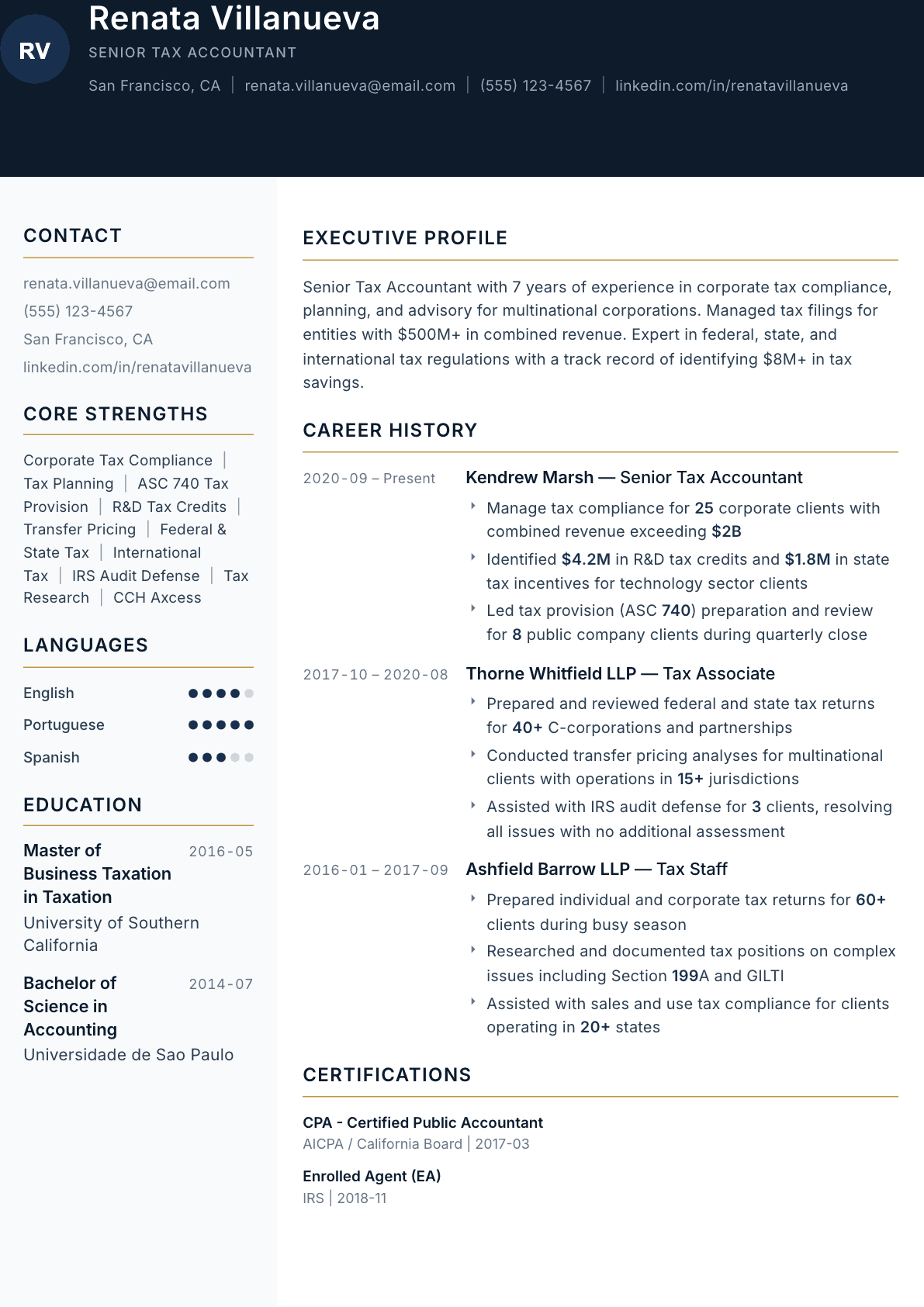
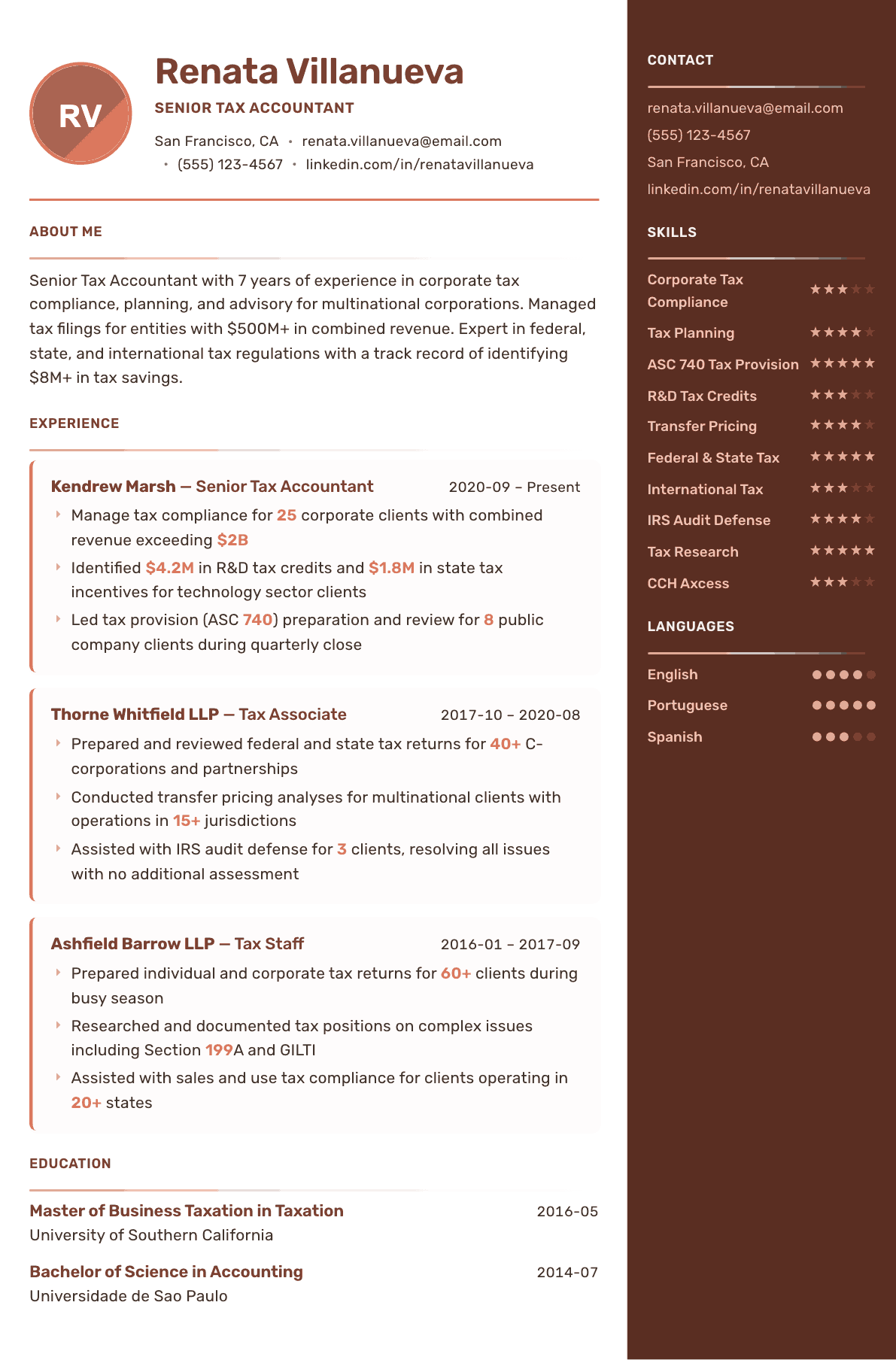
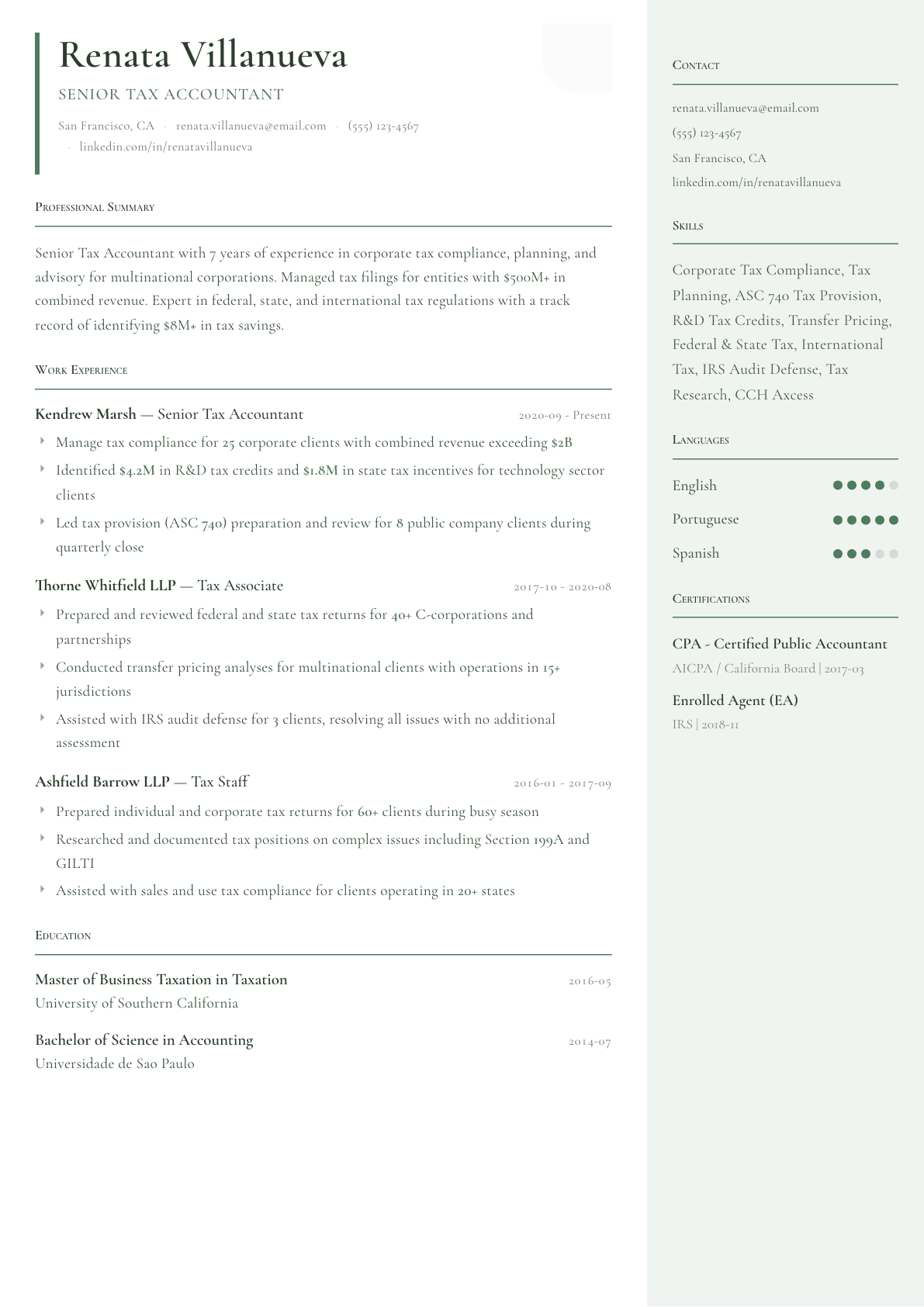
Example Tax Accountant summary
CPA and Senior Tax Accountant with 7 years in corporate tax compliance and planning at national accounting firms. Identified $8M+ in tax savings through R&D credits, state incentives, and strategic tax planning for multinational clients. Expert in ASC 740, transfer pricing, and international tax. Seeking a Tax Manager role to lead a growing compliance practice.
Skills to list on a Tax Accountant resume
- Corporate Tax Compliance
- Tax Planning & Advisory
- ASC 740 (Tax Provision)
- R&D Tax Credits
- Transfer Pricing
- Federal Tax
- State & Local Tax (SALT)
- International Tax
- IRS Audit Defense
- Tax Research
- CCH Axcess
- Thomson Reuters
- Partnership Taxation
What actually gets this resume read
- Highlight specific tax areas: corporate, individual, international, state & local, transfer pricing.
- Quantify tax savings, credits identified, and the revenue scale of clients you served.
- Include software proficiency: CCH Axcess, Thomson Reuters GoSystem, ProConnect, SAP.
- Show progression within Big 4 or national firms with increasing client complexity.
- CPA and EA credentials are essential; display them next to your name.
- Mention specific tax code sections and regulations you have expertise in.
How to write a tax accountant resume
Tax is a specialist profession that shares a job title across very different work. A tax accountant might prepare individual returns in a local practice, sit in a corporate department computing the quarterly provision, run partnership allocations for a fund administrator, handle state and local filings across dozens of jurisdictions, or work international structuring in a national firm. A hiring partner reads a tax resume first to answer which of those you have actually done, and second to see whether you review or only prepare.
The signals she uses are specific: the return types you have signed off on or prepared, the entity types, the industries, the software, the busy season volume you carried, and whether you have handled a notice or an examination without escalating it. Compliance depth and advisory depth are both respectable, but they are different products and a resume that blurs them looks unfocused.
This guide covers the section order tax employers expect, three summaries across staff, senior and manager level, before and after bullets, and the mistakes that make an experienced preparer look interchangeable with a seasonal one.
Format: credentials in the header and a return type inventory near the top
One page through senior level, two at manager and above. Put the CPA or Enrolled Agent designation directly after your name with the licensing state, and add your Preparer Tax Identification Number status if you sign returns. A tax employer is legally interested in who can sign, and the answer should not require an interview.
Right under the summary, give a short inventory: entity types and forms you have prepared or reviewed, jurisdictions, and the software. This block is what gets a tax resume read past the first ten seconds, because staffing decisions are made off exactly those facts.
- Header: name, CPA or EA with state, city and state, phone, email.
- Order: summary, return and entity inventory, experience, technical specialties, software, licenses and education.
- Candidates still sitting the exam should state sections passed and the planned date for the remainder.
Summary: entity types, complexity and where you add value
Name the entity mix in the first sentence: C corporations, S corporations, partnerships and their allocation complexity, individuals with pass through income, trusts and estates, exempt organizations, or foreign owned domestic entities. Then the complexity markers that show seniority: multistate apportionment, consolidated groups, tiered partnerships, inbound or outbound international positions, or accounting method changes.
Finish with the thing you are known for. Provision work under the income tax accounting standard, research and development credit studies, state nexus reviews, transfer pricing documentation support, or clean examination handling. Generalists are hired every season, but the candidate with a specific competence gets called first when that work is on the desk.
Experience: prepared, reviewed, and what you resolved
Use the profession vocabulary precisely. Prepared, reviewed, signed and supervised carry different meanings, and using review language when you only prepared is discovered in the first technical interview. Give season volume, since it is how tax employers measure capacity: the number of returns you prepared and the number you reviewed, split by entity type, together with the client size range.
Then show the work that goes beyond compliance. Positions researched and documented with the authority cited, notices answered, examinations managed through to closure, credits or incentives identified and substantiated, deferred tax reconciliations cleaned up, and planning conversations that changed an entity structure or an election. Naming the code area you know well, without reciting sections you have merely read, is what makes a tax resume feel written by a practitioner.
Mention the recurring calendar you have owned: quarterly estimates, extensions, the provision timeline against the audit deadline, annual reports and registrations. Reliability against a statutory calendar is a large part of what a tax employer is buying.
Software, research tools and the technology gap employers complain about
Name the preparation platform exactly: CCH Axcess or ProSystem, Thomson Reuters GoSystem Tax RS or UltraTax, Lacerte, Drake, ProConnect, Corptax or Longview for larger corporate departments, and Avalara or Vertex if you touch indirect tax. Firms convert their whole workflow around one of these, and platform familiarity is a genuine scheduling advantage in the middle of a season.
Then name the research tools, since knowing how to find and cite authority is the real skill underneath the software: Checkpoint, CCH AnswerConnect, Bloomberg Tax. Add the data side if you have it, such as Alteryx workflows for trial balance preparation, Excel automation for apportionment schedules, or fixed asset systems, because tax departments are actively hiring for people who can remove manual work from the compliance cycle.
Credentials, continuing education and the keywords in the posting
The CPA is the default credential for public accounting and corporate tax. The Enrolled Agent is a genuinely strong alternative for representation work and individual practice, and it should be stated with the credential name rather than hidden. A Master of Science in Taxation or a graduate tax certificate is worth a line of its own. If you hold a law degree with a tax focus, say so plainly because it changes the roles you can be hired into.
Postings recur on a fixed set of terms: tax compliance, tax provision, income tax accounting, multistate, apportionment, nexus, partnership allocations, research and development credit, transfer pricing, examination support, estimated payments, and the software names. Use the ones that are true, put each near an example, and keep the phrasing the employer used rather than a synonym, since tax terminology is precise and screening tools match it literally.
Tax Accountant resume summary examples
Tax staff
Tax staff accountant in a regional firm with two busy seasons preparing roughly 180 individual and 40 pass through returns in CCH Axcess, including multistate individuals and small partnerships. Passed three sections of the uniform examination. Seeking a senior track seat with review exposure.
Senior associate
CPA and senior tax associate with five years in corporate and partnership compliance, reviewing federal and multistate returns for middle market clients and preparing the quarterly and annual income tax provision. Handled two state examinations to closure. Looking for a manager track role in a corporate tax department.
Tax manager
Tax manager and CPA with ten years across public accounting and industry, owning the consolidated federal return, apportionment across 22 states, and the annual provision reviewed by the external auditors. Manages four preparers, runs the research and development credit study, and led an Alteryx rebuild of the trial balance workflow.
Work experience bullets: before and after
Before: Prepared tax returns for individuals and businesses.
After: Prepared roughly 180 individual and 40 partnership and S corporation returns each season in CCH Axcess, including multistate allocations and clients with rental and pass through income.
Volume, entity mix, jurisdiction complexity and the platform give a staffing partner everything she needs.
Before: Researched tax issues and provided guidance.
After: Researched a state nexus question raised by a client remote workforce, documented the position with the relevant statutes and rulings in a memorandum, and set the registration plan for two new states.
A documented position with an action that followed shows research capability rather than research exposure.
Before: Handled correspondence with tax authorities.
After: Responded to 14 federal and state notices and carried two state examinations to closure, including the document request schedule and the closing agreement discussion with the examiner.
Notice volume and examination closure are the clearest signal that you can be trusted with an authority contact.
Before: Assisted with the tax provision.
After: Prepared the quarterly and annual income tax provision for a consolidated group, reconciled deferred balances to the return, and cleared every auditor comment on the tax footnote in the first review round.
Provision work is judged by the auditor review, so naming that outcome is more persuasive than the task.
Before: Identified tax savings for clients.
After: Ran a research and development credit study for a software client: interviewed engineering leads, documented qualified activities by project, and built the substantiation file that supported the claim under later review.
Substantiation that survives review is the point of credit work, and the bullet shows the method rather than only the result.
Hard skills
- Federal corporate and partnership compliance
- Individual and pass through returns
- Income tax provision under the accounting standard
- Multistate apportionment and nexus analysis
- Partnership allocations and capital accounts
- Research and development credit studies
- Tax research and memorandum writing
- Notice response and examination support
- CCH Axcess and ProSystem
- Thomson Reuters GoSystem and UltraTax
- Checkpoint and Bloomberg Tax research
- Alteryx and Excel workflow automation
Soft skills
- Working to statutory deadlines
- Explaining a position to a nonspecialist client
- Reviewing another preparer work carefully
- Asking the client the uncomfortable question
- Documentation discipline
- Managing a season workload
Certifications worth listing
- Certified Public Accountant (CPA) (State Boards of Accountancy (AICPA Uniform CPA Exam))
- Enrolled Agent (EA) (Internal Revenue Service)
- Annual Filing Season Program Record of Completion (Internal Revenue Service)
- Certified Management Accountant (CMA) (Institute of Management Accountants)
- Chartered Global Management Accountant (CGMA) (American Institute of Certified Public Accountants and CIMA)
Mistakes that cost tax accountant candidates the interview
- Writing prepared and reviewed interchangeably, which collapses the moment a technical interviewer asks what you signed off on.
- Leaving out season volume and entity mix, which are the two facts a staffing partner uses to place a tax candidate.
- Listing code sections as a keyword strip. Name only the areas you can discuss with a client on the phone.
- Omitting the preparation software, when platform familiarity is a real scheduling advantage during a season.
- Describing examination work vaguely. Say whether you drafted the response, met the examiner, or watched a manager do both.
- Presenting bookkeeping and general accounting as tax experience, which reads as padding to anyone who works in tax.
Tax Accountant resume questions
Do I need a CPA to work as a tax accountant?
Not for every role. Enrolled Agents represent taxpayers and run individual practices without one, and many corporate compliance seats hire uncredentialed preparers. The CPA is expected for review and signing responsibility in public accounting and for most manager track positions.
How do I show busy season capacity on my resume?
Give return counts by entity type for a season, note the review volume separately if you reviewed, and mention the client size range. That combination tells an employer how much work you can absorb and at what complexity.
Should I list the tax software I have used?
Yes, and name the exact product rather than the vendor, since firms build their whole workflow around one platform. Distinguish between platforms you prepared in and ones you only viewed, because that difference matters in a season.
How do I move from public accounting into a corporate tax department?
Lead with provision experience, since that is the corporate department daily work, then the consolidated return, apportionment and any examination exposure. Add the automation you have built, because internal departments hire heavily for people who reduce manual compliance work.
What if I am still sitting the CPA exam?
Say exactly which sections you have passed and when you intend to complete the remainder, placed near your name rather than buried in education. Firms hire candidates mid exam constantly, and a concrete plan reads better than silence.
Related resume examples
- Accountant Resume example
- Auditor Resume example
- Forensic Accountant Resume example
- Tax Manager Resume example
- Tax Consultant Resume example
- CPA Resume example