Claims Adjuster Resume Examples: the lines they read
Claim Adjuster Resume Examples for Every Claims Line
By Mustafa Tarabya, founder of CVBooster · Published · Updated
Claim adjuster resume examples and a full claims adjuster sample: line, licenses and authority up top, pending with severity, examples by claims line.
Sample resumes for a claims adjuster
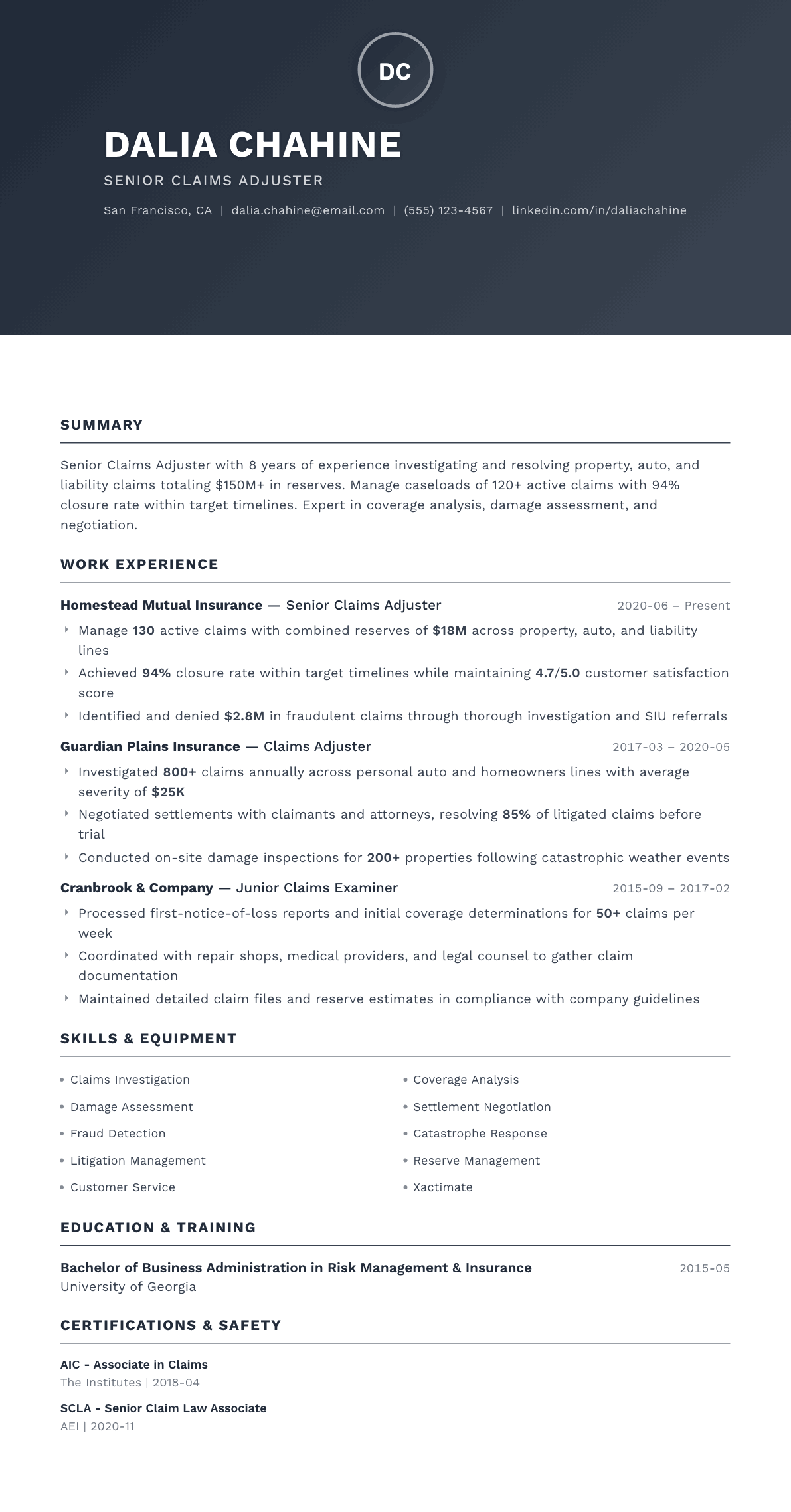
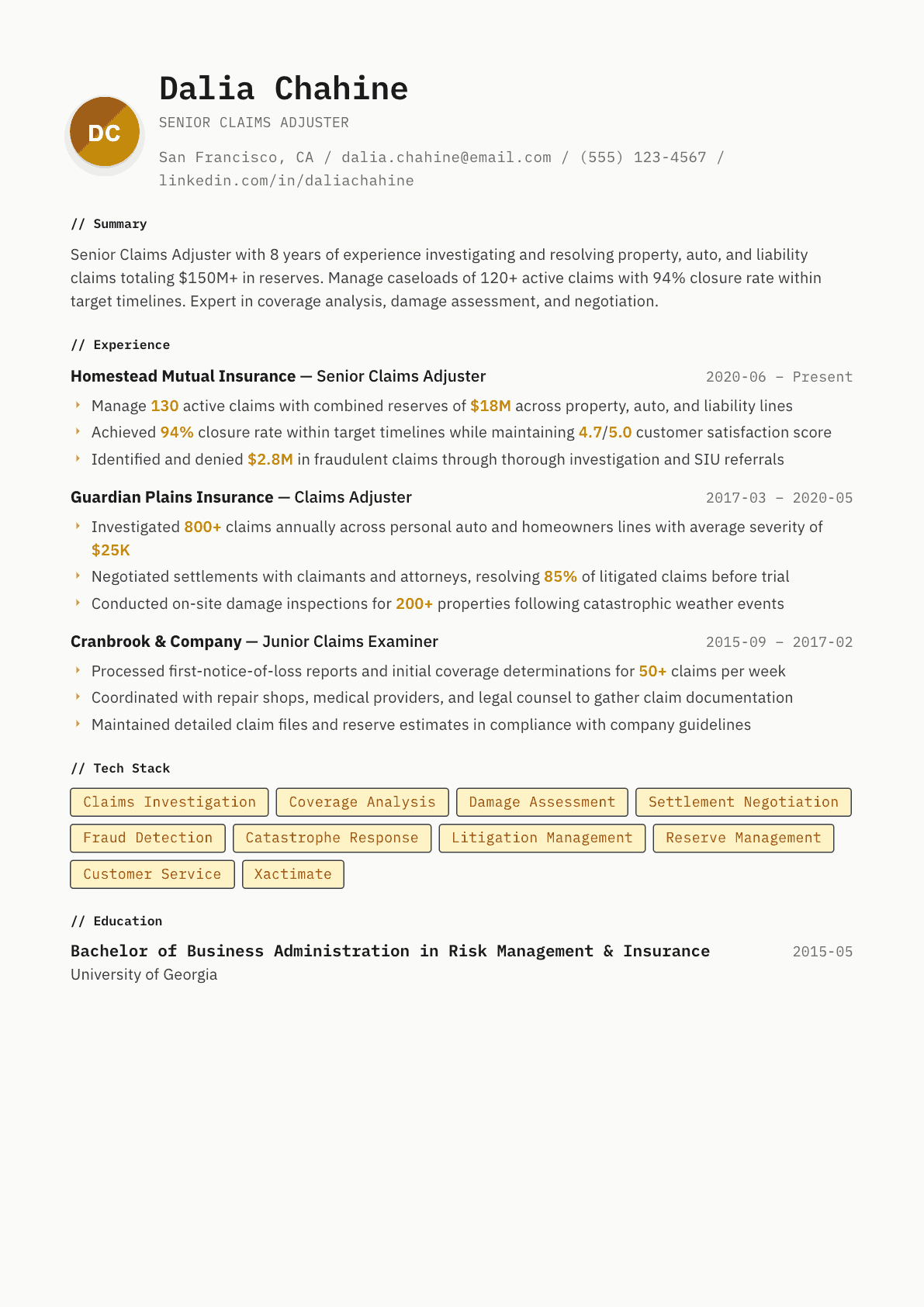
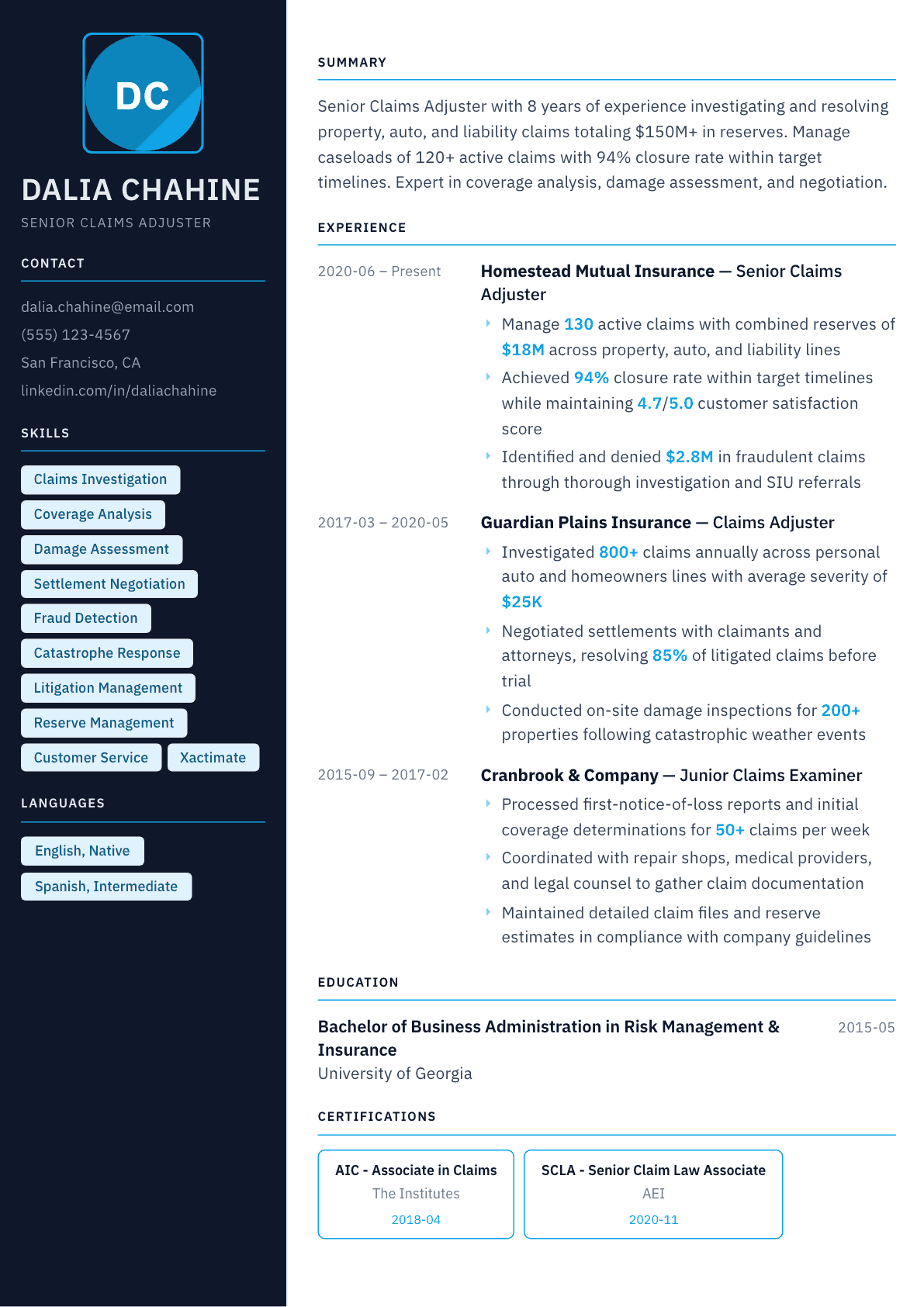
The same claims adjuster content laid out in three CVBooster templates, so you can see what the finished document looks like before you write a word.
Example Claims Adjuster summary
AIC-certified Senior Claims Adjuster with 8 years of experience resolving $150M+ in property and casualty claims. Manage 130+ active claims with a 94% on-time closure rate and 4.7/5.0 customer satisfaction. Expert in fraud detection, catastrophe response, and settlement negotiation. Seeking a Claims Manager role to lead a high-performing adjusting team.
Skills to list on a Claims Adjuster resume
- Claims Investigation
- Coverage Analysis
- Damage Assessment
- Settlement Negotiation
- Fraud Detection
- Catastrophe Response
- Litigation Management
- Reserve Management
- Customer Service
- Xactimate
- Guidewire ClaimCenter
- SIU Referrals
What actually gets this resume read
- Quantify caseload size, reserve amounts, and closure rates.
- Highlight specific claim types: property, auto, liability, workers comp, professional liability.
- Show fraud detection and SIU referral experience with amounts identified.
- Include catastrophe response experience and on-site inspection capabilities.
- Demonstrate negotiation skills with settlement-before-trial percentages.
- AIC and CPCU designations add credibility in claims management.
How to write a claims adjuster resume
A claims adjuster resume, or a claim adjuster resume as many postings spell it, is judged on three things a claims manager can see in ten seconds: what line of business you handled, how heavy your pending was, and whether you have settlement authority. Property, auto physical damage, bodily injury liability, workers compensation, commercial general liability and professional lines are separate careers, and an adjuster who does not name the line is asking the reader to sort them into a pile at random.
Authority is the fact most resumes leave out, and it is the one that most predicts the next role. An adjuster who settles within a stated limit without supervisor approval, sets reserves independently and handles litigated files is a different hire from one who documents and refers. State it plainly, along with your licensing, because adjuster licensing is state by state and reciprocity rules matter to an employer staffing several jurisdictions.
This guide covers the layout a claims resume needs, how to write pending, cycle time and settlement work honestly, claim adjuster resume examples by line of business, before and after bullets that show coverage analysis rather than file handling, and the questions adjusters ask when they move between lines, carriers and independent adjusting.
Format: line of business, licenses and authority near the top
One page for most adjusters, two once you carry a litigated inventory or supervise. Reverse-chronological and plain, because carrier applicant systems parse simply. Right under the summary, place a licensing block: each state license type and number, the designations you hold, and any adjuster license held as a nonresident.
Then a short capability line: lines handled, average pending, authority limit, and whether your files were desk, field or catastrophe. That block answers most of a claims manager first questions and keeps them reading.
- Header: name with AIC or CPCU when held, city and state, phone, email.
- Order: summary, licenses and designations, claims experience, systems, education.
- Each role names line of business, pending count, severity range, authority and territory.
Summary: line, severity, authority, and coverage depth
Say the line of business, the severity band of your files, your settlement authority and one specialty. Handling first party homeowners losses with an average severity in the low tens of thousands is a different job from handling commercial liability files with reserves an order of magnitude higher, even though both people are claims adjusters.
Coverage work is the skill that separates good adjusters, so name it. Reading a policy, applying exclusions and endorsements, issuing a reservation of rights, and writing a coverage position letter that survives review are the abilities that make a manager want to interview you.
Experience: investigation, coverage, evaluation, resolution
Walk each role through the file lifecycle. Investigation: contact standards met, recorded statements taken, scene and damage inspections, subrogation potential identified. Coverage: the policy analysis, exclusions applied, reservation of rights letters issued. Evaluation: reserve setting and reserve accuracy, damages analysis, medical record and wage loss review on injury files. Resolution: negotiated settlements, releases, mediations attended, files closed and cycle time.
Give special weight to the difficult files. A late reported claim with a coverage question, a disputed cause of loss with an engineer report, a claim with a suspected staged accident referred to the special investigation unit, or a case where a well documented evaluation held up at mediation are the stories that make an adjuster memorable.
Litigation management belongs here if you have it. Selecting and instructing defense counsel, setting a litigation budget, attending mediations and depositions, and evaluating exposure ahead of trial are supervisor track responsibilities and should not be buried in a general bullet.
Metrics a claims manager already tracks
Claims departments measure a standard set, so use their language rather than inventing your own: pending count, new assignments per month, closing ratio, average cycle time from assignment to closure, first contact within the standard, reserve accuracy or development, average paid indemnity and expense, reopened file rate, litigation rate, and quality audit scores from a file review program.
Quality audit results are the most persuasive of these because someone else scored them. If your files were reviewed by a quality assurance team or a reinsurer audit, say what the review covered and how your files came out.
Systems, estimating platforms and keywords
Name the claims system and, for property work, the estimating platform, because those are hard filters in postings: Guidewire ClaimCenter, Duck Creek, Xactimate, Symbility, CCC ONE, Mitchell and Audatex. Add the medical bill review or reserving tools if you used them, and any experience deploying to a catastrophe with mobile inspection technology.
Mirror standard posting phrases where they are true: coverage analysis, reservation of rights, reserve setting, subrogation, salvage, settlement negotiation, total loss evaluation, bad faith avoidance, special investigation unit referral, litigation management and claim file documentation.
Claim adjuster resume examples by line of business
A claim adjuster resume example only helps if it comes from your line, because a property manager and a bodily injury manager read for different proof. The complete sample on this page is written for a staff adjuster; the lines below show how the headline and the first bullet change for the other common paths, so you can borrow the shape without borrowing the wrong evidence.
An auto adjuster resume is the same document with auto in the headline: say whether you handle physical damage, auto liability or both, name the estimating platform, and give your total loss and supplement numbers in the first bullet, because auto claims managers sort on those before anything else.
Keep the same order in every version: line and authority in the headline, licenses beside it, then a first bullet that pairs pending with severity. Independent and catastrophe adjusters add deployments and carriers served; desk adjusters add cycle time and the phone or virtual inspection tools they use.
- Property field adjuster: Licensed in three states, Xactimate certified, residential and small commercial losses with on site inspections, scope writing and contents valuation.
- Auto adjuster resume (auto physical damage or auto liability): Desk and field appraisal on a steady pending, CCC ONE and Mitchell estimates, total loss evaluation and salvage, rental and supplement control.
- Bodily injury liability: Settlement authority within a stated limit, medical record and demand review, attorney represented files, litigation handled with defense counsel.
- Workers compensation: Lost time and medical only files, compensability decisions within state deadlines, return to work coordination with employers and nurse case managers.
- Independent or catastrophe adjuster: Deployments listed by event type and carrier, daily inspection volume, mobile estimating and clean file handoff to the carrier desk.
Claims Adjuster resume summary examples
Claims trainee
Licensed property and casualty adjuster in two states, completing a carrier training program on auto physical damage and now handling a pending of 60 low complexity files. Estimates in CCC ONE, meets 24 hour contact standards, and looking to move into first party property claims.
Field property adjuster
Field claims adjuster handling first party homeowners and small commercial property losses with a pending of 95 files and settlement authority to 50 thousand dollars. Writes estimates in Xactimate, issues reservation of rights letters on disputed causes of loss, and has completed three catastrophe deployments.
Senior liability adjuster
Senior claims adjuster on commercial general liability with a litigated inventory of 70 files, authority to 250 thousand dollars, and responsibility for reserve adequacy on the assigned book. Manages defense counsel, attends mediations, and mentors two adjusters on coverage analysis and evaluation.
Work experience bullets: before and after
Before: Handled a high volume of insurance claims.
After: Carried a pending of 110 first party property files across three states, taking roughly 35 new assignments monthly and closing at a rate that held the inventory flat through two storm seasons.
Pending, intake and the closing balance describe the workload a claims manager is staffing for, unlike the phrase high volume.
Before: Investigated claims and determined coverage.
After: Investigated a disputed water loss with an engineer inspection and recorded statements, applied the wear and tear exclusion, and issued a coverage denial that was upheld through the department of insurance complaint process.
A real coverage decision that survived outside review proves policy skill better than any summary of investigation duties.
Before: Negotiated settlements with claimants and attorneys.
After: Negotiated 140 bodily injury settlements within authority using a documented damages evaluation, resolving 22 represented claims before suit and attending 9 mediations with defense counsel.
Settlement counts, pre-suit resolutions and mediation attendance show negotiation depth rather than the fact that negotiation occurred.
Before: Set reserves on assigned claims.
After: Set and maintained indemnity and expense reserves on a liability inventory, reviewed the book quarterly for adverse development, and held reserve movement within the range set by the claims audit review.
Reserve discipline measured against an audit is the metric a claims leader watches most closely, so naming it lands.
Before: Identified potentially fraudulent claims.
After: Referred 18 files to the special investigation unit on indicators including prior loss history and inconsistent statements, supporting two investigations that ended in withdrawn claims.
Referral counts, the indicators used and an outcome show a real fraud eye rather than a claimed suspicion of fraud.
Hard skills
- Coverage analysis and policy interpretation
- Reservation of rights and denial letters
- Reserve setting and adverse development review
- Recorded statements and scene investigation
- Property estimating in Xactimate and Symbility
- Auto estimating in CCC ONE and Mitchell
- Bodily injury damages evaluation
- Settlement negotiation and releases
- Subrogation and salvage recovery
- Litigation management and defense counsel oversight
- Special investigation unit referrals
- Guidewire ClaimCenter and Duck Creek
Soft skills
- Empathy with a claimant after a loss
- Holding a position under pressure
- Clear file documentation
- Time control across a large pending
- Negotiating without escalating
Certifications worth listing
- Associate in Claims (AIC) (The Institutes)
- Chartered Property Casualty Underwriter (CPCU) (The Institutes)
- Associate in General Insurance (AINS) (The Institutes)
- Certified Fraud Examiner (CFE) (Association of Certified Fraud Examiners)
- State resident and nonresident adjuster licenses (State departments of insurance)
Mistakes that cost claims adjuster candidates the interview
- Not naming the line of business, so a property resume is screened by a bodily injury manager and discarded.
- Leaving out settlement authority, which is the fastest signal of seniority available to a claims adjuster.
- Listing licenses vaguely instead of state by state, when an employer needs to know which jurisdictions you can work today.
- Describing file handling without a single coverage decision, which reads as an administrator rather than an adjuster.
- Omitting the estimating platform on property and auto files, since it is a hard filter in most postings.
- Using claim counts alone with no pending, cycle time or audit result, so the reader cannot judge quality against volume.
Claims Adjuster resume questions
Should I list my adjuster licenses by state?
Yes, each state with the license type and the designated home state if you hold a nonresident license. Carriers staff by jurisdiction, and a candidate already licensed where the desk sits can be productive weeks earlier than one who is not.
What is the most important number on a claims adjuster resume?
Pending count paired with severity. Together they describe your capacity and the complexity you have handled. Add cycle time, closing ratio and any quality audit result, since those tell a manager whether the volume came with discipline.
How do I move from auto physical damage to bodily injury claims?
Lead with any injury exposure you have already touched: medical record review, wage loss verification, attorney contact, and evaluation of general damages. Name the coverage work you do today, and add courses from The Institutes to show the direction is deliberate.
What should a claim adjuster resume example include?
Your line of business, licenses by state, settlement authority, pending paired with severity, and the claims and estimating systems you use. A good example also shows coverage decisions and resolutions in the bullets, not just file handling, so copy the structure from an example in your own line.
Does catastrophe deployment experience help a staff adjuster application?
Yes, considerably. It shows you can produce under volume, work independently in the field, write estimates without a supervisor nearby and handle claimants in distress. Name the number of deployments and the type of event rather than just the word catastrophe.
Related resume examples
- Underwriter Resume example
- Compliance Analyst Resume example
- Risk Manager Resume example
- Bank Teller Resume example
- Fraud Analyst Resume example
- Insurance Agent Resume example