Head of People Resume Examples: the lines they read
Write a Head of People Resume That Wins Board Trust
By Mustafa Tarabya, founder of CVBooster · Published · Updated
Head of People resume examples, a sample people leader profile, keywords founders screen for, and a guide to writing every section.
Sample resumes for a head of people
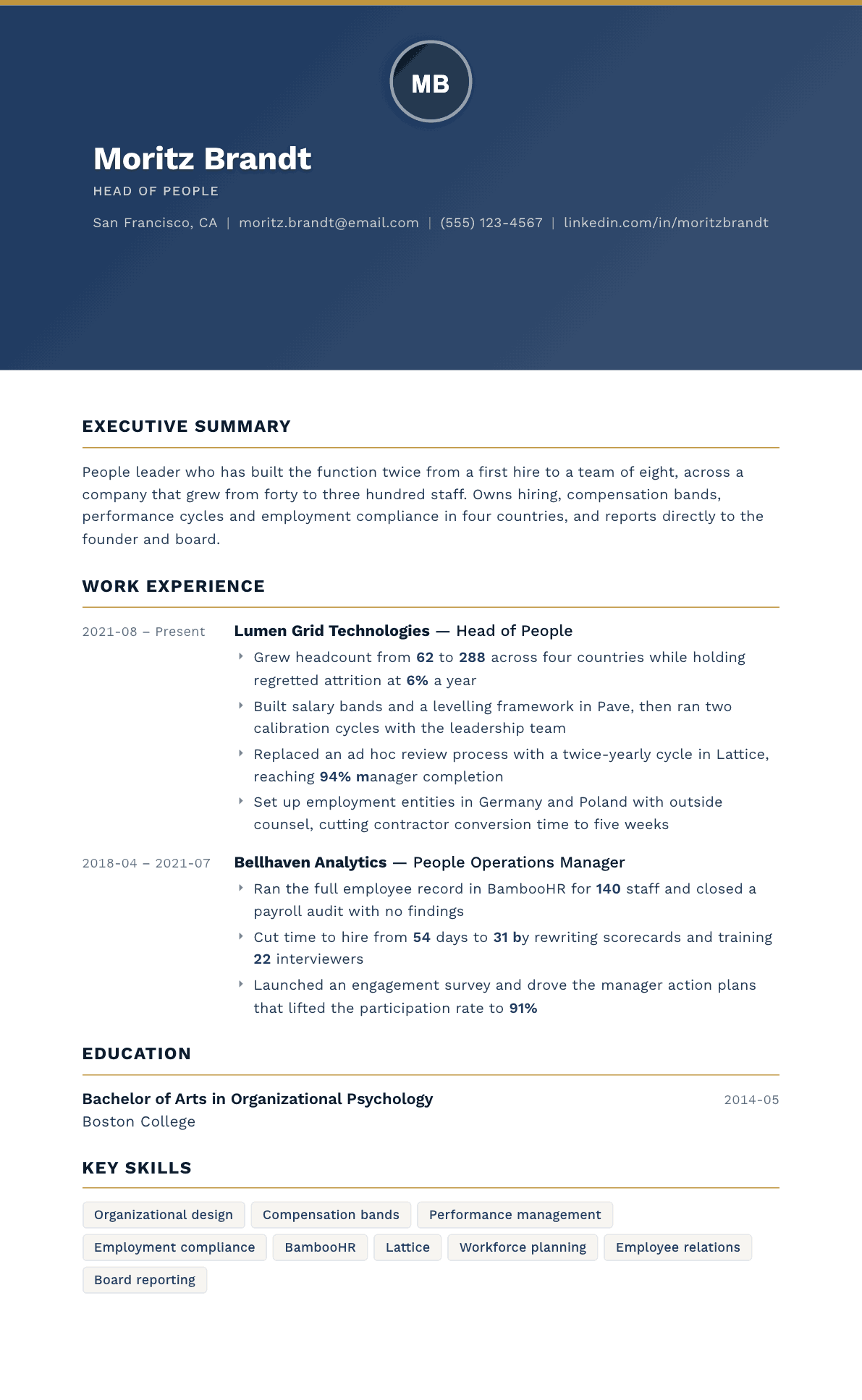
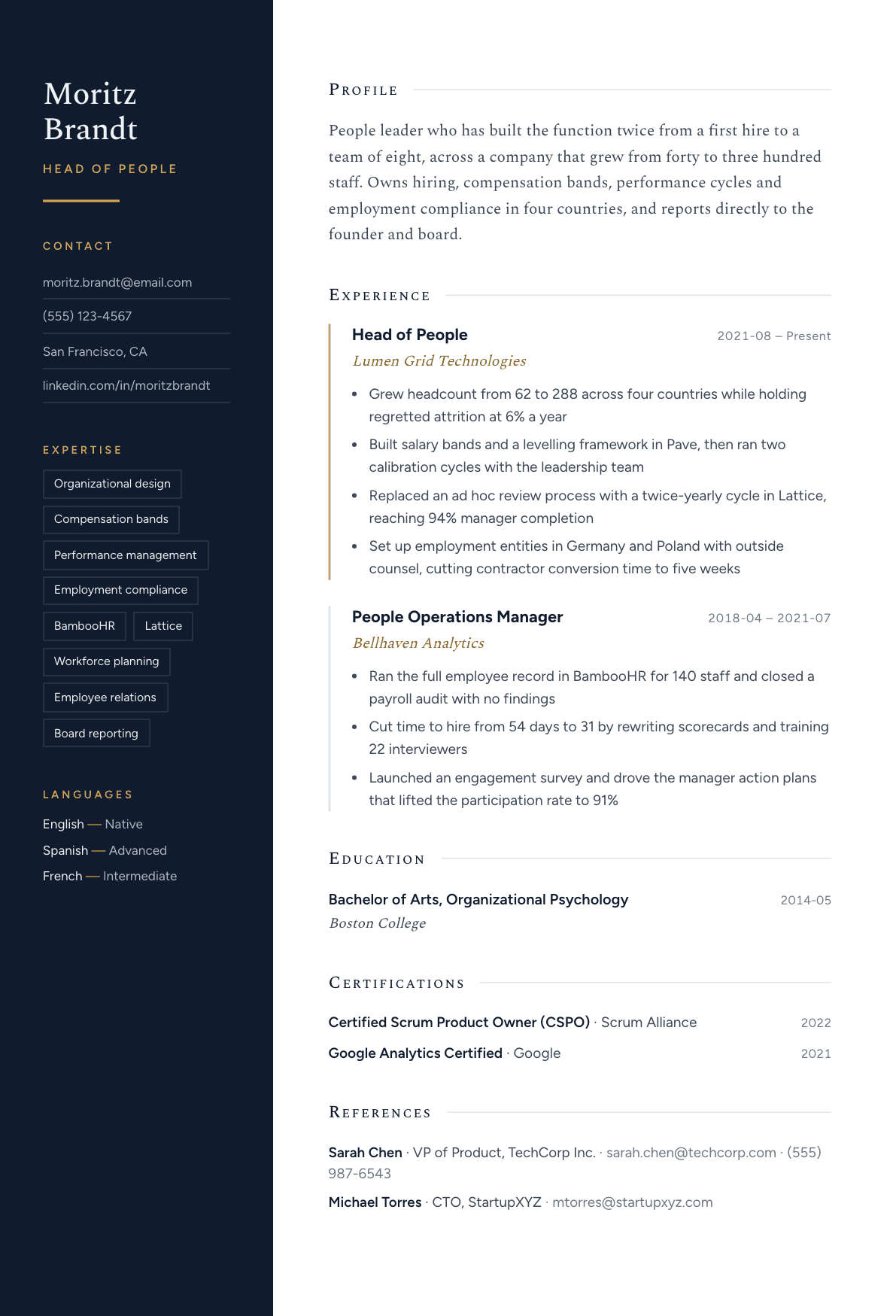
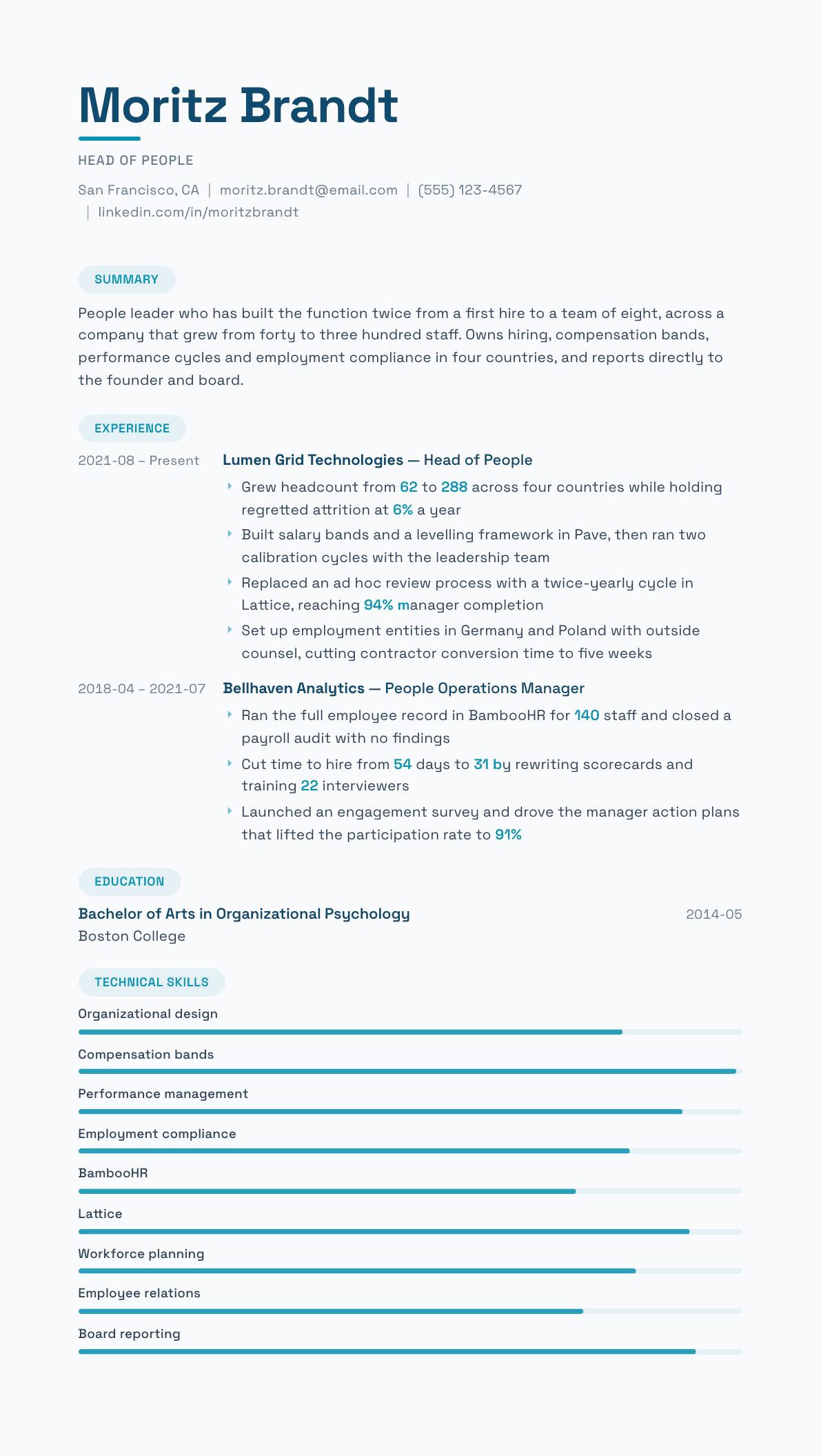
The same head of people content laid out in three CVBooster templates, so you can see what the finished document looks like before you write a word.
Example Head of People summary
Head of People with nine years across venture-backed software companies, currently owning hiring, rewards, employee relations and compliance for a three hundred person business in four countries. Built the levelling and pay band framework the leadership team now calibrates against, and coach a management group of thirty. Looking for a first people leader seat where the function reports to the founder.
Skills to list on a Head of People resume
- Organizational design
- Compensation strategy
- Workforce planning
- Performance management
- Employee relations
- Employment law compliance
- HRIS administration
- Total rewards
- Talent strategy
- Manager coaching
- Engagement surveys
- People analytics
- Succession planning
- Policy writing
- Board reporting
What actually gets this resume read
- Open with the headcount you supported and the stage of the company, because scope is the first thing a founder checks.
- Show the systems you own by name: the HRIS, the performance platform, the payroll provider and the countries they cover.
- Give each people program a before and after, such as review completion, offer acceptance or regretted attrition.
- Name the leaders you partnered with by function, since a people lead is judged on who took the advice.
- Separate the work you did yourself from the work your team delivered, so seniority is never guessed at.
- Put employment compliance and any entity or works council experience in its own line for international employers.
How to write a head of people resume
A Head of People resume lands on the desk of a founder, a chief operating officer or a board member who has usually never hired for this function before. They are not looking for a list of HR duties. They are trying to answer one question: if this person owns hiring, pay, performance and employment risk for us, will anything go wrong that we would not see coming?
That means scope is the first thing your resume has to prove. Headcount supported, number of countries, size of the people team, and who you reported to. A people leader running a two hundred person company with a payroll in three jurisdictions is doing a different job from one supporting forty staff in a single office, and the reader cannot tell the difference from a job title alone.
This guide covers the section order that works for a first people leader role, three example summaries at different stages, before and after bullets taken from the kind of drafts people leaders actually submit, and the questions that come up most when writing this resume.
Format: scope in the header, two pages once you have led a team
Reverse chronological, no columns, no skill rating bars. Under the job title in each role, add a short scope line before your bullets: headcount at the start and end of your time, the size of the people team, the countries covered, and the reporting line. That single line does more work than any summary sentence.
One page is fine if you are stepping up from a people operations manager seat. Once you have led a team through a growth phase or a reduction, two pages is normal and expected. Put anything that is really an HR administrator task into a compressed early career block rather than giving it full bullets.
- Header: name, city, phone, email, and a one line positioning statement such as first people hire or people leader for a scaling software business.
- Sections in this order: summary, experience with scope lines, selected people programs, education, certifications, systems.
- Keep a short systems line naming the HRIS, payroll provider and performance platform you have administered.
Summary: stage, scope, and the thing you are known for building
Four lines at most. Name the stage of company you operate best in, the headcount and geography you have carried, the parts of the function you own end to end, and the one program you are known for. Founders hire people leaders for a specific gap, usually hiring speed, pay structure or manager capability, so make yours obvious.
Avoid describing yourself as strategic. Every candidate for this job claims it. Show it instead by naming a decision you influenced: a levelling framework the leadership team calibrates against, a hiring freeze you planned the exit from, a reorganization you designed with the executive team.
Experience: programs you built, not the HR calendar
A weak people leader resume lists the annual cycle: onboarding, reviews, engagement survey, open enrollment. Everyone in the function does those. A strong one shows what state each area was in when you arrived and what state it was in when you left, and names the constraint you worked around.
Group your bullets by the four areas an executive team cares about. Talent, meaning hiring plan delivery and quality. Rewards, meaning bands, equity practice and benefits renewal. Performance and development, meaning the review cycle and manager capability. Risk, meaning employment compliance, employee relations cases and terminations handled without escalation.
Include the hard moments if you have handled them. A layoff run properly, a workplace investigation closed cleanly, a first works council conversation, an immigration case that did not fall over. These are the reasons a board wants an experienced person in the seat, and they are almost always missing from the draft.
Systems, compliance and the operating detail
Name the HRIS you have administered rather than only used, the payroll provider or employer of record, the applicant tracking system, and the performance platform. A founder is trying to work out whether you can run a migration without a consultant, so say if you led an implementation and how long it took.
For compliance, name the jurisdictions you have actually operated in and the flavor of work you did there: entity setup with counsel, contractor conversions, statutory leave, benefits renewals, or classification reviews. Vague claims of compliance expertise read as risk to anyone who has been through an audit.
Keywords a search will match on
Postings for this role reuse a small set of phrases: organizational design, total rewards, workforce planning, employee relations, performance management, people analytics, employment compliance, manager coaching and business partnering. Use the exact wording once in your summary or systems line and once inside a bullet where you show it happening.
If the company is venture backed, mirror its vocabulary: levelling, calibration, equity refresh, headcount plan, run rate. If it is a traditional employer, mirror theirs: job architecture, grading, succession, industrial relations. The same experience needs different labels depending on who is reading.
Head of People resume summary examples
First people leader seat
People operations manager stepping into a head of people role, currently the senior people person for a 90 employee software company. Own hiring, onboarding, the HRIS and the review cycle, and advise four department leads on pay and performance conversations. Looking for a first standalone people leader seat reporting to a founder.
Leading a small team
Head of people for a 250 person business across three countries, leading a team of four covering recruiting, people operations and rewards. Built the pay band and levelling framework, moved reviews to a twice yearly cycle, and closed 11 employee relations cases in the last year without escalation.
Executive people leader
Executive people leader with 14 years in the function, currently accountable for a 900 employee organization in seven countries with a people team of 12. Owns talent, rewards, compliance and the board people update, has run one restructuring and two acquisition integrations, and coaches a leadership group of eight.
Work experience bullets: before and after
Before: Responsible for all HR functions at a growing startup.
After: Sole people leader for a company that grew from 62 to 288 employees in four countries, owning hiring, pay bands, performance and employment compliance with no outside HR consultant.
The headcount, the growth and the absence of external support tell a founder exactly how much weight you carried alone.
Before: Implemented a performance management process.
After: Replaced ad hoc feedback with a twice yearly review cycle, trained 30 managers on writing evidence based ratings, and reached 94% completion in the first full cycle.
It names what existed before, the manager work that makes reviews stick, and a completion figure the reader can check.
Before: Handled employee relations issues.
After: Investigated and closed 11 employee relations cases including two formal grievances, documenting each to a standard that held when reviewed by outside employment counsel.
Volume plus the counsel review turns a sensitive area from a claim into evidence of sound handling.
Before: Worked on compensation.
After: Built salary bands for 34 roles across three markets, ran two calibration sessions with the leadership team, and corrected 19 out of band salaries within one budget cycle.
The band count, the calibration ritual and the corrections show a finished compensation system rather than a spreadsheet.
Before: Supported the leadership team.
After: Advised the founder and four function leads on a reorganization that moved 40 people into new teams, writing the consultation plan and the manager scripts for every conversation.
Naming the decision, the people affected and the artifacts you produced makes the advisory claim concrete.
Hard skills
- Organizational design
- Compensation bands and levelling
- Workforce and headcount planning
- Performance cycle design
- Employee relations investigations
- Employment compliance across jurisdictions
- HRIS administration and migration
- Total rewards and benefits renewal
- People analytics and reporting
- Restructuring and consultation
- Policy and handbook writing
- Board and executive reporting
Soft skills
- Executive influence
- Manager coaching
- Confidentiality under pressure
- Difficult conversation handling
- Cross functional partnership
- Judgment on ambiguous cases
Certifications worth listing
- SHRM Senior Certified Professional (SHRM-SCP) (Society for Human Resource Management)
- Senior Professional in Human Resources (SPHR) (HR Certification Institute)
- Global Professional in Human Resources (GPHR) (HR Certification Institute)
- Certified Compensation Professional (CCP) (WorldatWork)
Mistakes that cost head of people candidates the interview
- Listing the annual HR calendar as achievements, which reads as maintenance rather than leadership.
- Leaving out headcount, geography and team size, so the reader cannot size the job you actually did.
- Claiming to be a strategic partner without naming a single decision you changed.
- Hiding the hard work: layoffs, investigations and terminations are what an experienced hire is paid for.
- Using internal program names that mean nothing outside the company instead of describing what the program did.
- Writing two pages of philosophy about culture with no evidence of a system you built and ran.
Head of People resume questions
How is a head of people resume different from an HR manager resume?
An HR manager resume proves you can run the function correctly. A head of people resume proves you can decide what the function should be: the hiring plan, the pay structure, the risk you accept, and what you tell the board. Lead with decisions and scope rather than process ownership.
Do I need certifications for a head of people role?
They help in traditional employers and matter less in venture backed companies, where scope and stage carry more weight. If you hold a senior credential from a recognized body, list it in its own line. Do not let a missing certification stop you applying when your scope is right.
How do I show impact when most of my work is confidential?
Describe the shape of the work without the detail: the number of cases, the type, the outcome standard, and who reviewed it. You can say you closed two formal grievances and documented them for outside counsel without naming anyone or describing the allegations.
Should I include a layoff or restructuring on my resume?
Yes, if you led it. Boards want someone who has done it before. Write it neutrally: the number of people affected, the consultation approach, the notice and severance work, and how the remaining team was supported. Avoid language that celebrates the cost saving.
What if I was the only person in HR and have no team leadership to show?
Standalone scope is a selling point when you frame it that way. State that you were the sole people person, name the headcount you carried, and list the things you did without support that larger companies split across three specialists.
Related resume examples
- Chief People Officer Resume example
- HR Business Partner Resume example
- People Operations Manager Resume example
- HR Director Resume example
- HR Manager Resume example
- VP of Human Resources Resume example