VP of Human Resources Resume Examples: read this first
Write a VP of Human Resources Resume for the Board Table
By Mustafa Tarabya, founder of CVBooster · Published · Updated
A VP of human resources resume example with executive bullets, the governance and total rewards keywords search committees use, and a guide.
Sample resumes for a vp of human resources
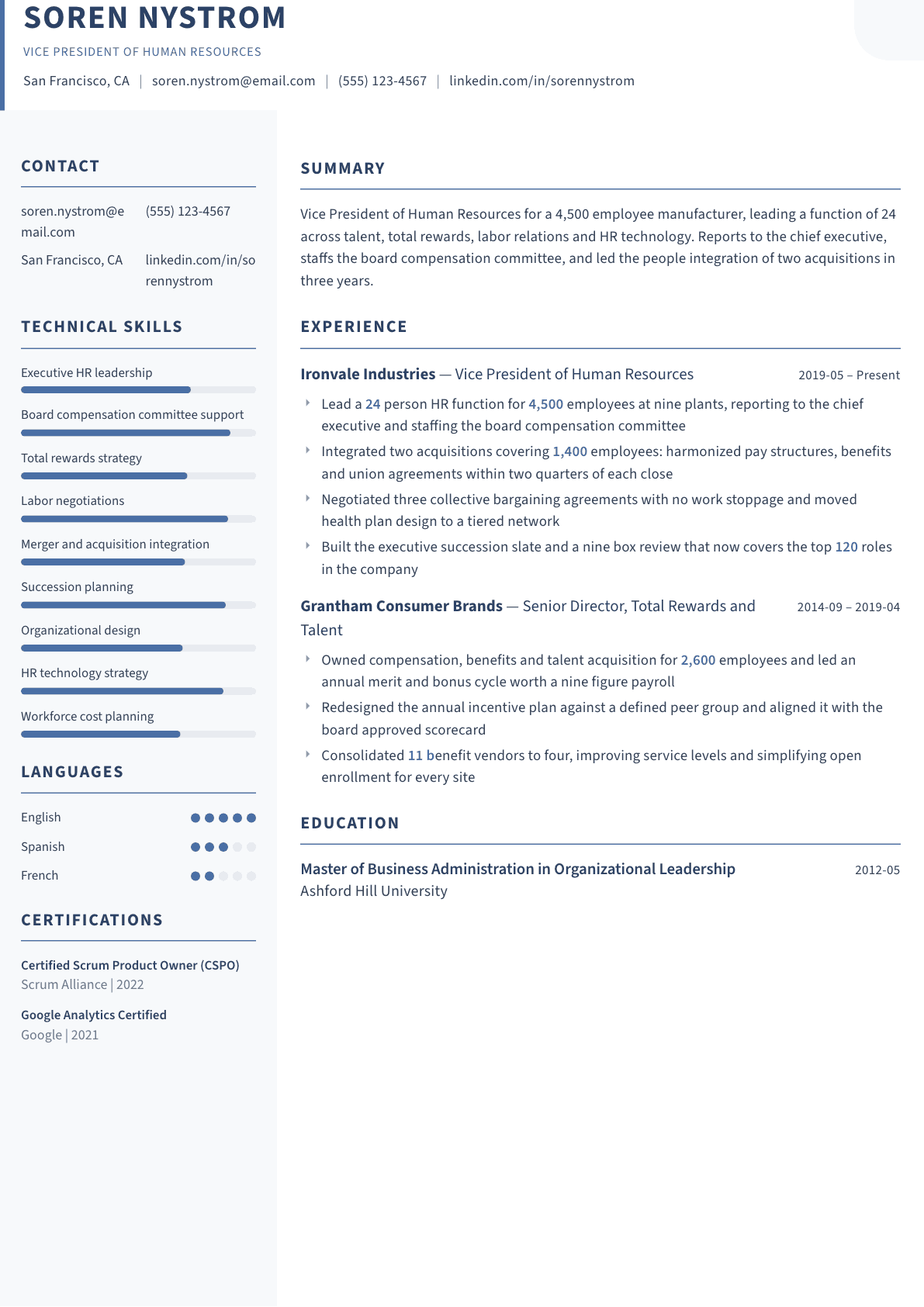
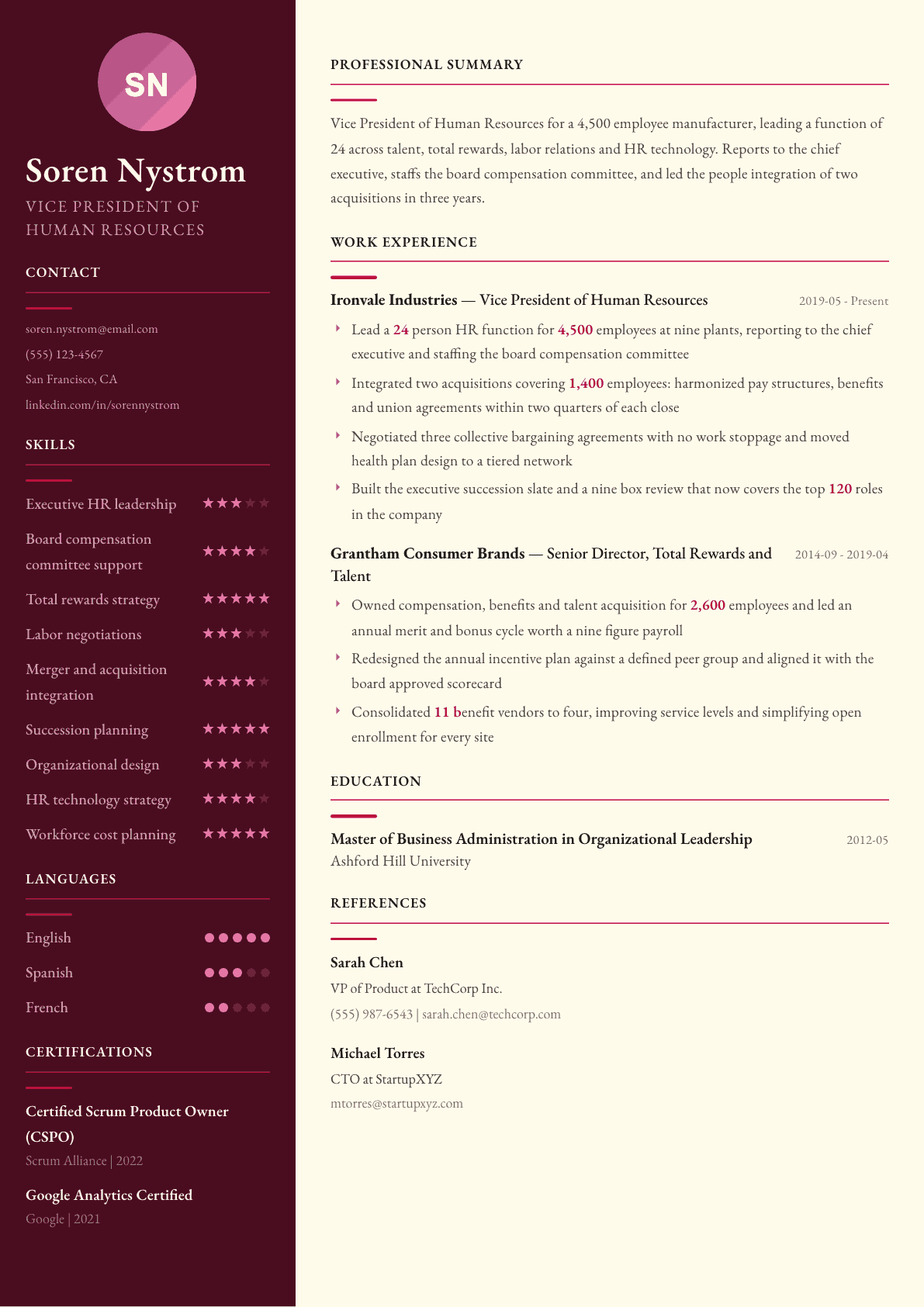
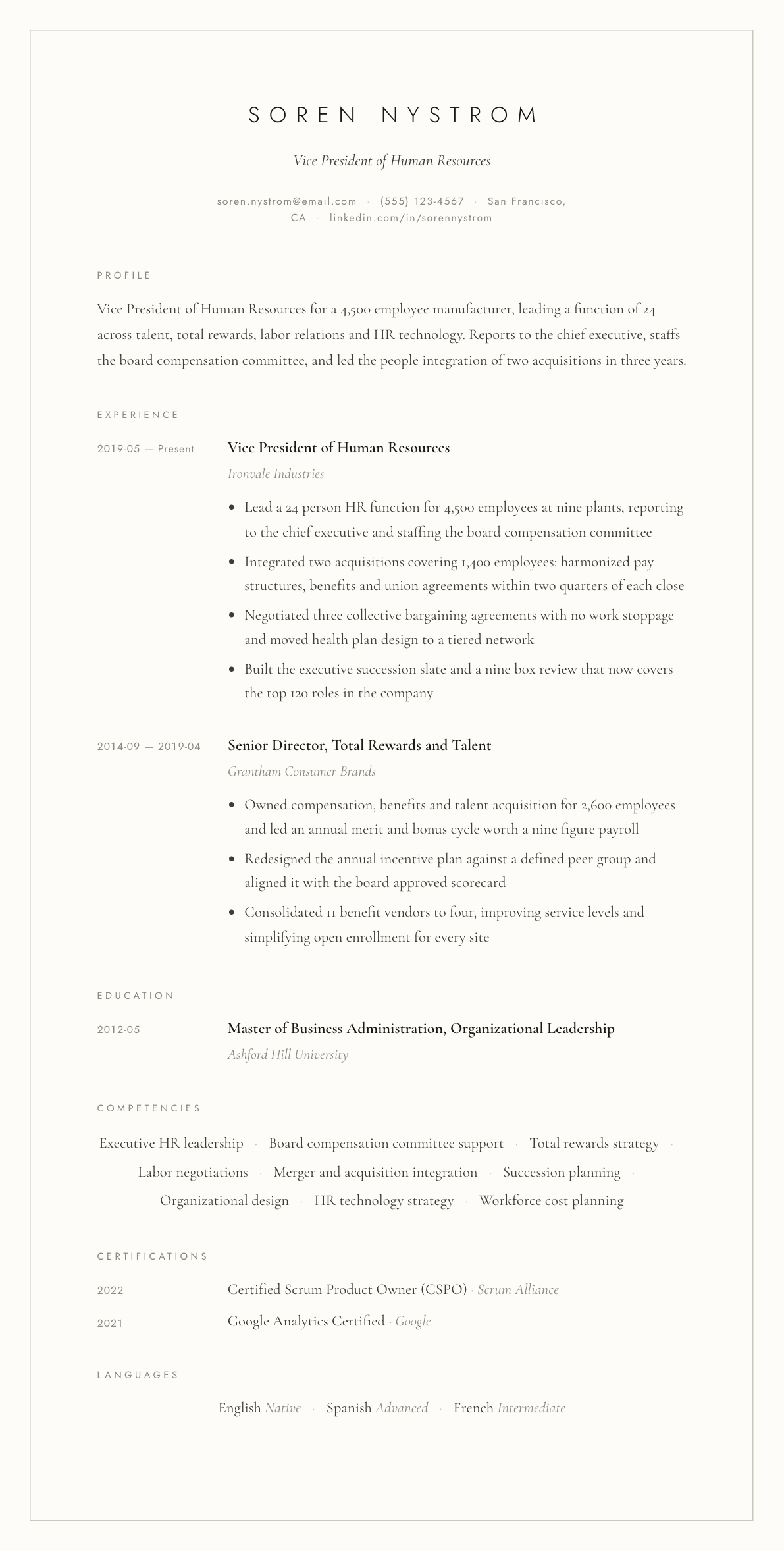
The same vp of human resources content laid out in three CVBooster templates, so you can see what the finished document looks like before you write a word.
Example VP of Human Resources summary
Vice President of Human Resources leading a 24 person function for a 4,500 employee manufacturer across nine plants. Reports to the chief executive, staffs the board compensation committee, and has integrated two acquisitions covering 1,400 employees. Negotiated three collective bargaining agreements without a work stoppage and built the succession slate covering the top 120 roles. Seeking a chief people officer seat in an industrial or multi site company.
Skills to list on a VP of Human Resources resume
- Executive HR leadership
- Board and compensation committee governance
- Total rewards strategy
- Executive compensation design
- Collective bargaining
- Labor relations strategy
- Merger and acquisition people integration
- Organizational design
- Succession and talent review
- Workforce cost modeling
- HR technology roadmap
- Culture and engagement strategy
- Global mobility oversight
- Employment law and risk governance
- People analytics
- Executive team partnership
What actually gets this resume read
- State the reporting line and the board exposure in the first two lines, because that is the first thing a search committee verifies.
- Describe the function you lead by structure: how many leaders report to you and which centers of expertise sit under them.
- Anchor achievements to enterprise events such as acquisitions, restructurings, bargaining cycles and executive pay design.
- Show workforce economics in a way a chief financial officer respects: cost per hire trend, benefits cost curve, or productivity per employee.
- Cut anything transactional. At this level a single onboarding or scheduling bullet undercuts the whole document.
- Keep the resume to two pages, with a short leadership philosophy line rather than a page of competencies.
How to write a vp of human resources resume
A VP of human resources resume is a governance document as much as a career history. The people reading it are a chief executive, a board search committee, or a retained recruiter briefing that committee, and their first question is whether you can sit in a room where executive pay, workforce cost and enterprise risk are decided and hold your own with the finance and legal leaders already there.
Very little of that is demonstrated by describing HR programs. It is demonstrated by reporting line, function structure, board exposure, the enterprise events you have led, and the workforce economics you can speak to without a briefing. The resume that wins at this level reads like the operating record of a business leader who happens to run the people function.
This guide covers how to state scope and governance in the first block, how to write achievements tied to enterprise outcomes, what to do with the transactional history that got you here, and the questions candidates ask when they are moving from director to vice president or from vice president toward a chief people officer seat.
Format: two pages, governance stated before achievements
Two pages, single column, conservative. Open with three or four lines of positioning, then a scope block covering employee population, geographies, function size and structure, reporting line, and board committee exposure. A search committee reads that block first and often decides on it alone whether to continue.
Name the leaders who report to you rather than only the total headcount. Saying that four center of expertise leaders in talent, total rewards, HR operations and labor relations report to you communicates function maturity in one line and separates a genuine VP from a large director role with an upgraded title.
- Scope block: forty five hundred employees, nine plants, twenty four person function, reporting to the chief executive.
- Governance line: staffs the board compensation committee, presents to the audit committee on workforce risk.
- Sections: positioning, scope and governance, executive experience, earlier career, education, board service.
Positioning: the mandate you have carried
Executive hiring is situational. A company preparing for a sale wants someone who has run diligence and retention agreements. A company with nine plants and three unions wants a labor leader. A company scaling quickly wants someone who has built structure ahead of growth. State the mandates you have carried so the reader can match you to the one on the table.
Say what you believe about running the function in one sentence, then let the experience prove it. A short line about how you build a people function, for example that you invest in frontline supervisor capability before adding corporate programs, is more memorable than a paragraph of leadership adjectives and it gives the interview somewhere to start.
Enterprise achievements: workforce economics and structural change
Choose achievements that changed the shape or the cost of the workforce. Acquisitions integrated with pay and benefits harmonized, collective bargaining agreements negotiated, an incentive plan redesigned against a defined peer group, a benefits strategy shift, a location strategy that moved work between sites, a succession slate that produced internal appointments to executive roles.
Express results in the terms your chief financial officer uses: cost per employee trend, benefits cost curve against renewal, productivity, span of control, internal fill rate for leadership roles. Avoid activity counts entirely. At this level a number describing how many people were trained tells the reader nothing about your judgment.
Give the reader the constraint you worked under. Integrations completed within two quarters of close, bargaining concluded without a work stoppage, restructuring executed while a customer commitment held. Constraints are what make executive achievements believable rather than decorative.
Board and executive compensation: state it precisely
Board work is a hard differentiator, so describe it accurately. Whether you prepare and present materials to the compensation committee, coordinate with an outside compensation consultant, run the annual review of executive pay against a peer group, or support disclosure preparation with legal and finance. Overstating board exposure is a fast way to fail a reference check, so keep it exact.
Where you have owned executive compensation design, describe the elements: base structure, annual incentive metrics aligned to the board approved scorecard, long term incentives and their measurement period. This is the vocabulary a committee chair uses, and using it correctly signals that you have been in the room.
Earlier career: compress it hard
Everything before your first executive role belongs in a compressed block: title, employer, dates, and at most one line where it adds something the recent history does not, such as deep labor experience or a specialist compensation foundation. The temptation to show the full climb is understandable and it costs you the second page.
One exception is worth keeping. If you built a specific expertise early that is central to the target job, keep a single sentence about it. A VP with a compensation analyst foundation applying to a company rebuilding its pay structure should keep that line, because it explains where the technical confidence comes from.
VP of Human Resources resume summary examples
Director moving to VP
HR director with fourteen years in industrial employers, currently leading a nine person function for two thousand employees at five sites with two bargaining units. Has integrated one acquisition and rebuilt the pay structure that followed it. Seeking a vice president seat with total rewards and labor accountability.
VP, single company
Vice President of Human Resources for a forty five hundred employee manufacturer, leading a twenty four person function across talent, total rewards, labor relations and HR technology. Reports to the chief executive, staffs the board compensation committee, and has integrated two acquisitions covering fourteen hundred employees.
Toward chief people officer
Senior HR executive with more than twenty years across industrial and consumer businesses, most recently accountable for ten thousand employees in six countries and a function of forty. Has led three bargaining cycles without a work stoppage, an executive incentive redesign, and a global HR technology consolidation.
Work experience bullets: before and after
Before: Oversaw all human resources functions for the company.
After: Led a twenty four person HR function across talent, total rewards, labor relations and HR technology for forty five hundred employees at nine plants, reporting to the chief executive.
Function structure, population, site count and reporting line together establish executive scope that oversight language never does.
Before: Supported acquisitions and integration activities.
After: Integrated two acquisitions covering fourteen hundred employees, harmonizing pay structures, benefit plans and union agreements within two quarters of each close.
The population, the three workstreams and the timeline turn involvement into accountable delivery.
Before: Worked with the board on compensation matters.
After: Staffed the board compensation committee, preparing peer group analysis and incentive plan recommendations with the outside consultant ahead of each meeting cycle.
Naming the deliverables and the consultant relationship shows exactly what board support meant in practice.
Before: Negotiated union contracts.
After: Led three collective bargaining cycles with no work stoppage, moving health plan design to a tiered network while holding scheduling flexibility for plant operations.
A negotiated tradeoff shows bargaining judgment, where a bare count of contracts shows only attendance.
Before: Built succession plans for leadership roles.
After: Built the executive succession slate and a talent review process now covering the top one hundred twenty roles, producing internal appointments to three officer positions.
Coverage and internal appointments prove the process produced leaders rather than documents.
Hard skills
- Executive HR leadership
- Board and compensation committee support
- Executive compensation design
- Total rewards strategy
- Collective bargaining
- Merger and acquisition people integration
- Organizational design
- Workforce cost modeling
- Succession and talent review
- HR technology strategy
- Employment risk governance
- Global mobility oversight
Soft skills
- Executive presence
- Influence without authority
- Discretion at board level
- Developing senior leaders
- Decision making under scrutiny
- Straight talk with the chief executive
Certifications worth listing
- SHRM Senior Certified Professional (SHRM-SCP) (Society for Human Resource Management)
- Senior Professional in Human Resources (SPHR) (HR Certification Institute)
- Certified Compensation Professional (CCP) (WorldatWork)
Mistakes that cost vp of human resources candidates the interview
- Leaving out the reporting line and board exposure, the two facts a search committee checks before anything else.
- Listing HR programs instead of enterprise events, which makes a vice president read like a very senior program manager.
- Keeping a full account of early career roles that pushes the executive achievements onto the second page.
- Overstating board involvement, a claim that collapses during a reference conversation with a former chief executive.
- Describing results without constraints, so a reader cannot tell whether the outcome was difficult or inevitable.
- Using a competency list where two integration or bargaining stories would have done far more work.
VP of Human Resources resume questions
What separates a VP of human resources resume from a director resume?
Governance and enterprise scope. A vice president resume shows the reporting line to the chief executive, the structure of the function underneath, board committee involvement, and results tied to workforce cost or structural change rather than to program delivery.
Should I include a leadership philosophy statement?
One sentence, if it is specific and the experience backs it up. A concrete belief about how you build a people function gives an interviewer a place to start, while a paragraph of values language occupies space that an integration story would use better.
How do I show global experience without a global title?
Describe the countries or entities you supported, the local partners you worked through, and what you actually handled, such as works council consultation, entity setup or global mobility. Specific jurisdictional experience is more persuasive than an international label.
Is an MBA expected for this level?
Not required, though it appears in many postings alongside a masters degree in human resources or organizational leadership. Evidence that you can discuss workforce economics with a chief financial officer matters more than the specific degree on the page.
How much earlier career detail should I keep?
Compress everything before your first executive role into titles, employers and dates, keeping a single line only where an early specialism is central to the target job. The reader is buying your last decade, and space spent elsewhere weakens the case.
Related resume examples
- Chief People Officer Resume example
- HR Manager Resume example
- Chief Human Resources Officer Resume example
- Head of People Resume example
- HR Director Resume example
- HR Business Partner Resume example