Chief People Officer Resume Examples: what gets the call
Craft a Chief People Officer Resume That Commands the C-Suite
By Mustafa Tarabya, founder of CVBooster · Published · Updated
Build an executive-level CPO resume demonstrating enterprise people strategy, board-level influence, culture transformation, and organizational scaling expertise.
Sample resumes for a chief people officer
The same chief people officer content laid out in three CVBooster templates, so you can see what the finished document looks like before you write a word.
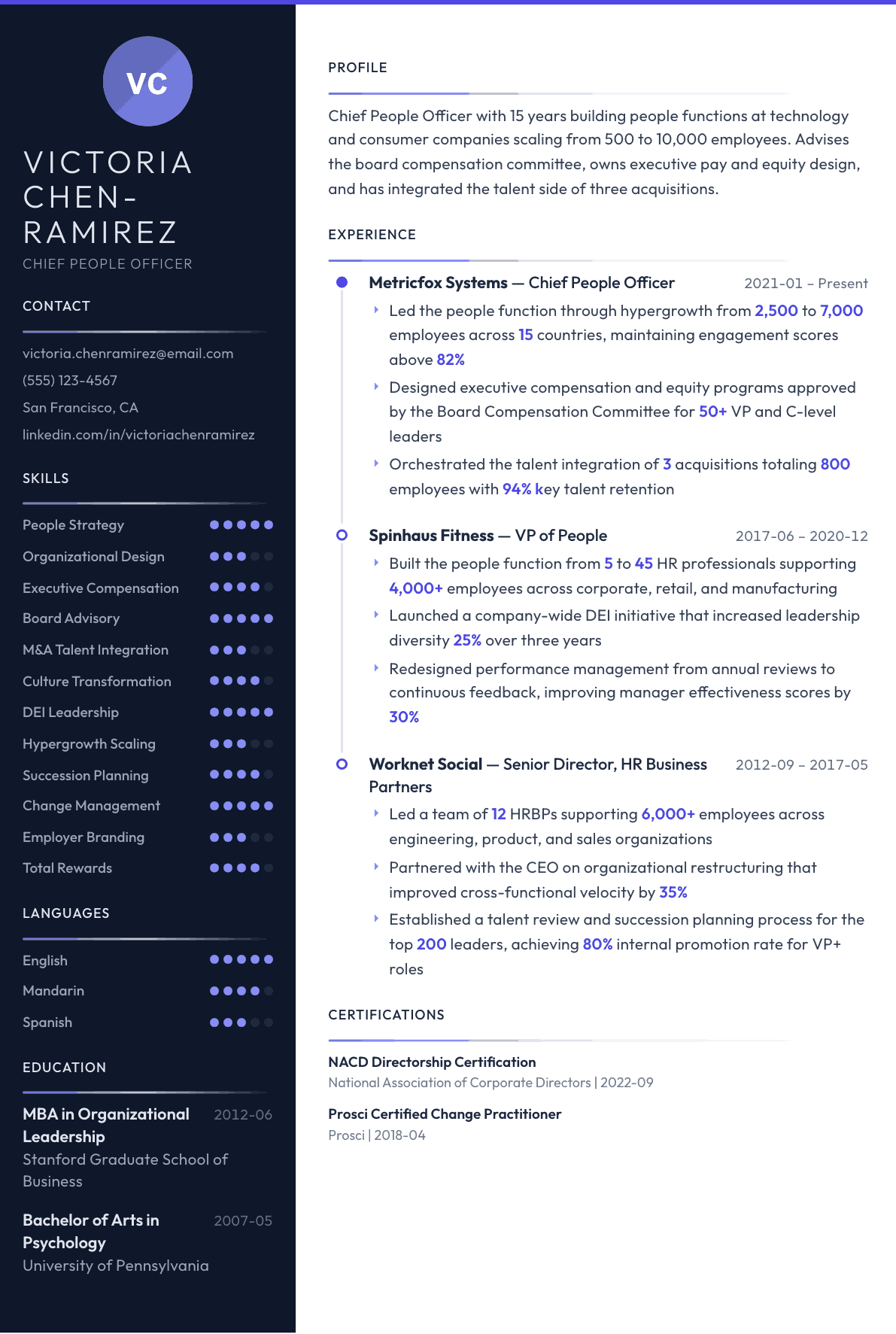
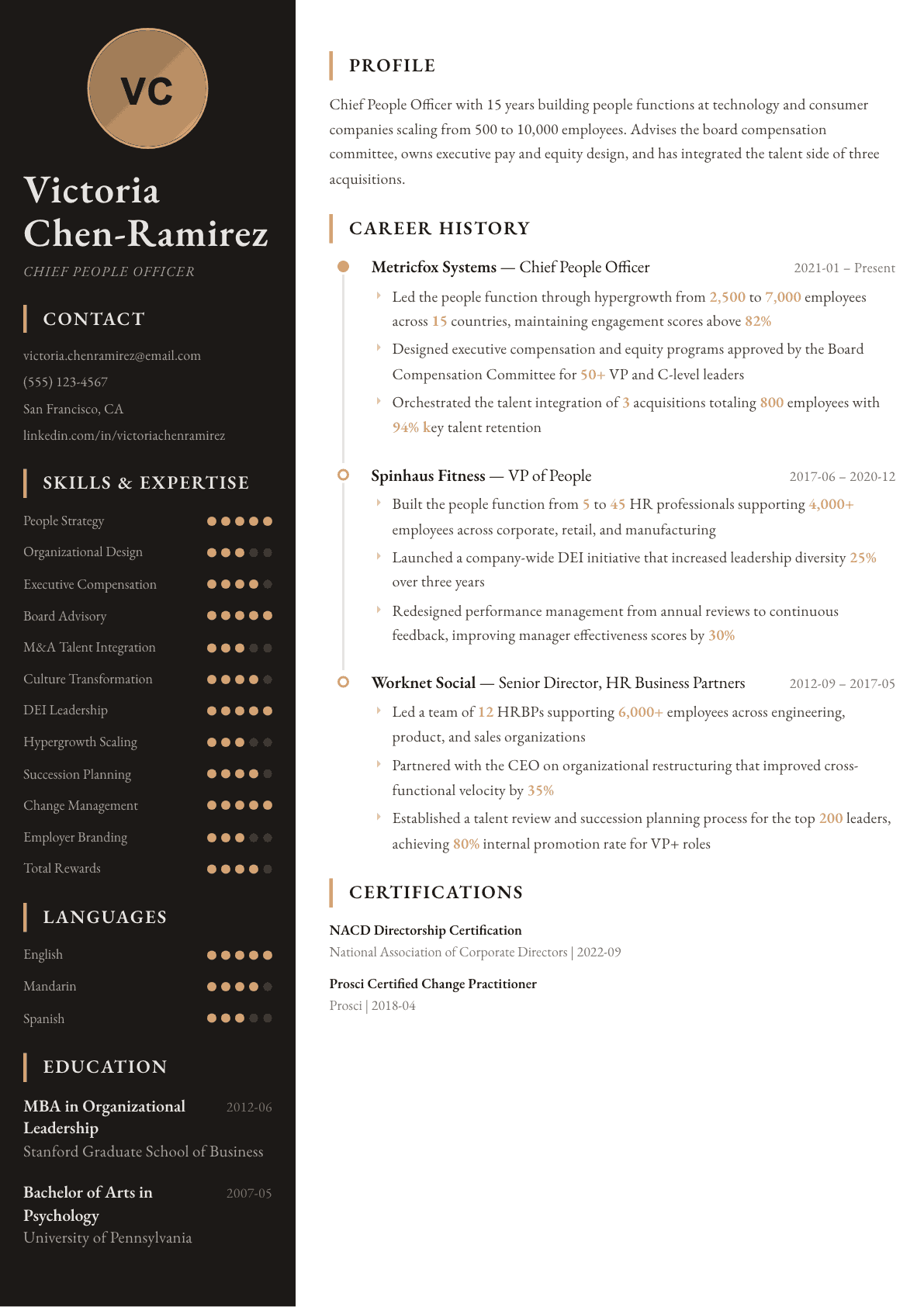
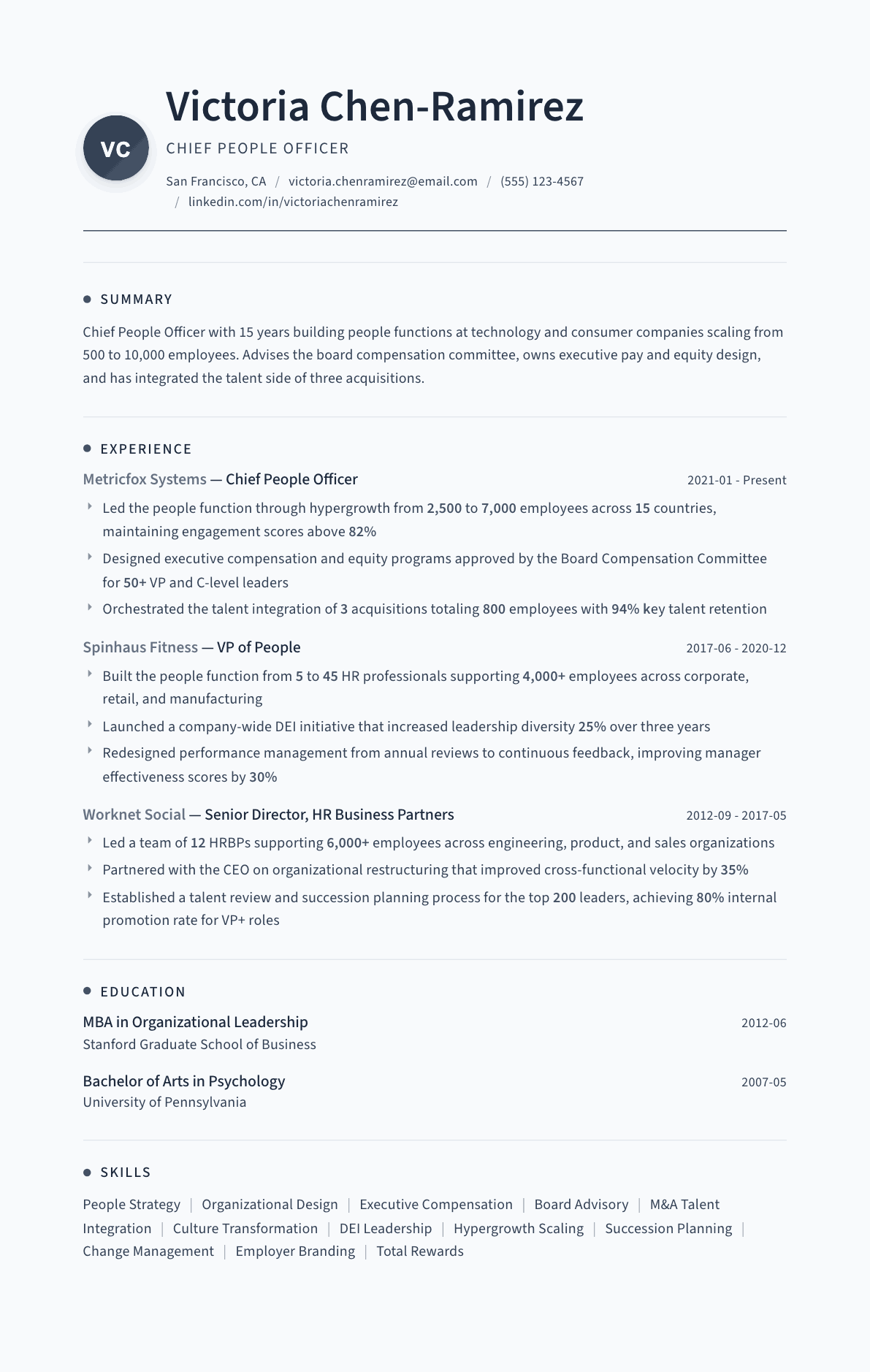
Example Chief People Officer summary
Chief People Officer, 15 years scaling people functions to 10,000 employees across 15 countries. Advises the board on executive compensation, integrated 3 acquisitions at 94% key talent retention, and held engagement above 82% through a headcount increase of 180%.
Skills to list on a Chief People Officer resume
- People Strategy
- Organizational Design
- Executive Compensation
- Board Advisory & Governance
- M&A Integration
- Culture Transformation
- DEI Strategy
- Hypergrowth Scaling
- Succession Planning
- Total Rewards
- Employer Branding
- Change Management
- IPO Readiness
- Executive Coaching
- Global HR Operations
What actually gets this resume read
- Lead with enterprise-scale impact: employee headcount managed, revenue supported, countries operated in, and acquisitions integrated.
- Highlight board-level responsibilities including compensation committee advisory, executive hiring, and organizational governance.
- Showcase M&A experience with talent retention and integration metrics.
- Demonstrate culture transformation at scale with engagement scores, award recognition, and employer brand improvements.
- Include speaking engagements, published articles, or industry recognition that positions you as a thought leader.
- Frame DEI and total rewards work as strategic business imperatives, not just HR programs.
How to write a chief people officer resume
A chief people officer resume is read by a chief executive, a board compensation committee chair or an executive search partner, and none of them are looking for HR competence. They assume that. They are looking for evidence that you have sat at an executive table where hard decisions got made, carried the people consequences of a strategy you helped set, and stood in front of a board without being handled.
The strongest files at this level answer four questions in the first ten lines: what kind of company, at what stage and headcount, what the people problem was, and what changed. Scaling from a few hundred people to several thousand, integrating an acquisition, running a reduction while keeping the critical talent, taking a company through an ownership change or a public listing, and rebuilding a leadership bench are each recognizably different mandates. Say which ones you have completed.
This guide covers what an executive resume for the top people role has to contain, how to write board and executive committee work without breaching confidence, the metrics a chief executive actually reads, three summaries at different points on the way to the seat, and the mistakes that keep strong human resources leaders out of the shortlist.
Format: two pages, company profile before every title
Two pages, plain and confident. No skills bars, no photograph, no summary of personal attributes. Under each employer, put a company profile line: sector, ownership structure, headcount and countries, revenue scale in relative terms, and the stage the business was in when you arrived. Then the mandate you were hired for.
Add a short block near the top for board and executive committee experience, because that is what separates a chief people officer resume from a vice president of human resources resume. Compensation committee support, board reporting, any nonexecutive directorships and any committee you sit on elsewhere.
- Header: name, city, phone, email, and a plain link to a professional profile.
- Order: summary, selected results, executive experience with company profiles, board and committee work, education, credentials and affiliations.
- A short selected results block of four to six lines at the top of page one is worth more than any objective statement.
Summary: the mandate, the scale, the transformation
Four lines at most. Name the sectors, the headcount and geographic scale you have led people functions across, the executive table you sat at, and the two or three transformations you are known for. Avoid the vocabulary of visionary leadership; a chief executive reading it is looking for evidence, not self description.
Be honest about the size of the function you have led. The number of human resources professionals reporting to you, the centers of excellence you owned, and whether talent acquisition, total rewards, learning, people operations and communications sat under you or beside you. Search partners map that structure directly against the role they are filling.
Experience: write mandates and outcomes, not functions
Under each executive role, open with the mandate in one sentence: what the business needed from the people function when you arrived. Then three to five outcome bullets. Organizational design work that changed how the company operated, a leadership bench that produced internal successors, a compensation architecture the board approved, an integration that retained the acquired leadership, a workforce reduction handled without losing the people the strategy depended on.
Attach the business consequence wherever you can. Speed to fill critical roles, regretted attrition among top performers, manager effectiveness, engagement movement, labor cost as a share of revenue, revenue per employee, and the time it took to stand up a new country or site. A people leader who speaks only in engagement scores reads as a functional head; one who ties people decisions to operating results reads as an executive.
Give the harder work its own space. Restructurings, site closures, union negotiations, executive terminations, investigations at officer level, pay equity remediation and crisis response. These are the situations a chief executive most wants to know you have survived, and most candidates leave them off the page out of caution.
Board, compensation committee and governance
Say what you presented and how often, without disclosing anything confidential. Executive compensation and equity design, say on pay preparation, succession planning for the executive team, culture and engagement reporting, human capital disclosure, and risk items such as investigations or litigation exposure at the officer level.
Name the advisors you have worked alongside. Compensation consultants, employment counsel, executive search partners and organizational advisors. Working effectively with those firms is a distinct skill, and describing it signals you have operated at the level the role demands.
- Compensation committee: executive pay benchmarking, equity plan design, performance metrics, retention arrangements.
- Succession: executive team succession maps, emergency succession planning, leadership assessment processes.
- Governance: human capital reporting, workforce risk disclosure, policy approvals at board level.
The measures a chief executive reads
Pick a small number and make them count. An executive resume with twenty metrics reads as noise; four that map to the mandate read as command of the business.
- Regretted attrition among top performers and in critical roles, against a baseline.
- Internal fill rate for senior positions and the depth of the successor bench for the executive team.
- Engagement and manager effectiveness movement, with the population and the survey instrument named.
- Time to hire and offer acceptance for the roles the strategy depended on.
- Total labor cost as a share of revenue, and the productivity or span of control changes behind it.
- Retention of acquired leadership through an integration, measured at twelve and twenty four months.
Chief People Officer resume summary examples
First people leadership seat
Vice president of human resources for a 1,200-person technology business, leading a team of 14 across talent acquisition, business partnering and people operations. Built the first company-wide performance and compensation architecture, cut regretted attrition in engineering by 30%, and reports directly to the chief executive.
People leader at scale
Senior vice president of people for a consumer group of 4,000 employees across corporate, retail and manufacturing, leading a function of 45. Rebuilt the leadership bench to an 80% internal fill rate for director roles and above, and replaced annual reviews with a continuous feedback model adopted across every site.
Chief people officer
Chief people officer of a technology company that grew from 2,500 to 7,000 employees across 15 countries. Advised the board compensation committee on executive pay and equity for 50 senior leaders, integrated three acquisitions with 94% retention of key talent, and held engagement above 82% through the entire scaling period.
Work experience bullets: before and after
Before: Led the human resources function for a large organization.
After: Led the people function for a 7,000-person business across 15 countries, with 45 professionals reporting through talent acquisition, total rewards, business partnering, learning and people operations.
Headcount, geography, function size and structure are the facts a search partner uses to match you to a mandate.
Before: Improved employee engagement across the company.
After: Held engagement above 82% through a period when headcount nearly tripled, by rebuilding manager onboarding, publishing survey results to every team within two weeks and holding leaders to a single committed action each cycle.
Holding a score through disruptive growth is a harder claim than raising one, and the three mechanisms make it credible.
Before: Managed the integration of acquired companies.
After: Integrated three acquisitions totaling 800 employees onto a single job architecture, pay structure and benefits platform within nine months of each close, retaining 94% of the leaders identified as critical before signing.
Naming what was integrated, the timeline and the pre-identified retention target shows a repeatable method rather than a survived event.
Before: Worked with the board on executive compensation.
After: Prepared and presented executive compensation and equity recommendations to the board compensation committee for 50 vice president and officer roles, working with an external consultant on peer benchmarking and performance metric design.
The audience, the population and the advisor relationship together prove genuine committee-level experience.
Before: Handled a company restructuring.
After: Designed and executed a restructuring across four sites, redeploying a third of affected employees into open roles, protecting every position identified as critical to the product roadmap and completing consultation in each jurisdiction on schedule.
It shows the hardest part of the job done with judgment, which most executive resumes avoid describing at all.
Hard skills
- People strategy and workforce planning
- Organizational design and operating model
- Executive compensation and equity design
- Board and compensation committee reporting
- Merger and acquisition talent integration
- Succession planning and leadership assessment
- Restructuring and workforce transition
- Total rewards architecture
- Employment law and labor relations oversight
- Human capital reporting and analytics
- Culture and engagement measurement
- Global expansion and entity setup
Soft skills
- Executive influence without authority
- Confidential counsel to a chief executive
- Judgment in ambiguity
- Difficult conversations at officer level
- Storytelling to a board
- Composure in crisis
Certifications worth listing
- SHRM Senior Certified Professional (SHRM-SCP) (Society for Human Resource Management)
- Senior Professional in Human Resources (SPHR) (HR Certification Institute)
- Global Professional in Human Resources (GPHR) (HR Certification Institute)
- Certified Compensation Professional (CCP) (WorldatWork)
- Professional Certified Coach (PCC) (International Coaching Federation)
Mistakes that cost chief people officer candidates the interview
- Writing a functional duties list. At this level the reader is buying mandates completed, not responsibilities held.
- Omitting company stage, ownership structure and headcount, which is how search partners match executives to briefs.
- Leaving out board and compensation committee work, the single clearest signal that separates this seat from a vice president role.
- Filling the page with culture language while never touching cost, productivity or the operating consequence of a people decision.
- Avoiding the hard mandates. Restructurings, investigations and executive exits are experience a chief executive specifically wants.
- Listing every human resources program ever launched instead of the four or five outcomes the business remembers.
- Using a designed template with charts and rating bars, which reads as junior at executive level.
Chief People Officer resume questions
How long should a chief people officer resume be?
Two pages. Executive search partners expect the company profiles, the mandates and the board work, and cutting to one page removes exactly the context that lets them match you to a brief. A separate one-page biography is useful alongside it.
How do I describe board work without breaking confidentiality?
Describe the type of material you owned and the audience, not the content of any decision. Executive compensation recommendations, succession maps and human capital reporting presented to a compensation committee are safe to name, while specific pay levels and named individuals are not.
Should I include a restructuring or layoff on my resume?
Yes, if you led it well. Chief executives hire people leaders who have handled the hardest situations, so describe the design, the redeployment, the protection of critical roles and the compliance with consultation requirements rather than the headcount removed.
Do I need certifications for a chief people officer role?
They are not decisive at this level, but a senior human resources credential or a compensation credential adds technical credibility, particularly if your background is heavier in business partnering than in total rewards. List them briefly at the end rather than near the top.
How do I move from a vice president of human resources title into the top people seat?
Show the three things the seat requires and the previous title often lacks: direct reporting to a chief executive, ownership of a full function including total rewards and talent acquisition, and material presented to a board or its compensation committee. Lead with whichever of those you already have.
Related resume examples
- HR Manager Resume example
- HR Business Partner Resume example
- Organizational Development Consultant Resume example
- Chief Human Resources Officer Resume example
- VP of Human Resources Resume example
- Head of People Resume example