HR Generalist Resume Examples: free ATS score and gap list
Write an HR Generalist Resume That Shows Full Cycle Ownership
By Mustafa Tarabya, founder of CVBooster · Published · Updated
Human resource generalist sample resume and HR generalist resume examples with bullets across employee relations, leave, benefits and recruiting, plus the keywords hiring managers expect.
Sample resumes for a hr generalist
The same hr generalist content laid out in three CVBooster templates, so you can see what the finished document looks like before you write a word.
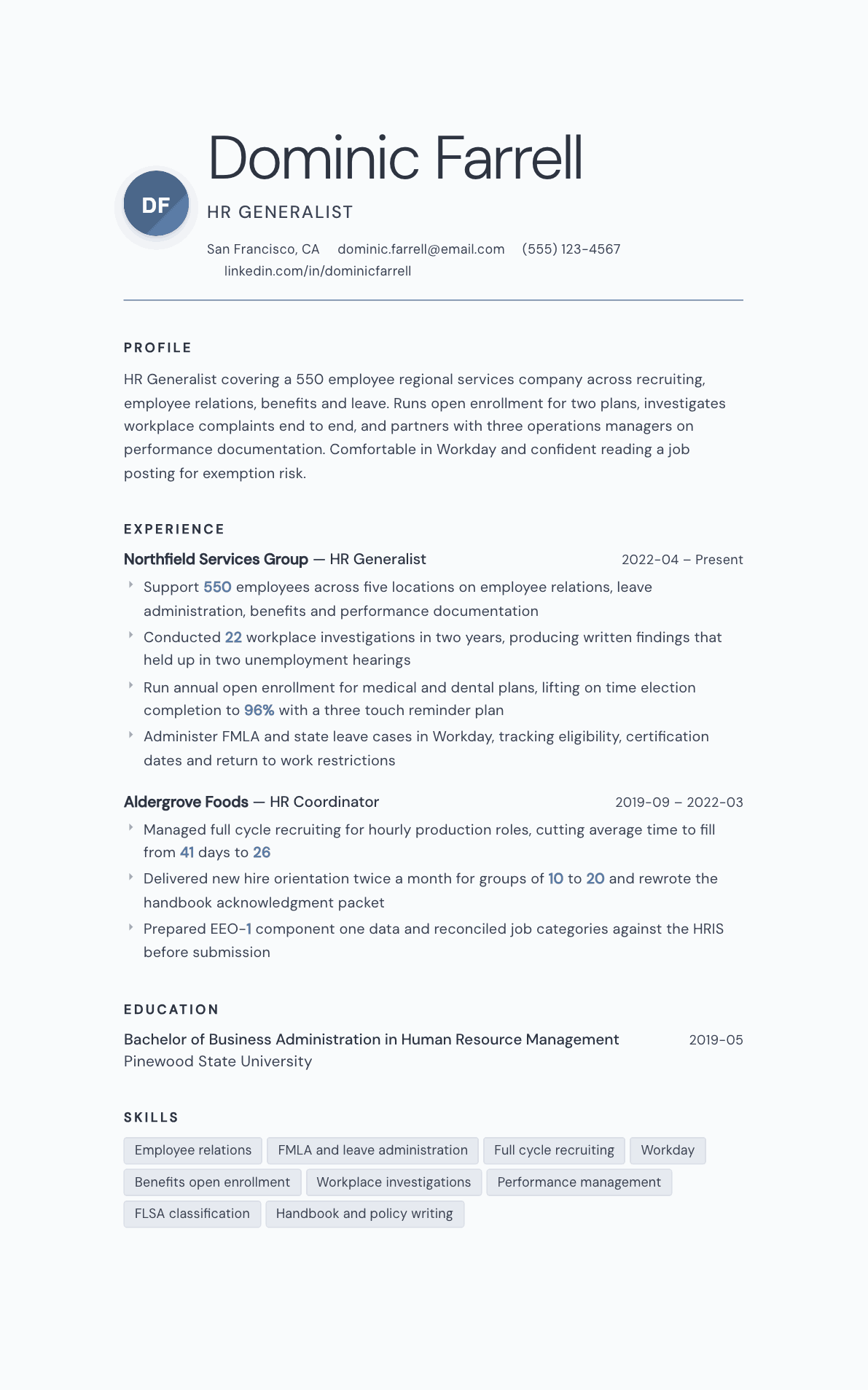
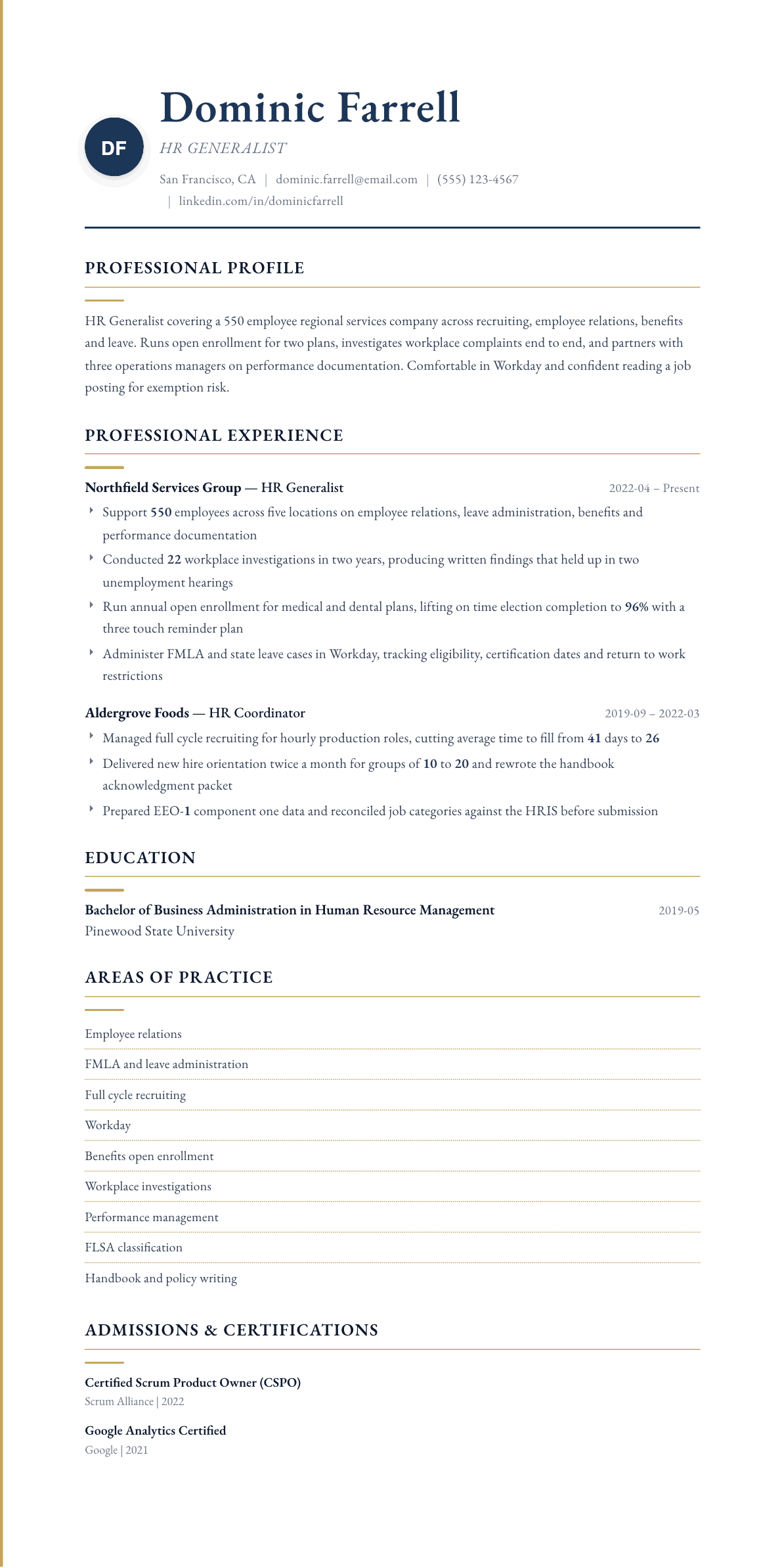
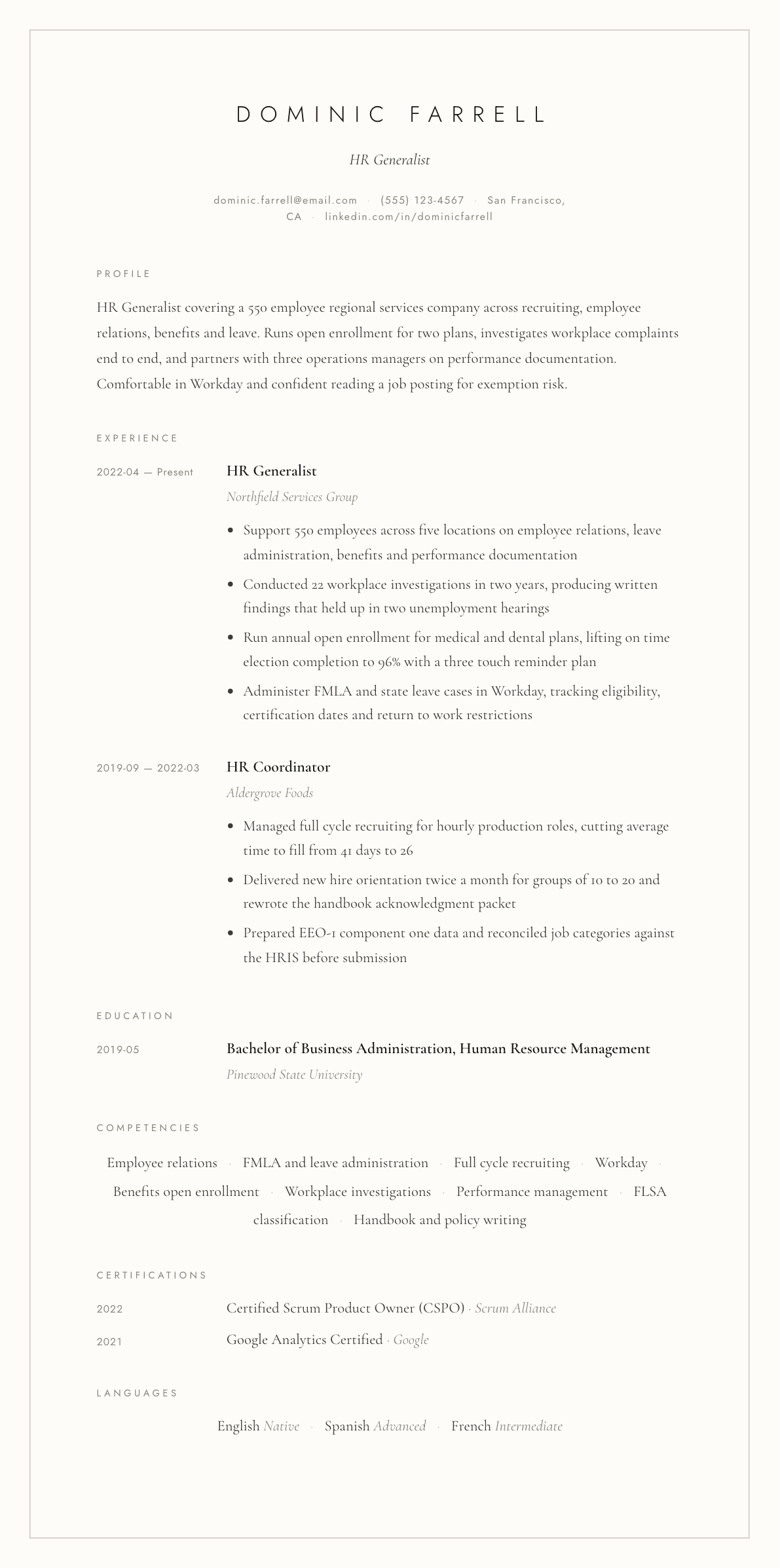
Example HR Generalist summary
HR Generalist with six years supporting a multi site employer of about 550 people across employee relations, leave, benefits and recruiting. Has conducted more than twenty workplace investigations with written findings, runs annual open enrollment, and administers FMLA cases in Workday. Reduced hourly time to fill by more than a third in a prior role. Seeking a generalist seat with compliance and manager coaching scope.
Skills to list on a HR Generalist resume
- Employee relations
- Workplace investigations
- FMLA and ADA administration
- Benefits administration
- Open enrollment
- Full cycle recruiting
- Performance management
- FLSA classification
- EEO-1 reporting
- Workday
- HRIS reporting
- Policy and handbook development
- New hire orientation
- Compensation review support
- Offboarding and exit interviews
- Employment law compliance
What actually gets this resume read
- Say how many employees you support and across how many sites, because generalist scope is meaningless without that ratio.
- List the disciplines you actually own: relations, recruiting, benefits, leave, compliance. Do not imply coverage you have never handled.
- Give investigations their own bullet with a count and an outcome, since that is the skill managers worry about most.
- Name the leave and compliance work by statute where it is accurate, such as FMLA, FLSA classification and EEO-1 reporting.
- Show the HRIS you administer and what you do in it: reporting, workflow configuration, data corrections, or all three.
- Balance the resume so recruiting does not crowd out relations work. A generalist who reads as a recruiter gets sorted into recruiting.
How to write a hr generalist resume
Generalist is the hardest HR title to write about, because it means something different at every employer. At a two hundred person company it means you are the entire HR department. At a five thousand person company it means you support two operating groups and hand compensation and benefits work to specialists. A hiring manager reading your resume is trying to establish which of those jobs you have actually done.
So the resume has to declare scope before it declares achievements. Headcount supported, number of sites, which disciplines you own outright, and which ones you share with a center of expertise. Once that is clear, the reader can judge everything else. Without it, strong bullets get discounted because the reader cannot size them. Whether the posting says HR generalist, generalist HR or human resource generalist, the reader is asking the same scope question.
What follows is the structure that answers those questions in order, three summaries at different career stages, a set of rewritten bullets drawn from the parts of the job that carry real risk, and the questions generalists ask most when the resume has to cover relations, recruiting, benefits and compliance all at once.
Human resource generalist sample resume: a complete entry
This human resource generalist sample resume is for a generalist with five years at a single site employer of about 400 people. It leads with scope, because the first thing an HR manager wants to know is how many employees you supported and which parts of HR you actually owned.
Summary: HR generalist with five years supporting 400 employees in manufacturing. Owns employee relations investigations, FMLA and leave administration, onboarding and the annual open enrollment. SHRM-CP.
Second sample, for someone one step earlier. Most human resource generalist resumes are written by people one step away from the title. The move is to show the generalist work you already do, grouped by discipline, rather than the coordinator duties you are trying to leave behind.
Summary: HR coordinator with three years at a 250 person healthcare employer, already handling onboarding, leave paperwork and first stage employee relations intake. aPHR certified, seeking a first HR generalist role.
Its strongest lines. Coordinate onboarding for about 80 new hires a year, from offer letter to first week schedule. Prepare FMLA paperwork and track leave dates for the HR manager. Take first stage employee complaints, document them and route them to the right investigator. Maintain employee records in the HRIS and run the monthly headcount report.
The experience entry for the first sample, HR Generalist, Redbank Components, reads as the bullets below.
- Support 400 hourly and salaried employees across two shifts as the site's only HR generalist, reporting to the HR manager.
- Investigate employee relations complaints from intake to written findings, about 20 cases a year, and recommend outcomes to the plant manager.
- Administer FMLA, ADA accommodation requests and short term disability, tracking every case to closure.
- Run open enrollment for medical, dental and 401(k), including employee meetings on both shifts.
- Rebuilt the onboarding checklist so every I-9 is completed and filed on time.
Format: scope line first, one page until about eight years
Reverse chronological, one page for the first several years, two once you have supported multiple populations through real events. Under each job title, add a scope line before the bullets: employees supported, locations, whether the workforce is exempt, nonexempt or unionized, and who you report to. That single line prevents the most common misread of a generalist resume, which is assuming your last job was smaller than it was.
Avoid dense two column layouts. Generalist postings often come from smaller employers whose parsers handle plain formatting far better, and the scope lines you just wrote are exactly the text that gets scrambled when a sidebar collapses.
- Scope line example: five hundred fifty employees, five locations, mixed exempt and hourly, reporting to the HR director.
- Sections: summary, core areas, professional experience, education, certifications.
- Use a compact core areas block so a screener can confirm coverage without reading every bullet.
Summary: name the disciplines you actually own
Say which parts of the function are yours. Employee relations, leave administration, benefits, recruiting, performance management, compliance reporting. Listing all of them when you have only touched three is the fastest way to lose an interview, because the first behavioral question will land on the discipline you cannot discuss in depth.
Then add one differentiator. Generalists who stand out usually have a spike: heavy investigation experience, multistate compliance, hourly hiring at volume, or unionized workforce exposure. Put the spike in the summary because it is the reason a specific employer will call rather than move on to the next similar resume.
Employee relations: the section that decides the interview
Investigations are the highest risk work a generalist does, and hiring managers screen for them harder than for anything else. Give the work its own bullet with a count over a period, the types of complaints in general terms, and what your product was: a written report, a recommendation, a documented corrective action, testimony at an unemployment hearing.
Describe manager coaching as a practice rather than a virtue. Say how many supervisors you support, what you coach them on, such as documentation quality, performance improvement plans and termination decisions, and what changed when you did. Keep the details general enough that no individual case is identifiable.
- Count investigations over a stated period rather than describing a single memorable case.
- Reference outcomes that a reader can verify in the abstract: hearings, arbitration avoided, corrective actions upheld.
- Never name an employee, a complainant or a case detail specific enough to identify either.
Leave, benefits and compliance: name the regimes correctly
Leave administration is where accuracy shows. Say what you administer, including FMLA eligibility and certification tracking, state leave laws where you have worked under them, accommodation requests under the ADA, and the return to work conversations you run with operations. Getting these names right on the page tells the reader you have handled real cases, because people who have not tend to write leave management and stop there.
The same rule applies to the rest of compliance. FLSA exemption reviews, EEO-1 reporting, handbook updates, policy acknowledgments and I-9 audits are each a distinct piece of work. Claim the ones you have done, describe them in a clause, and leave the others off rather than gesturing at general knowledge of employment law.
Recruiting and systems: enough, but not so much that you get retitled
Most generalists recruit. Show it with a requisition load, the roles you fill and a cycle time figure if you have one, then stop. When recruiting occupies half the resume the reader reasonably concludes you are a recruiter, and generalist openings go to the applicants whose relations and compliance depth is visible.
Systems get one clear thread. Name the HRIS and what you do inside it: running reports, correcting data, configuring a workflow, managing an open enrollment event. A generalist who can pull a clean turnover report without asking anyone is worth more to a small team than one who cannot, and that is worth saying plainly.
HR Generalist resume summary examples
First generalist seat
HR professional moving from coordinator to generalist after two years supporting three hundred employees on onboarding, benefits enrollment and leave paperwork. Recently took on first investigations under the HR manager and rewrote the employee handbook acknowledgment process. Seeking a generalist role in a multi site employer.
Five years in
HR Generalist supporting five hundred fifty employees across five sites on employee relations, leave, benefits and hourly recruiting. Has run more than twenty investigations with written findings, administers FMLA and state leave cases in Workday, and leads annual open enrollment. Comfortable coaching frontline supervisors through documentation.
Senior generalist
Senior HR Generalist with nine years across manufacturing and healthcare services, currently the sole HR presence for two plants with a partly unionized workforce. Handles grievances, investigations, FLSA classification reviews and workforce planning, and mentors two coordinators. Seeking an HR manager role with a small team.
Work experience bullets: before and after
Before: Handled employee relations issues.
After: Conducted twenty two workplace investigations over two years, producing written findings and recommendations that supported the outcome in two unemployment hearings.
A count, a period and a defensible product replace a phrase that could describe a single awkward conversation.
Before: Managed leave of absence requests.
After: Administered FMLA and state leave cases in Workday for five hundred fifty employees, tracking eligibility, certification deadlines and return to work restrictions with operations managers.
Naming the statutes, the system and the three tracking points shows real case management rather than intake.
Before: Ran open enrollment for the company.
After: Led annual open enrollment for medical and dental plans across five sites, using a three touch reminder plan that lifted on time elections to 96%.
The tactic and its result show a designed process instead of an administrative event that happened to you.
Before: Recruited for open positions.
After: Ran full cycle hiring for hourly production roles across two plants and cut average time to fill from forty one days to twenty six by opening evening interview blocks.
A before and after figure plus the cause explains what you changed, not only that you filled jobs.
Before: Advised managers on performance issues.
After: Coached fifteen frontline supervisors on documentation and performance improvement plans, reviewing every corrective action before delivery for consistency and legal risk.
The number of supervisors and the review step turn advice into a control the organization depends on.
Hard skills
- Employee relations and investigations
- FMLA and state leave administration
- ADA accommodation process
- Benefits administration and open enrollment
- Full cycle recruiting
- FLSA exemption analysis
- EEO-1 reporting
- Performance management
- Handbook and policy writing
- Workday
- HRIS reporting
- Exit interviews and offboarding
Soft skills
- Neutrality in a dispute
- Manager coaching
- Difficult conversations
- Judgment on escalation
- Confidentiality
- Comfort saying no to a leader
Certifications worth listing
- SHRM Certified Professional (SHRM-CP) (Society for Human Resource Management)
- Professional in Human Resources (PHR) (HR Certification Institute)
- Certified Employee Benefit Specialist (CEBS) (International Foundation of Employee Benefit Plans)
Mistakes that cost hr generalist candidates the interview
- Omitting the scope line, which leaves the reader guessing whether you supported eighty people or eight hundred.
- Claiming every HR discipline when the interview will probe the two you have never actually owned.
- Describing investigations in one vague phrase when it is the skill most employers screen hardest for.
- Letting recruiting bullets dominate the page until the resume reads as a recruiter applying to the wrong opening.
- Writing knowledge of employment law instead of naming the specific filings, statutes and reviews you have handled.
- Hiding the unionized or multistate experience that would make you the obvious candidate for a particular employer.
HR Generalist resume questions
What is the difference between an HR generalist and an HR business partner?
A generalist runs the transactional and compliance backbone alongside advisory work, while a business partner focuses on consulting with leaders on workforce strategy with specialists handling execution. If your day includes leave files and open enrollment, generalist is the honest title.
What does a good human resource generalist resume look like?
One or two pages that open with the number of employees you supported and the HR disciplines you own, then experience bullets grouped by employee relations, leave and benefits, recruiting and compliance. The samples above show the version for a working generalist and for an HR coordinator moving up.
Should I list investigations if the details are confidential?
Yes, at the level of counts, categories and outcomes. Say how many you conducted, the general nature of the complaints such as attendance, harassment or policy violations, and what you produced. Never include names, dates or facts that could identify anyone involved.
Do I need a certification to move up from generalist?
It is not required, but a credential from a recognized HR body appears in many manager level postings as preferred and can break a tie. Employers weigh demonstrated relations judgment and compliance ownership more heavily than the letters themselves.
How do I write a generalist HR resume for a smaller company?
Lead with breadth and self sufficiency. Small employers want someone who can run payroll input, benefits renewal, hiring and an investigation without a specialist behind them, so show examples where you owned a discipline outright rather than supporting someone else who did.
Related resume examples
- HR Business Partner Resume example
- Human Resources Resume example
- HR Specialist Resume example
- Employee Relations Specialist Resume example
- HR Intern Resume example
- Onboarding Specialist Resume example