Insurance Sales Agent Resume Examples: read this first
Craft an Insurance Sales Agent Resume Carriers Take Seriously
By Mustafa Tarabya, founder of CVBooster · Published · Updated
Insurance sales agent resume examples with license lines, premium and policy count bullets, carrier keywords and a section-by-section writing guide.
Sample resumes for a insurance sales agent
The same insurance sales agent content laid out in three CVBooster templates, so you can see what the finished document looks like before you write a word.
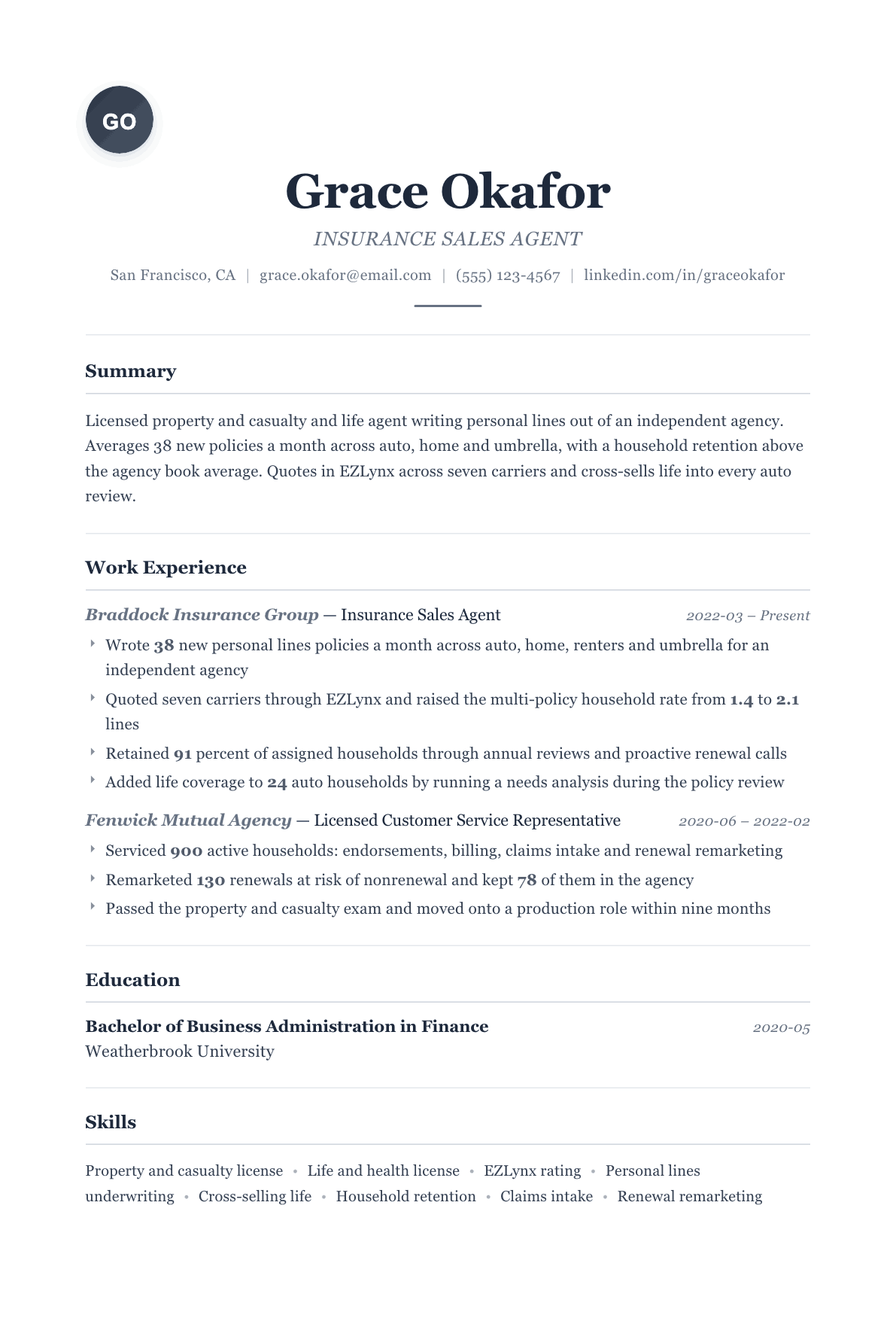
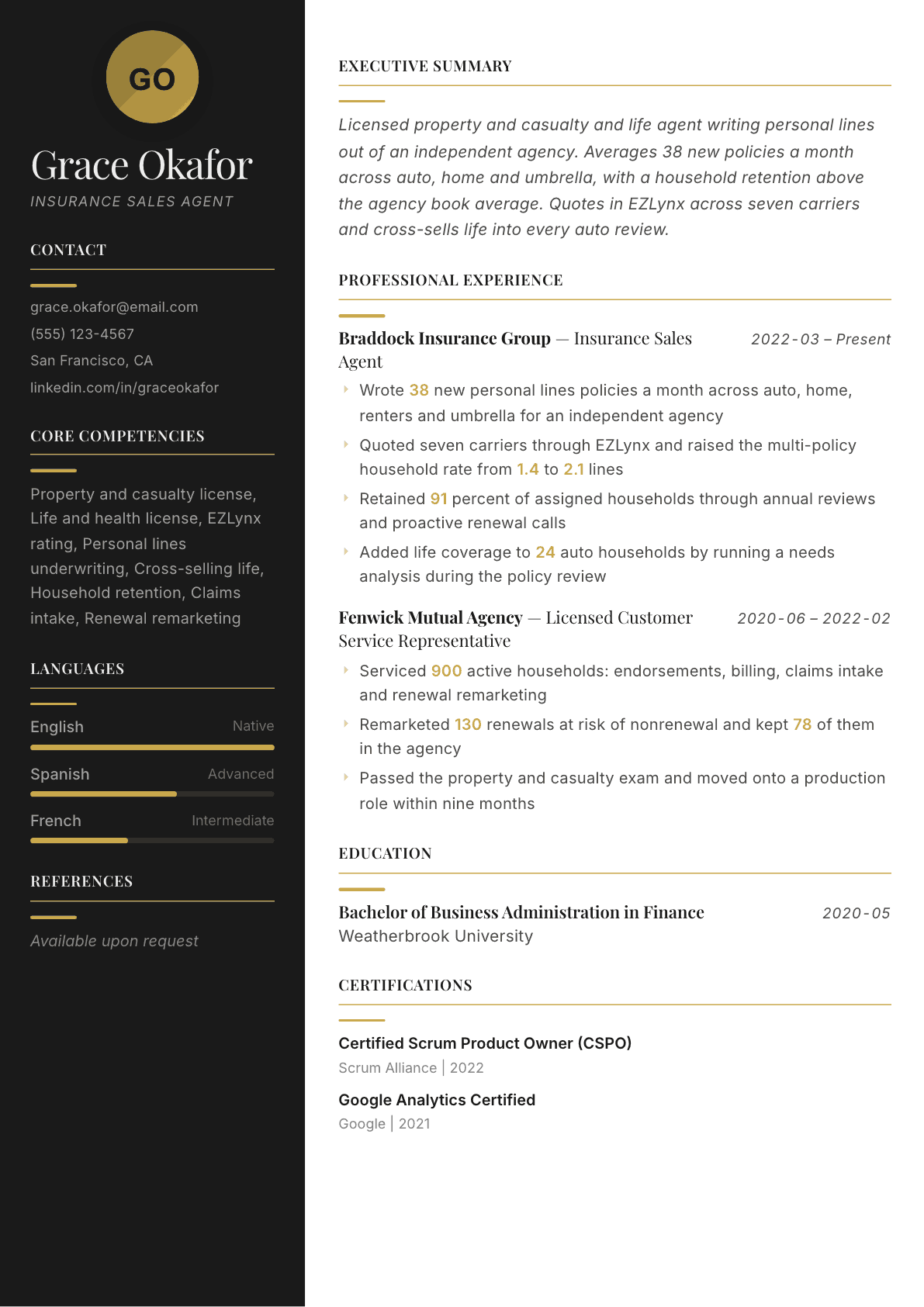
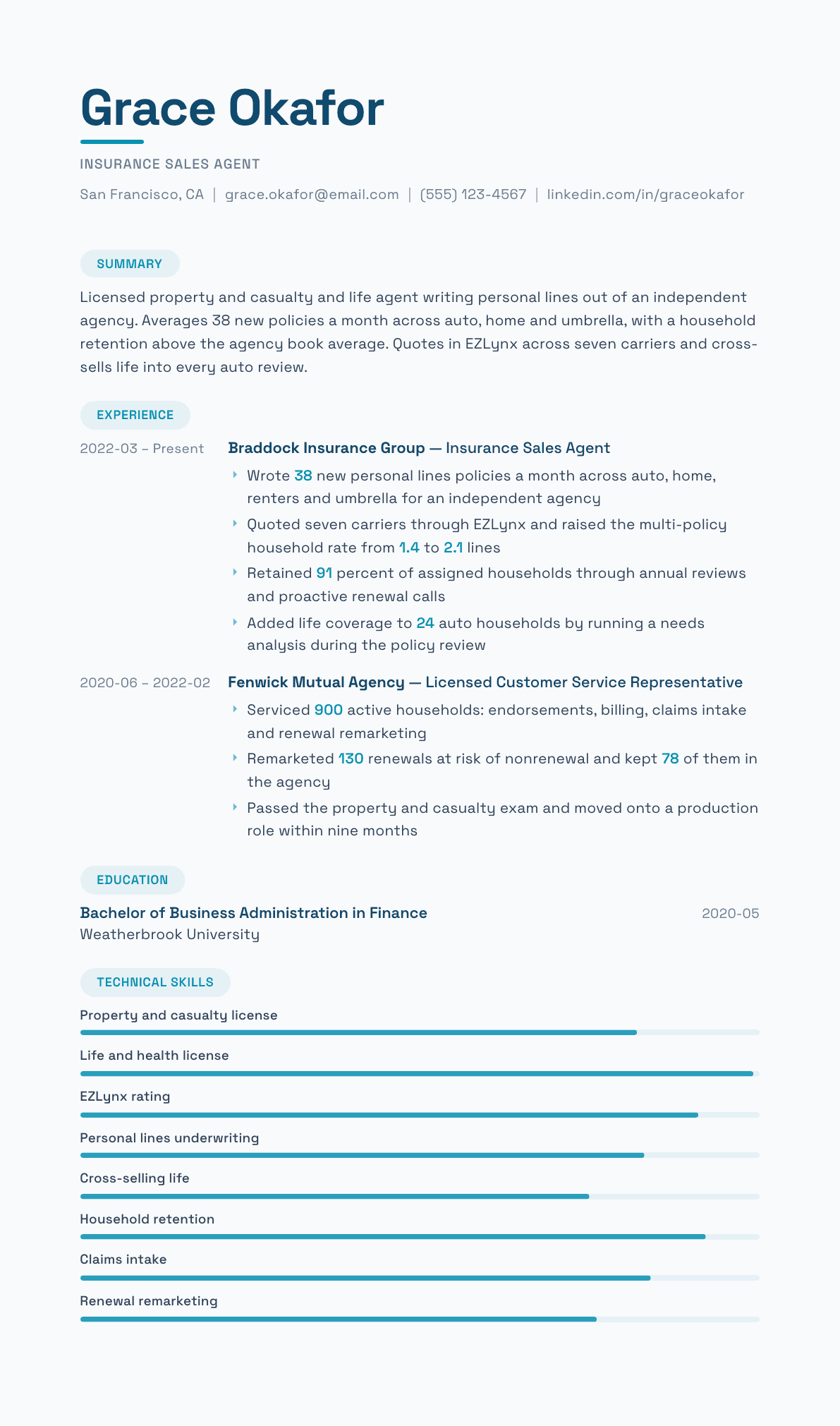
Example Insurance Sales Agent summary
Licensed insurance sales agent writing personal lines for an independent agency, averaging 38 new policies a month across auto, home, renters and umbrella. Quotes seven appointed carriers in EZLynx, lifted the multi-policy household rate from 1.4 to 2.1 lines, and holds retention near 91 percent through annual reviews. Property and casualty plus life and health licensed, resident state current.
Skills to list on a Insurance Sales Agent resume
- Property and casualty licensing
- Life and health licensing
- Personal lines quoting
- Commercial lines quoting
- EZLynx and comparative rating
- Underwriting guidelines
- Cross-selling and account rounding
- Household retention
- Renewal remarketing
- Claims intake and advocacy
- Needs analysis
- Referral partner development
- Agency management systems
- Compliance and disclosure
What actually gets this resume read
- Put your license types, resident state and expiration in the header area so a carrier recruiter stops looking for them.
- Report production as policies written, premium band and items per household rather than a single vague growth claim.
- Name the rating platform and the carriers you are appointed with, since agency owners hire against their own carrier list.
- Separate personal lines from commercial lines work, because those are two different hiring pipelines.
- Show retention and cross-sell numbers, not only new business, since agency profit lives in the renewal book.
- List any designation in progress, such as CPCU coursework, with the module completed rather than an unfinished claim.
How to write a insurance sales agent resume
An insurance sales agent resume answers a licensing question before it answers a sales question. The agency owner or carrier recruiter reading it needs to know which lines you are licensed to write, in which resident state, and whether the license is active right now. If that is not in the first few lines, the rest of the page waits.
After licensing comes production, and this is where most agent resumes go soft. Growing the book is not a number. Policies written per month, premium band, items per household, retention and cross-sell ratio are numbers, and an agency owner reads all five together because agency profit lives in the renewal book rather than in the new business count.
This guide sets out how to open the page, how to present production for personal and commercial lines, three summaries from a licensed service representative up to a producer, rewritten bullets, and the questions agents ask when they move between captive and independent agencies.
Format: license line first, one page for most agents
One page unless you have a long commercial lines history with named industry niches. Reverse chronological, single column, no graphics.
Put licensing in its own line directly under your name: the lines, the resident state, any nonresident states, and the expiration. An agency owner who has to hunt for that line assumes it is missing, and a missing license is the fastest rejection in this field.
- Header: name, city and state, phone, email, license types with resident state.
- Order: summary, licensing and appointments, production experience, systems, education, designations.
- List carrier appointments you have quoted with, since agency owners hire against their own carrier lineup.
Summary: lines written, agency type, production rhythm
State whether you write personal lines, commercial lines, life and health, benefits or a mix, and whether you worked captive, independent or as a direct writer. Those three environments quote, price and service completely differently, and an owner wants to know how much retraining your habits will need.
Close with your production rhythm rather than a total: policies or applications per month, average premium band, and the items per household you carry. A monthly rhythm reads as sustainable, while a single annual total tells the reader nothing about consistency.
Experience: written, retained, rounded
Open each role with the agency context: independent or captive, book size in households or accounts, how many carriers you had access to, and whether leads came from the agency, a call center, or your own referral network.
Then write three bullet types. New business: policies written per month with the mix across auto, home, renters, umbrella, or the commercial classes you handled. Retention: the share of assigned households you kept and how you did it, since annual reviews and proactive renewal calls are the practice an owner wants to see. Account rounding: items per household before and after you worked the book, and life or umbrella cross-sales into existing policies.
Add the service work honestly. Endorsements, billing questions, claims intake and renewal remarketing are what a producer actually spends mornings on, and pretending otherwise makes the page read as written by someone who has not done the job.
Systems, underwriting and the compliance line
Name the comparative rater and the agency management system: EZLynx, Applied Epic, AMS360, HawkSoft, QQCatalyst, Vertafore. These are direct search terms and they predict how quickly you can produce on day one.
Show underwriting judgment. Knowing which risks a particular carrier will decline, how to handle a prior claim history, and when to move a household to a different market is the difference between a quoting clerk and a producer. One bullet naming a class of risk you learned to place well is worth more than a list of adjectives.
Designations and the keywords carriers filter on
List only real designations with the real issuing body, and state coursework in progress with the module completed rather than implying the full credential. Common recurring terms in these postings include personal lines, commercial lines, account rounding, retention, comparative rating, underwriting guidelines, needs analysis, remarketing, referral partners and book of business growth.
Insurance Sales Agent resume summary examples
Newly licensed
Newly licensed property and casualty agent with two years as a licensed service representative for a 900-household book, handling endorsements, billing, claims intake and renewal remarketing. Passed the state exam while servicing full time and retained 78 of 130 at-risk renewals. Seeking a first production seat.
Three to five years producing
Insurance sales agent writing 38 new personal lines policies a month for an independent agency across seven appointed carriers. Raised the multi-policy household rate from 1.4 to 2.1 lines and holds retention near 91%. Property and casualty plus life and health licensed, quoting daily in EZLynx.
Senior producer
Senior producer with nine years across personal and small commercial lines, carrying a book of 620 households and 80 business accounts. Builds referral pipeline through mortgage brokers and auto dealers, mentors two newly licensed agents, and holds a consistently strong loss ratio on placed business.
Work experience bullets: before and after
Before: Sold auto and home insurance policies to new customers.
After: Wrote 38 new personal lines policies a month across auto, home, renters and umbrella, quoting seven appointed carriers in EZLynx.
Monthly volume, the line mix and the carrier count let an agency owner judge fit against their own market access.
Before: Retained most of my customers year over year.
After: Retained 91% of assigned households through scheduled annual reviews and a renewal call thirty days ahead of every rate change.
The retention figure plus the exact practice behind it turns a claim into a repeatable process the owner can hire.
Before: Cross-sold additional products where possible.
After: Raised items per household from 1.4 to 2.1 by running a coverage gap review on every auto renewal and adding life to 24 households.
Account rounding measured before and after is the clearest evidence of the behavior that makes an agency profitable.
Before: Helped customers with claims and service requests.
After: Handled first notice of loss for roughly 20 claims a month, coordinated adjuster contact within one business day, and kept the household through renewal in most cases.
Volume, response standard and the retention outcome show service work as a business contribution rather than a chore.
Before: Worked with local businesses for referrals.
After: Built a referral pipeline with three mortgage brokers and two auto dealers that produced about a quarter of new applications each month.
Naming the partner types and the share of production proves you can create your own flow rather than waiting on agency leads.
Hard skills
- Property and casualty quoting
- Life and health product knowledge
- Commercial lines quoting
- Comparative rating platforms
- Agency management systems
- Underwriting guideline application
- Account rounding and cross-selling
- Renewal remarketing
- Claims intake and advocacy
- Coverage gap and needs analysis
- Referral partner development
- Compliance and disclosure practice
Soft skills
- Explaining coverage without jargon
- Calm handling of claim conversations
- Follow-up on quotes that went quiet
- Trust building with families
- Persistence through renewal season
- Judgment on risk fit
Certifications worth listing
- Chartered Property Casualty Underwriter (CPCU) (The Institutes)
- Certified Insurance Counselor (CIC) (The National Alliance for Insurance Education and Research)
- Accredited Advisor in Insurance (AAI) (The Institutes)
- Chartered Life Underwriter (CLU) (The American College of Financial Services)
Mistakes that cost insurance sales agent candidates the interview
- Leaving licensing off the top of the page, which is the first thing an agency owner looks for.
- Reporting only new business and never retention, when the renewal book is where agency income comes from.
- Writing grew the book with no policy count, premium band or items per household to support it.
- Failing to say whether the work was captive, independent or direct, which changes the whole quoting habit.
- Skipping the rater and agency management system, both of which predict how quickly you can produce.
- Claiming a designation that is only partly completed instead of naming the modules actually passed.
Insurance Sales Agent resume questions
Do I need my license before applying for an agent role?
Many agencies will hire unlicensed candidates and sponsor the exam, so apply either way. If you are studying, say which exam and your scheduled test month on the resume, because a concrete date reads far better than an intention to get licensed.
How do I show production if my agency shared credit on accounts?
State your role on those accounts plainly, such as quoted and presented with the owner closing. Then separate the policies you wrote alone. Shared credit is normal and describing it accurately builds more trust than a total that will not survive a reference call.
Should a captive agent resume look different for an independent agency?
Yes. Independent owners want evidence you can compare markets, so emphasize any multi-carrier quoting, underwriting judgment and remarketing you have done. Also acknowledge the transition directly, since moving from one carrier to seven changes daily work substantially.
How do I handle a book of business I cannot take with me?
Describe the book by size and composition rather than by client names, and never imply that accounts will follow you. Agency owners hire for the ability to rebuild, so put your referral sources and prospecting method next to the book description.
Are insurance designations worth listing early in a career?
They are, even partway through. List the credential name with the issuing body and the modules you have completed. It signals commitment to the profession, which matters in a field where many new agents leave within the first two years.