Sales Representative Resume Examples: what gets the call
Sales Representative Resume Format and Examples
By Mustafa Tarabya, founder of CVBooster · Published · Updated
Sales rep resume format and sample: quota and attainment up top, pipeline and deal size bullets, and summaries from a first sales job to a senior rep.
Sample resumes for a sales representative
The same sales representative content laid out in three CVBooster templates, so you can see what the finished document looks like before you write a word.
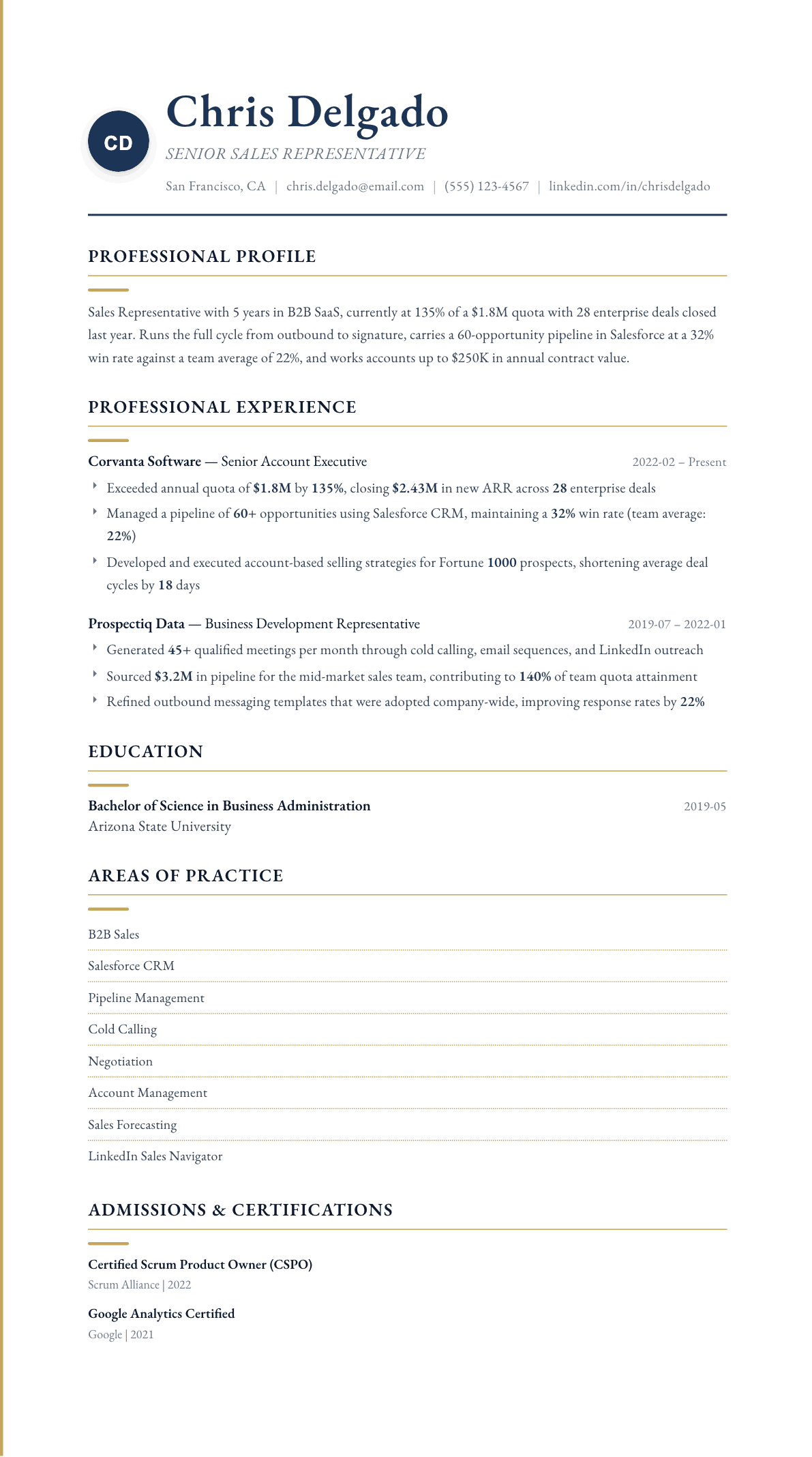
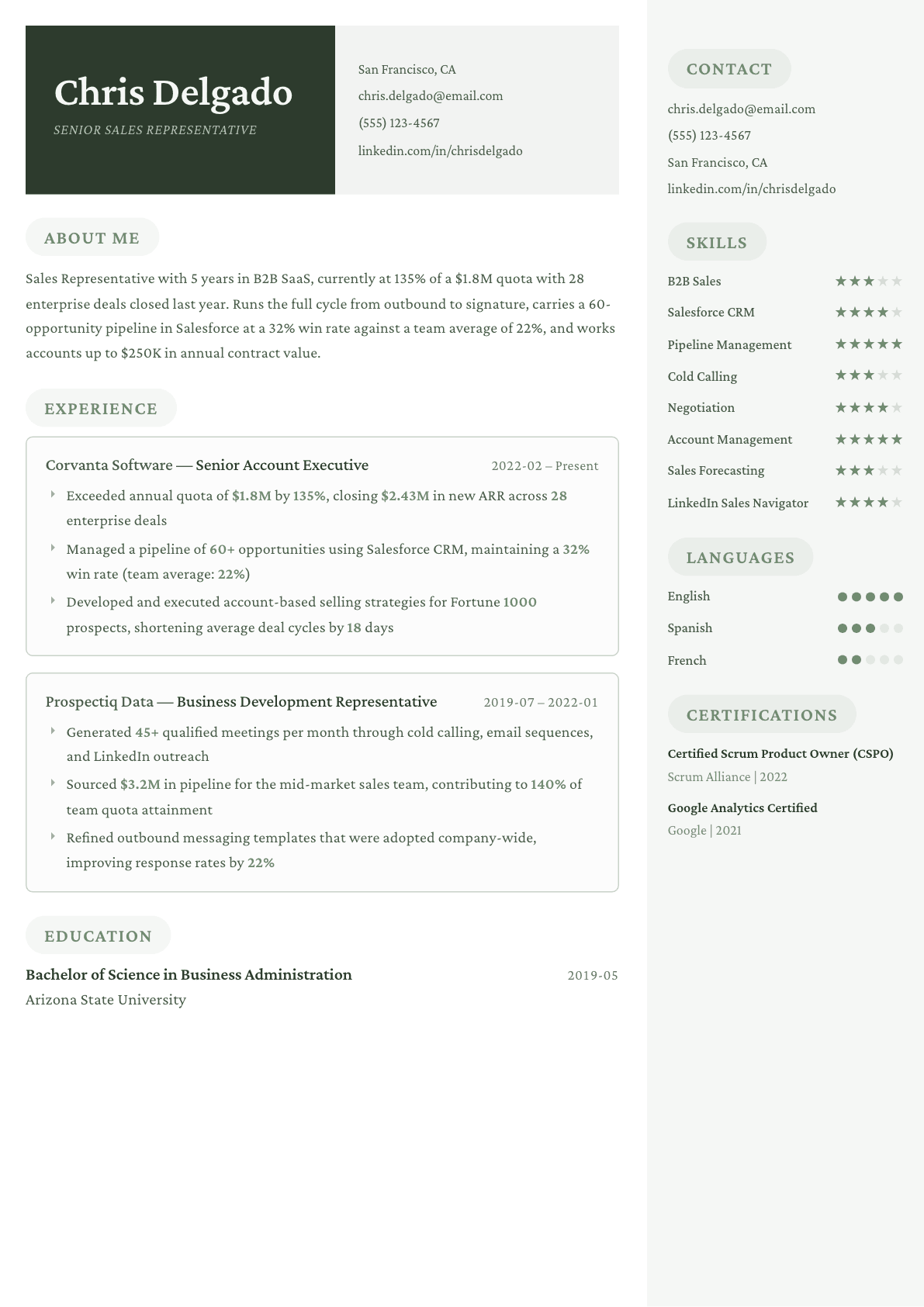
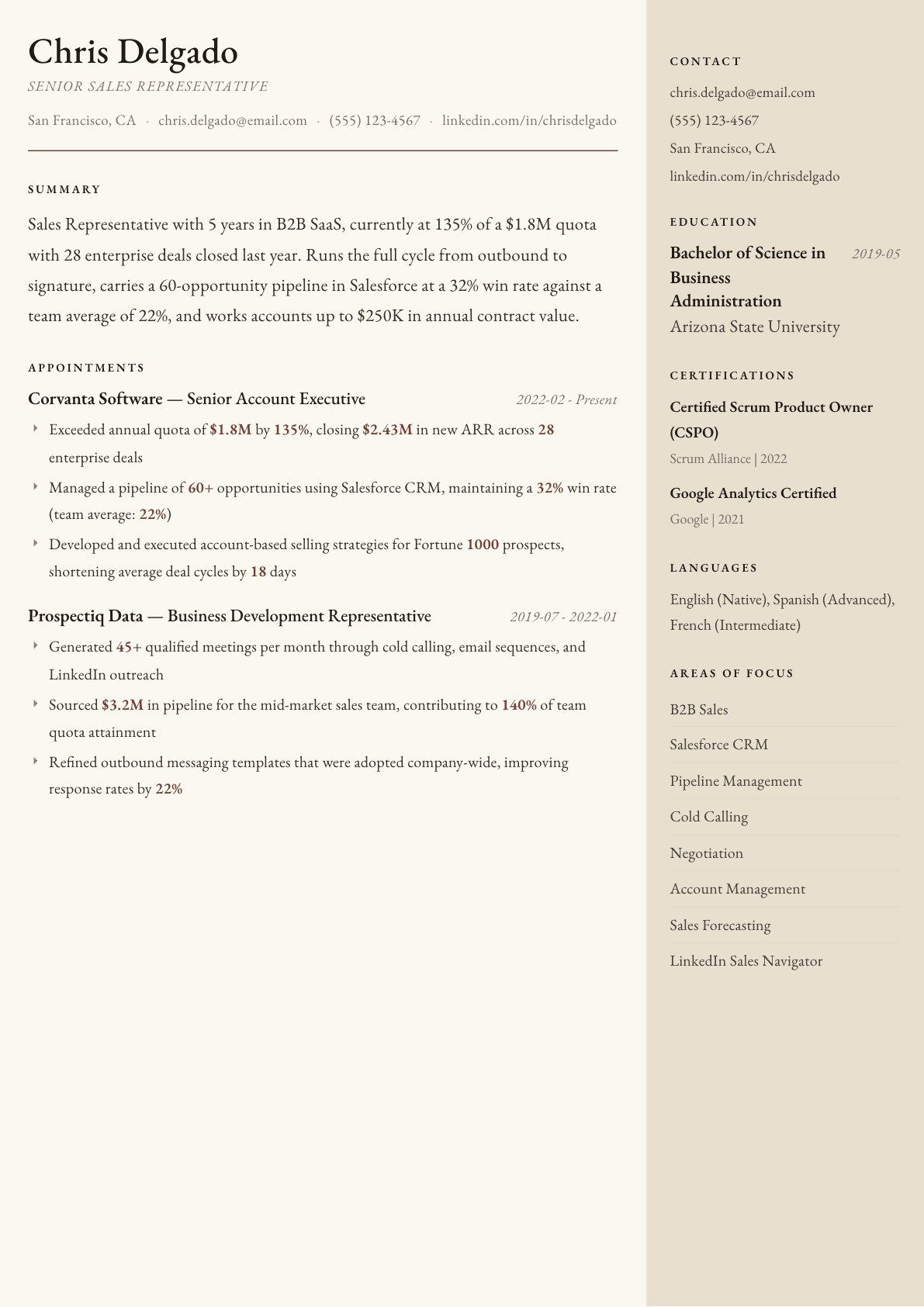
Example Sales Representative summary
Quota-crushing Sales Representative with 5 years of B2B SaaS experience and a career average of 128% quota attainment. Expert in full-cycle enterprise sales, managing complex deal cycles from prospecting to close with average contract values of $150K+. Combines consultative selling with data-driven pipeline management to consistently outperform targets and drive sustainable revenue growth.
Skills to list on a Sales Representative resume
- B2B Sales
- SaaS Sales
- Salesforce CRM
- HubSpot CRM
- Pipeline Management
- Cold Calling
- Email Outreach
- Negotiation
- Account Management
- Sales Forecasting
- LinkedIn Sales Navigator
- MEDDIC
- Solution Selling
- Presentation Skills
- Territory Management
What actually gets this resume read
- Always include quota attainment percentages: "Exceeded $1.5M annual quota by 130%" is the gold standard.
- Specify deal sizes (ACV/TCV), pipeline generated, and the number of deals closed to show your scale.
- Name the CRM and sales tools you use: Salesforce, HubSpot, Outreach, Gong, LinkedIn Sales Navigator.
- Highlight both hunting (new business) and farming (expansion/renewal) experience if you have it.
- Mention sales methodologies: MEDDIC, SPIN, Challenger, Sandler, or Solution Selling.
- Include a "Key Achievements" section or bold your most impressive numbers to catch the hiring manager's eye.
How to write a sales representative resume
A sales representative resume is the one document where the reader expects you to sell. Hiring managers in sales assume that the way you present your own record is a sample of the way you will present their product, so a vague resume is treated as evidence of vague discovery calls. The candidates who get interviews put quota and attainment in the first three lines and support them with pipeline, deal size and win rate underneath.
The screener also needs to place you in a motion. Inbound closing at a small deal size, outbound hunting into cold accounts, retail or in-home selling, distributor and field selling, and enterprise expansion are separate crafts with different interview loops. A resume that never names the deal size, the cycle length or the buyer title forces the recruiter to guess, and guessing usually means a rejection.
What follows is a complete sales rep resume sample, the structure that works for a sales representative resume, three summaries from a first sales job to a senior seller, five before-and-after bullets, sales rep resume examples by motion, and the questions reps ask when the numbers are complicated.
Resume format for a salesman or sales rep: one page, numbers first
Keep it to one page for almost any rep career. Reverse chronological, plain single column, no charts of quota attainment as graphics, because those get dropped by parsers and a number in text reads just as loudly.
The resume format for a salesman is the same whatever the job title says, sales representative, account executive or the older word salesman still used in auto and building supply postings: reverse chronological order, one page, and your numbers in the top third. A hiring manager in sales reads the page like a forecast, so the format has one job, which is to put attainment where the eye lands first.
Directly under the summary, many strong rep resumes carry a short achievements block: three lines of attainment by year, ranking within the team, and the largest deal closed. It gives the hiring manager the whole case in five seconds and lets the experience section do the explaining.
- Header: name, city and state, phone, email, and the market you sell into.
- Order: summary, key achievements, experience, skills and tools, education.
- Each job line carries the company, what it sells, the segment, and the quota you carried.
Summary: what you sell, to whom, and how you finish
Three lines. Product category, buyer, average deal size, cycle length, and your attainment across a run of years rather than one. A summary reading energetic self-starter with a passion for building relationships describes nobody and survives no screen.
If you are new to selling, replace attainment with the closest evidence you have: a commission or bonus target you beat in retail, call volumes and conversion in a contact center, an internship where you sourced meetings. New reps are hired on activity discipline and coachability, and both can be shown with real numbers.
Experience: quota, attainment, pipeline, then how you got there
The first bullet of every sales job should be the quota and the attainment against it, with the period stated. Two more bullets carry the mechanics: pipeline sourced by you as opposed to inherited, win rate against the team average, average contract value, and how the cycle length moved.
Then show the motion. Cold call volume and connect rate, sequences you wrote, trade shows worked, referrals generated, multithreaded accounts, mutual action plans used to control a close. These bullets prove that the attainment came from a repeatable process instead of one inherited account that renewed.
Avoid bullets that restate the job title. Building relationships with clients, managing a pipeline and meeting customer needs describe every seller in the pile and cost you the space a real number would have used.
Tools and methodology: the stack a manager will test
Name the CRM you live in, the sequencing tool, the call recorder, the enrichment and prospecting sources, and any quoting system. Salesforce, HubSpot, Outreach, Salesloft, Gong, ZoomInfo, Apollo and LinkedIn Sales Navigator are the ones postings list by name.
Name a methodology only if you can run it in an interview. MEDDIC and MEDDPICC show up in enterprise software postings, Challenger and Sandler in commercial and mid-market roles, and consultative or solution selling in field and distribution roles. Interviewers regularly hand a candidate a scenario and ask them to qualify it in the language they claimed.
Keywords the screen is scanning for
Recurring terms in these postings are quota attainment, prospecting, cold calling, pipeline generation, discovery, negotiation, closing, account expansion, renewals, forecasting, and the CRM name. Mirror the posting language once high on the page and once inside a bullet with a result attached. Never paste a keyword block at the bottom of the page: the hiring manager reads the file immediately after the software does, and a naked keyword list reads as padding.
Salesman CV sample and sales rep resume examples by sales motion
Here is a sales rep resume sample for an outside sales representative with four years of experience, applying for a larger territory. The numbers sit in the first lines because that is where the hiring manager looks.
After the full page come more resume examples a sales rep can actually use: experience sections, because that is where a hiring manager decides. Each one names the motion, the deal size band, the quota result and the rank on the team. The people, companies and figures are invented; keep the order of facts and replace the motion, the buyer and the numbers with your own.
In the UK the same page is called a salesman CV or a sales executive CV, and it carries the same numbers in the same order. Two habits differ: a short personal profile takes the place of the summary, and each job line names the product and the territory, such as field sales across the South West. The salesman CV sample at the end of the list is written that way, with an invented person and employer.
- Header: Alyssa Grant, Sales Representative, city, phone, email, LinkedIn.
- Summary: Outside sales representative with four years selling packaging supplies to manufacturers and distributors across a three-state territory. Above quota in each of the last three years, with a full cycle from prospecting to signed contract. Looking for a larger territory with new account hunting.
- Experience: quota and attainment per year, pipeline and new accounts opened, deal size and cycle length, and one deal you won, one bullet each.
- Earlier role: inside sales or customer service, two bullets that show calls, conversions or retention.
- Skills and tools: Salesforce or HubSpot, the sales method you were trained in, territory planning and product knowledge. Education: degree or relevant training, plus any sales certifications.
- Entry level, inside sales: Sales Development Representative, a payroll software company. Booked qualified meetings for two account executives from outbound calls and email; finished the year as the top booker on a team of eight; every activity logged in Salesforce the same day.
- Mid level, field sales: Territory Sales Representative, an industrial supply distributor. Owned 120 accounts across two states; opened 28 new accounts in a year from trade shows and referrals; finished above annual quota, second of nine reps in the region; renewed every top ten account.
- Mid level, retail to B2B: Account Representative, an office equipment dealer, after four years as a store sales lead. Closed lease and service contracts with small businesses; average sales cycle of three weeks; won the dealer award for new contracts in the second full year.
- Senior level, enterprise: Senior Account Executive, a logistics platform. Closed multi year contracts with retail and manufacturing buyers at director and vice president level; ran a team selling motion with a solutions engineer and legal; above quota in each of the last three years.
- Salesman CV sample, profile: Daniel Hughes, Field Sales Executive. Salesman with five years selling building products to builders merchants and contractors across the South West, above target in each of the last three years and the top seller on a team of six last year.
- Salesman CV sample, experience: Field Sales Executive, a building products distributor. Manages 90 merchant and contractor accounts; opened 22 new accounts in a year from site visits and trade counter days; grew the largest account by adding two product ranges; logs every visit in the CRM the same day.
- Salesman CV sample, earlier role and education: Trade Counter Sales, a timber merchant, two years, top of the branch for add on sales. A levels, plus the distributor's own sales training course.
Sales Representative resume summary examples
First sales job
Business graduate moving into B2B sales after two years in retail, where I beat an individual monthly target for 19 of 24 months and ranked first of eleven on attachment rate. Comfortable on the phone, trained on HubSpot, and looking for a sales development or inside sales seat.
Five years selling
B2B software sales representative carrying a 1.8M annual quota with a 90-day cycle and an average contract value near 85K. Finished at 135%, 112% and 121% across the last three years, sourced 40% of my own pipeline, and hold a 32% win rate against a team average of 22%.
Senior enterprise seller
Senior account executive selling into Fortune 1000 operations and finance buyers on six to nine month cycles, with deals from 150K to 600K. Closed 2.4M against a 1.8M quota last year across 12 deals, and grew three existing accounts into multiyear expansions after the initial land.
Work experience bullets: before and after
Before: Consistently met or exceeded sales targets.
After: Closed 2.43M against a 1.8M annual quota, finishing at 135% and ranking second of fourteen account executives on the mid-market team.
A number against a stated quota plus a ranking gives the reader scale and relative performance in one line.
Before: Generated leads through cold calling and email.
After: Sourced 45 qualified meetings a month through 60 daily dials and a four-touch email sequence I wrote, producing 3.2M in self-generated pipeline.
Activity volumes plus the pipeline they produced show a repeatable engine rather than an occasional burst of prospecting.
Before: Built strong relationships with key clients.
After: Multithreaded four enterprise accounts to the finance and security buyers, which cut the average legal and procurement stage from 41 days to 24.
The relationship claim becomes credible once it names who was reached and what part of the deal moved faster.
Before: Used Salesforce to manage my pipeline.
After: Ran a 60-opportunity pipeline in Salesforce with weekly stage hygiene and next-step dating, keeping coverage above three times quota all year.
It shows the discipline behind the CRM rather than the fact that the company owned one.
Before: Handled renewals and upsells for existing accounts.
After: Owned renewal and expansion for 22 accounts worth 1.1M, retained 96% of the book, and added 310K in expansion through a quarterly business review cadence.
Book size, retention and expansion separate account ownership from generic customer contact.
Hard skills
- Full-cycle B2B selling
- Cold calling and outbound prospecting
- Discovery and qualification
- Pipeline management
- Negotiation and closing
- Account expansion and renewals
- Salesforce CRM
- HubSpot CRM
- Outreach and Salesloft sequencing
- LinkedIn Sales Navigator
- Gong call review
- Forecasting and commit calls
- Territory planning
Soft skills
- Handling objections without flinching
- Active listening on discovery calls
- Persistence through a long cycle
- Coachability in call reviews
- Time blocking and prospecting discipline
Certifications worth listing
- Challenger Sales Certification (Challenger Inc.)
- Sandler Sales Certification (Sandler Training)
- HubSpot Sales Software Certification (HubSpot Academy)
- Salesforce Certified Administrator (Salesforce)
- Certified Professional Sales Person (CPSP) (National Association of Sales Professionals)
Mistakes that cost sales representative candidates the interview
- Saying you exceeded targets without stating the target, which reads as a number too small or too soft to print.
- Hiding the average deal size and cycle length, so the manager cannot tell transactional selling from enterprise pursuit.
- Filling bullets with relationship language and leaving no evidence of prospecting, the activity most sales managers screen hardest for.
- Presenting attainment as a graphic or a chart, which many parsers drop and which forces a human to squint at percentages.
- Claiming a methodology by name without being able to qualify a live deal in it during the interview.
- Listing every product the company sold instead of what you personally closed and to which buyer title.
Sales Representative resume questions
What if I never had a formal quota?
Use whatever target existed: monthly revenue, units, appointments booked, attachment rate, or a bonus threshold. State the target, state your result, and say how you ranked against peers. Managers care that you were measured and beat the measure.
How do I handle a bad year on a sales resume?
Show the year with its real attainment and add one clause of context in the same bullet, such as a territory change, a product recall, or six months on a new segment. Then show the following period recovering. Leaving the year out creates a gap that draws a harder question.
What is the best resume format for a salesman?
Reverse chronological, one page, single column. Put a three line achievements block under the summary with attainment by year, your rank on the team with the team size, and your largest deal. Each job line names what you sold and to whom. Functional formats hide the numbers sales managers are hiring for.
What does a salesman CV sample include in the UK?
A short profile with what you sell, to whom and your result against target, then each job with the product, the territory, the accounts you manage, the new accounts you opened and your rank on the team. Add the CRM you use and your education, keep it to two pages at most, and leave out a photo and date of birth.
What do the best sales rep resume examples have in common?
They name the motion, the buyer and the deal size in the first line of each job, then give quota attainment and rank on the team. Every bullet carries a number from the sales record, and the tools a manager will test, such as the CRM and the outreach platform, appear by name.