Loss Prevention Resume Examples: the lines they read
Write a Loss Prevention Resume Built on Shrink and Cases
By Mustafa Tarabya, founder of CVBooster · Published · Updated
Loss prevention resume examples with shrink, apprehension, and audit bullets, plus a writing guide for retail asset protection applications.
Sample resumes for a loss prevention
The same loss prevention content laid out in three CVBooster templates, so you can see what the finished document looks like before you write a word.
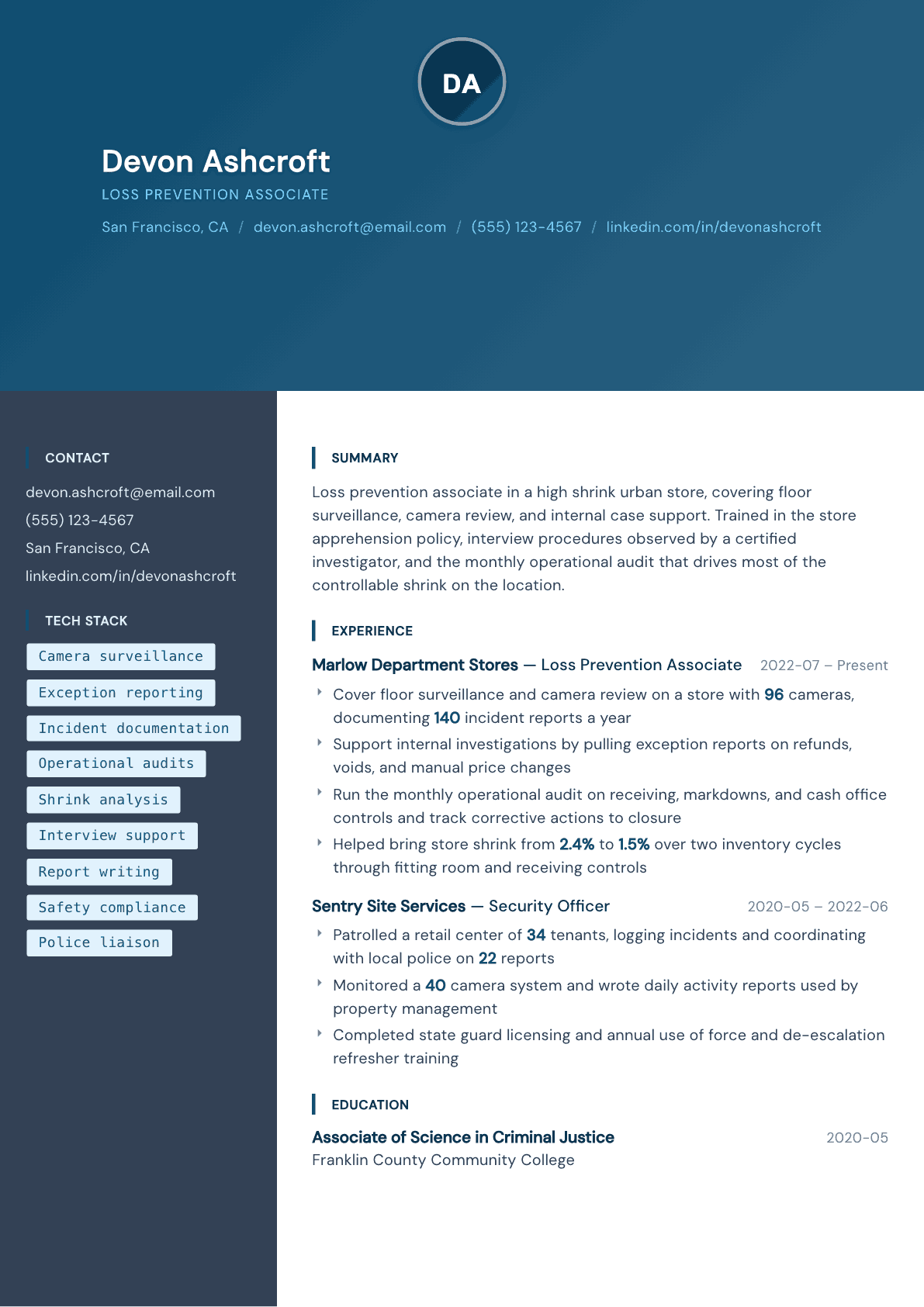
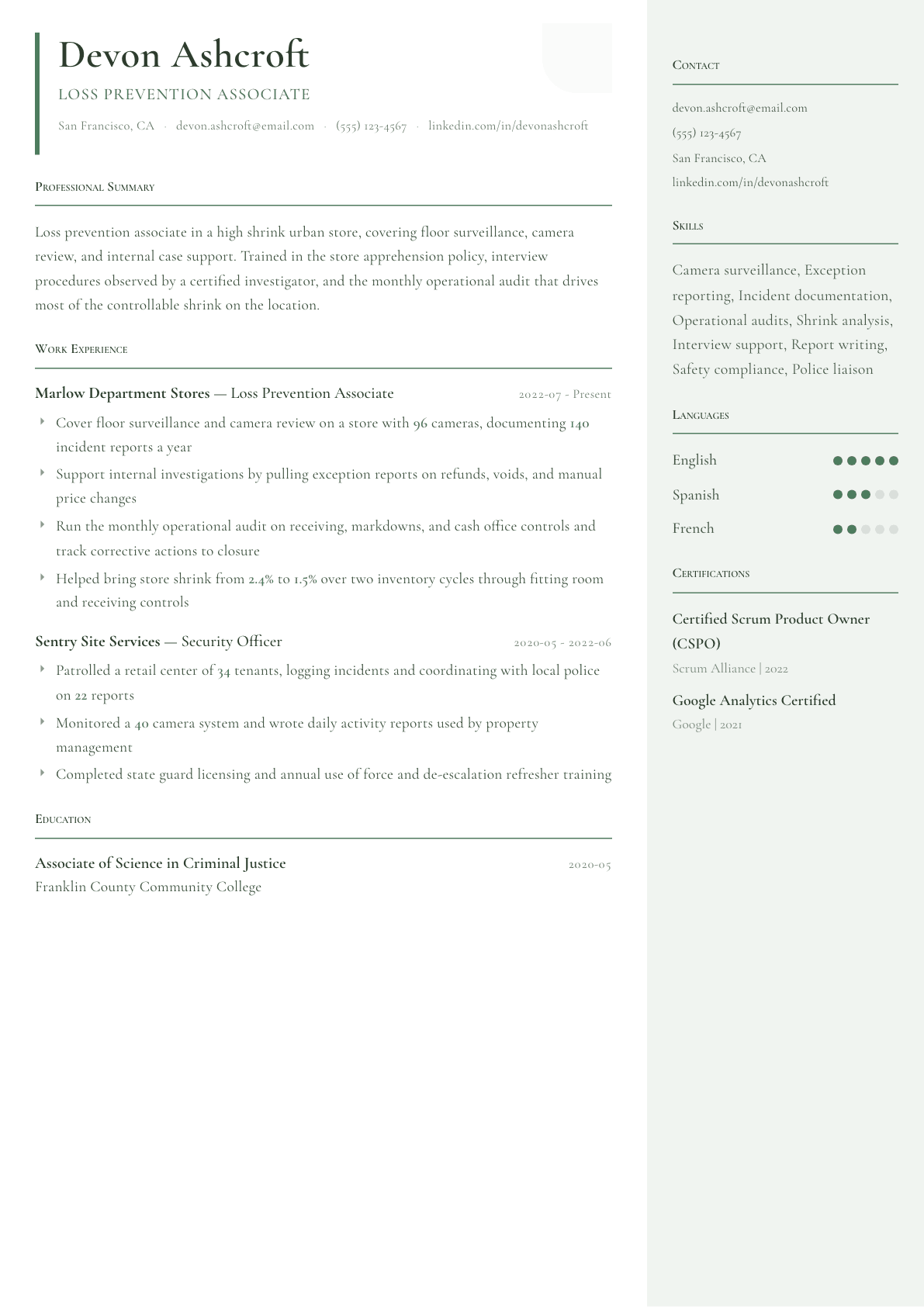
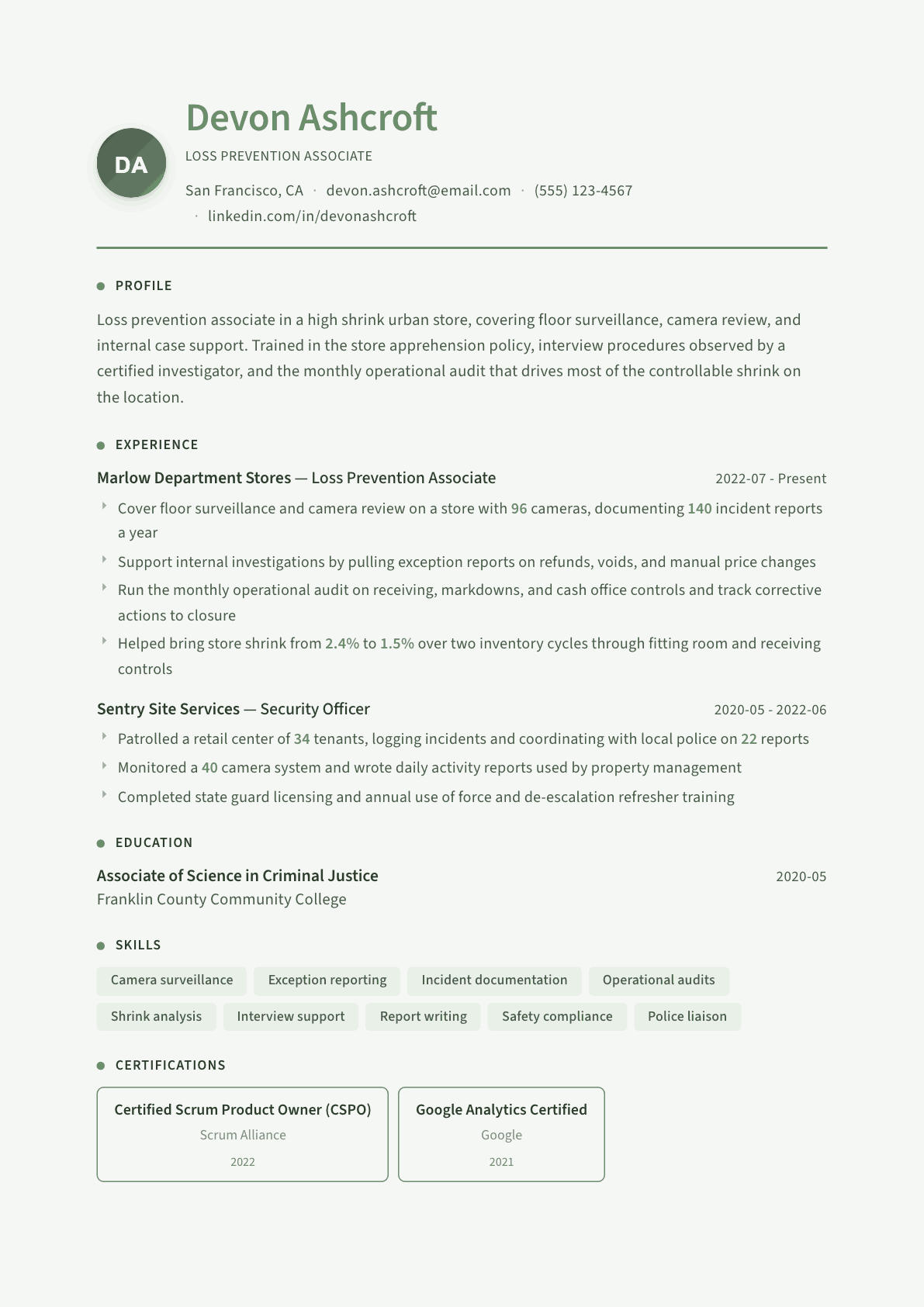
Example Loss Prevention summary
Loss prevention associate with four years across retail asset protection and contract security, covering camera review, exception reporting, and internal case support in a high shrink store. Helped move shrink from 2.4% to 1.5% over two inventory cycles through receiving and fitting room controls, and documents 140 incident reports a year.
Skills to list on a Loss Prevention resume
- Shrink reduction
- Camera surveillance
- Exception report analysis
- Internal investigations
- Interview and statement support
- Incident report writing
- Operational audits
- Inventory control
- Refund and void review
- Safety and hazard compliance
- Access control
- Law enforcement coordination
- Case documentation
- Awareness training delivery
What actually gets this resume read
- Lead with shrink results tied to an inventory cycle, because that is the number asset protection is judged on.
- Describe audits and controls before apprehensions, since most recovered value comes from process, not stops.
- Name the exception reporting and camera systems you used, and say what you looked for in the data.
- Be careful with apprehension counts: report volume and policy compliance, never anything that identifies a person.
- List any state guard license or investigative credential with the issuing body and current status.
- Show your report writing, because a case is only as strong as the documentation behind it.
How to write a loss prevention resume
Loss prevention hiring managers read a resume for evidence of process, not for stories about catches. The shrink number on a store's inventory result comes mostly from paperwork, receiving errors, refund fraud, and weak controls, and only partly from the person walking out with merchandise. A resume built around apprehensions signals someone who will miss most of the loss.
The second thing a district asset protection manager checks is discipline around policy. Approach and detention rules exist to protect the company and the employee, and an applicant who describes chasing anyone or working outside the policy will not be interviewed, no matter how many stops they made.
This guide covers how to structure the page, what to write instead of apprehension counts, three summary examples from a new associate to a multi-store investigator, before and after bullets, and the questions loss prevention applicants ask when they move between retail formats.
Format: one page, store profile before the bullets
One page until you cover multiple stores, then two at most. Give every role a profile line: format, store volume band, camera count, whether the site is high shrink, and whether you worked overtly in uniform or covertly on the floor. Those details change the job completely and a district manager reads them first.
Keep case detail generic. Names, dates of individual incidents, and anything identifying a person or an ongoing matter should never appear on a resume, and a candidate who includes them raises a discretion concern before the interview starts.
- Header: name, city and state, phone, email, and any state guard license with its status.
- Section order: summary, experience, licenses and certifications, skills, education.
- State whether you worked uniformed, plain clothes, or both, since programs differ.
Summary: shrink result, controls, and case support
Three lines. Name the format and the store profile, then the shrink direction across a stated number of inventory cycles, then the two or three controls you were responsible for. Investigation support belongs in the third line rather than the first, because that is the order the work actually matters in.
Coming from contract security or law enforcement, translate deliberately. Report writing, camera systems, evidence handling, and interview procedures all transfer, but retail asset protection is an audit and analytics job first, and the summary should show you understand that.
Experience: audits and analytics before apprehensions
Lead with the operational audit. Receiving door controls, markdown and destroy processes, cash office procedure, vendor check-in, and fitting room counts are where controllable shrink is won, and each one is a bullet with a corrective action and a closure.
Then exception reporting. Explain what you looked for in the point of sale data: refunds without a receipt, voids clustered on one operator, manual price changes, no-sale openings, and discount abuse. Naming the patterns you pulled shows you can work a case from data instead of waiting to see something on camera.
Then surveillance and case support. Camera counts, review hours, incident documentation volume, and the part you played in internal cases under a certified interviewer. Write apprehension work in terms of policy compliance and documentation quality rather than as a tally.
Close with awareness work: training store teams on shrink drivers, running the shortage meeting, and building associate awareness of refund and receiving controls. Stores reduce loss through their own staff, and asset protection leaders hire people who can teach.
Licenses, credentials, and legal care
List any state security guard license with the issuing state and current status, since requirements differ and a lapsed license is a scheduling problem. Investigative and interview credentials from recognized bodies belong here too, and they carry weight because internal cases depend on interviews being conducted properly.
Write nothing that implies you exceeded policy. Physical intervention, pursuit off property, or detaining without meeting every element of the store standard are the fastest ways to be screened out, and describing restraint under a written approach policy is a genuine strength on this page.
Skills and the keywords a district screen uses
Use the vocabulary of the field: shrink, shortage, exception reporting, internal investigation, operational audit, receiving controls, refund fraud, organized retail crime, incident report, case documentation, safety compliance, and access control. Add the camera and exception systems you have used by category if you cannot name the platform.
Safety belongs in the list too. In most chains asset protection owns the store safety program, so hazard walks, incident reporting, and claims documentation are part of the job and are often the half of the posting applicants forget to answer.
Loss Prevention resume summary examples
Moving in from security
Contract security officer moving into retail asset protection, with two years monitoring a 40 camera system across a 34 tenant retail center and writing the daily activity reports used by property management. State guard licensed, trained in de-escalation, and studying refund and receiving controls.
Three years in a store
Loss prevention associate in a high shrink urban store with 96 cameras, covering floor surveillance, camera review, and internal case support. Helped move shrink from 2.4% to 1.5% across two inventory cycles through receiving and fitting room controls, and documents 140 incident reports a year.
Multi-store investigator
Asset protection investigator covering nine stores, building internal cases from exception reporting and conducting interviews under company policy. Owns the shortage review with store managers, closed a multi-store refund scheme, and trains new associates on audit execution and report writing.
Work experience bullets: before and after
Before: Watched cameras and caught shoplifters.
After: Covered floor surveillance and camera review across a 96 camera system, documenting 140 incident reports a year under the store approach and detention policy.
System size, documentation volume, and the policy reference show a controlled program instead of a personal tally.
Before: Looked into internal theft when it happened.
After: Pulled exception reports on refunds, voids, and manual price changes to build internal cases, escalating supported files to the district investigator.
Naming the data patterns and the escalation path proves you can work a case analytically and within the chain of authority.
Before: Did store audits every month.
After: Ran the monthly operational audit on receiving, markdowns, and cash office controls, and tracked every corrective action to closure with the store manager.
The audit scope and the follow-through to closure are what actually reduce controllable shrink.
Before: Helped reduce shrink at my store.
After: Helped bring store shrink from 2.4% to 1.5% over two inventory cycles by tightening fitting room counts, receiving verification, and the markdown process.
A result tied to inventory cycles and named controls lets a district manager judge whether the improvement was real.
Before: Trained employees about theft.
After: Delivered shortage awareness training to store teams on refund controls, receiving verification, and reporting routes, and led the monthly shortage meeting.
Training content and ownership of the shortage meeting show you use the store team as the main loss control.
Hard skills
- Shrink and shortage analysis
- Operational audit execution
- Exception report analysis
- Internal investigation support
- Interview and statement documentation
- Camera system monitoring and review
- Incident and case report writing
- Receiving and vendor controls
- Refund and void review
- Physical inventory support
- Access control and key management
- Store safety and hazard compliance
Soft skills
- Discretion
- Objectivity in a case
- Patience during long reviews
- Composure in confrontation
- Working with store leadership
- Clear written communication
Certifications worth listing
- LPQualified (LPQ) (Loss Prevention Foundation)
- LPCertified (LPC) (Loss Prevention Foundation)
- Certified Forensic Interviewer (CFI) (International Association of Interviewers)
- State Security Guard License (State licensing authority)
- OSHA 10-Hour General Industry (OSHA Outreach Training Program, U.S. Department of Labor)
Mistakes that cost loss prevention candidates the interview
- Building the resume around apprehension counts, which tells a district manager you will overlook the paperwork half of shrink.
- Describing pursuits, physical intervention, or detentions outside policy, the fastest way to be removed from consideration.
- Including identifying case details, which reads as a discretion risk regardless of how impressive the case was.
- Leaving out audits and exception reporting, the two activities that recover the most controllable loss in a store.
- Never stating the store profile, so the reader cannot tell a low shrink suburban site from a high shrink urban one.
- Ignoring the safety program, which asset protection usually owns and which appears in most postings.
Loss Prevention resume questions
Should I put the number of apprehensions on a loss prevention resume?
Use it sparingly and never as your headline. A count without context invites questions about policy compliance and about whether you spent your time where the loss actually sits. Lead with audits, exception reporting, and shrink results, then reference case volume as documentation.
How do I move from security guard work into retail asset protection?
Translate the transferable half, camera work, report writing, de-escalation, and license status, then show that you understand the audit and analytics side. Reading the refund, receiving, and markdown controls of a store before your interview will make the difference at that stage.
What certifications are worth holding in loss prevention?
The Loss Prevention Foundation credentials are widely recognized across retail asset protection, and an interview credential matters if you will conduct internal interviews. A current state guard license is required in many jurisdictions, so list it with the state and its status.
How do I write about shrink results if my store had a bad number?
Show direction and mechanism rather than a snapshot. Improving a high shrink store across two inventory cycles is a stronger story than inheriting a low number. If the result went the wrong way, use the controls you built instead, such as a receiving audit or a refund review routine.
What is the career path from a store loss prevention role?
The usual route runs from store associate to multi-store investigator, then district or regional asset protection manager, with side moves into safety, organized retail crime teams, and corporate audit. Each step scores analytics and audit ownership more heavily than floor surveillance.