E-Commerce Manager Resume Examples: the lines they read
Create an E-Commerce Manager Resume That Converts
By Mustafa Tarabya, founder of CVBooster · Published · Updated
Build a high-impact e-commerce manager resume with ATS-friendly templates tailored for online retail leaders.
Sample resumes for a e-commerce manager
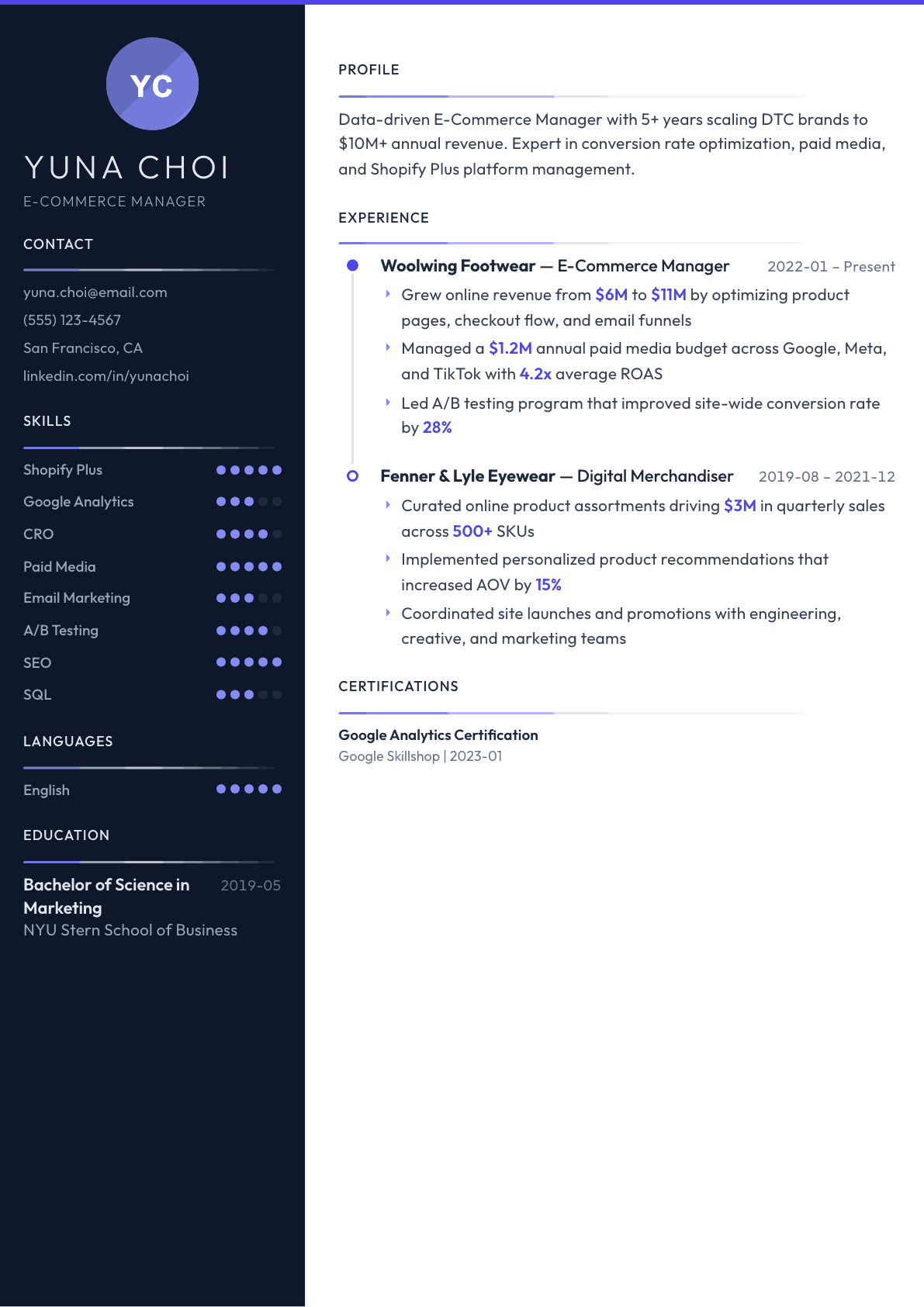
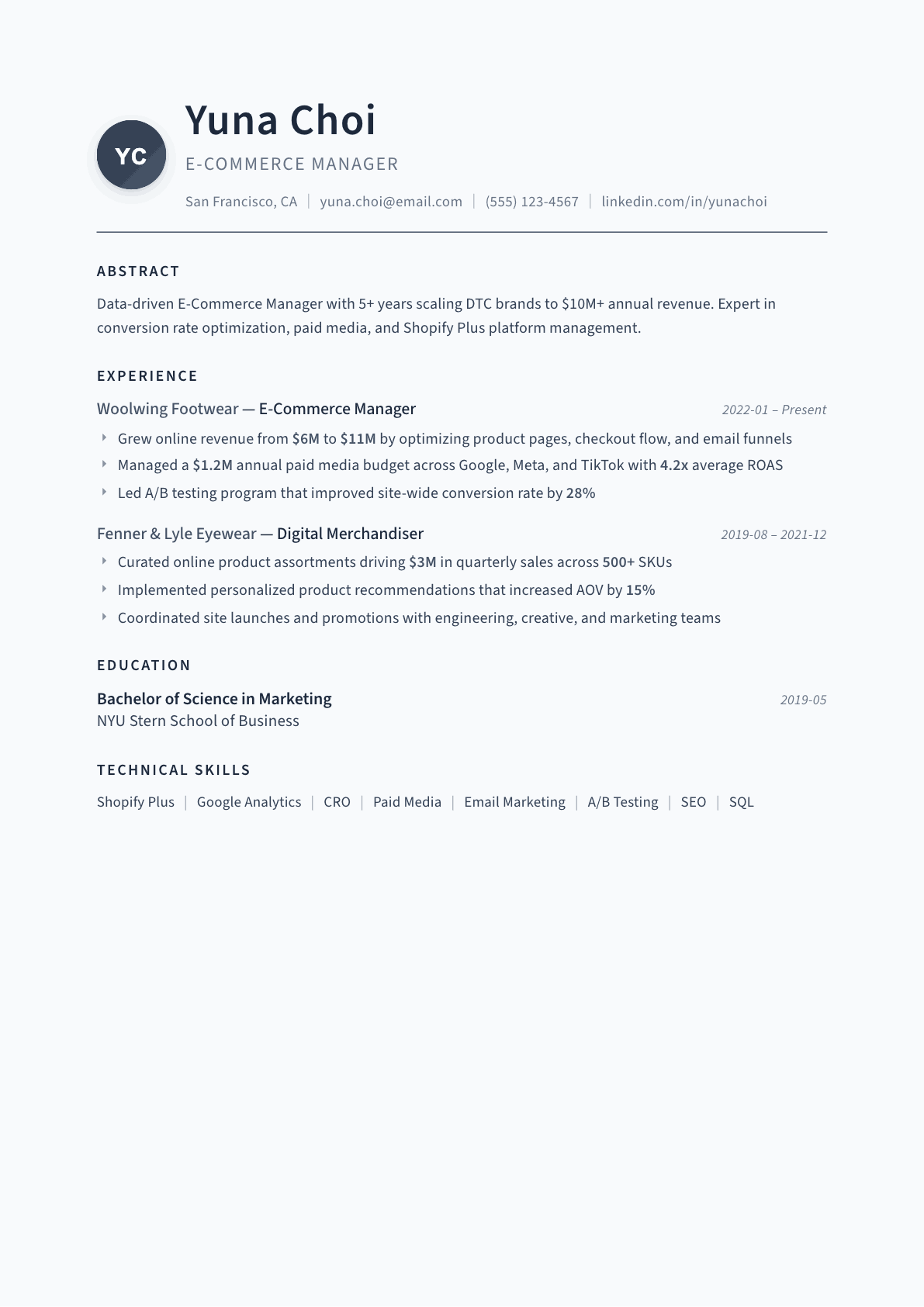
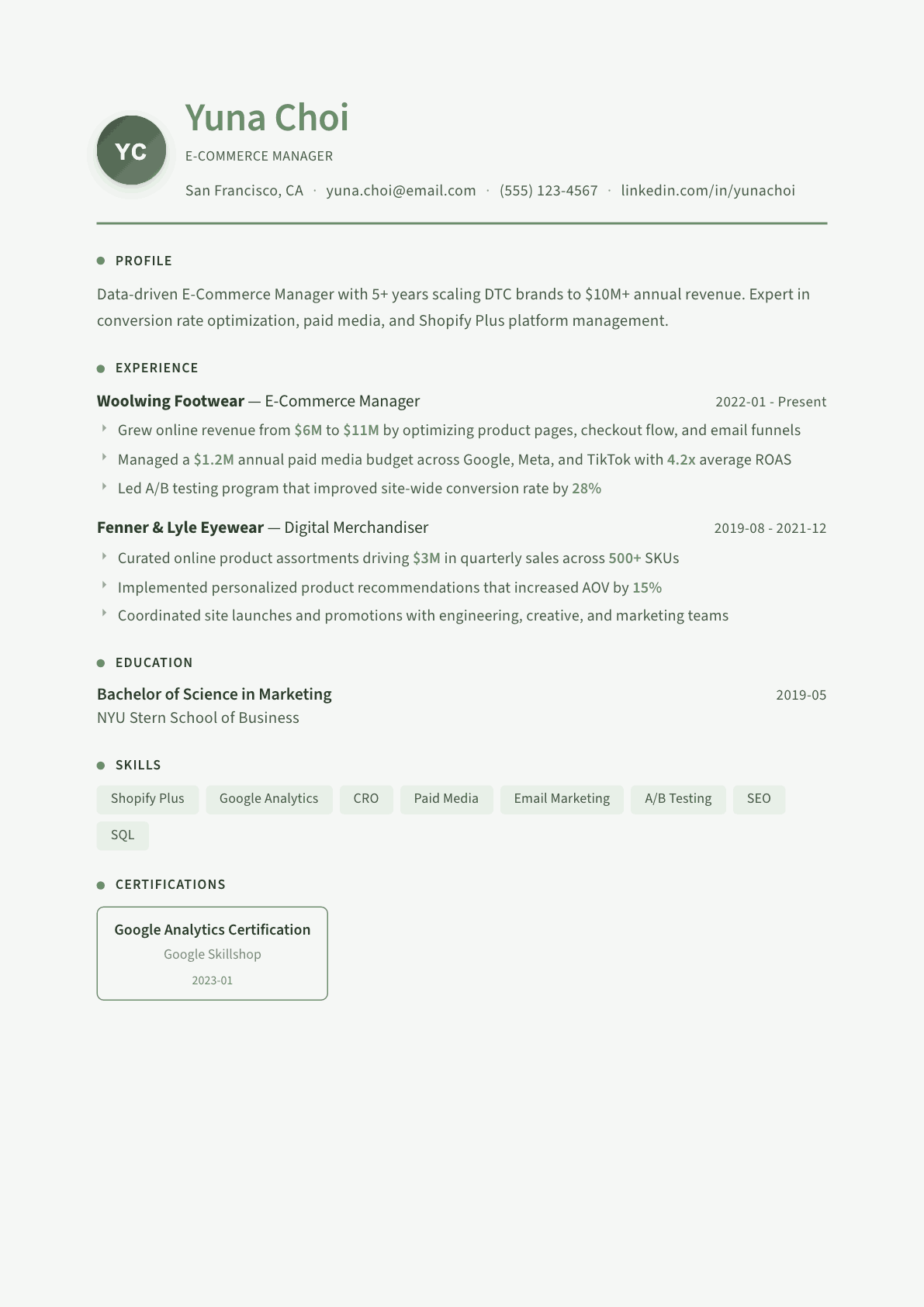
The same e-commerce manager content laid out in three CVBooster templates, so you can see what the finished document looks like before you write a word.
Example E-Commerce Manager summary
E-commerce manager, 5 years in direct-to-consumer, took one footwear brand from $6M to $11M online by rebuilding product pages, checkout and the email flows behind it. Runs a $1.2M paid media budget at 4.2x return on ad spend and a testing program that lifted site conversion 28%.
Skills to list on a E-Commerce Manager resume
- Shopify / Shopify Plus
- Google Analytics
- Conversion Rate Optimization
- Paid Media Management
- SEO / SEM
- Email & SMS Marketing
- A/B Testing
- SQL & Data Analysis
- Product Merchandising
- UX Optimization
What actually gets this resume read
- Highlight revenue growth, conversion rate improvements, and ROAS metrics prominently.
- List specific platforms (Shopify, Magento, BigCommerce) and analytics tools you use.
- Show cross-functional collaboration with marketing, engineering, and creative teams.
- Include A/B testing methodology and data-driven decision-making examples.
How to write a e-commerce manager resume
An e-commerce manager resume has to answer one question before anything else: what did you own. The title covers at least four different jobs. Some e-commerce managers own the storefront and merchandising. Some own paid acquisition and email. Some own the marketplace channels on Amazon and elsewhere. Some own the whole online profit and loss statement including fulfillment cost and returns. The hiring director is trying to work out which one you are.
The second question is whether you move the funnel or only report on it. Sessions, conversion rate, average order value, revenue per session, repeat purchase rate, return rate and contribution margin after advertising and fulfillment are the metrics an online business runs on. Naming the platform you administered is table stakes. Showing that you changed one of those numbers, and how, is the resume.
This guide covers the channel scope block, how to describe platform and stack experience without sounding like a tool list, summaries for a coordinator, a manager and a head of e-commerce, before and after bullets, and the questions people ask when moving from marketing or retail merchandising into online.
Format: a scope block that says what you owned
One page under seven years, two after that, single column and reverse chronological. Under each title write a scope line before the bullets: annual online revenue band or order volume, the channels you owned, the platform, the size of the catalog, the team and agencies reporting to you, and whether the business was direct to consumer, business to business, marketplace or a mix.
Catalog size and business model change the job more than most candidates realize. Running a curated assortment of a few hundred stock keeping units in a single market is a merchandising job. Running many thousands of items across marketplaces and multiple countries is a data and operations job. Say which one you did so the reader stops guessing.
- Header: name, city and state or remote, phone, email, and a portfolio or professional profile link if the site is public.
- Section order: summary, channel and scope block, experience, technical stack, certifications, education.
- For each role: platform, channels, catalog size, team and agency structure, and the metrics you owned in the plan.
The metrics that carry weight
Write the funnel in order and put a number on the steps you influenced: traffic by source, conversion rate, average order value, revenue, return rate and contribution after advertising and fulfillment. Advertising return on ad spend belongs there too, but pair it with revenue, because a high return on a small budget and a modest return on a large one are different achievements.
Retention numbers separate senior candidates. Repeat purchase rate, subscription renewal, email and SMS revenue share, and cohort revenue over the first year all show that you think past the first order. So does the returns and exchange picture, since return rate quietly decides whether a category is profitable at all.
Site performance is a metric, not an engineering detail. Page load, mobile conversion against desktop, checkout abandonment and search result quality on the site are all things an e-commerce manager is accountable for even when engineers do the work. Naming what you diagnosed and what improved is the fastest way to sound like an operator.
Merchandising, content and the catalog
Describe how the store was built and maintained: assortment planning for online, category and collection structure, product page content standards, imagery and video requirements, size and fit information, reviews and user generated content, and on-site search and filtering. These are the levers that move conversion without buying a single click.
Pricing and promotion belongs here too. Promotional calendar ownership, markdown strategy on slow stock keeping units, bundling, free delivery thresholds and their effect on average order value, and how you coordinated with retail stores if the business had both. Omnichannel work such as buy online pick up in store or store fulfillment of online orders is worth its own bullet because it is operationally hard.
Stack and operations: name products, not categories
Name the store platform and version tier: Shopify Plus, BigCommerce, Magento or Adobe Commerce, Salesforce Commerce Cloud, WooCommerce or a headless build. Then the surrounding stack: analytics and tag management, the email and SMS platform, the product information management or feed tool, the customer support desk, the review platform, the subscription tool and the search provider.
Add the operations side, because e-commerce managers who understand it are scarcer. Order management and its handoff to the warehouse, inventory sync across channels, carrier selection and delivery promise, returns processing, fraud screening and payment providers. A candidate who can talk about the cost of an outbound parcel and the effect of a delivery threshold on margin is running a business, not a website.
Keywords the screener is scanning for
Postings repeat a stable vocabulary: conversion rate optimization, average order value, return on ad spend, customer acquisition cost, retention, merchandising, product detail page, checkout, marketplace, fulfillment, catalog management, A/B testing and the platform names. Mirror the ones you can prove in both the summary and a bullet.
The emphasis differs by employer type. A direct to consumer brand weights acquisition, retention and brand site experience. A marketplace-heavy seller weights listing quality, advertising inside the marketplace, buy box and inventory health. A business to business seller weights account pricing, quoting, reordering and integration with the customer purchasing system. Rewrite the top third of the page for each.
E-Commerce Manager resume summary examples
E-commerce coordinator
E-commerce Coordinator with two years maintaining a 900-item catalog on Shopify: product uploads, collection merchandising, promotional setup and weekly reporting in Google Analytics. Rewrote the top 50 product pages and supported a checkout test that lifted mobile conversion by 9%.
E-commerce manager, five years in
E-commerce Manager owning a direct to consumer storefront on Shopify Plus plus Amazon and eBay channels, with two coordinators and a paid media agency. Grew online revenue by 62% over two years while holding blended return on ad spend at 3.4 and lifting repeat purchase rate to 31%.
Head of e-commerce
Head of E-Commerce accountable for the online profit and loss statement across four countries on Adobe Commerce, leading a team of nine across merchandising, acquisition, content and operations. Owns forecasting, promotional strategy, fulfillment cost per order and the returns program.
Work experience bullets: before and after
Before: Managed the company website and online sales.
After: Owned a Shopify Plus storefront with a 4200-item catalog plus Amazon and eBay channels, directing two coordinators and a paid media agency against a shared revenue and margin plan.
Platform, catalog size, channel mix and team structure define the job the title alone leaves ambiguous.
Before: Improved the website conversion rate.
After: Raised site conversion from 1.6% to 2.3% over three quarters by rebuilding product detail pages around fit and material content, adding review imagery, and cutting checkout from four steps to two.
A measured before and after with the actual changes shows a method a hiring director can imagine you repeating.
Before: Ran paid ads and email campaigns.
After: Directed a paid search, paid social and email program at a blended return on ad spend of 3.4, and rebuilt the abandoned cart and post-purchase flows into 22% of email revenue.
Separating channel results from the retention program shows where the revenue actually came from.
Before: Worked with the warehouse on order fulfillment.
After: Cut average order dispatch time from 2.4 days to under 1 by reworking the order management handoff, splitting pick waves by carrier cutoff, and moving oversized items to a regional freight partner.
Naming the operational changes proves you influenced fulfillment rather than forwarding complaints to it.
Before: Handled product listings and content.
After: Standardized product data across 4200 items in a product information management tool, enforced imagery and attribute rules, and improved on-site search result relevance so zero-result searches fell by half.
Catalog hygiene is invisible work, so the tool, the standard and the search outcome make it legible.
Hard skills
- Shopify Plus administration
- Adobe Commerce and BigCommerce
- Conversion rate optimization and A/B testing
- Google Analytics and tag management
- Paid search and paid social management
- Email and SMS lifecycle programs
- Marketplace channel management
- Product information management and feeds
- Merchandising and assortment planning
- Promotional and markdown planning
- Order management and inventory sync
- Returns and fraud screening
- SQL and dashboard reporting
- Technical SEO for category and product pages
Soft skills
- Cross-functional coordination
- Agency management
- Prioritizing a test roadmap
- Commercial judgment
- Clear reporting to leadership
- Calm during peak trading
Certifications worth listing
- Google Analytics Certification (Google Skillshop)
- Google Ads Search Certification (Google Skillshop)
- Meta Certified Digital Marketing Associate (Meta Blueprint)
- Shopify Foundations Certification (Shopify)
- Adobe Commerce Business Practitioner (Adobe)
- Klaviyo Product Certification (Klaviyo)
Mistakes that cost e-commerce manager candidates the interview
- Leaving the scope undefined, so the reader cannot tell whether you owned acquisition, merchandising, marketplaces or the full online statement.
- Listing platforms and tools without a single number showing what changed while you used them.
- Reporting return on ad spend with no budget or revenue attached, which hides whether the result was meaningful.
- Ignoring returns, fulfillment cost and margin, the three things that decide whether online revenue is actually profitable.
- Treating marketplace work as the same job as brand site work, when listing quality, advertising and inventory health are separate disciplines.
- Writing agency-managed results as your own without saying you directed the agency and set the targets.
- Skipping catalog size and business model, which change the difficulty of the role more than the revenue figure does.
E-Commerce Manager resume questions
What metrics belong on an e-commerce manager resume?
Traffic by source, conversion rate, average order value, revenue, return on ad spend with the budget attached, repeat purchase rate, return rate and contribution margin. Pick the ones you genuinely influenced and show the change plus the action behind it.
How do I move into e-commerce from retail merchandising?
Translate what you already do. Assortment planning, markdown decisions, planogram thinking and vendor negotiation all map onto online category structure, promotional calendars, product page hierarchy and supplier terms. Then add a platform credential and any catalog work you have handled.
Should I list every tool I have used?
No. List the store platform, analytics, the acquisition and retention tools, and the catalog or feed system, then stop. A stack section longer than your results section suggests you administered software rather than ran a commercial channel.
How do I show impact when an agency ran the advertising?
Say that you directed the agency and name what you owned: the budget, the target, the creative brief, the audience strategy and the reporting cadence. Managing an agency to a result is a genuine skill, and claiming their execution as your own reads badly in an interview.
Is Amazon marketplace experience the same as e-commerce management?
It overlaps but it is its own discipline: listing content, advertising inside the marketplace, buy box competitiveness, inventory health and account standing. Label it clearly as marketplace management, then show separately whether you have also run an owned storefront.