Retail Operations Manager Resume Examples: free score
Craft a Retail Operations Manager Resume Built on Process and Numbers
By Mustafa Tarabya, founder of CVBooster · Published · Updated
Retail operations manager resume example covering labor models, inventory shrink, store standards and rollouts, with a full writing guide.
Sample resumes for a retail operations manager
The same retail operations manager content laid out in three CVBooster templates, so you can see what the finished document looks like before you write a word.
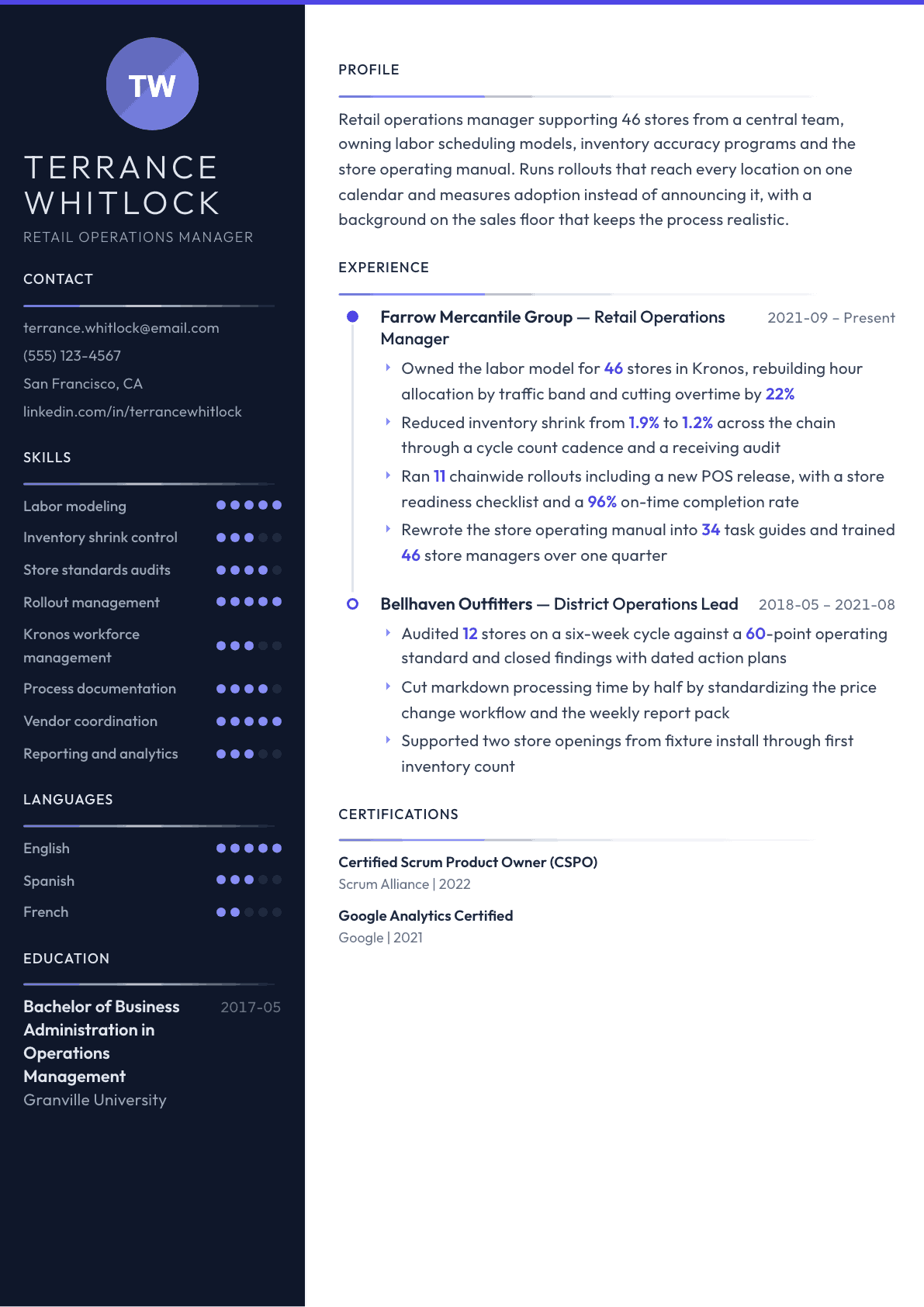
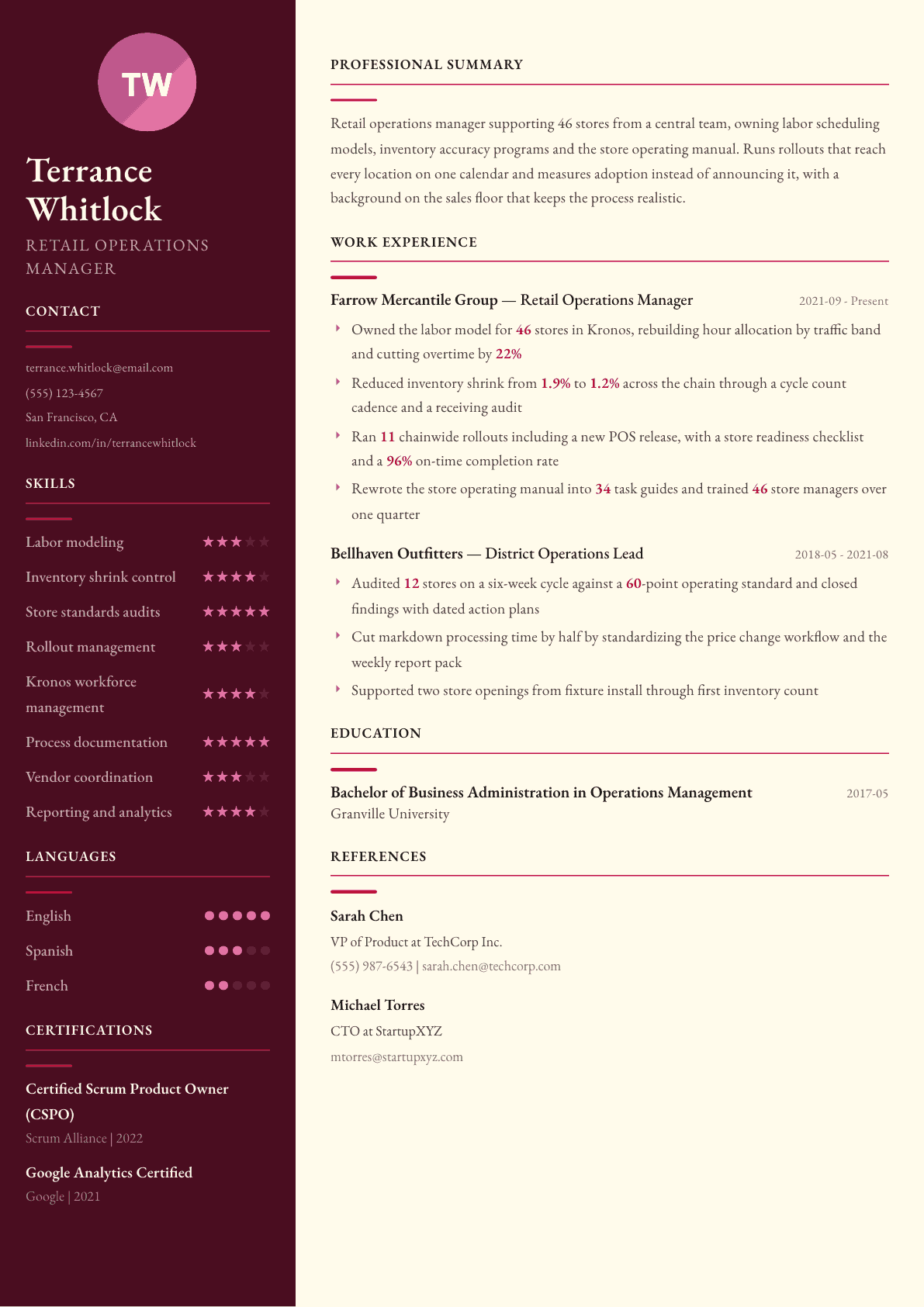
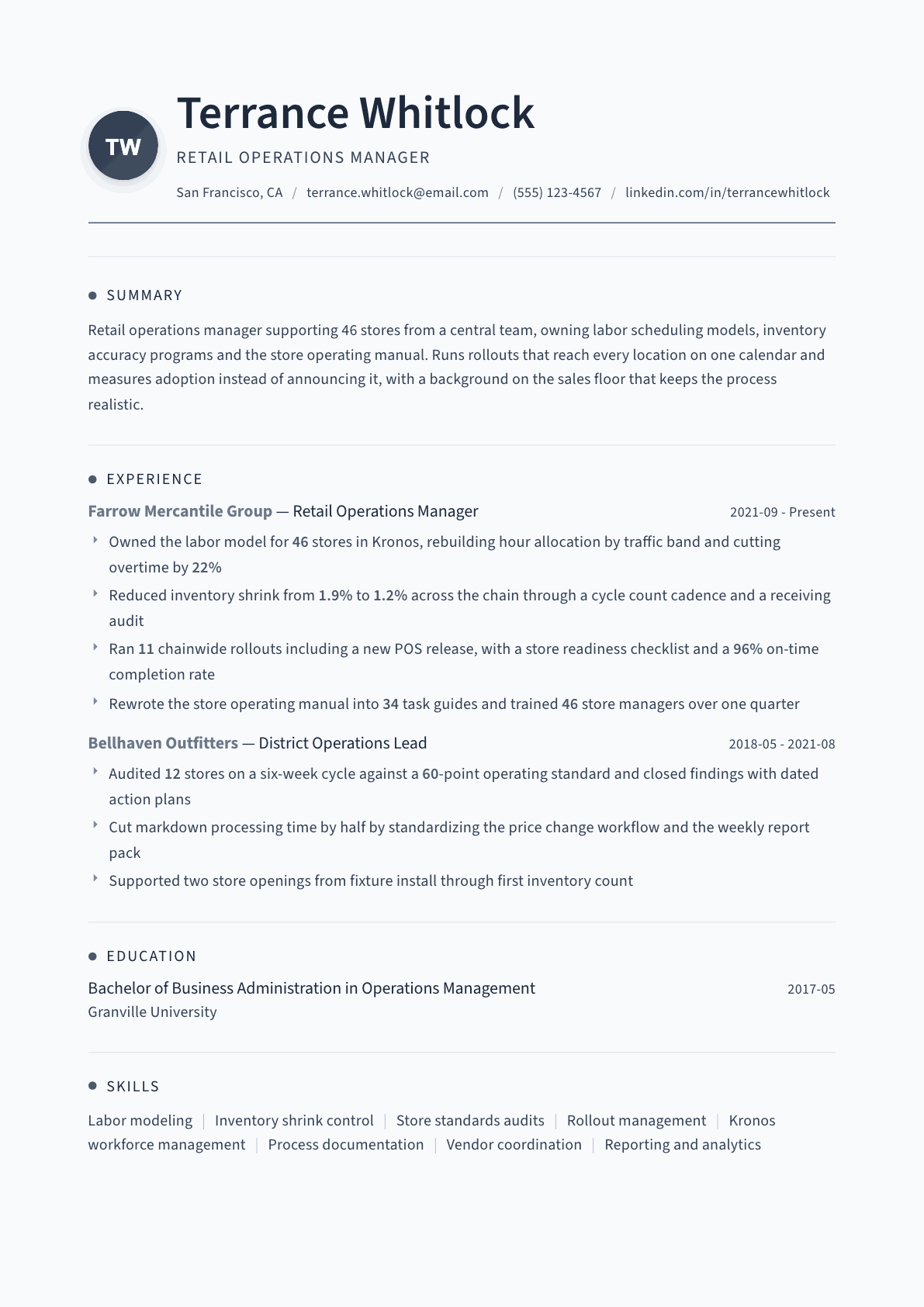
Example Retail Operations Manager summary
Retail operations manager supporting 46 stores with ownership of the labor model, the inventory accuracy program and the store operating manual. Cut chain shrink from 1.9% to 1.2%, took overtime down 22% through a rebuilt hour allocation, and landed eleven rollouts with a store readiness checklist. Looking for a central operations role in a growing specialty chain.
Skills to list on a Retail Operations Manager resume
- Retail operations
- Labor scheduling models
- Workforce management systems
- Inventory shrink reduction
- Cycle counting
- Store standards and audits
- Rollout and change management
- Standard operating procedures
- Loss prevention partnership
- Markdown and price change process
- Store openings
- Vendor and supply coordination
- Reporting and dashboards
- Store manager training
- Expense control
What actually gets this resume read
- Lead with store count, total headcount supported and whether you owned labor, inventory or both.
- Give shrink as a rate and show the movement, because that single number carries most of an operations interview.
- Name the workforce management and inventory systems you administered rather than the ones you merely used.
- Describe a rollout end to end: what changed, how many stores, how you measured completion and what broke.
- Show the audit program you ran, the point count of the standard, and how findings were closed.
- Separate central operations work from store leadership work so the reader knows which chair you sat in.
How to write a retail operations manager resume
Retail operations sits between the stores and everyone who sends the stores work. The person hiring for it wants proof that you can build a process a store manager will actually follow on a busy Saturday, and then measure whether it stuck. A resume that reads like a list of projects announced, with no adoption or result attached, gets filtered out early.
The role also has two very different shapes. In one, you support stores from a central team and own labor models, inventory programs and rollouts. In the other, you sit in a district and audit execution. Both are called retail operations manager and the resume has to say which chair you sat in, because the interview loops are not the same.
This guide covers the structure a central operations reader expects, the four numbers that carry the job, how to write a rollout that a skeptical director will believe, and the questions operations candidates ask when they move from store leadership into a support role.
Format: scope line first, projects second
Open each job with the scope: number of stores supported, total store headcount, geography, and which functions reported to you or were owned by you. Operations hiring is scope-driven, and a reader who cannot see whether you supported eight stores or four hundred cannot place you.
Then organize the bullets by function rather than chronology inside the job: labor, inventory, standards, rollouts, expense. A director skims for the function they need filled and stops when they find it.
- Scope line: store count, headcount supported, regions, functions owned.
- Group bullets by function so a reader can find labor or inventory without reading everything.
- Distinguish central support work from district field work in the job title or the scope line.
Labor: the model, not just the schedule
Store payroll is the largest controllable cost in retail, so labor work belongs high on the page. Say whether you built or administered the labor model, what drove hour allocation, and how the model was validated against traffic or transaction data. Naming the workforce management platform matters here, whether that is Kronos, Legion, Reflexis, Blue Yonder or an internal tool.
Give the outcome in the terms a finance partner uses: overtime as a share of hours, payroll as a share of sales, or coverage during peak hours. Then add what did not get worse, because a labor cut that shredded customer scores is not a win and an experienced director will ask.
Inventory and shrink: rate, movement, mechanism
Shrink is the number that gets an operations resume read twice. State the rate before, the rate after, and the specific mechanism: a cycle count cadence, receiving audits, a fitting room policy, a high-theft item program, or a partnership with loss prevention on exception reporting.
Cover inventory accuracy separately from shrink, because they are different problems. Accuracy failures break the online order promise; shrink hits the margin. If you owned the physical inventory calendar and the third-party count vendor, say so, since that is a real operating burden most candidates never mention.
Rollouts and standards: prove that stores actually did it
Every operations candidate says they led rollouts. Very few say how many stores were ready on the deadline. Write the rollout with the change, the store count, the training method, the readiness checklist, and the completion rate on the date it was due. That single figure is what separates a project announcement from operations work.
For store standards, name the audit instrument. A sixty-point operating standard on a six-week cycle with dated action plans is a real system. Saying you conducted store visits is not. Add how findings were closed and who was accountable for closing them.
When a rollout went badly, one honest line about what broke and what you changed for the next one reads stronger than a page of clean successes.
Keywords and tools that get the file opened
Central retail teams screen on function words: store operations, labor model, workforce management, shrink, cycle counts, standard operating procedures, rollout, store readiness, expense control, task management. Task management platforms such as Reflexis, Zebra Workcloud, Yoobic or an internal tool are worth naming because they are the daily instrument of the job.
Add the reporting stack, since operations lives in data. Excel at a serious level, plus whichever visualization tool the reports were built in, tells a director you can answer a question without waiting on analytics.
Retail Operations Manager resume summary examples
Moving from store leadership
Store manager with five years running a high-volume location, moving into central operations. Rebuilt the store task calendar, cut markdown processing time by half, and piloted a cycle count routine later adopted by the district. Strong on the store reality behind every process a support team writes.
Supporting a chain
Retail operations manager supporting 46 stores with ownership of the labor model, the inventory accuracy program and the operating manual. Cut shrink from 1.9% to 1.2%, reduced overtime 22% through a rebuilt hour allocation, and landed eleven chainwide rollouts on a store readiness checklist.
Director track
Operations leader supporting more than two hundred stores across four regions, with a team of six operations managers. Owns labor strategy, task management and the store standards program, and has taken chain shrink down for three consecutive years while holding customer experience scores flat or better.
Work experience bullets: before and after
Before: Managed store operations for multiple locations.
After: Supported 46 stores and 900 employees from the central team, owning the labor model, inventory accuracy program and store operating manual.
Scope and owned functions replace a phrase that could describe any job in retail.
Before: Helped reduce shrink across the chain.
After: Took chain shrink from 1.9% to 1.2% by introducing a monthly cycle count cadence and a receiving audit against advance notices.
The before, the after and the mechanism make the result checkable instead of asserted.
Before: Led the rollout of a new point of sale system.
After: Ran a chainwide point of sale release across 46 stores with a store readiness checklist and manager certification, hitting 96% on-time completion.
Completion on the deadline is the only rollout number a director trusts.
Before: Improved scheduling efficiency.
After: Rebuilt hour allocation in Kronos by traffic band, cutting overtime 22% while adding coverage in the two busiest hours of each day.
Naming the system, the method and the tradeoff turns an efficiency claim into an operating decision.
Before: Created standard operating procedures.
After: Rewrote the operating manual into 34 task guides and certified 46 store managers on them within one quarter.
Documents matter only if people were trained on them, so the training count carries the bullet.
Hard skills
- Store operations management
- Labor modeling and hour allocation
- Workforce management platforms
- Shrink reduction programs
- Cycle counting and physical inventory
- Store standards audits
- Rollout and change management
- Standard operating procedure design
- Task management systems
- Markdown and price change process
- New store openings
- Expense and budget control
- Excel modeling and reporting
Soft skills
- Writing for a store audience
- Influence without direct authority
- Field listening before process design
- Cross-functional negotiation
- Escalation triage
- Training delivery
Certifications worth listing
- RISE Up Business of Retail: Operations and Profit (National Retail Federation Foundation)
- Loss Prevention Certified (LPC) (Loss Prevention Foundation)
- Certified Six Sigma Green Belt (CSSGB) (American Society for Quality)
- Project Management Professional (PMP) (Project Management Institute)
Mistakes that cost retail operations manager candidates the interview
- Listing rollouts with no store count, no deadline and no completion rate.
- Talking about shrink without the rate, the movement or the program that produced the change.
- Leaving the workforce management and task platforms off the page when they are the daily tools of the role.
- Blurring central support work with district field work so the reader cannot tell which job you held.
- Claiming a cost reduction with no mention of what happened to service or sales.
- Writing process work as documents produced rather than behavior changed in stores.
Retail Operations Manager resume questions
How do I move from store manager into retail operations?
Rewrite your store job as process work. Pull out anything you standardized, piloted or documented that spread beyond your four walls, then name the labor, inventory and audit systems you used. Field credibility is an asset in operations if you translate it into process language.
What is the most important metric on a retail operations resume?
Shrink rate and payroll as a share of sales carry the most weight, with rollout completion close behind. Give each one a before and after and the mechanism you used, because a rate without a movement tells a hiring director almost nothing.
Should I list every system I have touched?
List the ones you administered or configured, and separate those from the ones you only used. A director will ask you to walk through a labor model build or a task calendar setup, and the answer needs to match what the page implies.
How long should a retail operations manager resume be?
One page up to about eight years, two pages after that. Use the second page only for a project list with store counts and outcomes, not for older store roles that can be compressed to a single line each.
Do I need a project management certification for this role?
It is not required, but rollout-heavy operations teams do notice one. What they weigh more is a track record of changes that landed on time across every location, described with the readiness process and the completion rate that proved it.