Paraprofessional Resume Examples: the lines they read
Resume for a Paraprofessional Teacher or Teacher Aide
By Mustafa Tarabya, founder of CVBooster · Published · Updated
Resume for a paraprofessional teacher or teacher aide: a sample top third, IEP support bullets, behavior data language and district keywords by level.
Sample resumes for a paraprofessional
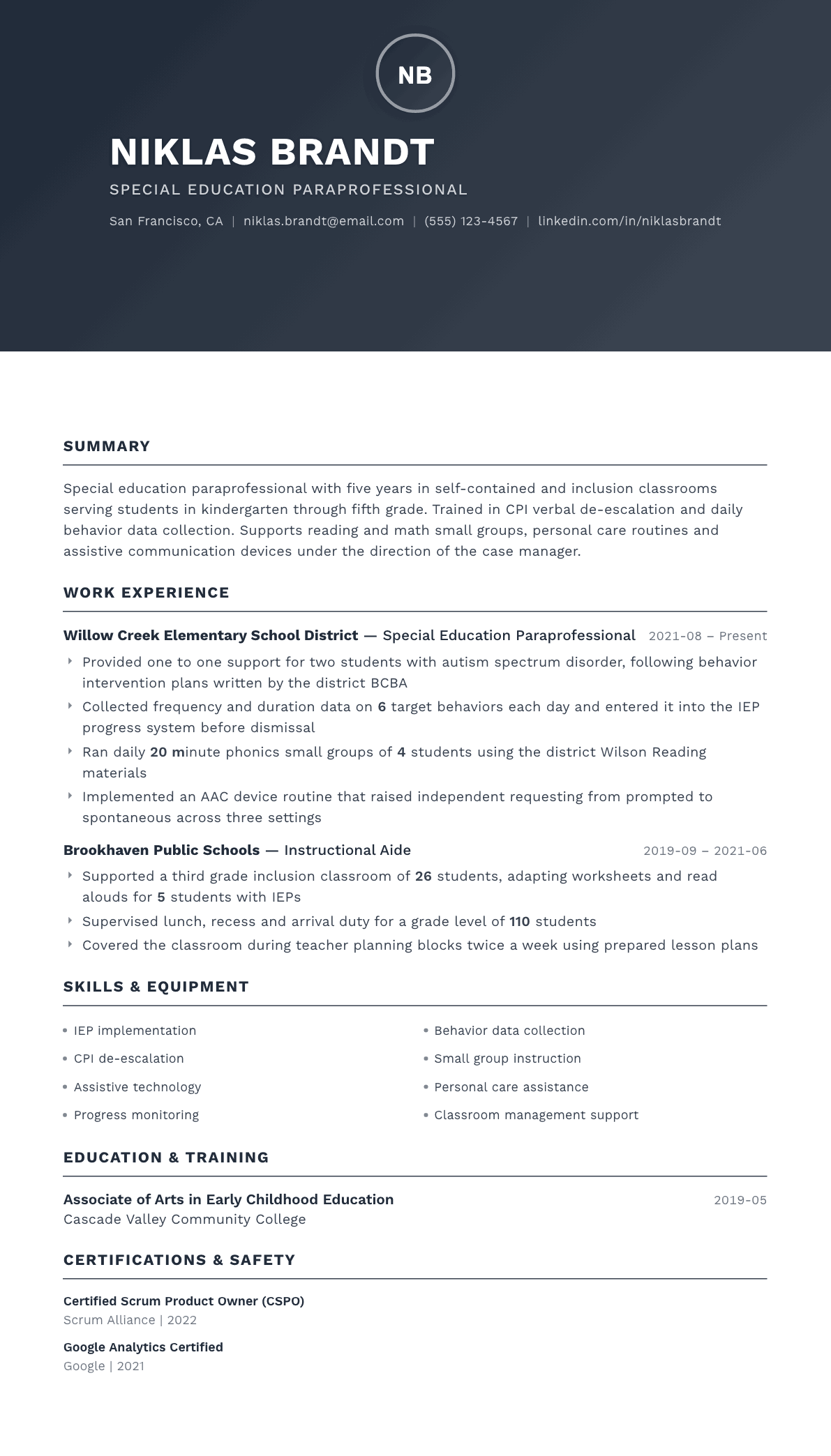
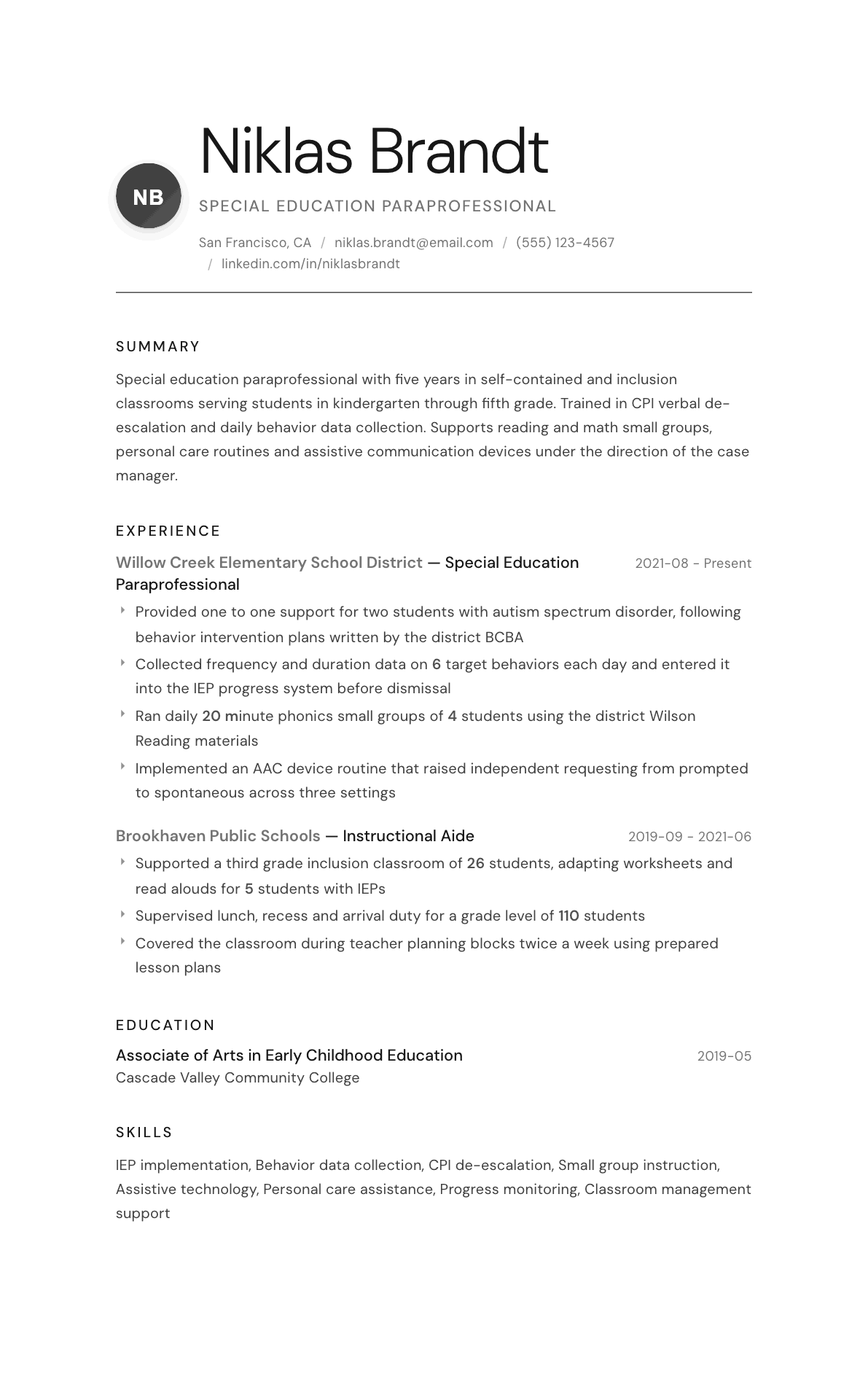
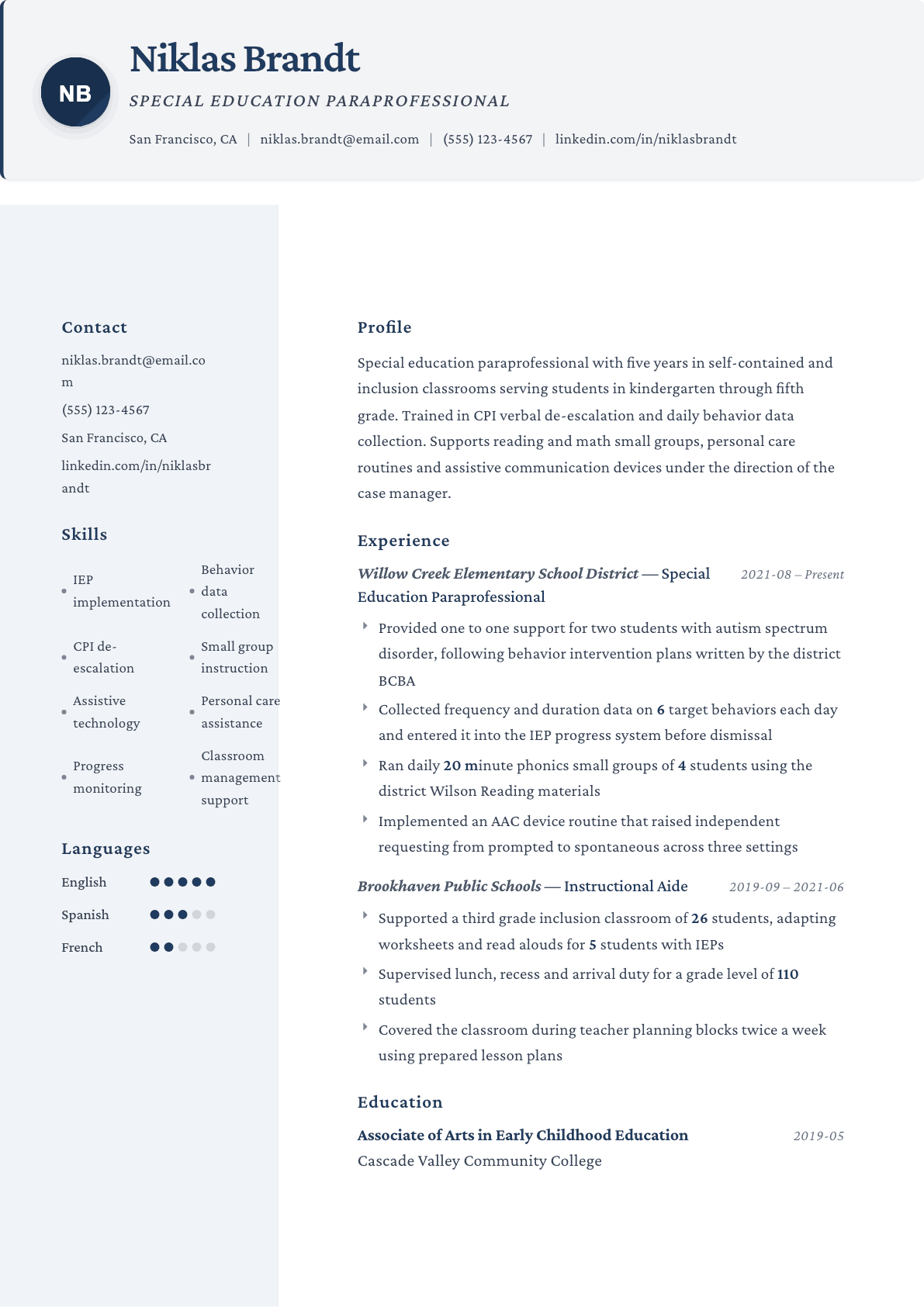
The same paraprofessional content laid out in three CVBooster templates, so you can see what the finished document looks like before you write a word.
Example Paraprofessional summary
Paraprofessional with four years supporting elementary students with autism, emotional disabilities and specific learning disabilities in both resource and inclusion settings. Skilled at running phonics and math small groups, collecting daily behavior data, and prompting AAC use. ParaPro Assessment passed and CPI trained. Looking for a district role on a self-contained team with a strong case manager.
Skills to list on a Paraprofessional resume
- IEP support
- Behavior intervention plans
- Data collection
- Small group instruction
- Reading fluency practice
- Math manipulatives
- Assistive technology
- AAC devices
- Personal care routines
- Visual schedules
- De-escalation
- Progress monitoring
- Classroom setup
- Student supervision
What actually gets this resume read
- Name the classroom setting in every job: self-contained, resource room, inclusion, or life skills, because they are different jobs.
- Say which disability categories you have supported and what supports you delivered, without ever naming a student.
- List your ParaPro Assessment result or the college credits that meet your state paraprofessional requirement near the top.
- Describe the data you collected, the sheet or system you used, and who read it, since districts run on documented progress.
- Include physical and personal care duties such as lifting, toileting or feeding when the posting asks for them.
- Put de-escalation and restraint training with the issuing program name, because principals filter on that line.
How to write a paraprofessional resume
A paraprofessional resume is screened by a district human resources office that must first prove you meet the state qualification rule, and then read by the special education coordinator or principal who needs to know which classroom you can walk into on Monday. The first reader is looking for a line: an associate degree, two years of college credit, or a passing ParaPro Assessment result. If that line is missing, the file stops there no matter how good the rest is.
The second reader is asking a narrower question. Can this person follow a behavior intervention plan written by someone else, keep data honestly, handle a toileting routine without drama, and stay calm when a student elopes from the room? Those answers live in how you describe the settings you have worked in, not in adjectives about patience and compassion.
This guide covers the section order districts expect, how to name classroom settings and disability categories without ever identifying a student, three summaries for different stages of a paraprofessional career, before and after bullets, and the questions aides ask most when they apply for a new building.
Format: one page, qualification line high on the page
Reverse chronological, one page, plain single column. District applicant tracking systems handle attachments poorly, and many require you to retype the whole resume into an online form anyway, so keep the structure simple enough to copy field by field.
Put a short qualifications block directly under your contact details. It should carry your state paraprofessional qualification route, your college credits or degree, and any training the district will ask about: de-escalation, CPR and first aid, seizure response, or safe transfer and lifting.
- Header: name, city and state, phone, email. No photo, no full street address.
- Order: summary, qualifications and training, experience, education, skills.
- A career changer with no school experience leads with a relevant experience section that includes childcare, camp, coaching or caregiving work.
Name the setting, because every paraprofessional job is different
The single most useful thing you can add is the classroom model. Self-contained, resource, inclusion, life skills, behavior support, early childhood, and one to one assignment are all different jobs with different days. Write the model, the grade band, the class size and the number of students with individualized education programs you supported.
A line such as "self-contained K-2 classroom, eight students, one teacher and two aides" tells a coordinator instantly whether you have done the work she is hiring for. Compare that with "assisted teacher in elementary classroom", which could describe copying worksheets.
Name disability categories in general terms: autism spectrum disorder, emotional disability, intellectual disability, specific learning disability, deaf or hard of hearing, orthopedic impairment. Never name a student, a diagnosis attached to a person, or anything that could identify a family.
Experience bullets: what you implemented and what you recorded
A paraprofessional does not write the plan. You implement it, and you document what happened. Strong bullets show both halves. Say which supports you delivered, following whose plan, and what you recorded afterward: frequency counts, duration, antecedent and consequence notes, toileting or feeding logs, or progress toward an annual goal.
Instruction belongs on the page too. Districts want aides who can run a small group with prepared materials. Name the program, the group size and the block length: a twenty minute phonics group of four students using the adopted reading materials is a concrete claim, and the interviewer can ask about it.
Include the unglamorous duties honestly, since they are half of the posting. Arrival and dismissal, bus duty, lunch and recess supervision, personal care, transfers and lifting, feeding, and riding with a student on the special education route.
- Say who directs your work: the classroom teacher, the case manager, the board certified behavior analyst, or the speech pathologist.
- Give the data system you enter results into, whether that is a paper sheet, a district progress tool or a behavior tracking app.
- Note any assistive technology you have supported, from a communication device to a switch, a stander or a sound field system.
Qualifications, training and the credentials that get you called
Every state sets its own paraprofessional standard, and most districts accept one of three routes: a two year degree, a set number of college credits, or a passing score on a formal assessment. Write yours plainly, with the college name or the assessment name, so the human resources reviewer can check a box rather than guess.
After that, list the safety and behavior trainings by the program that issued them. Crisis Prevention Institute training, Mandt System, Registered Behavior Technician credentialing, and first aid and CPR from a recognized issuer all carry weight because they lower the district risk profile. Restraint and seclusion training matters in behavior classrooms, and interviewers ask about it directly.
Skills section: keywords the district posting already uses
Pull the wording from the posting. District job descriptions repeat the same terms year after year: individualized education program, behavior intervention plan, functional behavior assessment, least restrictive environment, prompting hierarchy, discrete trial, task analysis, sensory break, visual schedule, augmentative and alternative communication.
Keep the list to things you have really done, since interviews for these roles are practical. A coordinator may ask you to describe a prompting hierarchy or explain what you would record for an aggression incident, and a bluffed keyword falls apart in one question.
Resume for a paraprofessional teacher, teacher aide or paraeducator
Districts post this job under several names: paraprofessional, paraprofessional teacher, teacher aide, instructional assistant and paraeducator. The work is the same, so copy the exact title from the posting into your header and summary, and keep one line in the summary that uses the other common names so a keyword search on any of them finds you.
Below is the top third of a resume for a paraprofessional teacher applying to an elementary inclusion post. The name, school and district are invented; keep the order and put your own setting, group sizes and training in their place.
- Header and summary: Rosa Delgado, Paraprofessional (Teacher Aide). Five years supporting K-3 inclusion and resource classrooms, running daily reading groups and recording behavior data for the case manager. ParaPro Assessment passed.
- Paraprofessional, Maple Grove Elementary, five years: supports two inclusion classrooms of 24 students with one general education teacher and one special education teacher; leads two daily phonics groups of four students.
- Implements behavior intervention plans written by the district behavior specialist and logs frequency data every day in the district progress tool.
- Qualifications: associate degree in early childhood education, Nonviolent Crisis Intervention training, first aid and CPR.
Paraprofessional resume summary examples
First school job
Paraprofessional candidate with three years in licensed childcare and a passing ParaPro Assessment result. Experienced with toileting routines, visual schedules and calm redirection for children aged three to six. First aid and CPR current. Seeking an early childhood special education classroom in the district.
Four years in
Special education paraprofessional with four years split between a resource room and a self-contained K-2 classroom of eight students. Runs daily phonics and math small groups, collects frequency data on target behaviors, and prompts a student communication device across settings. CPI trained and comfortable with transfers.
Lead aide
Lead paraprofessional with nine years in behavior support and life skills classrooms, currently coordinating three aides on a middle school team. Writes the daily coverage rotation, trains new hires on data sheets and prompting, and represents the classroom staff at weekly student support meetings.
Work experience bullets: before and after
Before: Assisted the teacher with students who have special needs.
After: Supported a self-contained K-2 classroom of 8 students with autism and intellectual disabilities alongside one teacher and one other aide.
The setting, the class size and the staffing tell a coordinator exactly what kind of room you have worked in.
Before: Helped with student behavior.
After: Implemented behavior intervention plans written by the district behavior analyst and recorded frequency and duration data on 6 target behaviors each day.
It names whose plan you followed and what you documented, which is the actual job rather than a vague claim about behavior.
Before: Worked with small groups of students.
After: Led two daily 20 minute phonics groups of 4 students using the adopted reading materials, then logged fluency checks for the case manager.
Group size, block length, materials and the follow up record turn a generic line into evidence of instructional skill.
Before: Used technology with students.
After: Prompted a student communication device through a least to most hierarchy and expanded independent requesting from the classroom into the cafeteria and specials.
Naming the prompting method and the settings shows technical knowledge that districts specifically screen for.
Before: Did lunch and recess duty.
After: Supervised lunch, recess and arrival for a grade level of 110 students, running a structured recess option for students who needed a smaller group.
The scale and the added structure show initiative in a duty that most candidates list as filler.
Hard skills
- IEP goal support
- Behavior intervention plan implementation
- Frequency and duration data collection
- Prompting hierarchies
- Small group reading instruction
- Math manipulatives
- Augmentative and alternative communication
- Visual schedules and token systems
- Personal care and transfers
- Sensory break routines
- Progress monitoring records
- Student information system entry
Soft skills
- Following a teacher directed plan
- Calm redirection
- Confidentiality
- Team communication
- Patience with repetition
- Physical stamina
Certifications worth listing
- ParaPro Assessment (ETS)
- Registered Behavior Technician (RBT) (Behavior Analyst Certification Board)
- Nonviolent Crisis Intervention (Crisis Prevention Institute)
- Heartsaver First Aid CPR AED (American Heart Association)
Mistakes that cost paraprofessional candidates the interview
- Leaving the state qualification route off the resume, which stalls the file in human resources before a principal ever sees it.
- Writing "assisted the teacher" for every job, so the reader cannot tell a life skills classroom from a general education room.
- Including any detail that could identify a student or a family, which reads as a confidentiality risk and ends the interview.
- Listing only supervision duties and no instruction, when districts hire aides to run small groups with prepared materials.
- Omitting de-escalation, restraint or lifting training, since those lines are what make a behavior classroom hire possible.
- Sending the same resume to an early childhood posting and a high school life skills posting without changing the summary.
Paraprofessional resume questions
What qualifications do I need on a paraprofessional resume?
Most districts accept a two year degree, a set number of college credits, or a passing formal assessment result. Put whichever route you hold in a short qualifications block near the top, with the college or assessment named, so human resources can verify it fast.
How do I describe students without breaking confidentiality?
Describe the setting and the general disability category, never a person. Write the classroom model, the number of students you supported and the supports you delivered. Avoid initials, ages tied to one child, or any story that a parent could recognize as their own family.
Should I include childcare or camp work if I have never worked in a school?
Yes. Licensed childcare, camp counseling, coaching, respite care and direct support professional work all transfer. Frame each one around routines, behavior redirection, safety supervision and documentation, and the coordinator will read it as relevant classroom preparation.
Is a resume for a paraprofessional teacher different from a teacher aide resume?
No. Paraprofessional teacher, teacher aide, instructional assistant and paraeducator are names for the same school support job. Use the posting's exact title in your header, mention the other names once in your summary, and keep the content the same: your setting, group sizes, the plans you implement and your qualification route.
How do I move from paraprofessional to teacher on paper?
Add a line for the certification program or degree you are enrolled in with the expected completion term, and lead your bullets with instruction rather than supervision. Small group teaching, lesson delivery during teacher planning blocks and progress monitoring are the parts a hiring committee reads as teaching readiness.