Special Education Teacher Resume Examples: free score
Sample Special Ed Teacher Resume and Teaching Examples
By Mustafa Tarabya, founder of CVBooster · Published · Updated
Sample special ed teacher resume with licensure, caseload, IEP compliance and progress data, plus summaries from first-year teacher to department lead.
Sample resumes for a special education teacher
The same special education teacher content laid out in three CVBooster templates, so you can see what the finished document looks like before you write a word.
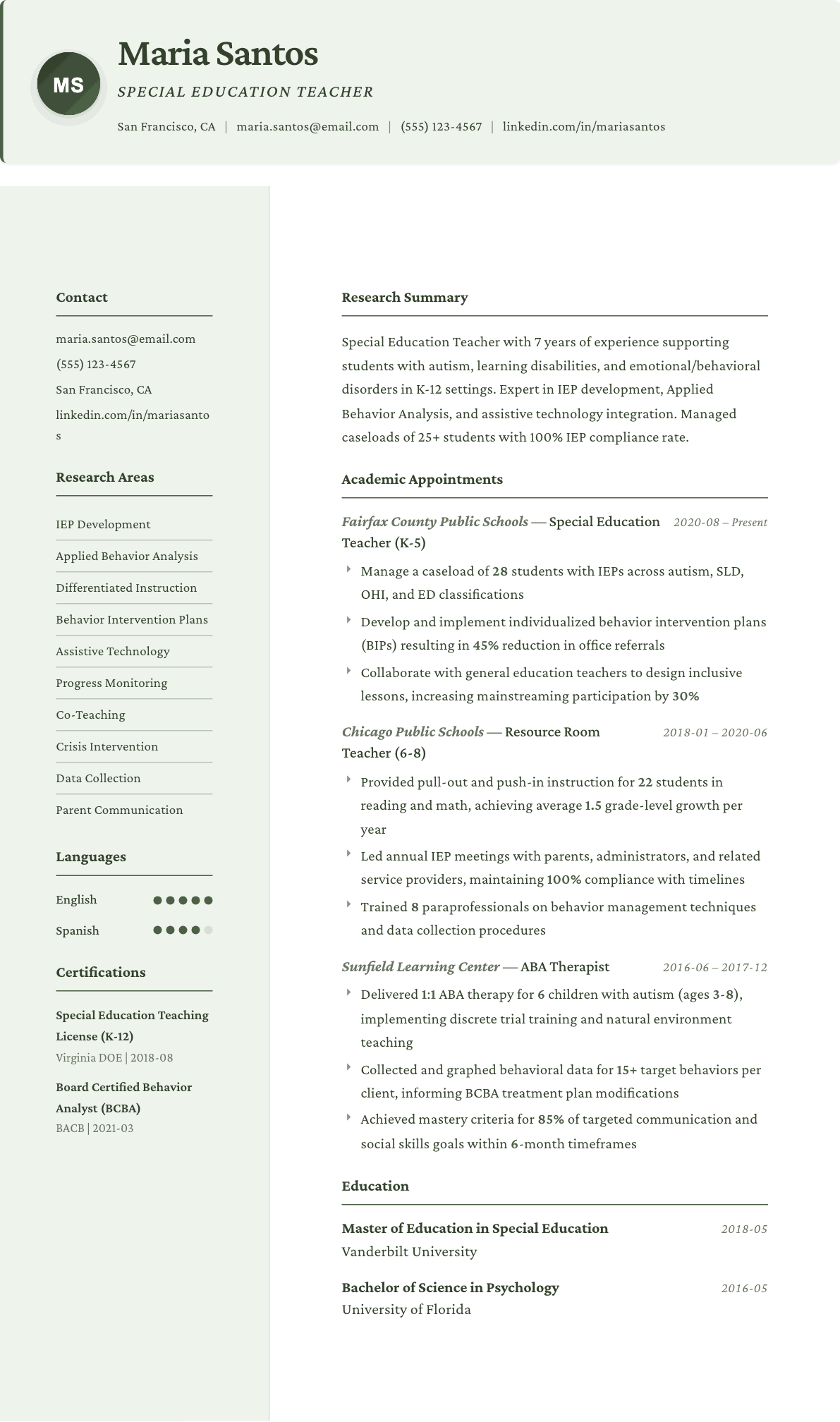
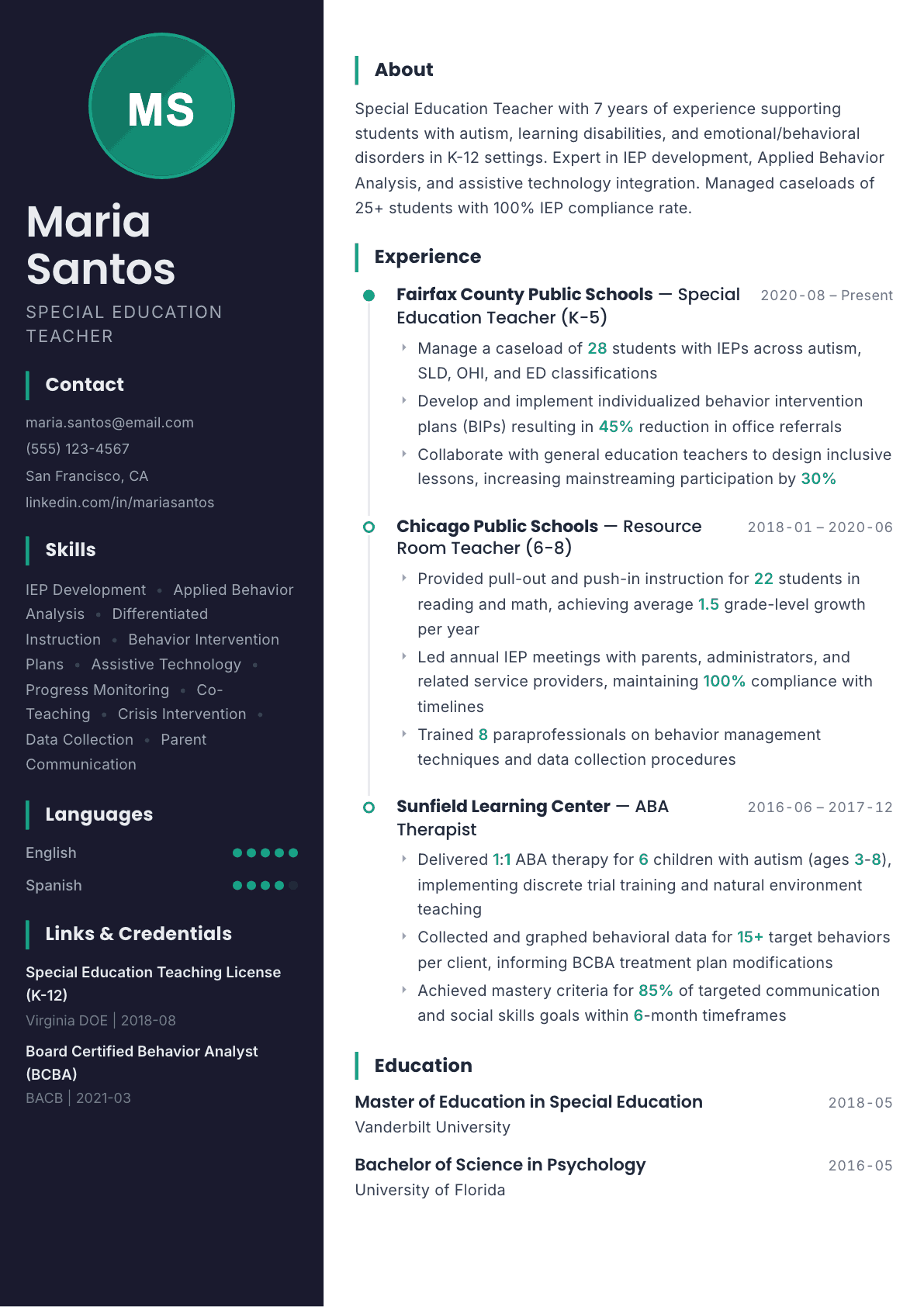
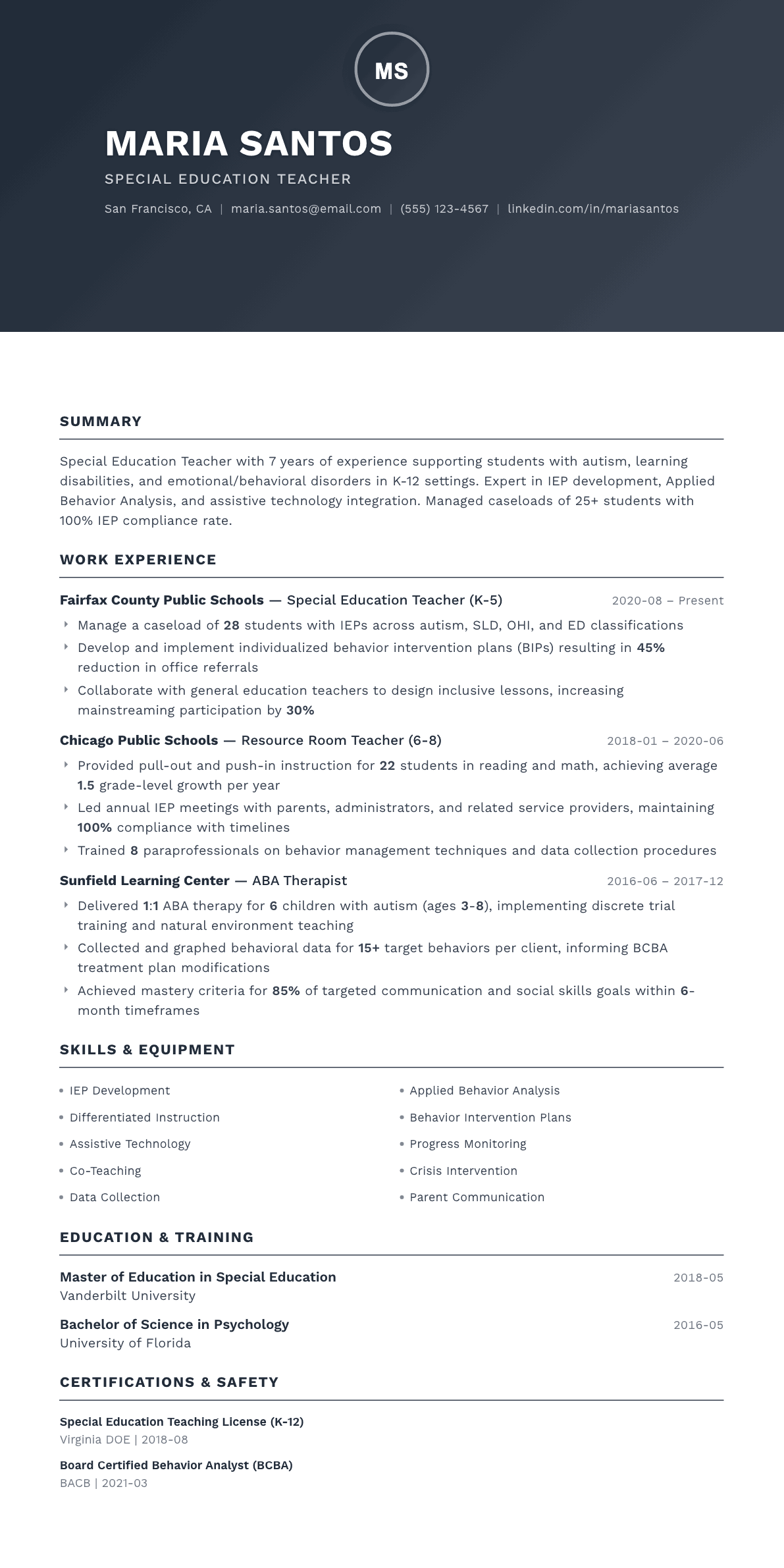
Example Special Education Teacher summary
Board Certified Behavior Analyst and Special Education Teacher with 7 years of experience supporting students with autism, learning disabilities, and behavioral challenges. Expert in IEP development, ABA strategies, and inclusive instruction. Maintained 100% IEP compliance while achieving measurable student growth across academic and behavioral domains.
Skills to list on a Special Education Teacher resume
- IEP Development & Compliance
- Applied Behavior Analysis (ABA)
- Differentiated Instruction
- Behavior Intervention Plans
- Assistive Technology
- Progress Monitoring
- Co-Teaching Models
- Crisis Intervention (CPI)
- Data-Based Decision Making
- Transition Planning
- Inclusive Education
- Parent Collaboration
- IDEA Compliance
- Functional Behavior Assessment
What actually gets this resume read
- Highlight IEP experience: development, implementation, progress monitoring, and annual reviews.
- Specify disability categories you serve: autism, SLD, OHI, ED, ID, speech/language.
- Quantify student progress: grade-level growth, behavior reduction data, goal mastery rates.
- Include certifications: state SPED license, BCBA, CPI, assistive technology credentials.
- Describe collaboration: co-teaching models, related service coordination, parent partnerships.
- Mention compliance: IDEA, Section 504, state special education regulations.
How to write a special education teacher resume
A special education teacher resume is checked by a district human resources office before any principal sees it. HR verifies the state license, the endorsement areas, the grade bands you are cleared to teach and whether your credential covers mild-moderate or extensive support needs. Only after that does the special services director read the file, and she reads it for one thing: can this person carry a caseload, write a defensible IEP and survive an annual review meeting with an advocate in the room.
Most applicants write about caring for children. Every director assumes that already. What she cannot assume is that you can run a resource schedule covering service minutes on twenty separate IEPs, collect progress monitoring data every two weeks, write a behavior intervention plan off a functional behavior assessment, and keep every timeline inside the window the state monitors.
Whether the posting asks for a special education teacher resume or a special education teaching resume, and whether you came looking for a sample special ed teacher resume, a SPED teacher resume or a special needs teacher resume, the reader is the same. SPED is the shorthand districts use on their own job boards and special needs is the wording many private schools and parents use, but the role, the license check and the caseload questions do not change, so use the posting's own wording in your summary. This guide follows the order a special services director reads the file, with summaries for a first-year teacher, a mid-career case manager and a department lead, before and after bullets, and the questions special educators ask most when they sit down to write.
Format: credentials in the header, licensure in its own block
Use a single-column reverse-chronological layout. District applicant tracking systems parse plainly, and a graphic sidebar full of icons often loses the license line entirely. Put the credential right under your name: the license type, the issuing state, the endorsement areas and the grade span. A reader who has to hunt for your endorsement assumes you do not have it.
Keep it to one page in your first three years and two pages after that. A second page is normal once you have several placements, a behavior specialist role or district committee work, but a third page reads as padding.
- Header: name, license type and state, endorsement areas, city, phone, email.
- Sections in order: summary, licensure and endorsements, teaching experience, education, skills, professional development.
- First-year teachers put education and student teaching above experience and name the cooperating district.
Summary: setting, caseload size, disability categories
Three lines. Name the setting first, because resource room, co-taught inclusion, self-contained and life skills are four different jobs with four different daily schedules. Then the grade band, the caseload size and the disability categories you have actually served: autism, specific learning disability, other health impairment, emotional disturbance, intellectual disability, multiple disabilities.
A director staffing an extensive support needs classroom will not shortlist a resume that says only that you support diverse learners. She wants to know whether you have toileting, feeding, seizure protocols and augmentative communication in your hands, or whether your experience is pull-out reading intervention.
Experience: service model, caseload, and what you were accountable for
Open each job with a context line before the bullets: the district, the school level, the service delivery model, the caseload number and the classifications. Something like resource and co-taught support, grades three through five, caseload of twenty-six across autism, specific learning disability and other health impairment. That single line answers most of what the director wanted to ask in a screening call.
Then write bullets about the parts of the job that are hard: writing present levels that survive a due process complaint, chairing a meeting where the parent brought counsel, converting a functional behavior assessment into a behavior intervention plan that the general education teacher will actually run, and adjusting goals mid-year off progress monitoring rather than at the annual review.
A special education teaching resume also has to show the teaching, not only the paperwork. Name the instruction you deliver: the reading or math intervention program, explicit instruction in small groups, the communication systems you use with nonverbal students, and the accommodations you build into co-taught lessons. One bullet that says which program you ran, for how many students and what the progress data showed is worth more than a paragraph about differentiated instruction.
Include the adults you managed. Most special educators direct paraprofessionals without the title of supervisor, and directors care deeply about whether you can train, schedule and give feedback to two or three adults in your room.
Compliance and data: the section that separates candidates
Say which IEP platform you have used, because the district will train you on theirs faster if you already think in one: Frontline, SEIS, IEP Direct, PowerSchool Special Programs or Infinite Campus. Then show the compliance work: annual review and triennial reevaluation timelines, prior written notice, eligibility determination meetings, extended school year decisions, and transition plans for students at age fourteen or sixteen depending on your state.
Progress monitoring is the other half. Name the measures you used, curriculum-based measurement probes, discrete trial data, frequency and duration counts on target behaviors, and say how often you graphed and reported. A director who reads that you collected data weekly and revised two goals mid-year knows you are not writing goals and forgetting them until spring.
Skills and keywords the district system is scanning
District postings recycle the same phrasing from the state education code, so mirror it once in the skills list and once inside a bullet: individualized education program, least restrictive environment, functional behavior assessment, behavior intervention plan, specially designed instruction, accommodations and modifications, co-teaching, differentiated instruction, assistive technology and transition planning.
List the interventions and programs by name rather than in the abstract. Wilson, Orton-Gillingham, Unique Learning System, Read 180, TouchMath, PECS, proloquo based communication devices and a structured teaching approach all tell a reader something exact. Reserve soft skills for the bullets, where you can show them in the middle of a difficult meeting rather than claim them in a list.
Special education resume example, start to finish
A special education resume example is most useful as a whole page, so here is a complete one for a resource room teacher applying to a self contained position in a neighboring district. The person and schools are invented. Use the order, the caseload line and the compliance bullet; those are the parts other special education resumes leave out.
- Header: Daniel Brooks, M.Ed. City, phone, email. Licensure block: state special education license, mild to moderate disabilities, kindergarten through grade twelve; elementary education certification.
- Summary: Special education teacher with seven years in resource and inclusion settings, a caseload of about eighteen students with learning disabilities, autism and other health impairments, and a record of IEP meetings held on time. Seeking a self contained classroom for students with moderate needs.
- Current role, Special Education Teacher, a public middle school, five years: case manager for eighteen students; delivers specialized reading and math instruction in a resource room and co teaches two inclusion classes.
- Writes and leads every annual IEP and reevaluation meeting on the caseload, with progress reports sent each grading period; trained two new teachers on the district IEP software.
- Collects behavior and academic progress data weekly and uses it to adjust goals; worked with the behavior specialist on a behavior intervention plan that reduced removals from class for one student.
- Previous role, Special Education Teacher, an elementary school, two years: inclusion support in grades one to three; supervised two paraprofessionals.
- Education and training: Master of Education in Special Education; Crisis Prevention Institute training; Orton Gillingham based reading training.
Special Education Teacher resume summary examples
First-year teacher
Newly licensed special education teacher endorsed in mild to moderate disabilities, K-8, with a year of student teaching split between a resource room and a co-taught fourth grade classroom. Wrote 6 IEPs under supervision, trained in Wilson Reading System Level I and nonviolent crisis intervention.
Five years in
Special education teacher and case manager with 5 years in K-5 resource and inclusion settings, carrying a caseload of 26 students across autism, SLD and OHI classifications. Maintained IEP timeline compliance across 3 school years and directed 2 paraprofessionals daily.
Department lead
Special education department lead with 12 years across resource, self-contained and extensive support needs classrooms, now coordinating services for 90 students and 8 staff at a middle school. Chairs eligibility and manifestation determination meetings and mentors first-year special educators for the district.
Work experience bullets: before and after
Before: Wrote IEPs for students with disabilities.
After: Case managed 26 IEPs across autism, SLD and OHI, writing present levels from curriculum-based measurement data and chairing all 26 annual reviews within state timelines.
The caseload, the classifications and the timeline turn a job duty into evidence that you can hold compliance.
Before: Helped with student behavior in the classroom.
After: Conducted functional behavior assessments for 4 students and wrote behavior intervention plans that general education teachers ran during specials, cutting office referrals for the group by 45%.
Naming the assessment, the plan and who carried it out shows the full behavior cycle rather than a vague claim of management.
Before: Worked with general education teachers.
After: Co-taught 3 sections of grade 5 math using station teaching, planning weekly with the general education teacher and writing the accommodations page each unit assessment ran under.
The co-teaching model and the planning routine tell a principal exactly what your inclusion practice looks like.
Before: Supervised paraprofessionals.
After: Trained and scheduled 3 paraprofessionals on discrete trial data collection and toileting protocols, and built a rotation that kept 1:1 coverage during related service pull-outs.
It shows you can direct adults and solve the coverage problem that breaks most self-contained rooms.
Before: Used technology to support learning.
After: Completed SETT framework assessments for 5 nonverbal students and implemented AAC devices and PECS boards, with 2 students moving from single-picture exchange to 3-word requests within the year.
A named framework and a communication outcome replace a claim any teacher in any subject could make.
Hard skills
- IEP development and case management
- Functional behavior assessment
- Behavior intervention plans
- Progress monitoring and data collection
- Curriculum-based measurement
- Co-teaching models
- Specially designed instruction
- Assistive technology and AAC
- Transition planning
- Applied behavior analysis techniques
- Accommodations and modifications
- Frontline and SEIS IEP platforms
- Eligibility and reevaluation process
Soft skills
- De-escalation
- Parent conference facilitation
- Paraprofessional coaching
- Collaboration with related services
- Advocacy
- Patience under sustained behavior load
Certifications worth listing
- Board Certified Behavior Analyst (BCBA) (Behavior Analyst Certification Board)
- Registered Behavior Technician (RBT) (Behavior Analyst Certification Board)
- Nonviolent Crisis Intervention (Crisis Prevention Institute)
- Wilson Reading System Level I Certification (Wilson Language Training)
- Associate Level Certification (Academy of Orton-Gillingham Practitioners and Educators)
- National Board Certification, Exceptional Needs Specialist (National Board for Professional Teaching Standards)
Mistakes that cost special education teacher candidates the interview
- Leaving the endorsement area off, so HR cannot tell whether your license covers the classroom being staffed.
- Describing the setting as a special education classroom without saying resource, co-taught, self-contained or extensive support needs.
- Listing caseload nowhere, which forces the director to guess whether you managed 8 students or 30.
- Writing bullets about caring and passion instead of compliance, data and behavior work, which are the parts districts cannot train quickly.
- Hiding the IEP platform, when knowing the district system is one of the fastest ways to look ready on day one.
- Using a two-column template with icons; district parsers frequently drop the licensure block out of the sidebar.
- Forgetting paraprofessional supervision, which is real personnel experience and reads as leadership.
Special Education Teacher resume questions
What does a good sample special ed teacher resume look like?
It puts licensure in its own block near the top, opens with a summary naming the setting, caseload size and disability categories, and gives each role a caseload line plus bullets on instruction, IEP compliance and progress data. The full special education resume example on this page shows how it reads on one page.
Should I list my caseload size on a SPED or special needs teacher resume?
Yes, on every position, whatever the posting calls the role. Caseload is the single number a special services director uses to judge workload experience. Give the count and the classifications, and note if it changed across years, because a jump from 14 to 28 is itself an accomplishment.
How do I show IEP compliance without naming students?
Talk in aggregates and processes. Say how many annual reviews and triennial reevaluations you chaired, that you held timelines across school years, and which platform you documented in. Never name a student, a parent or a specific due process case.
What should a special education teaching resume include?
Your license and endorsement areas in their own block, a summary naming setting, caseload and disability categories, and for each job a context line, instruction bullets and IEP compliance bullets. Add the intervention programs you deliver, crisis intervention training if you hold it, and any RBT or BCBA hours, which help for self-contained and emotional support classrooms.
How should a general education teacher moving into special education write the resume?
Lead the summary with the move and the endorsement you hold or are completing. Then pull forward every inclusion student you served, the accommodations you implemented, the IEP meetings you attended as the general education member and any intervention program you delivered.