Elementary School Teacher Resume Examples: free score
An Elementary Education Resume Example Principals Read to the End
By Mustafa Tarabya, founder of CVBooster · Published · Updated
Elementary education resume example with a full teacher sample, grade band and growth bullets, license placement and the keywords districts screen for.
Sample resumes for a elementary school teacher
The same elementary school teacher content laid out in three CVBooster templates, so you can see what the finished document looks like before you write a word.
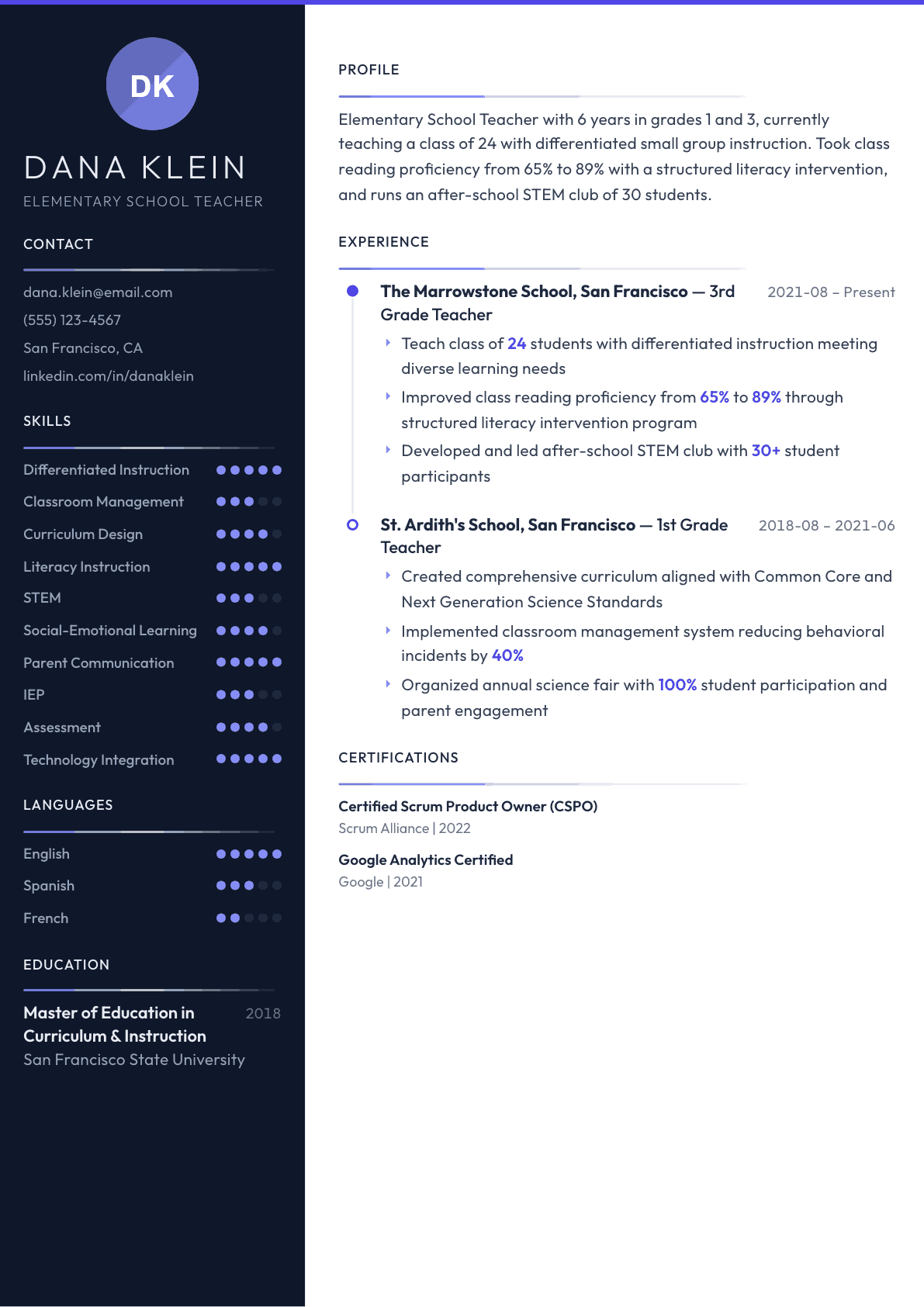
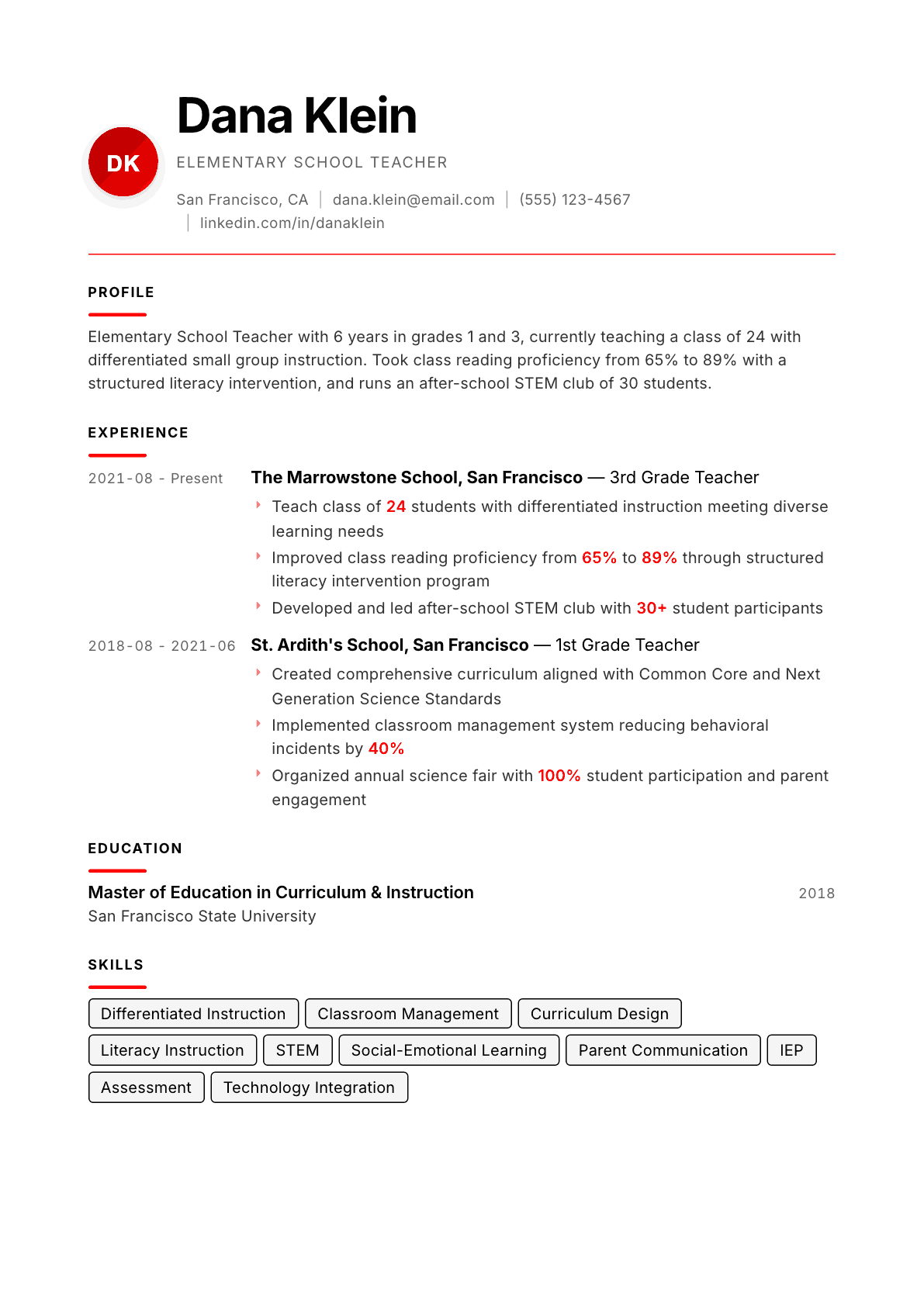
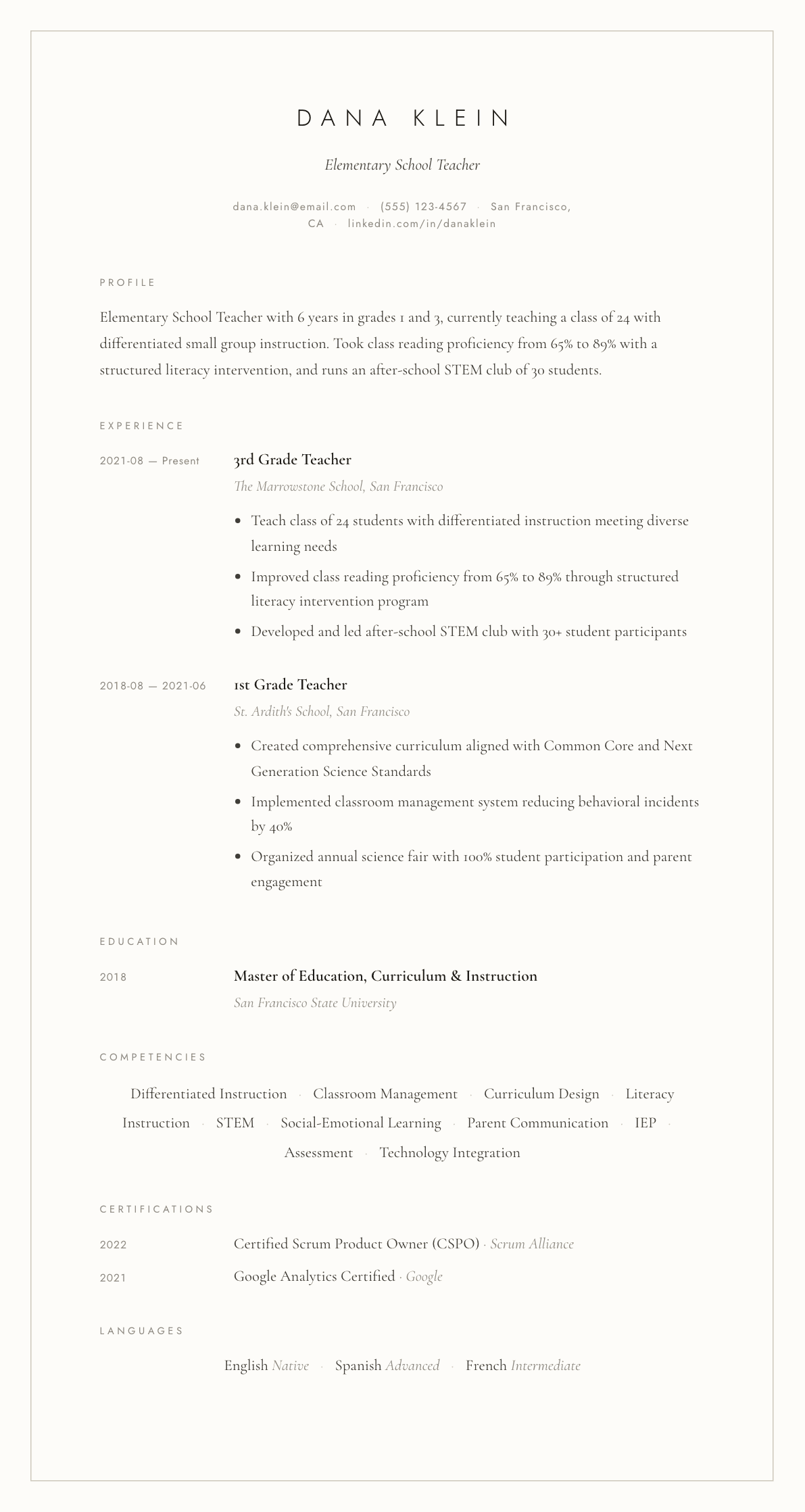
Example Elementary School Teacher summary
State-certified elementary teacher, 6 years across first and third grade, currently 24 students with differentiated reading and math groups. Reading proficiency up from 65% to 89%, behavioral incidents down 40% after a new classroom management system, and a science fair with full class participation.
Skills to list on a Elementary School Teacher resume
- Differentiated Instruction
- Classroom Management
- Curriculum Design
- Literacy Instruction
- STEM
- Social-Emotional Learning
- Parent Communication
- IEP
- Assessment
- Technology Integration
What actually gets this resume read
- Highlight state certifications and endorsements.
- Quantify student achievement gains and test score improvements.
- Show classroom management and differentiation strategies.
- Include extracurricular leadership (clubs, sports, committees).
- Mention technology integration and digital learning tools used.
How to write a elementary school teacher resume
An elementary school teacher resume is read by a principal filling a specific grade in a specific building, often in a hurry. Her questions are narrow: is this person licensed for the grade band, which grades have they actually taught, can they teach reading the way our district teaches it, and will parents in this community trust them. Everything on the page should serve one of those four questions.
The reading question has become the sharpest one. Many districts have moved to structured literacy and screen candidates for phonics knowledge, so terms like phonemic awareness, decodable text, systematic phonics and progress monitoring now do real work on an elementary resume. A candidate who writes only about a love of reading with children is answering a question nobody asked.
This guide works as an elementary education resume example from top to bottom, for new graduates with an elementary education degree and for experienced teachers alike. It covers the license line, how to write a grade-level classroom so a principal can picture it, the assessment and intervention language districts screen for, and the questions elementary teachers ask when they change grades, districts or states.
Format: one page, license and grades taught above the fold
One page for the first several years, two once you have added intervention, coaching or leadership work. Put the license immediately under your header: the state, the certification area such as elementary education for a grade band, and any endorsement in reading, English learners, special education or gifted education. Districts filter applicants by endorsement, so an unlisted one may as well not exist.
Directly beside it, list the grades you have taught. A principal filling a second grade opening wants to see second grade on the page in the first two seconds, and a teacher who has taught kindergarten through fifth over a career should say so as a range rather than making the reader assemble it from dates.
- Header: name, city and state, phone, email, state license with certification area and grade band, and any endorsements.
- Section order: license, summary, teaching experience, instructional strengths, education, professional development.
- Student teachers list each placement with the grade, the school demographic and the length of the placement.
- New graduates put the elementary education degree, the university and the license status, such as eligible or pending, directly under the header.
Summary: grade band, class profile, and one instructional strength
Name the grade band, the years and the class profile in the first line: class size, the share of English learners or students with individualized education programs, and the school setting. A teacher who has managed a class of 28 second graders with eight English learners has a skill set a principal can immediately match against her building.
Then name one instructional strength with the district's vocabulary attached: structured literacy and small group phonics, guided math with number talks, science through an inquiry model, or social emotional learning through a named program. Specificity here is what gets an interview over a stack of similar applications.
Experience: the classroom, the instruction, and the growth data
Open each role with the classroom: the grade, class size, the composition, whether you co-taught or worked in an inclusion model, and the schedule if it was unusual, such as departmentalized upper elementary or a multi-age classroom. That single line prevents the reader from imagining the wrong job.
Then write instruction with the specifics only a teacher would know. Small group rotation structure and how many groups you ran, the literacy block and its components, the mathematics program and how you differentiated within it, guided reading levels or a phonics scope and sequence, writing workshop, and the intervention block. Naming the adopted programs your district used tells a principal how much retraining you will need.
Attach growth data with an honest source: benchmark assessment results at fall and spring, reading level movement, a state assessment change for your class, or progress monitoring on the students you intervened with. Give the baseline and the measure name so the number can be read properly.
Add the classroom management approach and the family communication routine. A principal is hiring someone who will not send a stream of students to the office and will answer parents the same week, and both should appear as described practices rather than claims.
Assessment, intervention and the meetings you sit in
Name the assessments you administer and use: universal screeners and benchmark tools, running records, phonics inventories, curriculum-based measures, and the state assessment for your grade. Then show the cycle: data meetings, grouping decisions, progress monitoring frequency, and when you moved a student between tiers.
Include the process work that principals value because it protects the school: multi-tiered system of support meetings, student study teams, individualized education program meetings and your role in them, section 504 plan implementation, and English learner service planning. A teacher who writes individualized education programs and accommodations into daily plans rather than treating them as paperwork is visibly more experienced.
The extras a principal actually weighs
Beyond the classroom, principals hire for what the building will get. Grade level chair, curriculum committee, mentor teacher for a first year colleague, club or after-school program leadership, family engagement events, summer school, and any coaching of colleagues on a new adoption. Two or three of these are enough and they should be specific.
Add technology honestly. The learning platform your school runs, the assessment and communication systems, the interactive display and the digital tools children actually used. Skip a long list of applications, because a principal reads that as filler.
Elementary teacher resume example, start to finish
If you are looking for an example elementary teacher resume to set beside your own, here is a complete page for a third grade teacher with six years in the classroom applying to a new district. The teacher and schools are invented. Notice that the license and grade band come before the experience, and that each bullet names the class, the method or the result.
- Header: Megan Ruiz, Elementary School Teacher. City, phone, email, state teaching license for elementary education with an English learner endorsement.
- Summary: Elementary teacher with six years in second and third grade at a Title I school, teaching classes of twenty four with a large group of English learners. Strong in structured literacy and small group reading, and known for clear routines and steady communication with families.
- Current role, Third Grade Teacher, a public elementary school, four years: teaches all core subjects using the district reading and math programs; runs daily small group reading by assessed level; moved most of the class up at least one reading level by spring each year; co leads the grade team planning meeting.
- Previous role, Second Grade Teacher, the same district, two years: built a classroom library organized by level; taught a family literacy night each term with an interpreter.
- Education and extras: Bachelor of Science in Elementary Education; structured literacy training; after school robotics club sponsor.
Elementary School Teacher resume summary examples
First year out
Newly licensed elementary teacher certified for kindergarten through sixth grade with two student teaching placements in first and fourth grade. Ran small group phonics from a systematic scope and sequence, administered benchmark screeners, and led a family literacy night for 40 families during the spring placement.
Six years in
Third grade teacher with six years in a Title I school, teaching classes of 26 with nine English learners and four students on individualized education programs. Raised class reading proficiency from 62% to 88% over two years using structured literacy small groups and biweekly progress monitoring.
Grade level lead and mentor
Fifth grade teacher and grade level chair with fourteen years across kindergarten, second and fifth grade. Mentors two new teachers a year, leads the building data team, and piloted the district mathematics adoption before rollout across all six elementary schools.
Work experience bullets: before and after
Before: Taught a class of third grade students.
After: Taught a third grade class of 26 students including nine English learners and four students on individualized education programs, co-teaching mathematics with the inclusion specialist four days a week.
Class size, composition and the co-teaching arrangement tell a principal exactly what you have managed.
Before: Used differentiated instruction to meet all students' needs.
After: Ran four daily literacy groups from a phonics scope and sequence with decodable text, regrouping every six weeks from screener and running record data.
The group count, the materials and the regrouping cycle show a working system instead of a philosophy.
Before: Improved my students' reading scores.
After: Moved class reading proficiency on the fall to spring benchmark from 62% to 88%, with all six students below the tier three threshold in September reaching benchmark by May.
Naming the assessment window and what happened to the lowest students makes the gain credible to a data-literate principal.
Before: Managed classroom behavior effectively.
After: Ran a classroom management system built on posted routines, a morning meeting, and a two-step redirect before any office referral, resulting in three referrals across the year in a class of 26.
Describing the system and its outcome reassures a principal who is tired of managing behavior for other adults.
Before: Communicated with parents about student progress.
After: Sent a Friday class update to every family, held two conferences per student per year with work samples and benchmark data, and made proactive calls home in the first three weeks to every family.
A named routine with frequency turns parent communication from a claim into something a principal can rely on.
Hard skills
- Structured literacy and systematic phonics
- Guided reading and running records
- Small group rotation instruction
- Elementary mathematics instruction and number talks
- Benchmark and universal screening
- Progress monitoring
- Multi-tiered systems of support
- Individualized education program implementation
- English learner support strategies
- Writing workshop
- Standards-based lesson and unit planning
- Classroom management systems
- Learning platform and assessment system use
- Social emotional learning curriculum
Soft skills
- Building routines young children can follow
- Family communication
- Collaboration in a grade level team
- Patience with wide ability ranges
- Mentoring new teachers
- Composure during a hard behavior day
Certifications worth listing
- State Teaching License, Elementary Education (State Department of Education)
- National Board Certification, Middle Childhood Generalist (National Board for Professional Teaching Standards)
- Orton-Gillingham Classroom Educator Credential (Academy of Orton-Gillingham Practitioners)
- Adult and Pediatric First Aid and CPR (American Red Cross)
Mistakes that cost elementary school teacher candidates the interview
- Leaving off the certification area and grade band, which is the first field a district application system filters on.
- Writing about a passion for children instead of the instruction you deliver and the results it produced.
- Omitting class size and composition, so a principal cannot compare your classroom to the one she is filling.
- Reporting score gains with no assessment named, no baseline and no time period.
- Skipping the reading vocabulary districts now screen for, which reads as unfamiliarity with structured literacy.
- Listing twenty educational applications as technology skills, which a principal reads as padding.
- Never mentioning individualized education programs, section 504 plans or English learner services, all of which are part of every elementary classroom.
Elementary School Teacher resume questions
What does a good elementary teacher resume example include?
A header with your license and endorsements, a summary naming the grades you teach and your class profile, then each school with the grade, the programs you used and one growth result, followed by education, training and the extras you lead. One page, or two if you have long service and leadership roles.
How long should an elementary teacher resume be?
One page for the first five to seven years, and two pages once you have added intervention work, grade level leadership, mentoring or curriculum piloting. Principals read quickly during hiring season, so a tight one page is almost never a disadvantage.
How do I write an elementary education resume as a new graduate?
Lead with your elementary education degree and license status, then write each student teaching placement like a job: the grade, the class size, the reading and math programs you taught, and one result from a unit you planned. Add tutoring, summer camp or after school work, and list every grade you have taught near the top.
How do I show student growth if my school does not share data with teachers?
Use what you do hold: benchmark screener results for your class, reading level movement, progress monitoring graphs for intervention students, unit assessment results, and the number of students who left the lowest tier. Name the assessment so the figure can be interpreted.
What if I am changing grade levels or moving to a new district?
Say the target grade in your summary and lead with the experience nearest to it. For a district move, put the new state license or reciprocity status on the page, and name the adopted programs you know since districts value candidates who need less retraining.