Preschool Teacher Resume Examples: the lines they read
Preschool Teaching Resume Examples Directors Want to Read
By Mustafa Tarabya, founder of CVBooster · Published · Updated
Preschool teacher and preschool teaching resume examples with early childhood keywords, classroom bullets, ratios, curriculum and family communication.
Sample resumes for a preschool teacher
The same preschool teacher content laid out in three CVBooster templates, so you can see what the finished document looks like before you write a word.
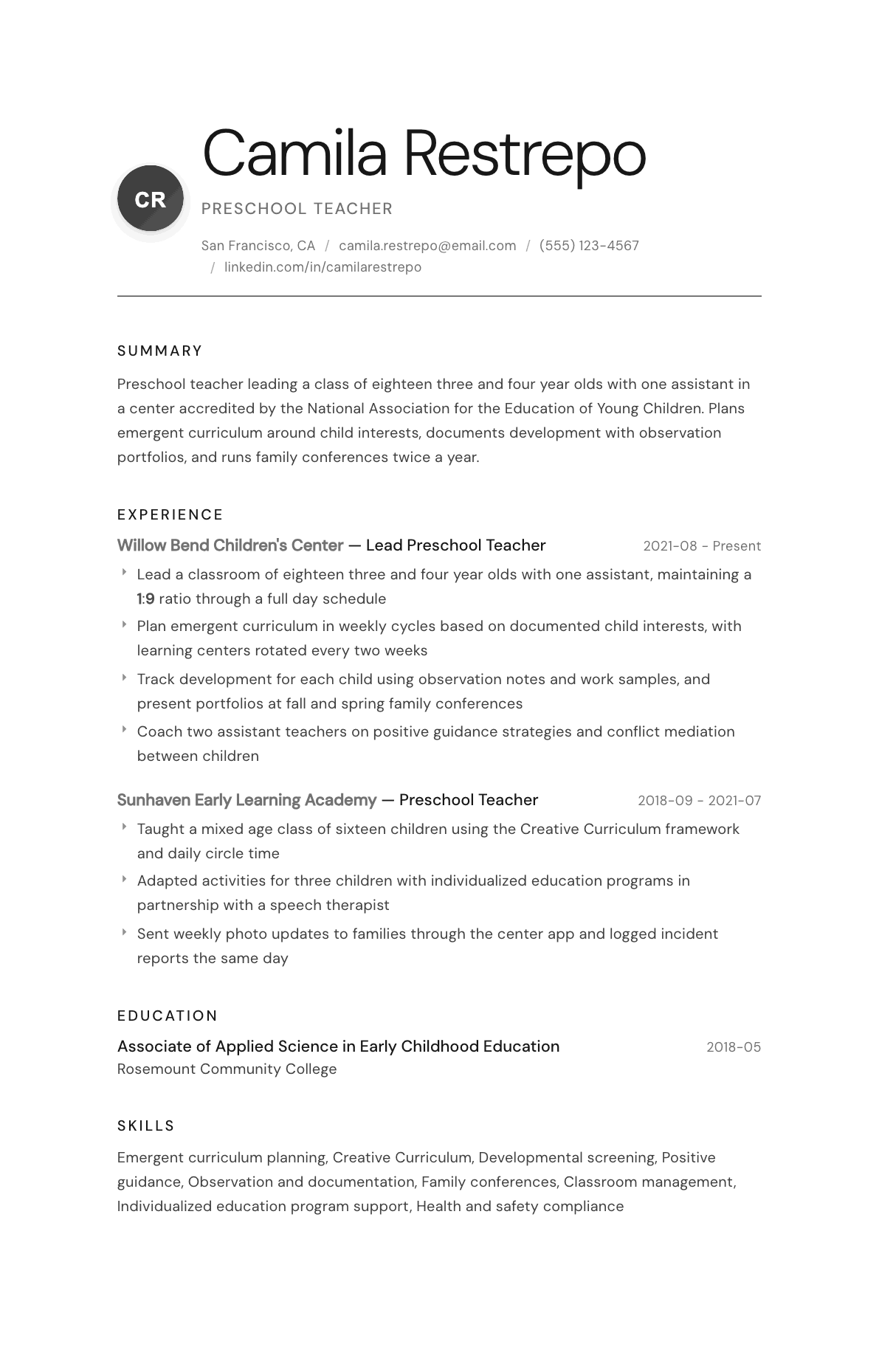
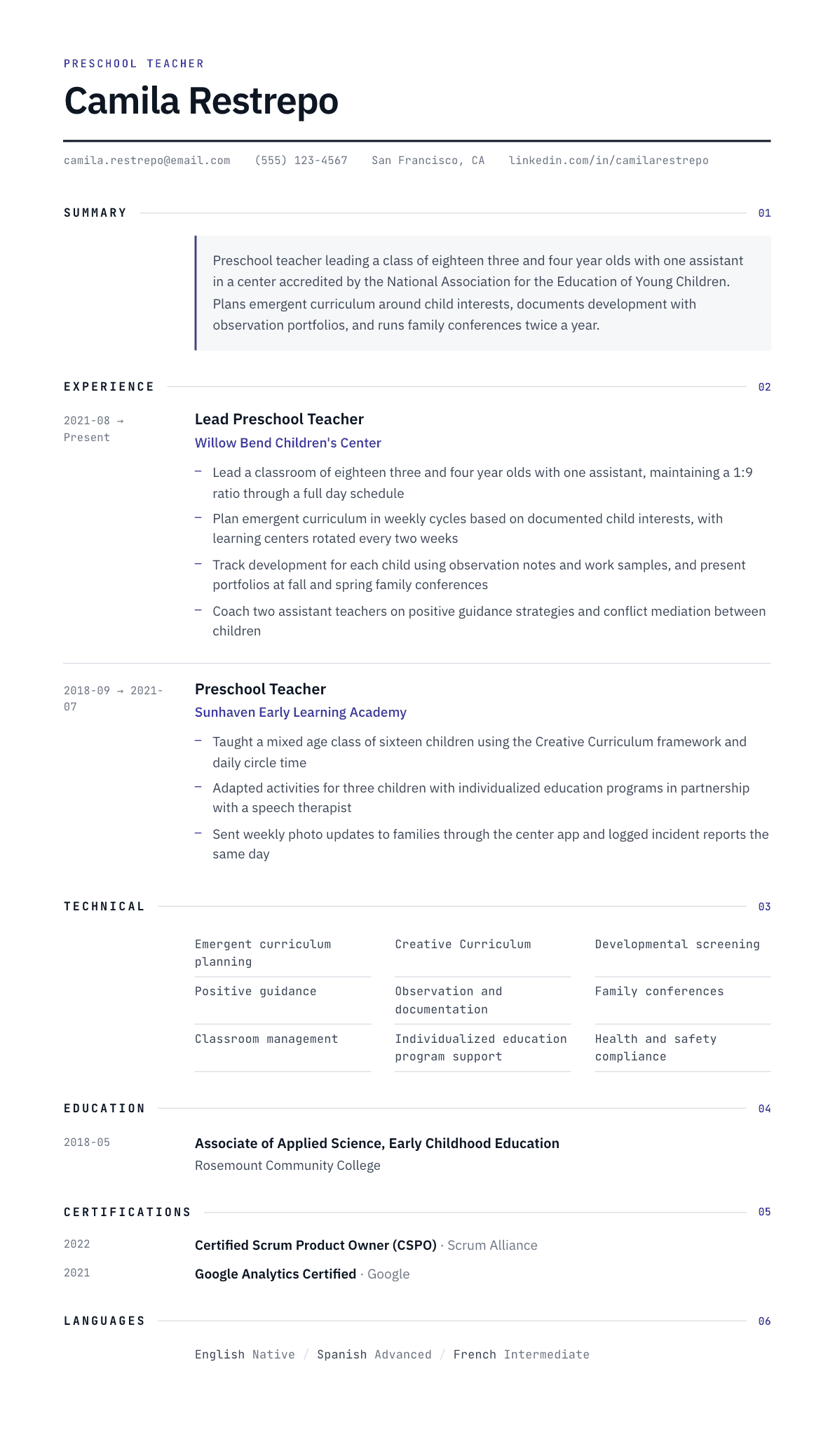
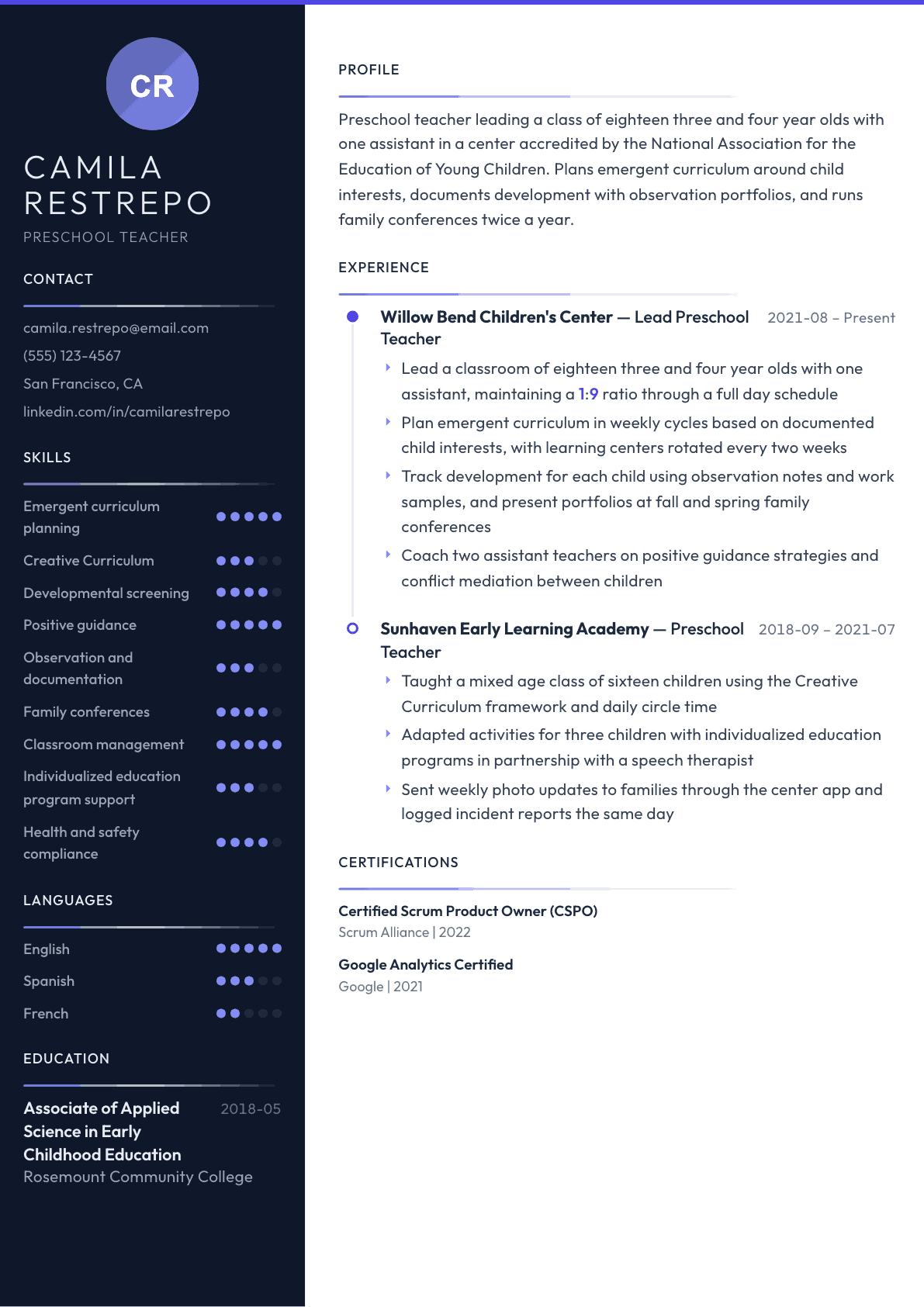
Example Preschool Teacher summary
Preschool teacher with six years leading full day classrooms of three and four year olds at a ratio of one adult to nine children. Plans emergent curriculum from documented child interests, keeps observation portfolios for every child, and runs two family conferences a year. Holds a Child Development Associate credential and coaches assistant teachers on positive guidance. Seeking a lead teacher role in an accredited center.
Skills to list on a Preschool Teacher resume
- Early childhood curriculum planning
- Creative Curriculum
- HighScope approach
- Emergent curriculum
- Developmental screening
- Observation and portfolio documentation
- Positive guidance and redirection
- Classroom routines and transitions
- Learning center design
- Early literacy activities
- Family conferences and daily reports
- Individualized education program support
- Licensing and health compliance
- Assistant teacher coaching
What actually gets this resume read
- Open each job with the age group, the class size and the adult to child ratio you worked at, because directors read for staffing fit.
- Name the curriculum framework you plan with, such as Creative Curriculum, HighScope, Montessori or an emergent approach.
- Show how you document development, whether that is portfolios, observation notes or a formal assessment tool.
- Give a concrete example of family communication: conferences, daily reports, the app you use and how often you post.
- List your Child Development Associate credential, degree and state early childhood certification in their own section.
- Include your current CPR and first aid status and any state licensing training hours, since centers must keep those on file.
How to write a preschool teacher resume
A preschool director hires under two pressures at once: the licensing file has to stay clean, and the classroom has to feel calm enough that families keep enrolling. Your resume is read against both. The director is checking that your credential, training hours and background clearance are current, and she is reading your bullets to work out what a Tuesday afternoon in your room actually looks like.
Most preschool resumes fail on specifics. They say nurturing, they say passionate about children, and they never say the age group, the class size, the ratio or the curriculum framework. Those four facts decide whether you can be scheduled, and a director who cannot find them will move on to a resume where she can.
This guide sets out the order a director reads in, how a preschool teaching resume changes with your starting point, three summaries covering an assistant, a lead teacher and a teacher moving toward a coaching role, before and after bullets from real classroom practice, and the questions early childhood teachers ask when they sit down to write.
Format: credential first, classroom facts second
One page is enough for most preschool teachers, two only after a decade with leadership duties. Put your name, your credential and your city in the header, then a credentials block naming the Child Development Associate or degree, the state early childhood certification if your state has one, current pediatric first aid and cardiopulmonary resuscitation training, and the annual training hours you maintain.
Directors keep those records in a licensing binder. Making them easy to find tells her you understand the compliance side of the job before she has asked a single question.
- Header: name, credential, city and state, phone, email.
- Order: summary, credentials and training, classroom experience, education, skills.
- Assistants and career changers add a practicum or volunteer block with hours and the age group served.
Summary: age group, class size, ratio, curriculum
Three lines that name the age band you teach, the class size, the adult to child ratio you worked at, and the curriculum framework you plan with. A director staffing a room of eighteen four year olds is looking for someone who has already held that shape of a room.
Add one thing you are known for. Leading transitions without a meltdown, running a language rich circle time, building the documentation panels families stop to read, or coaching assistants are all specific enough to be interesting. Nurturing is not.
Experience: the day, the planning, the documentation
Open each job with the setting and the numbers: center type, age group, class size, adults in the room and the daily schedule length. Then write bullets across three areas. What you plan and how often, how you document children learning, and how you handle behavior.
Planning bullets should name the framework and the cycle. Emergent curriculum planned in weekly cycles from documented child interests, or a published framework with learning centers rotated on a fixed schedule, both tell a director how you think about a classroom.
Documentation is the strongest bullet most preschool teachers leave out. Observation notes, work samples, photographs, portfolios and the conference where families see them are the evidence that your teaching is intentional rather than a sequence of activities.
Behavior bullets should show a strategy, not a result. Positive guidance, redirection, conflict mediation between children, visual schedules and a calm-down space are the practices a director wants to hear before she puts you with a challenging group.
Families, inclusion and the parts licensing checks
Family communication is a daily duty in early childhood, not an annual event. Name the channel and the rhythm: daily reports, the center app, photo updates, phone calls after an incident, and conferences in fall and spring. Directors have all fielded a complaint about a teacher who never communicates.
Inclusion belongs on the resume too. Working with a speech or occupational therapist, adapting activities for a child with an individualized plan, and supporting dual language learners are common in preschool rooms and rarely written down. Add the health and safety duties licensing requires: allergy protocols, medication logging, incident reports, sanitation routines and drills.
Skills and the words directors search for
Keep the skills section to teaching practice and tools: curriculum frameworks, developmental screening instruments, assessment platforms, the center communication app and classroom systems. Move warmth and patience into experience bullets where a specific practice makes them credible.
Postings in early childhood reuse a small vocabulary: lead teacher, ratio, developmentally appropriate practice, learning centers, circle time, observation, portfolio, positive guidance, family engagement, licensing compliance and the named curriculum. Mirror the posting wording once in the summary and once in a bullet.
Preschool teaching resume: what goes first for your starting point
Every preschool teaching resume answers the same three questions for a director: can you be counted in ratio, can you plan for this age group, and will families trust you. What you put first depends on where you are starting, because the strongest proof sits in a different place for an assistant, a lead teacher and someone coming from another job.
Keep the page to one sheet in each case, put the credential and the state training hours where the director can see them in the top third, and name the age group in the headline so nobody has to guess whether you have worked with twos or with pre-kindergarten.
- Assistant teacher moving up: credential or credential in progress first, then the classroom you support with age group and ratio, then the activities you planned and led on your own.
- Lead teacher: headline with lead teacher and age group, summary with class size and curriculum, then planning, assessment and family communication bullets.
- Elementary teacher moving to preschool: state license and early childhood coursework first, then the parts of your experience that match, such as kindergarten readiness, small groups and play-based centers.
- Childcare or nanny background: ages, number of children and weekly hours for each job, plus first aid and CPR, health and safety training and any practicum hours in a licensed center.
- Returning after a break: the credential with its current status, a short line on the gap, and recent training hours that show you know the current licensing rules.
Preschool Teacher resume summary examples
Assistant teacher
Assistant preschool teacher with two years supporting a classroom of sixteen three year olds, leading small groups and outdoor time. Completed a Child Development Associate credential and current pediatric first aid training. Seeking a lead teacher position in an accredited center.
Lead teacher
Lead preschool teacher running a full day classroom of eighteen three and four year olds with one assistant at a one to nine ratio. Plans emergent curriculum in weekly cycles from documented child interests, keeps observation portfolios for every child, and runs two family conferences a year.
Mentor teacher
Mentor preschool teacher with nine years leading classrooms and three coaching new staff across four rooms at an accredited center. Models positive guidance, reviews weekly plans with teachers, and prepared the center documentation for its most recent accreditation visit and state licensing inspection.
Work experience bullets: before and after
Before: Cared for a class of preschool children.
After: Led a full day classroom of eighteen three and four year olds with one assistant, holding a one to nine ratio through arrival, centers, outdoor time, lunch, rest and pickup.
Class size, ratio and the shape of the day let a director place you in a room immediately.
Before: Planned fun activities for the children.
After: Planned emergent curriculum in weekly cycles from documented child interests, rotating learning centers every two weeks and building each cycle around a shared inquiry question.
A named approach and a planning rhythm show intentional teaching rather than activity collection.
Before: Kept track of how children were doing.
After: Documented development for each child with dated observation notes and work samples, assembled portfolios each semester, and walked families through them at fall and spring conferences.
It makes assessment visible as a cycle that ends with a family conversation.
Before: Managed behavior in the classroom.
After: Used positive guidance and conflict mediation between children, introduced a visual schedule and a calm-down corner, and shortened the transition into rest time to a predictable routine.
Naming the strategies proves a method a director can trust with a difficult group.
Before: Talked with parents about their children.
After: Posted daily photo updates and learning notes through the center app, called families the same day after any incident report, and held two scheduled conferences a year for every child.
Channels and frequency turn a general claim into a communication routine the director can rely on.
Hard skills
- Emergent curriculum planning
- Creative Curriculum framework
- HighScope approach
- Learning center design
- Developmental screening
- Observation and portfolio documentation
- Early literacy and language activities
- Positive guidance strategies
- Individualized plan support and therapist collaboration
- Dual language learner support
- Licensing health and safety compliance
- Family conference facilitation
Soft skills
- Patience during long transitions
- Coaching assistant teachers
- Reading a room of eighteen at once
- Family relationship building
- Calm response to incidents
- Collaboration with therapists
Certifications worth listing
- Child Development Associate (CDA) Credential (Council for Professional Recognition)
- Pediatric First Aid and CPR (American Red Cross)
- Certified Childcare Professional (CCP) (National Early Childhood Program Accreditation)
- Montessori Early Childhood Credential (American Montessori Society)
Mistakes that cost preschool teacher candidates the interview
- Leaving off the age group and class size, which are the first two facts a director needs to place you.
- Writing adjectives about warmth instead of naming the curriculum framework and the planning cycle you use.
- Omitting the ratio you worked at, when staffing ratios are the constraint every center schedules around.
- Skipping documentation and assessment, which is what separates a teacher from a caregiver on paper.
- Hiding the credential, training hours and first aid status that the licensing file requires.
- Listing family communication as a value rather than a routine with a channel and a frequency.
Preschool Teacher resume questions
Do I need a degree to be a preschool teacher?
Requirements vary by state and by center accreditation, and many lead teacher roles accept a Child Development Associate credential with experience. List the credential, any degree in progress with its expected completion, and your annual training hours so a director can check her licensing requirement quickly.
How do I write a preschool resume with only babysitting experience?
Treat it as real experience but give it structure: the ages, the number of children, the hours per week and what you planned rather than supervised. Then add practicum hours, volunteer classroom time or a credential in progress to show you are building toward licensed practice.
What should a preschool teaching resume include?
A headline with the role and age group, a short summary with class size and curriculum, your credential and training hours, experience bullets on planning, assessment and family communication, and a skills list of frameworks and tools. Name the curriculum you used even if the center follows a different one.
What should an early childhood skills section contain?
Teaching practice and tools only: curriculum frameworks, screening instruments, assessment or portfolio platforms, the family communication app and classroom systems. Keep personal qualities out of the list and prove them inside experience bullets where a real practice supports them.
How do I show that I can handle challenging behavior?
Describe the strategy and the setting rather than the outcome. Name positive guidance, conflict mediation, visual schedules and a calm-down space, and give one example where you changed the environment or the routine instead of removing the child from the room.